

WOVR Check Australia: The 2026 Guide to Written-Off Vehicle Records
A WOVR record isn’t a death sentence for your car’s resale value, but ignoring its impact certainly is. Many Australian car owners panic when they realise a wovr check reveals their vehicle is listed, fearing it’s become a worthless asset overnight. It’s a common stress point. You want to be honest with buyers, yet you still need to get a fair price for your property.
We understand the confusion between a statutory write-off that can never be registered and a repairable one that simply needs the right paperwork. This guide helps you navigate these legal hurdles with confidence. It’s about stripping away the complexity so you can move forward with a clear plan.
Discover how a registry listing influences your vehicle’s market value and how to meet your disclosure requirements without losing out. We’ll provide a clear strategy to identify your car’s status, understand the typical 20-40% price adjustment, and connect with professional buyers who value transparency. You’ll gain the tools to turn a complicated history into a straightforward, successful sale.
Key Takeaways
- Identify the critical legal differences between statutory and repairable write-offs to determine if your vehicle can be legally re-registered.
- Perform a fast and official wovr check via the PPSR using your 17-digit VIN to access accurate national records.
- Quantify the “stigma discount” and learn how professional buyers evaluate the specific risks associated with a repaired vehicle’s history.
- Navigate Australian disclosure laws with confidence to protect yourself legally while ensuring a transparent and honest transaction.
- Streamline the selling process by connecting with professional buyers who specialise in purchasing vehicles with complex WOVR histories.
Understanding the WOVR Check in Australia
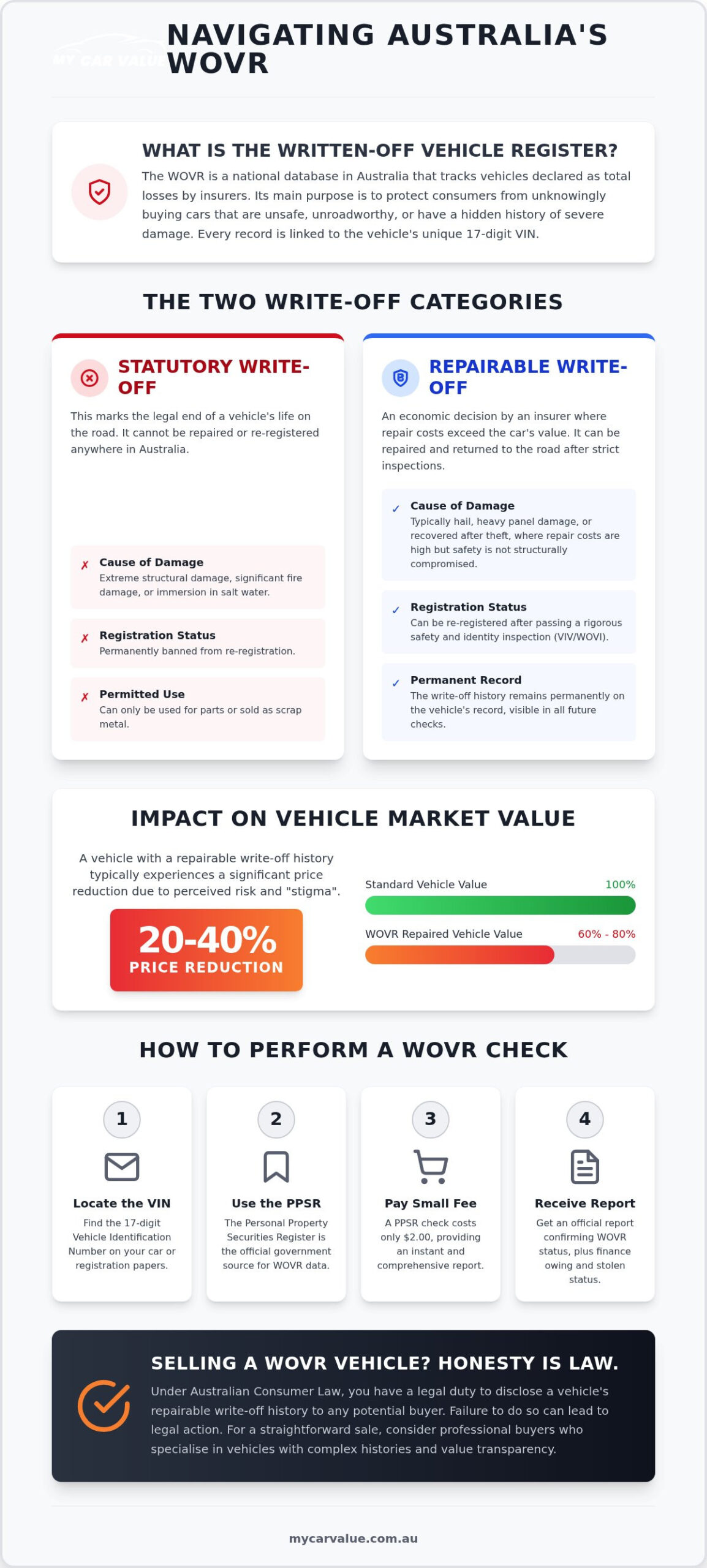
The Written-Off Vehicle Register (WOVR) is a critical national database that tracks vehicles declared as total losses. Its primary purpose is to protect consumers from unknowingly purchasing unsafe or unroadworthy cars. Every time a car is severely damaged or stolen and not recovered, it’s logged against its unique 17-digit Vehicle Identification Number (VIN).
This information flows through the National Exchange of Vehicle and Driver Information System (NEVDIS). It creates a transparent history that stays with the car for its entire life. Performing a wovr check is the only way to verify if a vehicle has a hidden past of significant damage.
A wovr check acts as a safeguard against vehicle rebirthing, a practice where the identity of a wrecked car is used to hide the history of a stolen one. By linking every record to the VIN, the system makes it nearly impossible for a car to hide its true condition. This level of transparency is why the register is a cornerstone of the Australian used car market.
The Role of the PPSR in WOVR Checks
The Personal Property Securities Register (PPSR) acts as the public window into this data. It is the central hub for vehicle history in Australia. For a $2.00 fee, a PPSR report provides a comprehensive snapshot of the car’s status. It doesn’t just show if a car is written off; it also reveals if there’s money owing on it or if it’s been reported stolen. This data comes directly from NEVDIS, ensuring the information is accurate and up to date.
Who Records a Vehicle on the WOVR?
Most listings on the register come from insurance companies. When the cost to repair a car exceeds its insured value, the insurer declares it a total loss. Understanding a Total Loss is essential because it triggers a legal requirement to notify the register. This notification must happen if the vehicle was manufactured within the last 15 years from the date the damage occurred.
Insurance companies have a strict timeframe to report these findings to state authorities. It’s not just insurers; fleet operators and self-insured organisations must also report write-offs. Additionally, police and state registration authorities can add vehicles to the register if they’re found to be unroadworthy due to structural damage or heavy stripping. This collective reporting ensures the database remains a reliable tool for every car buyer in the country.
Decoding the Categories: Statutory vs. Repairable Write-offs
Understanding the results of a wovr check requires knowing the difference between a statutory and a repairable classification. These labels dictate whether a vehicle can ever return to the road. Australian authorities use strict safety standards to categorise damage, ensuring that structurally compromised cars don’t put lives at risk. While one category marks the end of a car’s life, the other offers a complex path back to registration.
Statutory Write-offs: The End of the Road
A statutory write-off is the final legal status for a vehicle’s registration life. This tag applies when a car suffers extreme structural damage, fire, or immersion in salt water. Under the NSW Government rules on written-off vehicles, which reflect national standards, these cars can never be legally re-registered in Australia. They are restricted to parts only use. If your car receives this status, you must dispose of it through an authorised scrap metal dealer or auto wrecker. Attempting to sell a statutory write-off as a road-going vehicle is illegal and carries heavy penalties.
Repairable Write-offs: A Path to Re-registration
A repairable write-off occurs when an insurer decides the cost of repairs exceeds the car’s market value. This is an economic decision rather than a purely safety-driven one. While these vehicles can be repaired and returned to the road, the process is rigorous. You must pass a specific identity and safety inspection, often called a VIV or WOVI, depending on your state. Even after passing, the wovr check will always show the vehicle’s history. This permanent record is designed to protect future buyers, ensuring they know the car was once deemed a total loss. If you’re unsure how this history affects what your car is worth today, you can value my car online to get a realistic market perspective.
Australian Consumer Law mandates full transparency during a sale. If you’re selling a car with a repairable write-off history, you must disclose this to potential buyers. Failure to do so can lead to legal action and forced refunds. Most private buyers feel uneasy about this history, which is why many sellers struggle to find a fair price on the open market. Understanding these categories helps you set realistic expectations for your vehicle’s future. It allows you to navigate the selling process with all the facts on hand.
How WOVR Status Affects Your Vehicle’s Market Value
A vehicle’s financial worth changes the moment it appears on the register. Data suggests that repairable write-offs typically sell for 20% to 40% less than identical models with a clean title. This price drop occurs because buyers perceive a higher risk of hidden structural issues or future mechanical failure. While your car might drive perfectly, the market prices in the uncertainty revealed by a wovr check.
Professional buyers calculate this risk by evaluating the cost of potential future repairs and the difficulty of a quick resale. Private buyers often walk away entirely when they see a history of significant damage. However, providing a PPSR Written-Off Vehicle Check upfront builds trust. Transparency doesn’t remove the discount, but it prevents the sale from collapsing at the last minute.
Comparing market values requires a realistic approach. A car with a history of hail damage might retain more value than one involved in a high-speed collision. Use our vehicle market value calculator to see the baseline for your model before adjusting for its specific history.
The Impact on Insurance and Finance
Securing comprehensive insurance for a WOVR-listed car is often difficult. Many mainstream insurers refuse to cover vehicles with a write-off history, or they charge significantly higher premiums. This restriction directly impacts resale value because buyers struggle to protect their investment. Finance companies also view these cars as high-risk collateral. They may reject loan applications or offer less favourable terms for a repairable write-off. Market value is dictated by insurability as much as condition.
Maximising Value with a Detailed Service History
You can offset some of the price drop by providing meticulous documentation. Keep every repair certificate, receipt, and inspection report to prove the quality of the work performed. A comprehensive car service history check complements a wovr check by showing that the vehicle has been well-maintained since its return to the road. This evidence gives buyers confidence that the car is safe and reliable despite its past. Demonstrating a proactive approach to maintenance helps you negotiate from a position of strength and secure a better price.
Performing a WOVR Check: Step-by-Step via the PPSR
The first step in any wovr check is locating your vehicle’s unique 17-digit Identification Number (VIN). You can find this on the compliance plate in the engine bay, the passenger side door pillar, or at the base of the windscreen on the driver’s side. Check the number against your registration papers to ensure they match exactly. A single typo will result in an invalid report or, worse, a report for a completely different vehicle. Once you have the VIN, head directly to the official Personal Property Securities Register (PPSR) website to begin your search.
Avoid third-party websites that often dominate search engine results. These “scam” sites frequently charge $20 or more for the exact same data you can get directly from the government portal. The official PPSR fee for an online search in 2026 is just $2.00. This small investment provides the most affordable and accurate way to verify a vehicle’s history without unnecessary markups or hidden costs. Follow the prompts to enter your VIN, pay the fee via a secure gateway, and download your certificate immediately. It’s a fast, methodical process that removes the guesswork from your purchase.
What to Look for in the Report
Your PPSR certificate contains several data points, but the “Written-off” section is your primary focus. Check the date the record was created and the state jurisdiction that lodged it. This tells you exactly when the damage occurred and which state’s laws applied at the time. Crucially, verify that the VIN on the digital report matches the physical VIN on the car’s chassis. If these numbers don’t align perfectly, the report is useless and may indicate vehicle rebirthing. Ensure you check the record again on the day of purchase to confirm no new interests have been registered.
Common WOVR Codes and Their Meanings
The report uses specific codes to describe the damage that led to the write-off. Impact codes (I) usually indicate structural damage from a collision, while flood (F) or fire (E) codes suggest severe internal or electrical risks that may not be visible to the naked eye. Hail damage (H) is often viewed as the “best” type of repairable write-off for resale. Because hail damage is typically cosmetic rather than structural, these cars are often easier to re-register and maintain their value better than those with collision history. A wovr check also reveals the car’s “Stolen” status. Always ensure the report confirms the vehicle is not currently listed as stolen or encumbered by unpaid finance before you commit to a sale.
Selling a Vehicle with a WOVR History to Professional Buyers
Selling a car with a complex history to a private buyer is often a lesson in frustration. Most private individuals are looking for the simplest transaction possible. Once they perform a wovr check and see a “repairable write-off” status, they frequently disappear or offer prices that don’t reflect the car’s actual condition. This stigma is hard to overcome in the private market where fear often outweighs facts. You need a buyer who understands the data, not someone who panics at the sight of a registry listing.
Professional used car buyers operate on a different set of rules. They understand the technicalities of the national register and don’t dismiss a car simply because it has a past. These buyers evaluate the vehicle based on its current safety, structural integrity, and the actual market demand for its specific model. They have the resources to verify the quality of repairs. This allows them to offer a price based on data rather than emotion, ensuring you aren’t penalised unfairly for a well-repaired vehicle.
You must disclose the record upfront to avoid significant legal repercussions. Australian Consumer Law is very clear about transparency in vehicle sales. Hiding a write-off status can lead to the sale being voided or even legal action taken against you by the new owner. Being honest from the first contact actually works in your favour when dealing with industry experts. It establishes immediate trust and ensures the offer you receive is firm and won’t be retracted once the buyer does their own due diligence.
The Professional Advantage
Experts are equipped to assess the salvage and repair potential of your vehicle with high precision. Unlike private individuals, they possess the technical knowledge to distinguish between a car that’s been poorly patched and one that’s been restored to original manufacturer standards. They offer a level of speed and certainty that car auction alternatives often fail to provide. Auctions can be an expensive gamble, often involving transport fees and no guarantee of a successful sale. A professional buyer provides a clear path forward, handling the complex paperwork involved in transferring a WOVR-listed vehicle with minimal fuss.
Final Steps: Securing Your Sale
Start by organising your documentation to prove the car’s legitimacy. Have your most recent wovr check report and all relevant repair invoices ready for inspection. These documents are your best tool for defending your car’s value. They prove that the vehicle has been legally cleared and professionally maintained since the damage occurred. Use our comprehensive sell my car guide to finalise the transaction and ensure you meet all state-based notification requirements. This proactive approach turns a potentially stressful sale into a fast, transparent, and successful deal. Get a fast, fair valuation for your vehicle today at My Car Value.
Secure a Fair Price for Your Vehicle Today
You now have the knowledge to navigate the national register with precision. Understanding your car’s legal status is the first step toward a successful sale. A wovr check provides the transparency needed to build trust with potential buyers and meet your legal obligations. While a repairable history impacts market value, it doesn’t make your car unsellable.
By using data-driven insights and professional support, you can bypass the stress of the private market. We provide expert Australian market valuations and connect you with a reliable professional buyer network. This no-stress selling process is designed to save you time and ensure a fair outcome. You don’t have to handle the heavy lifting alone when experts are ready to facilitate the deal.
Take control of your car’s history and move forward with the confidence that you’re making an informed decision for your vehicle’s future.
Frequently Asked Questions
What is the difference between a statutory and repairable write-off?
A statutory write-off is a vehicle damaged so severely that it can never be legally re-registered in Australia. These cars are restricted to spare parts or scrap metal use only. In contrast, a repairable write-off is a vehicle where repair costs exceed its market value but it remains structurally sound enough to be fixed. Once repaired and passed through a state-based safety inspection, these vehicles can return to the road.
Can I re-register a car that has been on the WOVR?
You can only re-register a vehicle if it is classified as a repairable write-off. Statutory write-offs are permanently banned from Australian roads. To re-register a repairable car, you must complete all necessary repairs and pass a rigorous identity and safety inspection, such as a VIV or WOVI. Even after successful re-registration, the vehicle’s history remains on the national database to ensure full transparency for future owners and insurers.
Does a WOVR check show hail damage?
Yes, a wovr check identifies hail damage through specific damage codes listed on the PPSR certificate. Hail is often categorised as a repairable write-off because the damage is primarily cosmetic rather than structural. While these vehicles are easier to return to the road than collision-damaged cars, the record will still appear in the “Written-off” section of your report. This helps buyers understand why the car was previously deemed a total loss.
How much does a WOVR check cost in Australia?
An official wovr check performed online through the Personal Property Securities Register (PPSR) costs $2.00 in 2026. This is the most affordable way to access accurate national data. If you prefer an assisted search via a contact centre, the fee increases to $7.00. Avoid third-party websites that charge significantly higher prices for the same data. These official fees ensure every Australian can access vital vehicle history information without excessive costs.
Is it illegal to sell a car that is a repairable write-off?
It is perfectly legal to sell a repairable write-off in Australia, provided you follow strict disclosure laws. You must inform potential buyers of the vehicle’s status on the register before finalising the sale. Failing to provide this information can lead to legal action under Australian Consumer Law. Selling to professional buyers is often the most efficient path, as they understand the register and can provide a fair market valuation despite the car’s history.
How long does a vehicle stay on the Written-Off Vehicle Register?
A vehicle remains on the register permanently once it has been recorded. Even if a repairable write-off is professionally restored and passes all state-based safety inspections, the initial record is never removed from the national database. This permanent listing ensures a transparent history for the life of the vehicle. Future buyers will always see the date, state, and type of damage that led to the original write-off notification during their own history checks.
Can I get comprehensive insurance for a WOVR-cleared car?
Securing comprehensive insurance for a WOVR-cleared car is possible but often more difficult than for a vehicle with a clean title. Many mainstream insurers perceive these vehicles as higher risk and may refuse cover or charge higher premiums. Some providers might only offer third-party property damage insurance. It’s essential to disclose the vehicle’s history to your insurer immediately. Failing to do so could result in a rejected claim if you need to use your policy later.
Will a WOVR status significantly lower my car’s trade-in value?
A WOVR listing typically reduces a vehicle’s market value by 20% to 40% compared to a car with a clean history. This “stigma discount” reflects the perceived risk and the difficulty in securing finance or insurance for the vehicle. While trade-in offers from dealerships may be lower, connecting with professional used car buyers can help you secure a more competitive price. They use data-driven valuations to assess the car’s actual condition rather than relying on broad market fears.