

Car Auction Alternatives: Better Ways to Sell Your Vehicle in Australia
The auction block is often sold as the ultimate way to create competitive tension, but for many Australians, it is a high-stakes gamble that often ends in disappointment. You might expect a quick result, only to find your final payout gutted by a 7.5% commission or a $650 processing fee. If you are looking for car auction alternatives, you aren’t alone. With the average time to sell a used car sitting at 45.6 days in March 2026, the traditional path is becoming too slow and too expensive for the modern seller.
We understand the frustration of watching your vehicle’s value disappear into transport costs and uncollected storage fees. You deserve a transparent selling process that doesn’t involve waiting weeks for a hammer to fall. This article explains why professional buyer networks are the smarter choice for a fast, secure sale. Discover how to secure a competitive price without the tyre-kickers or the auction room anxiety. We will guide you through the best ways to bypass the middleman and settle your sale in days, not months.
Key Takeaways
- Identify the hidden fees and high commissions that often make traditional auctions a poor financial choice for Australian sellers.
- Explore the most effective car auction alternatives available today to find a better balance between sale price and convenience.
- Learn how to accurately assess your vehicle’s market value and condition to ensure you don’t undersell in a competitive market.
- Understand why professional buyer networks offer a safer, faster route to settlement than dealing with private tyre-kickers.
- Discover a streamlined, data-driven approach to selling that removes the gamble of the auction floor and provides immediate clarity.
Understanding the Australian Car Auction Scene
The Australian car auction market is dominated by two major entities: Pickles and Manheim. These companies operate massive facilities across every state, handling thousands of vehicles weekly. For many sellers, the auction house represents a quick way to offload a vehicle without managing multiple private viewings. However, the speed of the process often comes at a cost to the final sale price. While auctions are a staple of the industry, they are frequently less profitable for private sellers than modern car auction alternatives.
Understanding how car auctions work is the first step in deciding if this path suits your needs. Most auctions fall into two categories: reserve or unreserved. In a reserve auction, you set a minimum price. If the bidding doesn’t reach this figure, the car is “passed in.” You are then left negotiating with the highest bidder or paying to re-list the vehicle. Unreserved auctions are final. The car sells to the highest bidder regardless of the price. This creates a high-risk environment for private sellers who cannot afford a low-ball result.
How the Auction Process Works for Sellers
The journey begins with a valuation. Auction staff provide a guide based on recent sales, but the final reserve is your decision. Once agreed, you must organise transport to the auction centre. This involves logistical effort and cost, especially if the vehicle is unregistered. During the “under the hammer” moment, the bidding happens fast. If your car passes in, the process stalls. You still owe the entry fees, and your car remains sitting in a yard, losing value every day. It is a methodical but rigid system that doesn’t always favour the individual.
Public vs. Wholesale Auctions
Buyer profiles differ significantly between auction types. Public auctions attract bargain hunters looking for a cheap runabout. These buyers are often cautious and price-sensitive. Wholesale or dealer-only auctions are restricted to those with a motor dealer licence. These events move high volumes of stock between professional car yards. While the bidding is professional, these buyers are looking for a margin to resell the car. This is why many people now seek car auction alternatives that provide a direct link to these professional buyers without the overheads and uncertainty of a traditional auction house. Selling through the right network ensures you get the professional price without the dealer-only restrictions.
The Hidden Costs and Risks of Selling at Auction
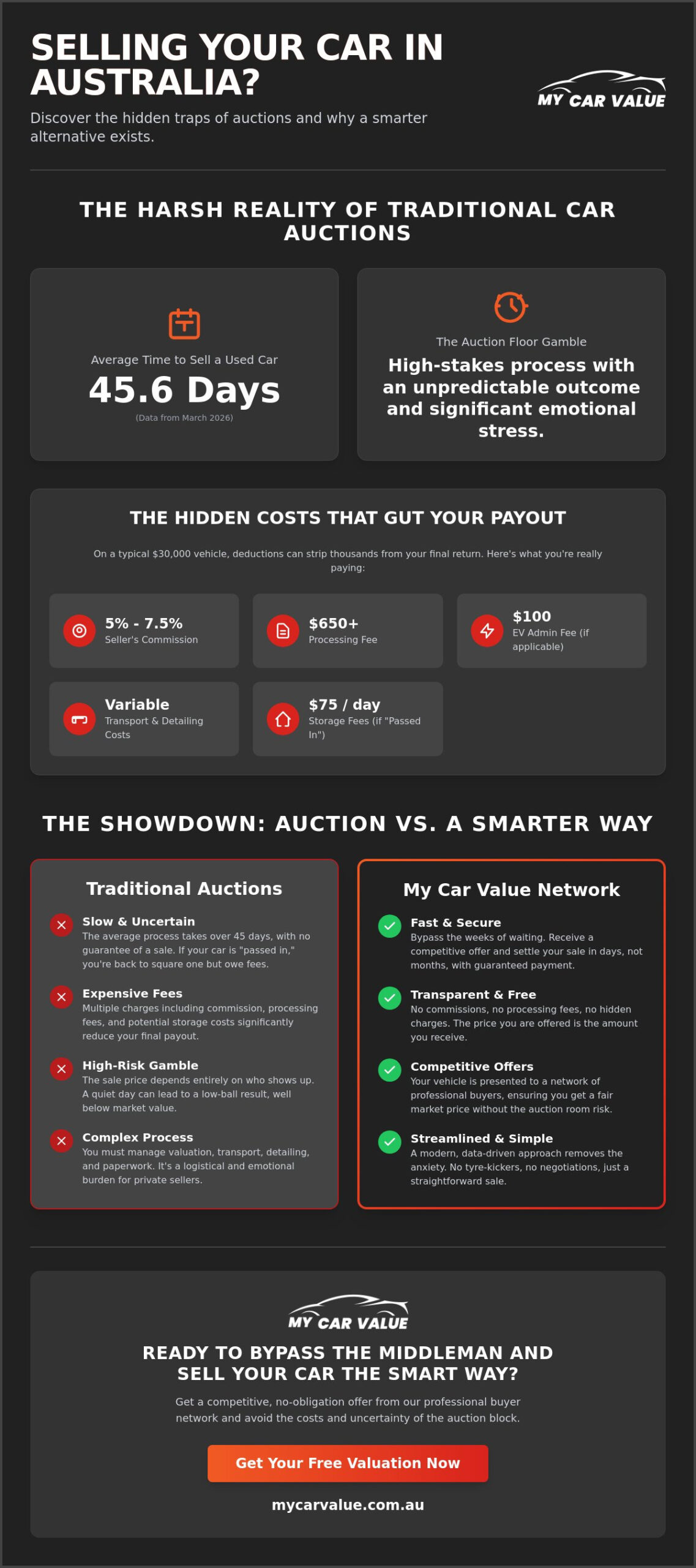
Selling at auction isn’t as simple as driving in and collecting a cheque. The financial reality often bites harder than expected. For a vehicle sold for more than $2,000 at a major house like Pickles, you will face a $650 processing fee plus an additional 1.65% of the final hammer price. If you are selling an electric vehicle, expect another $100 for the EV admin fee. These charges exist alongside seller commissions that usually hover between 5% and 7%. On a $30,000 car, these deductions can strip thousands from your return before you even consider transport or cleaning costs.
The time investment is another significant hurdle. While the actual bidding takes minutes, the preparation and administrative lead times are lengthy. Data from March 2026 shows the average time to sell a used car in Australia is 45.6 days. This contradicts the myth of the “instant” auction sale. If your reserve price isn’t met and the car is passed in, you are back at square one. You still owe the entry fees, and you may even face storage charges of $75 per day if the vehicle isn’t collected immediately. This is why many owners now seek car auction alternatives that offer more certainty and faster liquidity.
Financial Deductions You Need to Budget For
Beyond the headline commission, several smaller costs accumulate quickly. Auction houses often require a professional detail to make the car presentable for the lane; this is a mandatory expense you must cover upfront. You also need to factor in transport. If the car is unregistered or you cannot drive it to the centre yourself, towing fees will apply. Standard administrative checks, including PPSR searches and title verification, are usually passed on to the seller. Even state-based ownership transfer costs, which range from $25 to $100, must be accounted for in your final calculations.
The Emotional and Practical Gamble
Auctions are unpredictable by nature. You are at the mercy of who shows up on the day. A quiet room or a lack of interested bidders can lead to a “low ball” result that leaves you well below market value. The “as-is” nature of these sales also means buyers factor in a “risk discount,” bidding lower to cover potential mechanical issues they can’t test. This creates a stressful environment where you don’t know your final sale price until the last second. For a more stable experience, it is worth looking at a consumer-focused perspective on different selling methods. Before you commit to the auction room, you can Value My Car through a professional network to establish a firm baseline. Choosing car auction alternatives allows you to maintain control over the price without the high-stakes pressure of the auction floor.
Better Ways to Sell: Exploring Car Auction Alternatives
Many Australian car owners believe that if they avoid the auction house, they are stuck with the chaos of private listings. This isn’t the case. While forums and social media marketplaces are popular car auction alternatives, they require a significant investment of time and patience. A private sale might fetch a higher headline figure, but you must manage the photography, the listings, and the inevitable “tyre-kickers” who never show up. You also need to consider legal obligations, such as providing a roadworthy certificate in states like Victoria or Queensland, which adds upfront cost and mechanical risk before you even find a buyer.
Dealer trade-ins represent the other end of the spectrum. They offer maximum convenience but often provide the lowest financial return. A dealer must factor in their own overheads, reconditioning costs, and profit margin before making an offer. Understanding the real-world gap between trade in value vs private sale value in Australia is essential before you decide which path suits your situation. For those who want more than a trade-in price but don’t want the auction gamble or private sale stress, professional buyer networks have emerged as the “Goldilocks” solution. These networks provide a streamlined path to Used Car Buyers who are ready to transact immediately. This is one of the most effective car auction alternatives because it maintains competitive tension without the high commissions.
Why Professional Buyer Networks are Gaining Popularity
Digital networks bridge the gap between private sellers and professional car yards. Instead of waiting for a scheduled auction date, you receive a valuation based on real-time market data. This process eliminates the uncertainty of the bidding floor. Because these networks connect you with multiple professional buyers simultaneously, they create competition for your car. You avoid the stress of “passing in” a vehicle and the frustration of dealing with unvetted individuals from classified sites. It’s a faster, safer, and more methodical approach to selling. For a comprehensive overview of how cash car buyers Australia wide have modernised the process, it’s worth understanding what today’s professional networks offer before you commit to any selling method.
Comparing Convenience and Value
Efficiency is the primary driver for modern sellers. When comparing your options, consider the total time and risk involved in each method. A professional buyer network facilitates a quick settlement while removing the logistical burden of transport or storage. Use this quick comparison to guide your decision:
- Private Sale: High effort, 4 to 6 weeks average, maximum price potential but high security risk.
- Auction: Low effort, 2 to 4 weeks, unpredictable price with high seller fees.
- Professional Network: Very low effort, 1 to 3 days, competitive professional price with zero hidden fees.
Choosing a professional facilitator ensures you get a competitive price that reflects true market value. You can often settle the entire transaction within a few days. This method removes the need for expensive detailing or mechanical repairs often required by auction houses. It is a secure and transparent way to sell your vehicle in the current Australian market.
How to Evaluate Your Selling Options in the Current Market
- Step 1: Get a valuation. Use real-time data to establish a baseline. This prevents you from setting an unrealistic reserve at auction or underpricing your car in a private listing.
- Step 2: Assess condition. Be objective about mechanical and aesthetic issues. Small dents or a skipped service history will impact your price more than they did three years ago. A thorough car service history check can help you identify and address any gaps in your maintenance records before listing.
- Step 3: Check your timeline. Determine your urgency. If you need a settlement within 48 hours to fund a new purchase, traditional auctions and private sales are rarely the answer.
- Step 4: Calculate the net return. Don’t look at the headline offer. Subtract commissions, processing fees, and transport costs to find the actual cash that ends up in your bank account. For a detailed breakdown of how these figures compare across selling methods, the 2026 Australian guide to trade-in value vs private sale value provides a clear framework for calculating your true net return.
Often, the net result from car auction alternatives is higher than a “lucky” day at the auction house. This is because modern networks eliminate the middleman and the associated overheads that eat into your profit.
This extra profit can then be reinvested into your next vehicle or outdoor equipment. If you are preparing for a remote trip, you can explore Roof top tents at Adventurerz to find the best gear for your adventure.
Determining Your Car’s Real-World Worth
Online estimators are the most effective starting point. They provide immediate clarity by comparing your vehicle against thousands of similar sales. It’s vital to understand the gap between retail and wholesale values. Retail is the price a dealer asks on the lot; wholesale is the realistic price a professional buyer will pay. Using data-driven valuations allows you to negotiate with confidence. It moves the conversation from “I think it’s worth” to “The market says it’s worth.”
Choosing the Right Path for Your Vehicle
Auctions still have a place for specific vehicles. If you are selling a rare collectible or a salvage-grade car, the auction room provides the right niche audience. However, for standard passenger cars, the fees usually outweigh the benefits. Most sellers find better results through professional buyer networks that offer transparency and speed. For example, you can sell my car in Brisbane through a streamlined process that connects you directly to vetted buyers. This bypasses the 45-day average wait time seen in the broader market.
Ready to see how your car compares without the auction room gamble? Value My Car today to get a firm, data-backed starting point for your sale.
My Car Value: A Modern Alternative to the Auction Block
My Car Value provides a direct response to the inefficiencies of the traditional auction house. We act as the streamlined link between private sellers and professional buyers, removing the need for high-risk bidding wars. By using our platform, you access one of the most reliable car auction alternatives in the country. Our reach is truly national. Whether you are in Perth or Sydney, we connect you with buyers who value accuracy and speed over the spectacle of the auction lane.
The “Value My Car” tool serves as your essential first step. It replaces the guesswork of a reserve price with a figure rooted in current Australian market trends. This tool empowers you to make an informed decision before you even talk to a buyer. You maintain control throughout the process. This ensures the “low ball” risks mentioned earlier are completely eliminated from your selling experience.
The My Car Value Advantage
Our platform is built on three pillars: accuracy, network, and transparency. We provide valuations based on real-time data, not outdated price books. This ensures your offer reflects what buyers are actually paying right now. Our network consists only of reputable used car buyers who are vetted for reliability. Most importantly, we eliminate the financial sting of the auction room. You won’t face $650 processing fees or percentage-based commissions that erode your profit. It is a clean, professional transaction from start to finish.
Ready to Skip the Auction?
Starting the process is straightforward. Enter your vehicle details into our online tool to receive a free, no-obligation valuation. Once you have your figure, we handle the heavy lifting by connecting you with a buyer in our network. This methodical approach bypasses the 45-day market average and moves you straight to a settlement. See how we help sellers find used car buyers in Melbourne and across other major Australian cities. Don’t leave your sale to chance on a quiet auction morning. Choose a smarter, faster path and get the value your car deserves today.
Secure Your Vehicle’s True Value Today
Selling a car in Australia shouldn’t feel like a high-stakes gamble. You’ve seen how hidden commissions and unpredictable bidding rooms can quickly erode your final return. By exploring car auction alternatives, you move away from the uncertainty of the auction floor and toward a more methodical, transparent process. Professional buyer networks offer a faster path to settlement without the logistical headaches of transport or the frustration of unvetted private buyers.
Our streamlined digital process provides you with accurate, market-driven valuations based on real-time data. We connect you directly to a trusted network of professional Australian used car buyers, ensuring you receive a competitive offer without the 45-day market wait. This approach prioritises your time and your bank balance, stripping away the complexity of traditional selling methods. It is the most efficient way to secure a result that reflects your car’s real-world worth.
Get your free car valuation and skip the auction stress today. Take the first step toward a simpler sale and regain control over your vehicle’s value with confidence.
Frequently Asked Questions
What is the biggest disadvantage of selling a car at auction?
The biggest disadvantage is the lack of price certainty combined with high mandatory fees. You face seller commissions between 5% and 7% plus fixed processing fees that often exceed $600. These deductions occur regardless of whether the final bid meets your expectations. This makes the net return significantly lower than many car auction alternatives.
Are car auction prices usually lower than private sales?
Auction prices are typically lower because buyers bid on an “as-is” basis and account for the risk of unknown mechanical issues. Wholesale buyers also need to maintain a profit margin for resale. Private sales might show a higher headline figure, but they require weeks of effort and advertising costs that professional networks bypass.
Do I have to pay a fee if my car doesn’t sell at auction?
You must still pay the entry and listing fees even if your vehicle fails to sell. Most auction houses charge these costs upfront to cover their administrative and lane time. If the car is passed in, you may also incur daily storage fees of approximately $75 until you collect the vehicle or pay for a re-listing.
How is a professional buyer network different from an auction?
A professional buyer network replaces the live bidding floor with a direct, data-backed valuation. Instead of waiting for a specific auction date, you get an offer based on real-time market demand. This method removes the gamble of a quiet auction room and eliminates the high seller commissions found at traditional auction houses.
Can I sell a car with a blown engine through these alternatives?
Many professional buyers in our network accept vehicles in various conditions, including those with major mechanical faults like a blown engine. While a private buyer on a classified site usually wants a roadworthy car, professional car yards have the resources to repair or salvage non-running vehicles. This makes digital networks a versatile choice for damaged stock.
What documents do I need to sell my car to a professional buyer?
You need a current photo ID, proof of ownership such as your registration papers, and any available service history records. If there is still finance owing on the vehicle, you will also need a current payout letter from your lender. Having these documents ready ensures a fast and seamless settlement process. Completing a car service history check before meeting a buyer can also help you verify and present your maintenance records with confidence.
Is it better to trade in my car or use an auction alternative?
Trade-ins offer convenience but usually result in a lower offer because the dealer must factor in their own overheads. Using car auction alternatives like a professional buyer network creates competition for your car among multiple buyers. This often results in a better price while maintaining the same level of speed as a trade-in.
How long does it take to get paid when using a car auction alternative?
Settlement typically occurs within 24 to 48 hours once the vehicle inspection is finalised. This is significantly faster than the 45.6-day average time to sell a used car in the broader Australian market. Most professional networks prioritise immediate payment via electronic funds transfer once the final paperwork is signed.

[…] security risks. If you want to bypass the classified grind entirely, evaluating professional car auction alternatives offers an immediate pathway to liquidate without private market […]