

Car Service History Check: The Australian Guide to Maximising Value (2026)
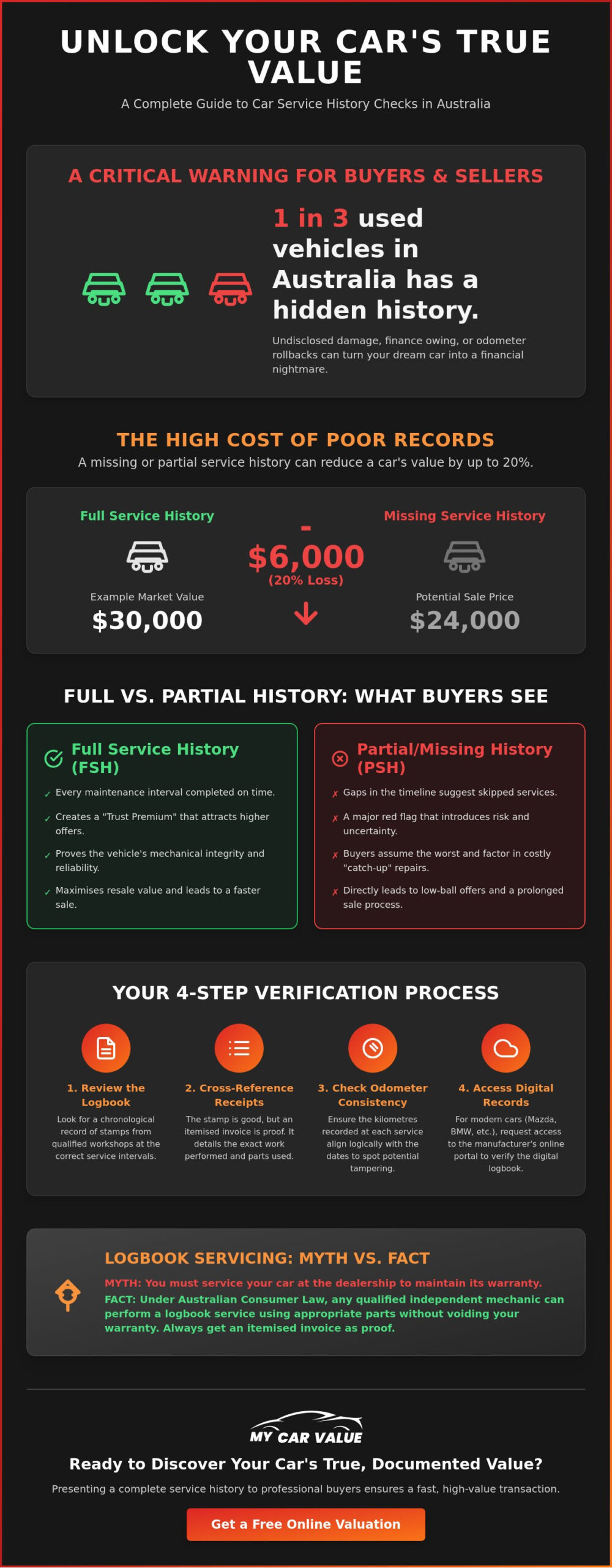
Did you know that one in three used vehicles in Australia has a hidden history? Whether it’s an odometer rollback, undisclosed damage, or finance owing, a missing paper trail often signals a financial disaster. Performing a comprehensive car service history check is the only way to ensure you aren’t buying a “lemon” or losing thousands in resale value due to poor record-keeping.
It’s stressful when logbooks go missing or manufacturers switch to digital-only systems that feel impossible to access. You want to know exactly what has happened under the bonnet before money changes hands. We’ll show you how to verify, recover, and leverage your maintenance records to secure the highest possible market price. This guide covers everything from the latest 2026 PPSR updates to the shift in digital logbook transparency. You’ll get a clear path to verifying history so you can buy or sell with total confidence.
Key Takeaways
- Learn how a complete record acts as a financial asset, securing higher offers through a “Trust Premium” from buyers.
- Follow a methodical process to conduct a car service history check, cross-referencing logbook stamps with physical receipts for total transparency.
- Understand how to access and verify digital service portals for modern brands like Mazda, BMW, and Mercedes-Benz.
- Identify the specific steps to recover missing records and prevent losing up to 20% of your car’s potential resale value.
- Discover how to present your maintenance history to professional buyers to ensure a fast, high-value transaction with minimal stress.
What is a Car Service History Check in Australia?
A car service history check is a comprehensive audit of a vehicle’s maintenance life. It functions as a chronological ledger, recording every oil change, brake pad replacement, and major mechanical overhaul since the car was first registered. In Australia, this check is the most reliable way to verify a vehicle’s mechanical integrity. It provides a clear view of how well the previous owner cared for the machine and whether they followed the manufacturer’s specific guidelines.
The process involves reviewing the logbook, service stamps, and physical receipts. While Vehicle history reports provide data on finance and accidents, the service history confirms the car’s internal health. If you are buying or selling, this documentation is your most valuable asset. It proves that the vehicle has been looked after properly, which directly translates to a higher market value.
Full vs Partial Service History: What is the Difference?
A Full Service History (FSH) is the ideal scenario for any car owner. It means every single maintenance interval specified by the manufacturer was completed on time. These services must be performed by qualified technicians at authorised workshops. When a car has FSH, it tells the buyer that no corners were cut. It offers peace of mind that the engine, transmission, and safety systems have been checked at the correct mileage points.
A Partial Service History (PSH) occurs when there are gaps in the timeline. Perhaps a service was skipped, or the owner performed “backyard” repairs without keeping professional records. PSH is a major red flag in the Australian second-hand market. It introduces uncertainty. Buyers often assume that if the oil wasn’t changed on time, other critical parts like the timing belt or cooling system might also be failing. Timely servicing is not just about keeping the engine running; it’s about preserving the car’s future reliability. In much the same way that a vehicle requires consistent care, maintaining your own health is a vital investment; for those seeking professional support, Houston Medical Wellness Clinic provides comprehensive wellness and anti-ageing treatments.
The Importance of Logbook Servicing Standards
Many Australian drivers believe they must return to the dealership to keep their service history valid. This is a myth. Under Australian Consumer Law, you are free to use any qualified independent mechanic. A “Logbook Service” is defined by the work performed, not the sign on the workshop door. As long as the mechanic follows the manufacturer’s schedule and uses appropriate parts, the history remains “Full” and your warranty stays intact.
To maintain the highest value, you need two things: a stamp in the logbook and an itemised invoice. The invoice is critical because it proves exactly what work was done and what parts were replaced. Professional buyers in major hubs like Sydney, Melbourne, and Brisbane look for this level of detail. While the industry is shifting toward digital records, the physical book remains the gold standard. It provides immediate, offline proof that the vehicle is “ready-to-go” without requiring a login to a manufacturer’s portal. Performing a car service history check ensures you have this proof ready when it matters most.
How Service History Impacts Your Car’s Market Value
In the Australian used car market, transparency is a currency. A documented maintenance trail provides a “Trust Premium” that private buyers and dealerships are willing to pay for. Without this evidence, you are essentially asking a stranger to gamble on your vehicle’s reliability. Most buyers aren’t willing to take that risk without a significant discount. They want to see that the car has been maintained by professionals who understand the specific needs of that model.
Research suggests that a missing logbook can reduce a vehicle’s market value by 10% to 20%. For a car valued at $30,000, that is a potential loss of up to $6,000. This drop happens because the lack of a car service history check forces buyers to assume the worst about the engine’s condition. They will factor in the cost of “catch-up” maintenance, which often results in low-ball offers or skipped listings. A vehicle with a complete history stands out in a crowded marketplace, often selling faster and for a higher price than its undocumented counterparts. Using a vehicle market value calculator alongside your verified service records gives you a data-driven benchmark to negotiate from a position of strength.
Mechanical Transparency and Risk Reduction
A complete history acts as a financial insurance policy for the next owner. It allows them to verify that expensive “big ticket” items, such as timing belts, water pumps, or transmission flushes, have been handled at the correct intervals. If these services aren’t documented, a buyer must assume they haven’t been done. This uncertainty leads to negotiation friction and lower final sale prices.
Documentation also serves as a vital cross-reference for odometer legitimacy. By checking the dates and distances recorded at each service, a buyer can confirm the mileage is consistent and hasn’t been tampered with. This level of detail is a core part of any official car buyer’s checklist used by savvy Australians. Performing a car service history check strips away the guesswork and replaces it with data-driven confidence, making the vehicle much more attractive to serious buyers.
Professional Buyer Expectations in Australia
Professional networks prioritising used car inventory, such as those at My Car Value, value vehicles with a Full Service History (FSH) far higher than those without. From a business perspective, an FSH vehicle is “ready-to-go.” It requires less mechanical reconditioning and is much easier to retail to the next customer. This efficiency allows professional buyers to offer more competitive prices.
If you are looking to sell quickly, having your records organised is the fastest way to secure a premium offer. Professional buyers often avoid cars with significant gaps in their history because the mechanical liability is simply too high. You can Value My Car online to see how a verified history influences your immediate market quote. Keeping your records in the glovebox isn’t just about maintenance; it’s about protecting your biggest mobile asset and ensuring you don’t leave money on the table during a trade-in.
How to Conduct a Comprehensive Car Service History Check
Conducting a car service history check requires a methodical approach. It isn’t just about glancing at a book. You need to verify that the data matches the reality of the vehicle. Start with the most accessible evidence and work your way through the digital and legal layers of the car’s past.
- Step 1: Inspect the physical logbook. Open the glovebox or check the owner’s folder. Look for a consistent timeline of stamps. If the car has lived in Perth but has stamps from a workshop in Adelaide, ask for an explanation.
- Step 2: Cross-reference stamps with receipts. Stamps are easy to fake. Itemised receipts for parts and labour provide the real proof. Check that the VIN on the receipts matches the car.
- Step 3: Contact previous service centres. Don’t be afraid to call the workshops listed in the book. Most mechanics keep digital backups and can confirm if the car was actually there on the dates claimed.
- Step 4: Utilise the VIN for digital records. Many modern manufacturers store history in the cloud. Contact a local dealer with the VIN to see what they have on file. Understanding what each character in that 17-digit code means is equally important; our guide to decoding vehicle identification number strings explains how to verify engine specs and confirm build dates directly from the VIN itself.
- Step 5: Perform a PPSR check. This is the final safety net to ensure the car’s history isn’t tainted by debt or major accidents.
The Role of the PPSR and NEVDIS in History Checks
A PPSR check is non-negotiable for any used car purchase in Australia. It accesses the National Exchange of Vehicle and Driver Information System (NEVDIS) to provide a snapshot of the car’s legal status. This report reveals if there is a PPSR check for vehicle finance interest registered against the car. If money is still owed, the lender could repossess the vehicle even after you’ve paid the seller.
The report also checks the Written-Off Vehicle Register (WOVR). This tells you if the car was ever declared a total loss due to hail, fire, or impact damage. As of June 2026, the official government fee for an online PPSR search remains a low $2.00. This small investment can save you from a “lemon” that is structurally compromised or legally encumbered. For a deeper understanding of how these legal checks fit into the broader picture of vehicle ownership, our essential guide to car history and vehicle records in Australia provides a comprehensive breakdown of the PPSR, WOVR, and the latest 2026 regulatory reforms.
Ensuring your assets are legally sound is a priority for any major transaction; if you’re also navigating the complexities of the real estate market, you can check out i.Conveyancing.Co for professional property conveyancing in Victoria.
Verifying Dealer Stamps and Independent Receipts
Falsifying service entries is a common tactic for unscrupulous sellers. To spot a fraud, look for the Australian Business Number (ABN) on every invoice. You can quickly verify an ABN online to ensure the workshop is a legitimate registered business. If the stamps all look like they were made with the same fresh ink on the same day, be suspicious.
Consistency is key. Professional buyers look for patterns in the oil grades and parts used. If a car has been serviced at a variety of random workshops with different oil types, it suggests the owner was looking for the cheapest option rather than the best care. A car service history check that shows a single, reputable mechanic has looked after the car for years is a massive green flag. It suggests the vehicle has received stable, expert attention throughout its life.
Dealing with Digital Logbooks and Missing Records
The glovebox of a modern car is becoming increasingly empty. In Australia, the shift toward digital logbooks is now the standard for brands like Mazda, BMW, and Mercedes-Benz. While this eliminates the risk of a dog-eared book going missing, it creates a new hurdle for owners who aren’t tech-savvy. Performing a car service history check on these vehicles requires access to manufacturer-specific cloud portals rather than a quick flip through paper pages.
Accessing Manufacturer Digital Service Records
Most premium and high-volume manufacturers now host records on centralised servers. To view your history, you typically need to create an owner account on the brand’s official app, such as MyMazda, My BMW, or the Mercedes me portal. Once you register your VIN, the app displays a full list of completed maintenance tasks. This digital trail is linked to the vehicle’s identity across the entire dealer network.
If you find the apps clunky, visit any authorised dealership service centre. Request a physical printout of the “Digital Service Schedule.” This document is highly valued by buyers because it is almost impossible to falsify. Unlike a rubber stamp that can be bought online, these records are verified by the manufacturer’s global database. Having this printout ready for a potential buyer demonstrates a level of professional transparency that paper books often lack.
Steps to Recover Missing Records
Losing a physical logbook doesn’t mean your car’s value is permanently damaged. You can reconstruct your history by contacting the workshops that previously worked on the car. Ask them for a “Statement of Service.” This is a formal summary of all work performed on your vehicle, usually provided on the workshop’s letterhead. It should include the dates, odometer readings, and a list of parts replaced. Most mechanics keep these records for at least seven years for tax purposes, so they are usually happy to provide a duplicate.
Tips for Organising Your Own Vehicle Records
Don’t wait until you want to sell your car to start organising. Create a dedicated digital folder on your computer for all PDF invoices and scanned receipts. A simple spreadsheet listing the date, mileage, and a brief description of the work done provides a quick overview for any inspector. This clarity removes friction during the sale process.
This level of organisation significantly speeds up the process when dealing with professional buyers. They can verify your claims in minutes rather than hours. If your records are currently a mess, take an hour this weekend to digitise them. If you want to see how much your documented history is worth, you can Value My Car today to get an instant, data-driven estimate based on the current Australian market.
Maximising Your Sale Price with a Verified History
The final step in your selling journey is turning your data into dollars. A comprehensive car service history check is your strongest negotiation tool. It moves the conversation from “what if” to “here is the proof.” When you present a clear maintenance timeline, you remove the buyer’s excuse to lower their offer based on mechanical uncertainty. You aren’t just selling a car; you’re selling a transparent record of reliability.
Professional buyers look for “retail-ready” stock. If your car has a perfect record, it requires less reconditioning before it can be sold again. This efficiency allows buyers to offer you a higher price upfront. They want the confidence that the vehicle won’t require major repairs immediately after the transaction. Transparency is the fastest way to close a deal at your target price without the typical back-and-forth haggling.
Presentation Matters: The Seller’s Portfolio
Don’t just hand over a loose stack of papers. Organise your receipts in a professional folder in chronological order. This small effort makes a massive impact on a buyer’s perception. It shows you are a meticulous owner who values the vehicle. Highlighting major recent services is particularly effective. If you’ve recently fitted new tyres, replaced the battery, or completed a major 100,000km service, make sure those receipts are at the front of your portfolio.
This immediate proof of value stops “low-ball” offers before they start. It proves the car is up to date and doesn’t need immediate spending from the new owner. Whether your records are physical or a collection of digital printouts from a manufacturer portal, having them ready for inspection creates an emotional atmosphere of trust. It suggests that the rest of the car has been treated with the same level of care.
Getting Your Valuation with My Car Value
Combining your verified history with a professional valuation is the smartest way to exit your vehicle. Our platform connects you with professional buyers in Sydney, Melbourne, and Adelaide who understand the premium value of a well-maintained car. We use your vehicle’s specific data to match you with a buyer who needs your exact make and model, ensuring you get a fair market offer.
Selling this way offers a significant advantage over traditional methods. You can skip the stress and unpredictable fees of a car auction and sell directly with total confidence. Professional buyers appreciate the ease of a “ready-to-go” vehicle with a documented car service history check. By following this guide, you’ve ensured your car is in the best possible position to command its maximum market value. Collect your records, organise your folder, and get your valuation today.
Secure Your Car’s Maximum Value Today
A verified car service history check is more than just maintenance proof; it’s a financial instrument that protects your vehicle’s liquidity. You now have the tools to navigate the shift toward digital records and reconstruct missing paper trails. By presenting a transparent, chronological portfolio, you eliminate the risk of low-ball offers and build immediate trust with any buyer.
The final step is to turn that transparency into a concrete offer. We provide a streamlined selling process that delivers accurate market valuations and connects you with a network of professional buyers nationwide. Don’t leave money on the table by guessing your car’s worth or settling for less than it deserves. Take control of your sale with data-driven confidence.
Value My Car Now to see how your well-maintained vehicle compares in the current Australian market. You’ve done the hard work of keeping the car in top condition; now it’s time to reap the rewards.
Frequently Asked Questions
Can I check a car’s service history online for free in Australia?
No centralised free database exists for checking car service history in Australia. While you can access digital records for free through manufacturer portals like MyMazda or MyBMW if you own the vehicle, third-party history reports usually involve a fee. These comprehensive reports bundle maintenance data with other critical information, but there is no government-run service that provides this for free.
What happens if a car has no service history?
A car with no service history typically loses between 10% and 20% of its market value. Buyers view a lack of records as a major risk, assuming maintenance has been neglected or skipped entirely. This uncertainty makes the vehicle much harder to sell and often results in low-ball offers from both private buyers and professional dealerships looking to mitigate their risk.
Is a digital service history as good as a paper logbook?
Yes, a digital service history is considered just as valid as a paper logbook and is often preferred for newer models. Digital records are stored on manufacturer servers, making them nearly impossible to falsify or lose. Professional buyers value the security of a cloud-based car service history check because it provides a verified, tamper-proof timeline of the vehicle’s maintenance life.
How do I find out where a car was previously serviced?
You can identify previous service locations by checking the stamps in the physical logbook or looking for service stickers on the inside of the windscreen. If these are missing, contact a local authorised dealer with your VIN. They can often access the manufacturer’s national database to see which service centres have recorded work on your vehicle across the country.
Does a PPSR check show the service history of a vehicle?
No, a PPSR check does not include the service history of a vehicle. A PPSR report focuses on financial interests, stolen status, and whether the car is on the Written-Off Vehicle Register. To verify maintenance records, you must perform a separate car service history check by inspecting the physical logbook or accessing the manufacturer’s digital service portal.
Can a mechanic refuse to give me service records?
A mechanic cannot legally refuse to provide you with records for work you have personally paid for. However, privacy laws may prevent them from sharing detailed invoices belonging to a previous owner. In these instances, many workshops will provide a “Statement of Service” that confirms the dates and mileage of past visits without disclosing the former owner’s personal information.
How much value does a full service history add to a car?
A full service history can add thousands of dollars to a car’s resale price, often representing a 10% to 20% premium over undocumented vehicles. This “Trust Premium” exists because documented care reduces the buyer’s risk of immediate mechanical failure. It ensures the car remains a liquid asset that is easy to trade or sell in a competitive market.
What is the difference between a logbook service and a basic service?
A logbook service is a comprehensive maintenance schedule that follows the manufacturer’s exact requirements to keep your warranty intact. A basic service is a minor maintenance task, usually limited to an oil and filter change. Logbook servicing is far more valuable for your vehicle’s history because it proves that every critical component has been inspected according to the factory timeline. For buyers who want to go even deeper, decoding vehicle identification number data alongside your logbook records allows you to independently confirm the exact model variant, engine specification, and build date of any vehicle you are considering.

[…] buyers look for risk. A complete logbook and a recent car service history check prove the car has been maintained. This reduces the buyer’s uncertainty and increases their […]
[…] now prioritise battery health transparency when looking at electrified options. A comprehensive car service history check is essential for these high-tech vehicles. It proves the battery and hybrid systems have been […]
[…] are based on real-time market data. To ensure you get the most accurate offer, providing a car service history check allows the buyer to see the maintenance record immediately. This transparency builds trust and […]
[…] rego papers match your driver’s licence details to avoid ownership transfer delays. Check our Car Service History Check guide to see how to recover lost records if you’ve missed a few stamps. Don’t forget […]
[…] receipt, and inspection report to prove the quality of the work performed. A comprehensive car service history check complements a wovr check by showing that the vehicle has been well-maintained since its return to […]
[…] as part of the sale. Transparency is your greatest tool during this phase. Providing a clear PPSR report is the most vital document for speed because it immediately confirms the vehicle has no hidden […]
[…] These documents prove you haven’t neglected the car’s mechanical health. Use a car service history check to ensure your records are up to date and easily accessible for the buyer. Double-check that the […]
[…] is a strong correlation between timely registration renewals and a consistent car service history. Owners who stay on top of their administrative obligations usually apply the same discipline to […]
[…] about off-road use builds immediate trust with professional buyers. Using a car service history check helps secure a top-tier offer by proving the vehicle has been maintained to a high standard. This […]
[…] vehicle’s resume. Missing stamps suggest neglect, which leads to lower offers. Review our Car Service History Check to ensure your records are in order before the appraisal. If you have minor mechanical issues, […]
[…] for an accurate PPSR report, which confirms the vehicle has no financial encumbrances. Reviewing a Car Service History Check can help you identify any gaps in your records before the buyer does. Be transparent about the […]
[…] legal status, the car service history check is your strongest tool for protecting your price. It transforms a subjective appraisal into a […]
[…] immediate trust with potential buyers. For more tips on proving your car’s worth, read our car service history check guide to see how full documentation maximises your final […]
[…] scheduled dealer or specialist workshop stamps degrades buyer confidence. Review our detailed car service history check guide to see how maintaining verified logbooks safeguards resale […]
[…] air and chassis mud are value killers that no amount of detailing can hide. You should perform a car service history check to prove your vehicle’s health before seeking an […]
[…] slate. Maintaining a complete record is the best way to prove your car’s worth; refer to our Car Service History Check Guide to see how documentation protects your investment. A full Australian service log can add thousands […]
[…] Clear any encumbrances before seeking a final offer to ensure the transaction is seamless. Using a car service history check helps build immediate trust with professional buyers by proving you have nothing to hide regarding […]
[…] a certificate of health for your vehicle. Professional buyers and savvy private individuals use a car service history check to confirm that every maintenance interval was met on time. If your car uses a digital logbook, […]
[…] clear PPSR car check is essential for buyer confidence. It proves the vehicle has no outstanding finance and […]
[…] on the vehicle, the fault, the cost and how you plan to sell. If you have service records, this guide to checking a car’s service history can help you organise […]