

Car History: The Essential Guide to Vehicle Records in Australia (2026)
Buying a used vehicle without a comprehensive car history check is like signing a legal contract without reading the fine print. With a record 140,058 new vehicles sold in Australia in June 2026 alone, the secondary market is moving faster than ever. You might be unknowingly inheriting someone else’s financial debt or a structural nightmare that should have stayed off the road.
It is natural to feel anxious about hidden encumbrances or repairable write-offs. You want a fair deal and the peace of mind that comes with a transparent transaction. This guide will show you exactly how to verify any vehicle’s past to protect your investment and maximise your selling price in the local market. We will provide a clear breakdown of the PPSR and WOVR systems, explain how to locate a VIN, and detail the latest 2026 regulatory reforms. You will gain the knowledge needed to avoid being ripped off and move forward with absolute confidence.
Key Takeaways
- Identify the critical differences between financial encumbrances on the PPSR and safety alerts on the Written-off Vehicle Register (WOVR).
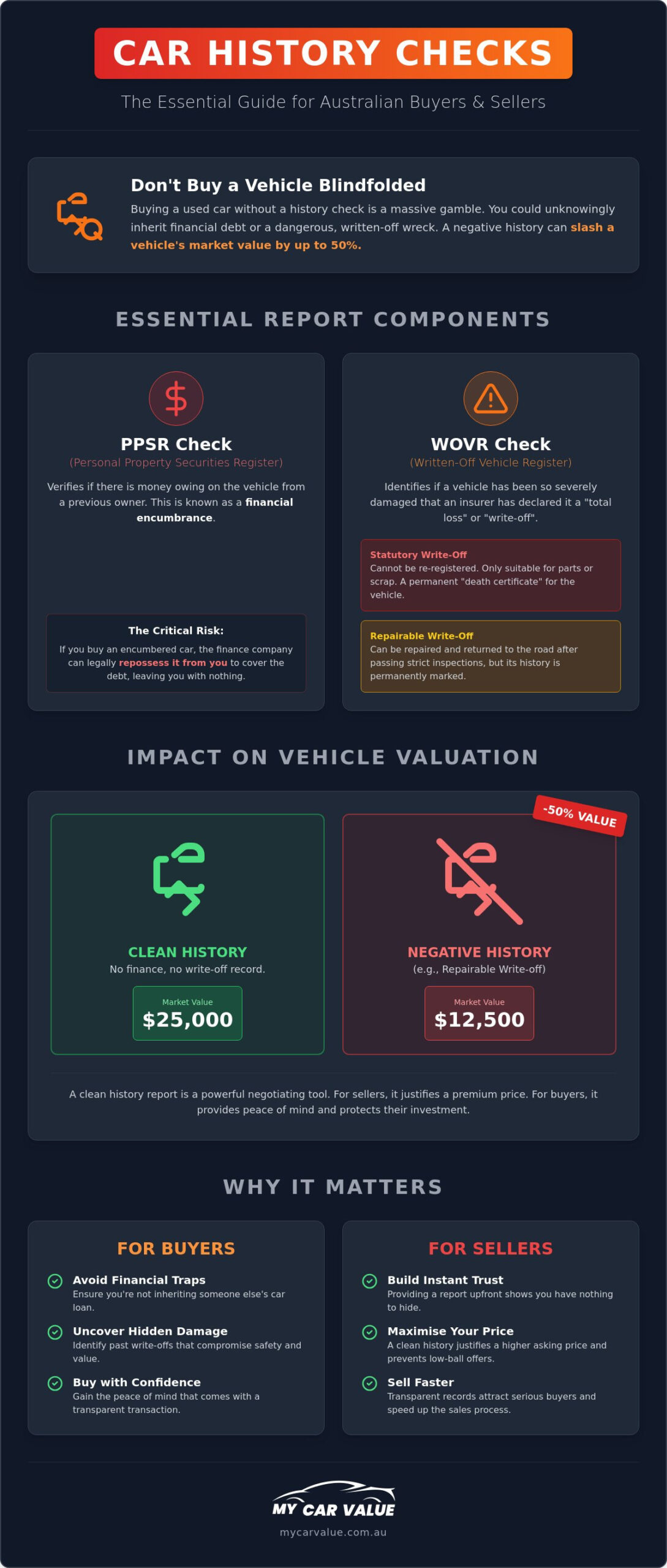
- Discover how a negative car history can slash a vehicle’s market value by up to 50% and how to avoid these high-risk assets.
- Learn how to use a clean history report as a powerful negotiating tool to increase buyer trust and secure a faster sale.
- Follow a straightforward two-step process to locate your 17-digit VIN and select the right reporting level for your needs.
- Understand why market liquidity ensures that cars with transparent records sell significantly faster than those with hidden pasts.
What is Car History and Why is it Essential in Australia?
Car history is the comprehensive digital footprint of a vehicle’s life in Australia. It tracks every major event from the moment a car leaves the showroom floor until it reaches the wrecking yard. In the 2026 used car market, transparency is the new currency. Buyers no longer rely on a handshake or a verbal promise. They demand data. With record new car sales and the rapid rise of electric vehicles, the sheer volume of transactions makes digital verification essential for every buyer and seller.
This data is anchored to a unique 17-digit Vehicle Identification Number. Think of this as the car’s fingerprint. It allows authorities and private providers to link records across state lines and different owners. Australia previously used the Register of Encumbered Vehicles (REVS), which was a fragmented, state-based system. This was replaced by the more robust Personal Property Securities Register (PPSR). This modern system provides a centralised, national database that offers immediate clarity on a vehicle’s legal standing. It ensures that data from Western Australia is just as accessible to a buyer in New South Wales as it is locally.
The Difference Between Service History and Official Records
Many people confuse a logbook with a car history report. A service history records maintenance and mechanical care. It shows when the oil was changed or if the timing belt was replaced. While vital, it doesn’t tell the whole story. Official history reports cover legal, financial, and safety status. They reveal if the car is stolen, has unpaid debt, or is a written-off wreck. You need both datasets to get an accurate vehicle market value calculator result. Without official records, you’re only seeing half the picture. A car might run perfectly but still be legally owned by a finance company.
Who Benefits from a Comprehensive History Check?
A thorough data check serves everyone involved in a transaction. It removes the friction often found in private sales and ensures all parties are protected.
- Buyers: You protect yourself from “lemons” and inherited financial liability. Knowing a car’s past prevents you from buying a vehicle that can be legally repossessed by a bank because the previous owner failed to pay their loan.
- Sellers: You can prove the integrity of your asset. Providing a car history report upfront builds immediate trust and helps you secure a premium price. It eliminates the “tyre-kickers” who are unsure about the car’s background.
- Professional Buyers: Used car specialists use this data to mitigate risk. Accurate records allow them to provide instant, firm offers without the need for lengthy manual inspections or guesswork.
Essential Components of an Australian Car History Report
A reliable car history report is built on several data pillars that reveal the true status of a vehicle. The foundation of any legitimate check is the Personal Property Securities Register (PPSR). This national system tracks financial interests and legal encumbrances. If a car has a “security interest” registered against it, there is an active loan. Buying such a vehicle is incredibly risky. The financier can legally repossess the car to recover their debt, even if you paid the seller in full. Always ensure the report shows “No registrations found” before you hand over any cash.
Understanding PPSR and Financial Encumbrance
Encumbrance is the technical term for money still owed on a vehicle by a previous owner. It’s a common issue in private sales where a seller tries to offload a car before finishing their finance contract. If you ignore this, you’re essentially buying someone else’s debt. A clear PPSR status is a mandatory prerequisite for any meaningful car service history check result. Without this verification, your investment is never truly secure.
WOVR Status: Repairable vs Statutory Write-offs
The Written-off Vehicle Register (WOVR) categorises damaged cars into two distinct groups. A statutory write-off is a vehicle so severely damaged that it is only fit for parts or scrap. These can never be registered again in Australia. A repairable write-off has been deemed a total loss by an insurer but can legally be returned to the road after passing a rigorous inspection. However, even after repairs, these vehicles carry a stigma. They are often harder to insure and suffer a significant drop in resale value. As of July 1, 2026, the Northern Territory has implemented stricter reforms for re-registering these vehicles, requiring detailed repair logbooks and professional certification. Always check the WOVR for codes related to flood or hail damage, as these can cause long-term electrical issues that aren’t immediately visible during a test drive.
Beyond finance and damage, a report verifies the car’s legal identity. It checks police records to ensure the vehicle isn’t reported stolen and validates the current registration status. Odometer history is another vital component. By comparing historical readings from service records, previous sales, and registration renewals, you can identify “clocking” fraud. This is when a seller winds back the odometer to make the car look less used. If the numbers don’t follow a logical, upward progression, walk away from the deal. In 2026, digital service records make this harder to hide, but manual overrides still occur. Verifying these figures ensures you don’t overpay for a vehicle that is closer to the end of its life than the dashboard suggests. Knowing these details helps you sell my car in Sydney with full transparency and confidence.
How Car History Impacts Your Vehicle’s Valuation
A vehicle’s past directly dictates its present market value. It isn’t just a safety precaution; it’s a financial instrument. A “checkered” car history featuring previous accidents, repairable write-off status, or a history of neglect can reduce a car’s value by 20-50%. In a crowded marketplace, buyers treat any red flag as a reason to demand a steep discount or walk away entirely. This leads to the concept of “market liquidity.” Clean cars possess high liquidity because they’re low-risk assets. They sell faster and for significantly more money than vehicles with clouded records.
Professional buyers in major hubs like Sydney or Melbourne prioritise clear titles above all else. They use data from resources like the NSW vehicle history report to calculate risk-adjusted offers. If a report shows multiple owners in a short period or inconsistent odometer readings, the buyer must account for potential hidden costs. A verified, clean history allows them to offer a premium because the risk of future litigation or mechanical failure is drastically lower. If you want to maximise your return, providing this data upfront is essential.
The Cost of Non-Disclosure for Sellers
Attempting to hide a vehicle’s past is a losing strategy. Modern professional buyers use sophisticated databases that will always find the truth. Non-disclosure often leads to cancelled sales and damaged reputations. Upfront transparency builds immediate trust and leads to a smoother sell my car experience. A clear history report is the fastest way to organise a professional valuation. It removes the guesswork and allows the transaction to proceed without friction.
Building Trust with Professional Used Car Buyers
My Car Value connects sellers with buyers who value transparency and speed. When you provide a verified history, it allows for firm, non-negotiable offers rather than vague estimates that change upon inspection. Professional buyers value their time as much as yours. They don’t want to guess what they are purchasing before they arrive. Have your VIN ready to expedite the valuation process. This simple preparation transforms a stressful negotiation into a straightforward business transaction. By leading with data, you position your car as a premium asset in the Australian market.
Step-by-Step: How to Perform a Car History Check
Conducting a car history check is a systematic process that transforms uncertainty into data-driven confidence. It’s a methodical task that moves from data collection to analysis. Follow these steps to ensure you have the full picture before committing to a purchase or sale.
Where to Find Your VIN and Engine Number
Your search begins with the 17-digit Vehicle Identification Number (VIN). This unique code is the only reliable way to track a vehicle’s life. Number plates are less dependable because they can be swapped or replaced between states. You can find the VIN on the compliance plate in the engine bay or stamped on the chassis. It is also often visible through a small window at the base of the windscreen on the passenger side. If you don’t have the vehicle handy, look at your registration certificate or insurance documents. Ensure the VIN on the paperwork matches the physical vehicle exactly. Any discrepancy is an immediate red flag that suggests the car’s identity has been compromised. For a deeper understanding of what each character in that sequence means, our guide on decoding vehicle identification number strings will show you how to verify engine specs, confirm build dates, and identify the exact model variant you are purchasing.
Free vs Paid History Checks: What is the Difference?
It is vital to understand what different levels of reporting actually provide. Free registration checks offered by state authorities only show the rego expiry date and basic vehicle details like the make and model. They do not reveal financial debt or write-off status. For a complete car history, you must use the official PPSR.gov.au portal or a reputable third-party provider. A basic PPSR search carries an official government fee of $2.00 and identifies if a vehicle is stolen or has money owing. Comprehensive reports, which range from approximately $5.99 to $39.95 in 2026, add extra layers like odometer history and previous sales data. Professional buyer networks in Brisbane or Perth often handle these checks as part of their standard valuation process to save you the hassle.
Access the Data and Review Red Flags
Once you have the VIN, enter it into your chosen portal and download the certificate. Review the results for two specific terms: “encumbered” and “written-off.” An encumbered status means a bank or finance company still has a legal claim to the car. A written-off status indicates the car was previously declared a total loss by an insurer. If the report shows the vehicle is a statutory write-off, it can never be registered again. If it is a repairable write-off, you must verify that all repairs were certified by qualified professionals. This is especially important following the July 2026 reforms in the Northern Territory that require stricter logbooks for repaired vehicles.
The final step is using this information to determine the real-world value of the asset. A clean report validates the asking price. Any history of damage or debt provides leverage for negotiation. If you want to skip the manual paperwork and get a firm offer based on your vehicle’s unique record, you can Value My Car today for an instant result. This ensures you are making a decision based on live market data rather than guesswork.
Maximising Value: Using History to Sell Your Car Faster
A clean car history report is your most effective closing tool. It transforms your vehicle from a question mark into a low-risk asset. In a market where buyers are cautious about hidden debts and structural damage, providing a clear record upfront shifts the power dynamic. You stop defending your asking price and start stating facts. This transparency creates immediate market liquidity. Clean cars don’t just sell for more; they sell significantly faster because they remove the primary barrier to a transaction: fear of the unknown.
Using a report as a negotiating tool is a savvy move for any seller. When a private buyer or dealership tries to haggle, your verified history acts as a shield. It proves that the vehicle has no financial encumbrance and has never been a repairable write-off. This data-driven approach eliminates the emotional stress of traditional car sales. You aren’t asking for a price based on sentiment; you are demanding a value based on a verified, high-quality record. Safety and certainty are premium commodities in 2026.
Preparing Your “Digital Logbook” for Sale
Organisation is key to a premium sale. Collate your PPSR certificate, physical service logbooks, and receipts for recent repairs into a single “history pack.” Buyers in Adelaide and other major hubs specifically look for well-documented vehicle histories to avoid the risks associated with the used market. Presenting this complete pack justifies a higher asking price and builds immediate rapport. It shows that you have been a responsible custodian of the vehicle. This preparation often results in a smoother inspection process, as the buyer already has the answers to their most critical questions before they even see the car in person. Once you have agreed on a price, understanding how to transfer car registration in NSW correctly ensures you meet the 14-day deadline and avoid costly late fees that can sour an otherwise seamless handover.
The My Car Value Advantage: Speed and Accuracy
The traditional private sale process is often slow and fraught with uncertainty. Our platform bypasses these hurdles by using real-time data to provide accurate, market-reflective valuations. We understand that your time is valuable. By leveraging car history data, we connect you with professional buyers who specialise in efficient transactions. These buyers value transparency and are prepared to make firm offers because the risk has already been mitigated. They handle the complex transfer paperwork and PPSR checks, ensuring the process is as seamless as possible.
Don’t leave your vehicle’s value to chance. Use the data you have gathered to secure the best possible return on your investment. You can Value My Car now to see exactly what your clean history is worth in today’s competitive market. Get your valuation today with the confidence that comes from a clear and verified history.
Secure Your Financial Future on the Road
Mastering your vehicle’s records is the most effective way to eliminate risk in the Australian used car market. You now understand how the PPSR protects you from repossession and how the WOVR identifies critical structural safety issues. A transparent car history doesn’t just provide peace of mind; it directly safeguards your capital and ensures you aren’t overpaying for a hidden liability.
Using data to your advantage ensures you never leave money on the table during a sale. We’ve streamlined the entire experience so you can bypass the traditional stress of private listings and endless tyre-kickers. Our system provides accurate market valuations based on real-time data and connects you with a reliable network of professional Australian buyers who prioritise integrity. This modernised approach removes the friction from traditional trade-ins and private sales.
Value My Car Today to experience a simplified selling process built on speed and accuracy. You’ve done the research; now it’s time to move forward with total confidence in your asset’s true worth.
Frequently Asked Questions
Is a car history report the same as a PPSR check?
No, they aren’t identical. A PPSR check is a specific component of a broader car history report. While the PPSR focuses on financial encumbrances, stolen status, and write-off records, a comprehensive report adds layers like odometer history, previous sales data, and valuation insights. You get the legal basics from a PPSR check, but a full report provides a deeper look at the vehicle’s life.
Can I get a car history report for free in Australia?
You can’t get a comprehensive report for free. State transport authorities provide free registration checks, but these only show the rego expiry and basic vehicle descriptions. They don’t reveal if money is owing or if the car is a write-off. You must pay the official $2.00 government fee for a PPSR certificate or a higher fee for a detailed report from a private provider.
What should I do if my car history report shows the vehicle is stolen?
Contact your local police immediately and stop all negotiations with the seller. Buying a stolen vehicle means you have no legal title to it. The car will be seized by authorities and returned to its rightful owner or insurer, leaving you without a vehicle and out of pocket. Provide the police with the VIN and any contact information you have for the seller.
How long does a car history report stay valid for?
A report is only a snapshot of the database at the exact second it was generated. It doesn’t have an expiry date, but its accuracy diminishes instantly. A seller could theoretically register a new security interest or have an accident an hour after you run the search. Always generate your own fresh report on the day you intend to finalise the purchase.
Does a minor accident show up on a car history report?
Not usually. Minor accidents only appear if they result in an insurance company declaring the vehicle a total loss. The Written-off Vehicle Register doesn’t track small dents or cosmetic repairs paid for privately. This is why you should always combine a digital check with a physical inspection to identify any previous panel work or non-structural repairs.
Why is my VIN not showing any history in the database?
This usually happens because of a typing error. VINs are 17 characters long and don’t include the letters I, O, or Q to avoid confusion with numbers. Double check the characters on the vehicle’s compliance plate. If the car was manufactured before 1989, it might not have a standard 17-digit VIN, which can prevent it from appearing in modern national databases. Understanding the full structure of your VIN is made easier with a dedicated resource on decoding vehicle identification number characters, which explains exactly what each position represents and why certain letters are excluded.
Can a car be sold if it has a financial encumbrance?
Yes, but the debt must be settled during the transaction. The most secure method is to pay the finance company the outstanding balance directly and give the seller the remaining change. Never give the full purchase price to a seller and trust them to pay off the loan. If they don’t, the financier can still legally repossess the car from you.
How much does a WOVR status affect my car’s trade-in value?
A repairable write-off status typically slashes a car’s value by 20% to 50% compared to a clean equivalent. Even if the repairs are perfect, the “written-off” label stays with the vehicle for life. Professional buyers and dealerships view these as high-risk assets that are harder to sell and insure, which is why their offers will be significantly lower than market average.