
Vehicle Market Value Calculator: How to Estimate Your Car’s Worth in 2026
Why does one website tell you your SUV is worth $35,000 while another insists it’s only $28,000? It’s a common frustration for Australian car owners who find themselves caught between conflicting data and the fear of being low-balled by a dealer. You deserve a price that reflects the actual state of the 2026 market, not a generic estimate that ignores your meticulous service history or recent upgrades. Using a vehicle market value calculator should provide clarity, yet the gap between book value and real-world cash often feels like a guessing game.
We understand that you want a realistic price range without the stress of endless research. This article explains exactly how modern valuation tools work in the current Australian climate, where SUVs now make up over 74% of used car transactions. You’ll discover how to distinguish between outdated Redbook figures and live market demand. We also provide a clear path to help you move from a digital estimate to a fast, successful sale with complete transparency. Let’s get your car valued accurately so you can move on to your next vehicle with confidence.
Key Takeaways
- Understand how a vehicle market value calculator aggregates real-time sales data to provide a realistic starting point for your sale.
- Learn the critical difference between a generic price estimate and a firm cash offer in the competitive 2026 market.
- Discover why a complete service history and a clear PPSR check are essential for securing the top end of your valuation.
- Prepare your vehicle for a professional inspection with a practical checklist that covers everything from paperwork to presentation.
- Master the art of using your data-driven valuation as a powerful negotiation tool when connecting with professional car buyers.
What Is a Vehicle Market Value Calculator and Why Use One?
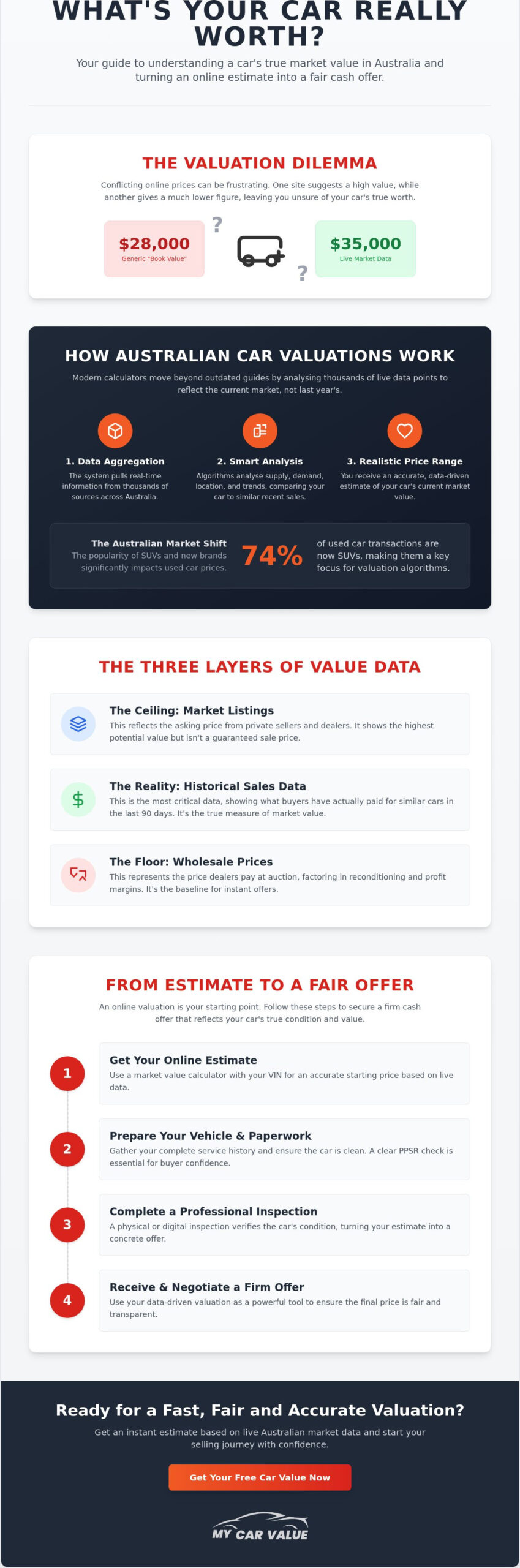
An online vehicle market value calculator is a digital tool designed to strip away the guesswork from selling your car. It acts as a data aggregator, pulling information from thousands of private listings, dealer transactions, and auction results across Australia. By processing these data points, it provides a realistic price range based on what similar models are actually selling for right now. This is particularly useful in 2026, as the influx of affordable Chinese brands and a high volume of used SUVs have made the market more price-sensitive than ever.
It’s vital to distinguish between a “price estimate” and a “firm offer.” A calculator provides a statistical benchmark based on current market trends. A firm offer, however, is a guaranteed price a buyer is willing to pay after a physical or digital inspection. Starting with a Car valuation tool establishes a transparent baseline. It ensures you don’t enter negotiations with an inflated figure that scares off buyers, nor a low figure that leaves money on the table. This transparency builds immediate trust, turning a typically stressful process into a straightforward transaction.
The Benefits of Using a Digital Estimator
Using a digital tool saves you hours of manual research. Instead of scrolling through classified websites and trying to average out prices yourself, you get an impartial third-party perspective in seconds. These tools also help you identify seasonal trends. For instance, 4WD values often fluctuate based on holiday periods or fuel price shifts. Getting an instant result allows you to time your sale for maximum return without the bias of a salesperson or the pressure of a “tyre-kicker” in your driveway.
Calculator vs. Professional Appraisal
Digital algorithms are incredibly efficient at valuing high-volume vehicles with standard features. They use vast datasets to find the “sweet spot” for your specific make and model. However, they have limitations. A vehicle market value calculator might struggle with rare factory options or specific aftermarket modifications that add significant value. While an algorithm handles a 100,000km commuter car perfectly, a human expert is often needed for low-use vehicles or cars with complex service histories. If your car is a standard model in good condition, the digital result is usually your best starting point to ensure you aren’t being low-balled by a dealer. For a no-cost option, using a free car valuation calculator can give you an accurate market estimate before you commit to any sale strategy.
How Australian Car Value Calculators Actually Work
An Australian vehicle market value calculator operates on a sophisticated blend of historical benchmarks and live market movements. Unlike generic global tools, local calculators rely heavily on the Redbook and Glass’s Guide ecosystem. These services have provided the industry standard for car valuation in Australia for decades. However, the 2026 market moves faster than a printed guide. Algorithms now ingest thousands of daily data points from private classifieds and dealer management systems to adjust for sudden shifts in demand. This is crucial as the rise of Chinese brands like BYD and MG puts downward pressure on traditional used car prices. The tool interprets these shifts to give you a figure that reflects the current week, not the previous year.
This rapid processing of complex data is a prime example of how firms like IntellifyAi are leveraging intelligent automation to drive enterprise transformation, making once-manual processes like car valuation more accurate and efficient for everyone.
Supply and demand play a massive role in the final output. For example, with SUVs accounting for 74.18% of used car transactions in 2025, the algorithm prioritises high-turnover models. If you are selling a popular SUV in Sydney, your calculated value might be higher than a sedan in a rural town. Location matters because transport costs and local popularity influence what a buyer will pay. To ensure you get the most accurate figure, the FTC recommends checking multiple sources to verify a vehicle’s history and market standing. It’s about finding a balance between what the “book” says and what people are actually paying at the petrol pump.
Understanding the Data Sources
- Market listings: These show what other sellers hope to get. They represent the current “ceiling” of the market.
- Historical sales: These reflect what buyers actually paid in the last 90 days. This is the most honest data point available.
- Wholesale data: This is the “floor” price used by dealers. It accounts for the costs of reconditioning and reselling the vehicle.
The Role of the VIN and Chassis Number
Using your VIN (Vehicle Identification Number) is the most reliable way to get a precise result from a vehicle market value calculator. Manual entry often misses specific trim levels or factory-fitted options like a sunroof or upgraded sound system. The VIN links directly to Australian registration records, ensuring the model year and engine specifications are 100% correct. This level of detail prevents the common mistake of under-valuing a premium variant. It ensures the calculator sees exactly what the manufacturer built, not just a generic guess. If you want to see how these factors impact your specific car, you can get a professional valuation in Melbourne to see your real-world worth.
Beyond the Numbers: Factors That Shift Your Car’s Real-World Value
While a vehicle market value calculator provides a solid data-driven starting point, it cannot “see” the specific condition of your car. In 2026, Australian buyers are more discerning about vehicle history than ever before. A complete logbook with regular stamps from a reputable service centre can add thousands to your final selling price. This “Service History Premium” is the difference between a quick sale at the top of the range and a long, drawn-out negotiation. It proves that you have prioritised preventative maintenance over mere ownership. Understanding how used car prices are tracked reveals that mechanical reliability and verified history remain the core drivers of value retention across the global and local markets.
Mechanical neglect is far more damaging to your valuation than standard wear and tear. Small stone chips or minor interior scuffs are expected on any used vehicle. However, smoke smells, ripped upholstery, or a grinding noise during a test drive are red flags that trigger heavy price deductions. In 2026, with the rise of high-tech interiors in new Chinese models, a dated or poorly maintained cabin feels even more obsolete to used car buyers. Presentation is no longer just about a quick wash; it’s about proving the car has been respected. If you’re considering your next purchase, understanding which cars with best resale value Australia offers in 2026 can help you make a smarter buying decision that protects your long-term investment.
The Importance of a Clean Car History
A digital estimate usually assumes your vehicle has a clean title. If your car is listed on the Written-Off Vehicle Register (WOVR), its market value can drop significantly, often by half. Professional buyers always conduct a PPSR (Personal Property Securities Register) check to ensure there is no finance owing. If your car has encumbrance, it must be cleared before a sale can be finalised. Validating these details early protects the calculator’s top-end estimate and builds trust with potential buyers. For a deeper look at how to verify your records, read our car service history check guide.
Mechanical and Cosmetic Condition
Most valuation tools offer a range from “Fair” to “Excellent.” To reach the “Excellent” bracket, your car needs to be mechanically sound and cosmetically superior. Recent maintenance, such as a new set of tyres or a major service, provides a high return on investment. Buyers value the immediate saving of not having to spend $1,000 on maintenance the week they take delivery. Small repairs, such as fixing a cracked tail-light or professional detailing, often return double their cost in the final sale price. If you want to see how these factors apply to your local area, you can find experts to help sell my car in Adelaide who understand these specific condition premiums.
Preparation Checklist: How to Ensure Your Valuation Is Spot On
Accuracy is the foundation of a reliable estimate. When using a vehicle market value calculator, the data you input determines the quality of the result. Start by checking your current odometer reading. It is the single most important variable for any valuation algorithm. In a market where used car sales grew by 4.2% in March 2026 alone, buyers have more choices than ever. An accurate kilometre count ensures the calculator uses the correct depreciation curve for your specific model. Next, take high-resolution photos of any minor scratches or stone chips. Transparency prevents “price-shock” during the final inspection. Disclosing a small dent now is far better than having a professional buyer discover it later and reduce their offer.
With SUVs making up over 74% of used car transactions, your vehicle needs to stand out in a crowded marketplace. A well-prepared car validates the top-end figure generated by a vehicle market value calculator. Follow this methodical checklist to move from a digital estimate to a firm cash offer without the usual friction. If you haven’t yet established your baseline figure, accessing a free car valuation calculator to estimate your vehicle’s worth is the ideal first step before working through the preparation steps below.
Organising Your Documentation
Gather your registration papers and stamped logbooks immediately. A missing service history isn’t just a minor detail; it’s a financial liability. Professional buyers look for consistency in maintenance. Keep receipts for major mechanical work like new tyres, battery replacements, or timing belt services. Review the documents needed to sell a car in Australia to avoid state-based delays. This preparation shortens the time between the initial estimate and the final payment. It proves you’ve been a responsible owner and justifies a premium price.
Final Physical Preparation
Clean the car thoroughly inside and out. A dirty interior often suggests mechanical neglect to a buyer. Wash the engine bay to remove dust and oil residue. This simple step shows the vehicle has been pampered. Address “curb appeal” issues like foggy headlights or scratched rims. These small imperfections are often cheap to fix but can distract buyers from the car’s overall quality. Remove all personal items, including dash-cams, seat covers, and phone mounts. Presenting a “blank canvas” allows the next owner to see the car’s potential. Ready to see what your car is worth? Value my car in Sydney today for a fast, accurate result that reflects the real-world market.
From Estimation to Sale: Turning Your Valuation into a Fair Offer
A digital estimate is only as good as the offer it generates. Once you have a figure from a vehicle market value calculator, you possess a powerful negotiation tool. Use this data-backed anchor to set your expectations. If a buyer offers a figure significantly below this baseline, ask for a specific justification based on current market trends. This shifts the dynamic from a subjective debate to a professional, evidence-based discussion. In a market where used car sales reached 222,810 units in March 2026, having precise data allows you to stand firm on a fair price.
The transition from estimating to selling should be seamless. Many sellers waste weeks on private listing sites, dealing with low-ball offers and inconsistent communication. By using your valuation as a starting point, you can bypass the chaos and move straight to a verified transaction. If you’re ready to take the next step, our ultimate 2026 guide to sell my car in Australia covers every stage of the process, from state-specific requirements to securing fast payment. This approach ensures you don’t leave money on the table or spend unnecessary hours managing a private sale. It provides a clear path forward in a crowded marketplace where SUVs now dominate 74% of transactions.
Why Professional Buyers Are the 2026 Standard
Professional buyers represent the most efficient way to sell your car in the current climate. They eliminate the tyre-kickers and time-wasters common on social media marketplaces. One major advantage is the potential to secure a sale without a Roadworthy Certificate (RWC) in some states, as professional buyers often handle reconditioning in-house. This saves you the immediate cost and stress of mechanical inspections. Before you commit to a trade-in, consider car auction alternatives that provide a more direct and transparent path to payment. These networks value speed and offer a guaranteed exit strategy for your vehicle.
Getting Started with My Car Value
My Car Value simplifies the entire process by acting as your savvy intermediary. Enter your vehicle details into our streamlined platform to receive an instant connection to our network. We specialise in connecting sellers with Used Car Buyers across Australia, from Perth to Brisbane. Our focus remains on transparency and immediate clarity, removing the legacy hurdles of the automotive industry. Value My Car today and experience the easiest way to sell. The final steps are straightforward: we verify your documentation, conduct a quick final inspection, and organise a secure transfer of funds. It is the fastest way to turn your car’s worth into real-world cash.
Secure Your Car’s True Worth Today
Estimating your car’s value in the 2026 market doesn’t have to be a guessing game. By starting with a vehicle market value calculator, you establish a data-driven baseline that reflects current Australian demand. Remember that your service history and a clean PPSR check are just as vital as the make and model. These factors, combined with a well-prepared vehicle, ensure you secure an offer at the top end of the market range. You now have the tools to move past the uncertainty of private listings and negotiate with confidence.
My Car Value provides a streamlined alternative to traditional sales methods. We are trusted by thousands of Australian car owners to deliver fast, transparent, and data-driven valuations. Our platform offers direct access to a nationwide network of professional used car buyers, ensuring you bypass time-wasters and secure a fair deal quickly. Take the final step toward a successful sale by getting the clarity you deserve. Get an accurate market valuation and connect with buyers at My Car Value. You’re ready to turn that digital estimate into a secure payment today.
Frequently Asked Questions
Is a vehicle market value calculator 100% accurate?
A vehicle market value calculator provides a statistical range rather than a 100% accurate figure. It uses live market data to create a reliable baseline, but it cannot account for your car’s unique physical state or specific maintenance history. For a precise offer, a digital or physical inspection is required to verify the condition of the paintwork, tyres, and interior components.
Does the calculator take my car’s modifications into account?
Most online tools do not factor in aftermarket modifications. A standard vehicle market value calculator relies on factory specifications and trim levels linked directly to your VIN. While a bull bar or upgraded suspension might add value to a specific buyer, these features usually require a manual appraisal from a professional buyer to be priced accurately within the current Australian market.
What is the difference between trade-in value and private sale value?
Trade-in value is typically lower because the dealer must cover reconditioning, storage, and a profit margin for resale. Private sale value represents the amount you might get selling directly to another individual. While private sales often yield a higher figure, they involve significantly more risk, advertising costs, and the time-consuming process of managing inspections and test drives yourself.
Why is my car’s calculated value lower than what I see on classified sites?
Classified sites show what sellers are asking, not what they are actually receiving. Many private sellers list their cars at an optimistic “ceiling” price to allow room for negotiation. A calculator focuses on historical sales data and wholesale benchmarks. This provides a more realistic expectation of the actual cash amount you will likely receive once the deal is finalised.
Do I need to pay for a professional valuation in Australia?
You generally don’t need to pay for a standard market valuation in Australia. Most digital tools and professional car buyers offer this service for free to help you understand your car’s worth. You only typically pay for a valuation if you require a formal, written certificate for legal purposes, such as a deceased estate, a divorce settlement, or an insurance dispute.
How often should I update my car’s market value estimate?
You should update your estimate every three months to stay ahead of rapid market shifts. The Australian automotive landscape changes quickly; for instance, the high volume of used SUV sales in early 2026 has direct impacts on depreciation rates. Regular checks ensure your price remains competitive and reflects current supply and demand levels across your specific state or territory.
Will a high number of previous owners affect the calculator result?
A high number of previous owners can negatively impact your car’s real-world value. While a digital tool might not always ask for this specific detail, professional buyers use it to gauge the continuity of care. Fewer owners typically suggest a more consistent service history, which often justifies a higher price at the top end of the estimated market range.
Can I use a calculator for a car with a blown engine or mechanical issues?
Digital calculators are designed for vehicles in “Fair” to “Excellent” running condition. If your car has a blown engine or major mechanical faults, a standard estimate will not be accurate. In these cases, it is more effective to contact professional buyers directly to receive a salvage or “as-is” quote based on the vehicle’s remaining parts and scrap metal value.

[…] because it doesn’t account for the reconditioning costs a buyer must absorb. Remember that vehicle market value calculators should be used as a guide only. They provide the context, but the market provides the […]
[…] the current odometer reading. Avoid using filters or hiding damage. Before you submit these, use a vehicle market value calculator to set a realistic baseline. Have your VIN and chassis number ready. Providing these details […]
[…] PPSR check is the most effective way to prove your car has a clean title. This report reveals if the vehicle […]
[…] an accurate starting point is essential. Using a vehicle market value calculator allows you to set realistic expectations before visiting a dealership. This tool uses live data to […]
[…] history of hail damage might retain more value than one involved in a high-speed collision. Use our vehicle market value calculator to see the baseline for your model before adjusting for its specific […]
[…] sophisticated algorithms to formulate instant offers that reflect these real-time changes. Using a vehicle market value calculator is the first step in aligning your expectations with the current market. While traditional Redbook […]
[…] starts with decoding your vehicle identification number. This 17-digit code is the only way to ensure an exact model variant match. Choosing the wrong trim […]
[…] you begin gathering physical documents, you must establish a realistic market baseline. Use a vehicle market value calculator to understand your car’s worth in the current 2026 market. Having an accurate, data-driven […]
[…] dozens of trim levels and optional extras that significantly impact the final figure. This is why decoding vehicle identification number (VIN) data is the most reliable way to get an accurate result. The VIN acts as a digital […]
[…] significant weight. Finally, take clear photos of these features and compare your result with a vehicle market value calculator to establish a realistic price […]
[…] between your expectations and reality. To get a precise reading on current trends, you can use a Vehicle Market Value Calculator to see how today’s conditions affect your car’s […]
[…] vans can shift within weeks based on new tax incentives or fuel price changes. You can use this Vehicle Market Value Calculator to establish your baseline, but remember that a real offer requires a professional eyes-on […]
[…] fees. There is also the cost of your time spent managing enquiries and tyre-kickers. Using a vehicle market value calculator helps you set a realistic baseline before you list your car. A professional offer can often be more […]
[…] as the following year’s model. This distinction is crucial because it directly impacts your car valuation. Buyers often pay more for a later model year, even if the build date is nearly […]
[…] Equally critical is establishing clear title status. Settle any lingering finance obligations early, or have current payout letters ready to confirm encumbrance details. Establishing this transparency upfront removes friction from the settlement process. To set an accurate benchmark before presenting your paperwork, check your specifications against an independent vehicle market value calculator. […]
[…] you have this number, compare it directly against the current market price of your vehicle. Using a vehicle market value calculator gives you a grounded appraisal based on current Australian sales data. This comparison establishes […]
[…] To get a clear picture of your rig’s worth, organise your vehicle details for an accurate vehicle market value calculator assessment. If you want to skip the stress of private sales, you can Value My Car through a […]
[…] to an estimated private-sale value. For more detail on the factors behind an estimate, read this vehicle market value calculator guide. Use an instant car valuation australia result as a first reference, then assess any professional […]
[…] cars providers look for clear service histories and honest disclosures about minor defects. Use a vehicle market value calculator to set a realistic baseline before you start. Common mistakes, like hiding a known mechanical fault […]
[…] Asking prices help show how sellers position similar cars, but listings don’t confirm completed sale prices. An advertised car may sell for a different amount or remain unsold. For broader context on how valuation factors fit together, see this vehicle market value calculator guide. […]
[…] Comparable listings can help you understand the market, but they aren’t direct matches if they show undamaged vehicles or different specifications. Compare like with like where possible, then account for condition instead of treating an advertised price as your car’s value. For broader context on how vehicle details shape an estimate, see the vehicle market value calculator guide. […]