

How to Get a Good Trade-In Price: The 2026 Australian Seller’s Checklist
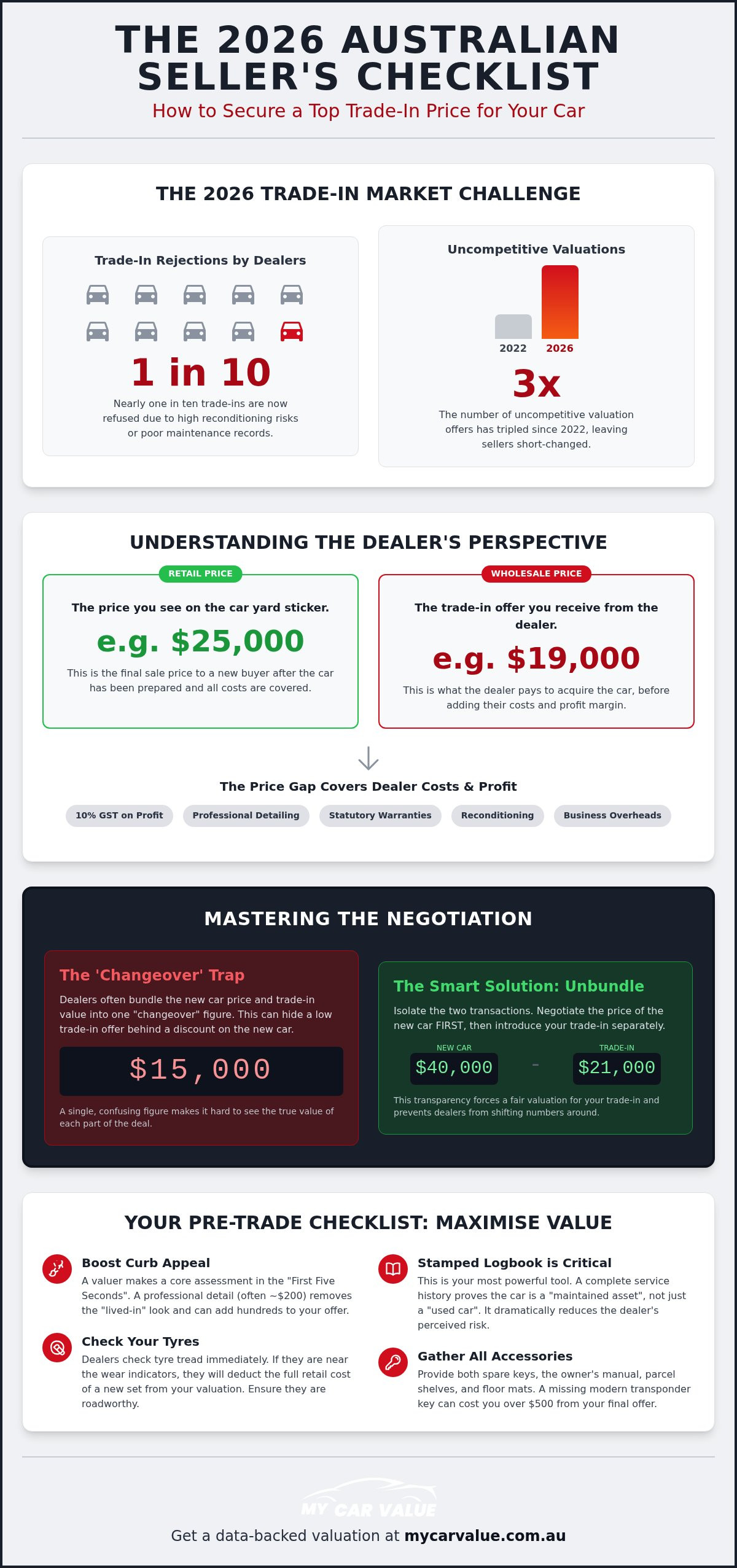
Did you know that Australian car dealers are now knocking back nearly one in ten trade-in offers they receive? Recent 2026 industry data shows that uncompetitive valuations have tripled since 2022, leaving many local sellers feeling short-changed. Understanding how to get a good trade-in price is no longer just about a quick car wash and a firm handshake. It requires a data-driven approach to ensure you don’t leave thousands of dollars on the table.
It’s natural to feel frustrated by the confusing gap between retail prices and wholesale offers. You want a fast, fair transaction without the stress of being outmanoeuvred by a professional negotiator. This guide provides the 2026 Australian Seller’s Checklist to help you master the trade-in process before you even step onto the dealership forecourt. We will show you how to use the Value My Car tool to establish true market value, explain the impact of current 2026 LCT thresholds, and prepare your vehicle for a professional inspection that commands respect. Gain the confidence to secure a deal that reflects what your car is actually worth.
Key Takeaways
- Establish a data-backed baseline using the Value My Car tool to bridge the gap between wholesale offers and retail expectations.
- Optimise your vehicle’s “First Five Seconds” with a stamped logbook and professional presentation to reduce high reconditioning costs.
- Master the negotiation by unbundling the transaction and learning how to get a good trade-in price through isolation of the vehicle’s value.
- Identify why live market data is more accurate than traditional valuation guides in the fast-moving 2026 Australian car market.
- Explore the advantages of connecting with professional used car buyers for a transparent cash offer rather than settling for dealership credit.
Understanding the Dealer Mindset: Why Trade-In Prices Vary
Dealers operate on margins, not charity. To understand how to get a good trade-in price, you must first accept that a dealer acts as a middleman. They buy your car at a wholesale rate and sell it at a retail rate. This gap covers their business overheads, including the 10% GST on the profit, professional detailing, and mandatory statutory warranties required by Australian consumer law. If the offer feels low, it usually reflects the dealer’s need to turn a profit after these fixed costs are deducted.
Retail vs. Wholesale: The Price Gap
The wholesale price is what a dealer pays to acquire stock quickly. It is consistently lower than the “list price” you see on classified websites. This difference exists because the dealer takes on the financial risk of the vehicle. They must account for potential mechanical failures and the length of time the car might sit on the lot. A foundational step in understanding car valuation is recognising that “market value” for a dealer is the price they can achieve at a professional auction or on their own forecourt after expenses. A low offer is rarely a personal insult. It is a business calculation based on their current stock levels and local market demand in 2026.
The ‘Changeover’ Trap
Dealers often steer the conversation toward the “changeover” figure. This is the total amount you pay to swap your old car for a new one. It is a common tactic to mask a low trade-in offer by providing a generous discount on the new vehicle purchase. To truly master how to get a good trade-in price, you must unbundle these two transactions. Negotiate the price of the new car first. Only once that figure is locked in should you introduce your trade-in. This transparency prevents the dealer from shifting numbers between columns to make a poor deal look attractive. Always determine your “walk-away” price before you enter the yard. If the dealer cannot meet your researched valuation, be prepared to leave the negotiation immediately.
Reconditioning costs also play a massive role in the final offer. In early 2026, dealers have become increasingly selective. Recent industry data shows that dealers now refuse nearly 9% of trade-ins due to high reconditioning risks or poor maintenance records. A car with worn tyres or a missed service entry represents a liability. Dealers will deduct the retail cost of these repairs from your offer, not the wholesale cost they actually pay. Presenting a clean car with a complete service history is the fastest way to protect your value. A stamped logbook proves the car has been maintained, which reduces the dealer’s perceived risk and keeps more money in your pocket.
The Pre-Trade Checklist: Curb Appeal and Paperwork
First impressions are final in the car yard. A valuer makes a core assessment within the first five seconds of seeing your vehicle. If the exterior is covered in road grime or the interior smells of stale coffee, the valuer assumes the mechanical maintenance has been equally neglected. Presentation is the most controllable factor when researching how to get a good trade-in price.
Mechanical and Cosmetic Presentation
A professional detail is often the best $200 you’ll spend. It removes the “lived-in” look and restores showroom appeal. Address minor cosmetic issues like small paint chips or trolley dents. While these seem trivial, they act as leverage for a dealer to justify a lower offer. Pay close attention to your tyres. Dealers perform a “tyre test” immediately. If the tread is near the wear indicators, they will deduct the retail cost of four new tyres from your valuation. Ensuring the car meets basic roadworthy standards prevents easy deductions.
The Paperwork Trail
Documentation provides the evidence needed to back your asking price. A complete car service history check is your most powerful tool. A stamped logbook proves the vehicle has met every manufacturer milestone. This is a critical part of preparing your car for trade-in. It shifts the narrative from a “used car” to a “maintained asset”.
Gather all physical accessories. This includes spare keys, the owner’s manual, and any removable parcel shelves or floor mats. Modern transponder keys are expensive to replace, often costing over $500. If one is missing, expect a significant hit to your offer. Before you head to the dealership, ensure your rego is current and you have a clear PPSR status. For a fast assessment of your car’s current market standing, you can Value My Car online to see where you sit before negotiating.
Organise your receipts for major recent works. If you have recently replaced a timing belt or refurbished the transmission, keep those invoices on the front seat. These documents turn verbal claims into verified value. By removing the dealer’s uncertainty, you remove their reason to offer a lower price.
Researching the Real Market Value in Australia
Data is your strongest ally at the negotiation table. Without an objective baseline, you are simply guessing. To understand how to get a good trade-in price, you must separate emotional attachment from current market reality. Start by monitoring demand for your specific make and model on major classified sites. However, don’t confuse “asking price” with “sale price.” A car listed for $30,000 might actually sell for $26,000 after weeks of negotiation. Dealers know this discrepancy and will use it to justify lower offers.
Guidebooks vs. Reality
Traditional guides like Redbook or Glass’s Guide are helpful starting points. They aren’t finish lines. In 2026, market volatility means these guides can lag behind real-world trends by several months. For instance, recent auction data from Pickles and Mannheim shows that some second-generation Volkswagen Tiguan models are fetching between 15% and 22% below their Redbook valuations. Similarly, Jeep Cherokee KL models from 2017 to 2018 are often achieving only 55% of their equivalent guide value. Optional extras like sunroofs or premium leather rarely recover their original cost. While they make your car easier to sell, they don’t always translate into a higher trade-in figure. Kilometres also play a vital role. The Australian average is 15,000km per year. If your vehicle exceeds this, expect a tiered reduction in value for every 5,000km over the benchmark.
Getting a Baseline Valuation
Establishing an accurate starting point is essential. Using a vehicle market value calculator allows you to set realistic expectations before visiting a dealership. This tool uses live data to reflect what professional buyers are actually paying right now. Market value is the price a willing buyer pays in the current climate.
Our Value My Car service provides a transparent market snapshot that strips away the guesswork. Compare this digital quote with any “low-ball” offers you receive locally. If a dealer’s price is significantly lower than your baseline, ask them to justify the difference based on reconditioning costs or current stock levels. Having this data on hand shifts the power dynamic. It transforms you from a passive seller into an informed participant who knows exactly how to get a good trade-in price in the 2026 market.
Negotiation Tactics: How to Secure the Best Offer
Negotiation is a tactical game. When the valuer performs the “Silent Walk-Around,” remain quiet. They are looking for reasons to drop the price. Don’t help them. If they point out a scratch or a dent, acknowledge it with a simple nod but don’t offer an excuse. Silence often forces the dealer to justify their deductions, putting the burden of proof on them. This creates a professional atmosphere where your vehicle is treated as an asset, not just a liability they are doing you a favour by taking.
The ‘Two-Step’ Negotiation Process
Treat the purchase and the trade-in as two distinct transactions. This is the gold standard for how to get a good trade-in price. First, negotiate the best possible drive-away price for your new vehicle. Do not mention your trade-in yet. If the salesperson asks, tell them you haven’t decided what to do with your current car. Once the new car price is written down and agreed upon, only then introduce your trade-in. This prevents the dealer from inflating the trade-in offer while quietly removing discounts from the new car. It ensures total transparency and allows you to see the true value of each part of the deal.
Handling Common Dealer Objections
Expect pushback. Dealers often claim “the market is soft for this model” or “we already have three of these on the lot.” Counter these excuses with the data you gathered in the research phase. State clearly: “My independent valuation reflects current 2026 auction trends for this specific trim level.” This shows you are an informed seller who isn’t susceptible to standard sales scripts. If the offer remains significantly below your baseline, mention that you have quotes from other professional buyers. The most powerful tool you have is the ability to walk out. If the deal doesn’t feel right, leave.
Using multiple quotes creates a competitive environment. If you show the dealer that their offer is the lowest of three, they are more likely to sharpen their pencil. This competition is essential for anyone wanting to know how to get a good trade-in price without the typical stress. It turns the tables, making the dealer compete for your business rather than you begging for theirs. By unbundling the deal and using your research, you transform the negotiation from a stressful confrontation into a logical business arrangement.
The Modern Alternative: Professional Used Car Buyers
Many Australians believe the only path to a new vehicle is through a dealership forecourt. However, learning how to get a good trade-in price often involves looking beyond the traditional trade-in model. Connecting with used car buyers is a modern alternative that frequently yields a higher return. By bypassing the dealership middleman, you remove a layer of profit margin that usually comes out of your pocket. This channel prioritises efficiency and transparency over the high-pressure tactics of a traditional car yard.
Speed, Ease, and Transparency
Dealerships are built on a complex web of finance commissions and reconditioning margins. Professional buyers operate differently. They offer a streamlined 24-hour turnaround, moving you from valuation to cash in the bank without the typical “up-selling” pressure found in a showroom. A cash offer provides ultimate flexibility. Unlike a trade-in credit, which locks you into a specific dealer’s inventory, cash allows you to negotiate as a “no-trade” buyer elsewhere. This often unlocks deeper discounts on your next purchase because you aren’t complicating the deal with a trade-in. Professional networks actively seek “clean” stock to fill specific inventory gaps, meaning they are often willing to pay more for well-maintained vehicles than a generalist dealer would.
How My Car Value Facilitates the Best Price
We simplify the entire sell my car process by acting as your expert facilitator. Instead of you visiting multiple yards to find a fair offer, we match your vehicle with the right specialist buyer from our network. This ensures market transparency. Our data-driven approach removes the guesswork and the stress of face-to-face negotiation with professional salespeople. We do the heavy lifting by identifying buyers who specifically want your make and model, which naturally drives a more competitive offer.
To secure your value, start with a free, impartial valuation. Once you have your baseline, we connect you with buyers who are ready to act. This methodical approach ensures you aren’t just hoping for a fair deal; you are engineering one. If you want to know how to get a good trade-in price while avoiding the traditional dealer headache, this modern channel is your most effective tool. Take the first step by getting your valuation today and see how simple the process can be.
Take Control of Your Car’s Value Today
Securing a fair deal in the 2026 market requires more than just luck. It demands preparation and transparency. You now have the tools to optimise your vehicle’s presentation, unbundle the dealership’s complex figures, and use live market data to your advantage. By shifting from a passive seller to an informed participant, you eliminate the stress of the negotiation process. You understand that how to get a good trade-in price is a matter of engineering the right conditions before you ever visit a yard.
Remember that you aren’t limited to a single dealership’s offer. Professional networks provide a streamlined alternative that values your time as much as your vehicle. Use your research to set a firm baseline and don’t be afraid to walk away if the numbers don’t align with reality. Our platform provides expert market valuations in minutes and connects you with professional used car buyers nationwide. This streamlined, stress-free selling process puts the power back in your hands.
Enter your next negotiation with total confidence. You’ve done the hard work, and you’re ready to secure the return your car deserves.
Frequently Asked Questions
Is it better to trade in or sell my car privately in Australia?
Selling privately often yields a higher price but requires substantial time for photography, enquiries, and inspections. A trade-in is faster but usually pays less because the dealer takes on the resale risk. Using a network of professional used car buyers provides a superior alternative. It offers the speed of a dealership transaction while ensuring you receive a competitive market rate based on current 2026 demand.
How much does a car’s service history affect its trade-in value?
Service history is one of the most critical factors in valuation. A complete logbook proves the vehicle has been maintained to manufacturer standards, which significantly reduces the dealer’s reconditioning risk. Cars without a verified history are often penalised with lower offers. Dealers must assume major mechanical work is pending. Providing a stamped record is a primary step in how to get a good trade-in price.
Can I trade in a car that still has finance owing on it?
You can trade in a vehicle with outstanding finance. The dealer will request a payout figure from your lender and settle the debt as part of the transaction. If your car is worth more than the loan, the surplus acts as a deposit for your next purchase. However, if you owe more than the trade-in value, you will need to pay the difference or refinance the negative equity into your new loan.
Should I fix dents and scratches before trading in my car?
Focus only on minor cosmetic improvements. A professional detail or small paint touch-ups can improve the initial valuation significantly. Avoid major mechanical or body repairs. Dealers pay wholesale rates for these services, which are much cheaper than the retail prices you would pay. Instead, mention any recent major maintenance works and provide receipts to prove the car has been well-kept without spending unnecessary money on major overhauls.
Why is the trade-in offer so much lower than the price on the dealer’s lot?
Dealers operate on a wholesale-to-retail model. The price on the lot includes the dealer’s margin, GST, detailing, and mandatory statutory warranties required by law. They also factor in the risk of the car not selling quickly. Understanding these business costs helps you manage expectations. This transparency is vital when researching how to get a good trade-in price, as it allows you to negotiate from a position of logical market reality.
What documents do I need to bring to the dealership for a trade-in?
You must bring your registration certificate, a complete service logbook, and all spare keys. If there is finance owing, provide a recent payout letter from your lender. You will also need a valid Australian driver’s licence. Having these documents ready prevents the dealer from using missing information as a reason to delay the offer or lower the price. Organisation suggests you are a savvy seller who knows the vehicle’s worth.
How do I know if a dealer’s trade-in offer is actually fair?
Fairness is determined by data, not the salesperson’s opinion. Compare the dealer’s quote against the baseline you established using the Value My Car service. A fair offer should be within a reasonable range of current wholesale auction results. If the dealer’s price is significantly lower without a clear explanation of mechanical faults, use your researched valuation to challenge the figure or seek an alternative offer from a professional buyer.
Can I negotiate a trade-in price after the initial offer?
You should always negotiate the initial offer. Dealers expect a counter-offer and often leave room in their first quote. Use your research to explain why your vehicle deserves a higher price. Mention specific strengths like low kilometres, a full service history, or high-demand features. If the dealer refuses to move, be prepared to walk away. Having a backup quote from a professional network often encourages them to be more competitive.