
What Do Car Buyers Want? 2026 Australian Seller’s Guide
In 2026, a five-star safety rating from just three years ago is no longer the ultimate selling point for savvy Australians. With used EV sales climbing by 54.6 per cent while the broader market softens, the criteria for a successful sale have fundamentally changed. To secure the best possible price, you must understand exactly what do car buyers look for in a landscape defined by rapid tech shifts and new ANCAP safety protocols.
It’s natural to feel uncertain about which repairs are worth your investment or how to compete with the influx of feature-rich Chinese brands. You deserve a selling process that is transparent and free from the fear of being low-balled. This guide promises to simplify the market for you. You will discover the specific priorities of professional and private buyers so you can maximise your vehicle’s resale value. We provide a clear checklist of what to fix and how to justify a higher asking price, ensuring your next sale is fast, logical, and profitable.
Key Takeaways
- Understand how the 2026 shift toward hybrids and fuel-efficient SUVs influences buyer demand and current market valuations.
- Identify exactly what do car buyers look for when assessing mechanical reliability, including the critical role of a Roadworthy Certificate and tyre health.
- Maximise your vehicle’s kerb appeal by prioritising professional detailing and addressing minor aesthetic wear to create a strong first impression.
- Build seller credibility through transparent documentation, using full service histories and PPSR checks to eliminate buyer uncertainty.
- Learn to separate emotional value from market reality to set a data-driven price that attracts professional buyers and speeds up the sale process.
Understanding the Australian Buyer’s Mindset in 2026
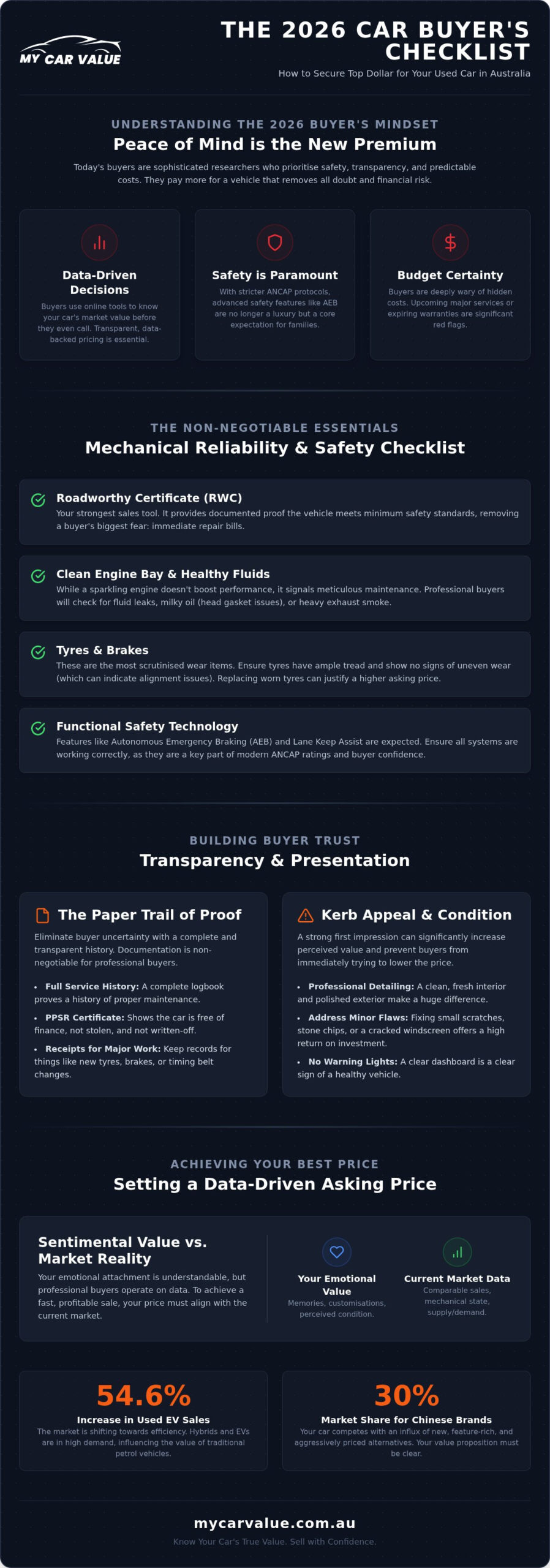
The 2026 Australian car buyer is a sophisticated researcher. They don’t just kick the tyres; they interrogate the data. When considering what do car buyers look for, you must realise that transparency is now the primary currency. These buyers are safety-conscious and deeply wary of hidden costs like upcoming major services or expiring warranties. They want a car that fits a predictable budget, not a vehicle that presents a financial risk.
Peace of mind is the “Certainty Factor” that defines modern transactions. Buyers pay a premium for a vehicle that removes doubt. This evolution is a significant chapter in the history of the Australian auto industry, as we’ve shifted from a few local options to a complex global market. Providing a clear, documented history is the most effective way to secure a top-dollar sale in this crowded national environment.
The Rise of the Informed Second-Hand Buyer
In 2026, buyers know your car’s market value before they even call you. Online comparison tools have levelled the playing field, making transparent pricing a necessity rather than a choice. Professional Used Car Buyers operate with even greater precision. While a private seller might get distracted by a premium sound system, a professional focuses on mechanical health and resale liquidity. They look for cars that can be turned over quickly with minimal refurbishment. They value honesty over salesmanship, so being upfront about the vehicle’s condition is vital to a smooth transaction.
Lifestyle vs. Practicality: What Drives the Purchase?
The Australian love affair with the SUV continues, but the focus has shifted toward efficiency. Families still demand the space of a large wagon or ute, but they are increasingly looking for hybrid powertrains to offset rising living costs. If you are selling a traditional petrol SUV, you need to highlight its specific value points to compete with the influx of feature-rich Chinese brands that have secured 30 per cent of the market.
Using a Value My Car service allows you to see your vehicle through a professional lens. It bridges the gap between your emotional attachment and the cold, hard data of the 2026 market. This ensures your asking price is competitive across all metropolitan centres and regional areas. By aligning your expectations with current buyer demand, you position yourself for a faster, more profitable sale.
Mechanical Reliability and Safety: The Non-Negotiable Essentials
In the 2026 market, a Roadworthy Certificate (RWC) is more than a legal requirement. It is your strongest sales tool. When you ask what do car buyers look for, the answer starts with mechanical certainty. A current RWC proves the vehicle meets the minimum safety standards, removing the buyer’s fear of immediate post-purchase repair bills. Pair this with a clean engine bay. While a sparkling engine doesn’t technically improve performance, it signals that the car has been meticulously maintained. Conversely, a layer of grime or oily residue suggests neglect, which can quickly derail a high-value negotiation.
Tyres and brakes are the most scrutinised wear-and-tear items. Buyers will check the tread depth and look for uneven wear, which indicates alignment issues. If your tyres are near the legal limit, replacing them before listing can often return more than the initial cost by justifying a higher asking price. These details align with broader automotive market trends where buyers prioritise turn-key reliability over project cars.
The Mechanical Baseline for Professional Used Car Buyers
Professional buyers conduct a systematic inspection that goes deeper than a test drive. They look for fluid leaks, transmission lag, and cooling system health. Common deal-breakers include milky oil (head gasket issues) or heavy smoke from the exhaust. However, minor repairs like replacing a cracked windscreen or fixing a faulty sensor offer a high return. Addressing these small issues prevents a professional from using them as leverage to slash your car’s value. Before you book an inspection, it’s wise to value my car to understand how your vehicle’s mechanical state compares to the current market average.
Safety Tech: The Features Buyers Won’t Compromise On
Safety technology is no longer an optional luxury. Features like Autonomous Emergency Braking (AEB) and Lane Keep Assist are now standard expectations for families and fleet buyers alike. These systems don’t just save lives; they reduce insurance premiums, making your car more affordable to own. In 2026, ANCAP ratings are more stringent, assessing everything from touchscreen usability to post-crash safety. A higher safety rating directly correlates to a faster transaction speed because it satisfies the buyer’s demand for long-term security and financial predictability.
Aesthetics, Presentation, and Modern Tech Features
Visual presentation is the psychological trigger that justifies your asking price. When considering what do car buyers look for, remember that a clean car suggests a well-maintained engine. Professional detailing is often the most cost-effective investment you can make before a sale. It removes the surface imperfections that buyers use as bargaining chips. A machine polish can restore paint depth, while a steam clean removes the “invisible” value killers like stale odours.
Kerb appeal is about the details that people notice before they even open the door. Pay close attention to these specific areas:
- Paint Condition: Address minor stone chips and swirls. A consistent finish suggests the car hasn’t been in a major accident.
- Wheels: Gutter rash on alloy wheels is a common eyesore. Repairing these can significantly modernise the vehicle’s appearance.
- Light Clusters: Faded or yellowed headlights are a major turn-off. Polishing them back to clarity improves both safety and aesthetics.
Interior Comfort and Wear-and-Tear
The interior is where the buyer will spend their time, so it must feel fresh. Focus on high-touch areas such as the steering wheel, gear shifter, and seat bolsters. These parts show the most wear and can make a low-kilometre car feel older than it is. Pet hair and smoke smells are the hardest objections to overcome. If a buyer detects these, they will often walk away or demand a heavy discount for professional remediation. Presenting “like-new” upholstery creates an emotional connection that facilitates a faster sale.
The Tech Gap: Upgrading vs. Selling As-Is
In 2026, smartphone integration is the baseline expectation. Apple CarPlay and Android Auto are non-negotiable for most commuters. If your older vehicle lacks these, an aftermarket head unit might add value, but only if it looks integrated and professional. Wireless charging pads have also become a standard requirement for newer models. Functioning reverse cameras and sensors are also critical safety requirements that buyers won’t compromise on. Modern, tech-heavy cars are valued differently by used car buyers who use data-driven tools to assess how your vehicle’s features stack up against current market standards.
Documentation and Transparency: Building Buyer Trust
Trust is the primary currency in the 2026 used car market. Buyers are naturally skeptical and often look for reasons to walk away from a deal. When you consider what do car buyers look for, understand that they are searching for certainty. A gap in your vehicle’s history creates doubt, and doubt leads to low-ball offers or cancelled sales. Documentation bridges this “Trust Gap” by providing a verifiable story of the car’s life. Organise your logbook, receipts, and registration papers into a clean folder. This simple act of preparation signals that you are a meticulous owner who hasn’t cut corners. It transforms the transaction from a high-stress investigation into a transparent, data-driven exchange.
The PPSR Report: A Buyer’s Shield
A PPSR check is the most effective way to prove your car has a clean title. This report reveals if the vehicle has any financial encumbrance, is recorded as stolen, or has been written off. If your car is on the Written-Off Vehicle Register (WOVR), honesty is your best policy. Hiding past accidents is a major deal-breaker because most buyers will run their own check before the final handshake. Providing a clean report upfront demonstrates total transparency and fast-tracks the negotiation process. A PPSR report is the buyer’s primary tool for verifying title.
Service History: The Story of Your Car’s Life
A car service history check is the gold standard for justifying a premium price. While some buyers recognise the value of dealer stamps, others are satisfied with consistent records from a reputable independent mechanic. The key factor is the timeline. When considering what do car buyers look for in a logbook, they want to see that maintenance occurred at the correct intervals. Highlight the completion of “major services” such as timing belts, water pumps, or hybrid battery health checks. These high-cost items provide the next owner with financial predictability. Clear records prove that the car’s mechanical health matches its visual presentation, making it easier to defend your asking price.
Translating Buyer Preferences into a Top-Dollar Sale
To secure a top-dollar sale, you must view your vehicle as a commodity rather than a collection of memories. Understanding exactly what do car buyers look for allows you to strip away the “Emotional Value” that often leads to overpricing. While you might value the reliability of the last five years, a buyer only cares about the next five. Market value is dictated by data: recent sales of similar makes, current stock levels, and the mechanical certainties we have discussed in previous sections. Aligning your price with these realities is the fastest way to attract serious offers.
Preparation in the final 24 hours before a viewing can make or break the deal. Perform a final sweep to remove all personal items, including loose change, gym gear, and charging cables. Clean the windows inside and out to ensure a crystal-clear first impression during the test drive. Check your tyre pressures and top up the windscreen washer fluid. These small, practical steps prove the car is ready for immediate use and hasn’t been neglected in the days leading up to the sale.
Setting a Realistic Asking Price
Start with a logical baseline. Use a vehicle market value calculator to find your car’s worth based on current Australian market trends. From this point, adjust your price based on your specific odometer reading and wear. If your kilometres are lower than the national average for your model’s age, you can justify a premium. Always build in a “Negotiation Buffer.” This is a small margin above your lowest acceptable price that allows the buyer to feel they have secured a win without compromising your financial goal.
Choosing the Right Way to Sell
Decide whether you prioritise the potentially higher price of a private sale or the speed of a professional transaction. Private sales often involve weeks of filtered emails, low-ball offers, and “no-show” inspections. This process can be draining and unpredictable. In contrast, professional used car buyers offer a streamlined path to a certain outcome. They look at what do car buyers look for from a wholesale perspective and can often finalise a sale within 24 hours. My Car Value removes the stress of private classifieds by connecting you directly with reputable purchasers who value your time as much as your vehicle. Ready to see what your car is worth? Value My Car today.
Take Command of Your Car Sale in 2026
Selling a car in the current Australian market requires a shift from emotional attachment to data-driven transparency. Success depends on understanding exactly what do car buyers look for, from verified service histories to the latest safety tech. By prioritising mechanical reliability and professional presentation, you remove the friction that often stalls private sales. You now have a clear checklist to justify a higher asking price and secure a faster transaction.
You don’t have to navigate this complex process alone or settle for low-ball offers. Utilising professional market data ensures your expectations align with reality. Whether you are selling a fuel-efficient SUV or a modern hybrid, your documentation and kerb appeal will speak for themselves. This pragmatic approach saves time and maximises your return without the stress of private classifieds.
Take the first step toward a smoother sale today. With a national network of professional used car buyers and accurate market valuations, you can finalise your sale with total confidence and minimal effort.
Frequently Asked Questions
What is the most important thing car buyers look for in 2026?
In 2026, transparency is the top priority for Australians. Buyers want certainty regarding mechanical health and safety standards. With the market shifting toward fuel-efficient SUVs and hybrids, they prioritise vehicles with verifiable data and clear histories. When asking what do car buyers look for, the answer is a low-risk purchase. They look for a car that won’t surprise them with hidden costs or outdated safety tech like older ANCAP ratings.
Does a full service history really increase my car’s value?
Yes, a full service history is the gold standard for maximising resale value. It serves as documented proof that you have maintained the vehicle according to manufacturer standards. This reduces the buyer’s perceived risk of future mechanical failure. Consistent records, whether from a dealer or a reputable independent mechanic, allow you to justify a premium price. It transforms your car from an unknown quantity into a reliable asset with a predictable future.
Should I fix small scratches and dents before selling my car?
Fixing minor aesthetic issues usually offers a high return on investment. Small scratches and dents suggest a lack of care, which can lead buyers to assume the engine has been neglected too. Improving your car’s kerb appeal through paint correction or professional detailing removes easy bargaining chips for the buyer. It ensures the first impression is positive, allowing you to hold firm on your asking price during the final negotiation process.
How much do high kilometres affect what buyers are willing to pay?
High kilometres typically lower a vehicle’s market value, but they aren’t a deal-breaker if the maintenance is impeccable. Buyers use the odometer to estimate the remaining life of major components like the transmission or hybrid battery. If your car has high kilometres, you must highlight the completion of major interval services to reassure the purchaser. A well-documented history can often offset the stigma of high usage by proving the car’s ongoing reliability.
What tech features are considered ‘must-haves’ for used car buyers now?
In 2026, smartphone integration via Apple CarPlay or Android Auto is a baseline requirement for most commuters. Buyers also prioritise safety tech like Autonomous Emergency Braking (AEB) and functioning reverse cameras. Wireless charging pads and multiple USB-C ports have also moved from luxury options to standard expectations. When considering what do car buyers look for, modern tech features are essential because they directly impact the vehicle’s daily usability and long-term resale potential.
Is it better to sell my car privately or to a professional buyer?
The choice depends on whether you value your time or a slightly higher potential price. Private sales often involve weeks of managing inquiries, no-show inspections, and low-ball offers. Connecting with professional used car buyers offers a faster, more transparent alternative. You avoid the stress of private classifieds and finalise the sale quickly. This streamlined process provides immediate payment and removes the legal and safety risks associated with meeting strangers at your home.
What documents do I need to have ready when a buyer comes to look at my car?
You should have your logbook, current Roadworthy Certificate (RWC), and registration papers ready for inspection. Providing a recent PPSR report upfront builds immediate trust by proving the title is clear of debt. Organise all receipts for major repairs and tyre replacements in a clean folder. This professional presentation suggests you are a responsible owner. Having the right paperwork ready prevents delays and gives the buyer the confidence they need to commit to the purchase.
How does a PPSR check affect a buyer’s decision?
A PPSR check is a critical decision-making tool that verifies the car isn’t stolen, written off, or encumbered by debt. If a report shows financial interest from a lender, most buyers will walk away unless you can prove the debt will be cleared. Providing a clean report yourself demonstrates transparency and removes a major hurdle. It gives the buyer peace of mind that they will have legal ownership of the vehicle once the funds are transferred.