

How to Estimate Car Worth in Australia: The 2026 Seller’s Guide
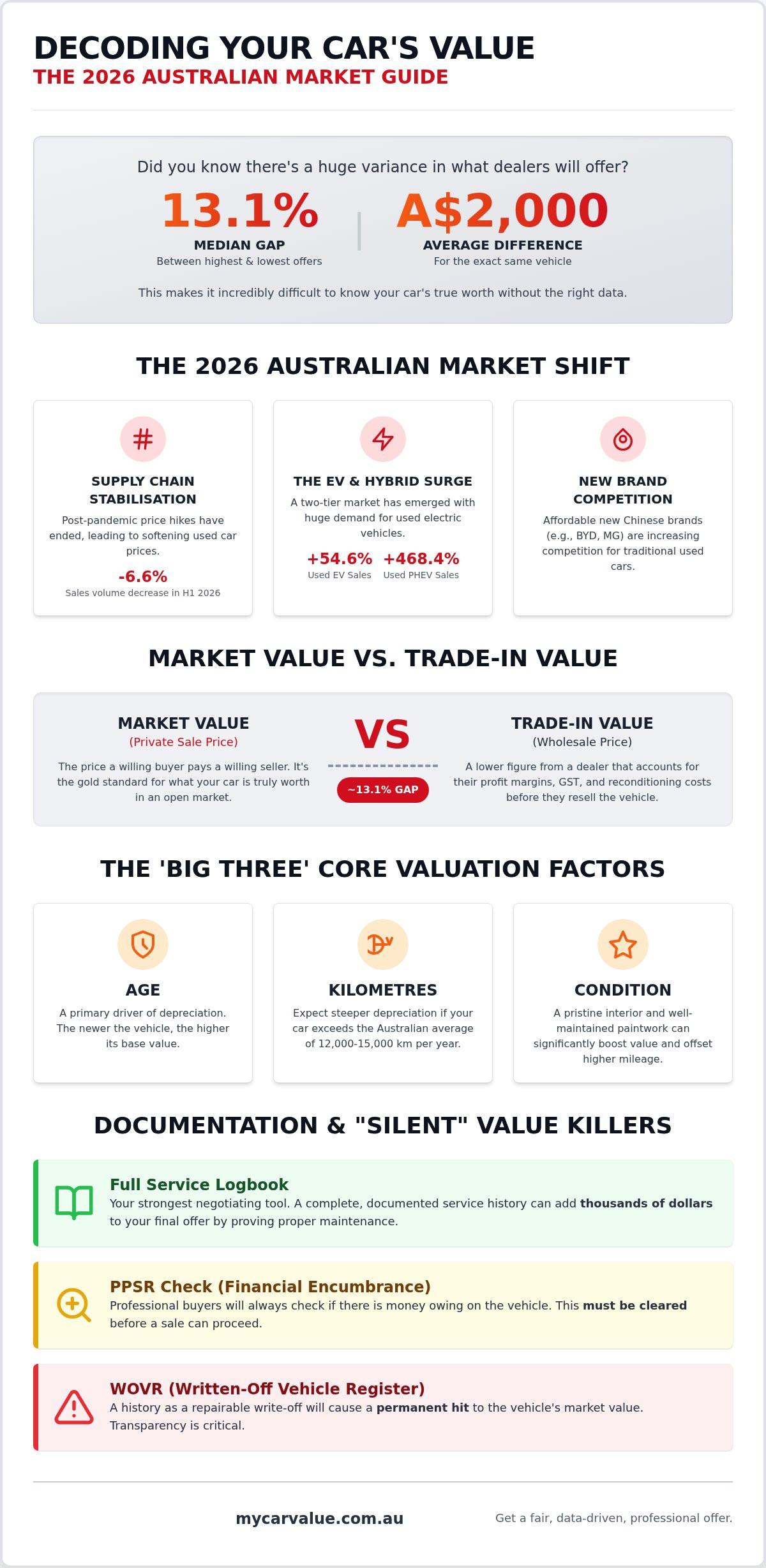
Did you know there is a median gap of 13.1 percent, or roughly A$2,000, between the highest and lowest dealer offers for the exact same vehicle in Australia? This massive variance makes it incredibly difficult to accurately estimate car worth without the right data. You likely feel the frustration of seeing conflicting prices online and the constant worry that a dealer might low-ball your offer. It is exhausting to prepare a car for sale only to face uncertainty about its true market value.
We understand that you want a transparent, straightforward process. This guide provides the exact factors that determine your vehicle’s value in the 2026 market, from the impact of new Chinese brands to the surging demand for used EVs. You will learn the critical difference between trade-in and retail values while discovering how to secure a professional offer without the typical stress of private classifieds. We will walk you through a logical, step-by-step method to get a defensible estimate and connect with genuine buyers who value your time. Let’s strip away the complexity and get you a fair price.
Key Takeaways
- Understand how 2026 market shifts and supply chain stabilisations impact your vehicle’s current resale value.
- Identify the “Big Three” factors and logbook requirements used to accurately estimate car worth.
- Learn why guide prices differ from real-world demand and how to use market data to your advantage.
- Follow a structured preparation plan to organise your paperwork and presentation for a superior professional offer.
- Access a national network of vetted professional buyers to eliminate the friction and risk of private sales.
Understanding the Australian Car Valuation Landscape in 2026
A car’s worth isn’t a fixed figure found in a ledger. It’s a fluid calculation based on historical data, immediate market demand, and your vehicle’s unique state. By mid-2026, the Australian automotive landscape has shifted. Supply chains have stabilised, ending the erratic price hikes seen in previous years. This return to normalcy means used car prices are softening, evidenced by a 6.6% decrease in sales volume during the first half of the year. To accurately estimate car worth today, you must look beyond static figures and understand current buyer behaviour.
Static book values often fail to capture the 2026 reality. The rapid growth of used electric vehicles (EVs) and plug-in hybrids (PHEVs)-which saw sales increases of 54.6% and 468.4% respectively-has created a two-tier market. Traditional vehicles now face stiffer competition from new, affordable Chinese brands like BYD and MG. Consequently, a “real-time” value is far more relevant than a six-month-old guide. Across Australia, local demand for specific fuel types can also swing your estimate by thousands of dollars.
Market Value vs. Trade-in Value: Which One Matters?
Market Value represents the price a willing buyer pays a willing seller in an open market. This is often synonymous with the Private Sale Price. It is the gold standard for what your car is worth. In contrast, Trade-in Value is a wholesale figure. It is naturally lower because it accounts for dealer profit margins, GST, and the cost of reconditioning. A Motorly analysis found a median gap of 13.1% (roughly A$2,000) between dealer offers for the same car. This gap is the primary source of seller stress. Understanding these Key Factors in Car Valuation helps you set realistic expectations before you negotiate.
Why Estimates Vary Across Different Platforms
Online tools use different algorithms to estimate car worth. Some platforms scrape “asking prices” from public listings. These are often inflated by seller optimism. Others use “settled prices” from professional auction houses or dealer networks. Public marketplaces reflect what people hope to get. Professional networks reflect what buyers actually pay. This discrepancy is why your online quote might not match a physical offer. Under Australian consumer law and insurance standards, Market Value is defined as the reasonable cost to replace a vehicle with an identical model in similar condition.
Key Factors That Influence Your Vehicle’s Real-World Value
To accurately estimate car worth, you must start with the “Big Three”: age, kilometres, and condition. In Australia, the average driver covers 12,000 to 15,000 km per year. If your odometer exceeds this range, expect a steeper depreciation curve. However, a vehicle’s state is not just a numbers game. A pristine interior and well-maintained paintwork can often offset higher mileage. Conversely, a neglected cabin or minor panel damage will drag down even the newest model’s valuation.
Your logbook serves as your strongest negotiating tool. A complete, documented service history can add thousands of dollars to your final estimate. It provides proof that the car has been maintained to manufacturer standards, significantly reducing risk for the next owner. Geography also dictates demand. In regions like Queensland or Western Australia, 4WDs and utes often hold their value better due to their utility. Aftermarket modifications are a different story. While a quality bull bar might help a ute, niche performance mods or loud exhausts usually lower the price. Most professional buyers prefer stock vehicles because they appeal to a wider audience.
The “Silent” Value Killers: PPSR and WOVR
Transparency is vital when you prepare to sell. Professional buyers always conduct a PPSR check to reveal any financial encumbrances or security interests. If there is money owing, it must be cleared before a sale can proceed. Even more critical is the Written-Off Vehicle Register (WOVR). If a vehicle has been flagged as a repairable write-off, its official market value takes a permanent hit. If your car has a history of being stolen and recovered, or has major damage records, be upfront. It won’t make the car unsellable, but it will set a lower price floor.
Modern Features and Fuel Efficiency Premiums
In 2026, fuel efficiency is a dominant driver in the used market. Used hybrid and EV models are currently outperforming traditional internal combustion vehicles in value retention. Safety is another non-negotiable factor. Vehicles with a 5-star ANCAP rating are significantly more desirable for family SUV buyers, directly impacting how you estimate car worth in that segment. Even the “colour tax” plays a role. Neutral shades like white, silver, and grey are easier to resell and often fetch higher prices than niche palettes like bright purple or orange. To see how these factors influence your specific vehicle, you can get a valuation in Brisbane or any other major Australian city.
Online Estimators vs. Redbook: Choosing the Right Valuation Method
When you prepare to sell, you’ll likely encounter two main paths to estimate car worth: automated online tools and industry guides like Redbook. Each serves a distinct purpose in the Australian market. A vehicle market value calculator offers immediate results by processing thousands of recent sales data points. This speed is a major advantage for sellers who value efficiency. However, these tools are only as good as the data they ingest. It’s vital to use platforms that prioritise Australian-specific data rather than global trends, as our local market conditions, taxes, and fuel prices create a unique pricing environment.
Redbook remains the traditional “gold standard” for professional entities. Insurers and banks rely on it to determine finance limits and total loss payouts. While it provides a reliable baseline, it’s a guide, not a guarantee. Professional human-led valuations often beat these automated systems for high-end or unique vehicles. A human can appreciate custom factory options or a rare colour that an algorithm might overlook. To ensure transparency, the ACCC pricing guidelines help define how prices should be presented to consumers, ensuring you aren’t misled by hidden costs during the valuation process.
How Automated Valuation Models (AVMs) Work
Most modern estimators use “scraping” technology to aggregate marketplace data from across the country. They look at what similar cars are listed for in Adelaide, Perth, and beyond. While powerful, AVMs have blind spots. They can’t detect the smell of cigarette smoke, see a small tear in the leather, or hear a faint engine knock. These physical nuances can swing a final offer by hundreds of dollars. For this reason, a free car valuation is a starting point, not a final destination.
The Redbook Standard in the Australian Industry
There is often a noticeable discrepancy between “Book Value” and what used car buyers are actually paying on the ground. Redbook provides a historical perspective based on broad averages. Professional buyers, however, operate in real-time demand. If a specific model suddenly becomes popular due to a new safety rating or fuel spike, the market price will outpace the book value. Don’t rely on a single source. Compare multiple estimates to find a realistic median before you commit to a sale.
Maximise Your Estimate Before Selling to Pro Buyers
Securing a premium offer requires more than just a reliable vehicle. It demands strategic preparation. Professional buyers look for stock they can turn over quickly with minimal reconditioning. To accurately estimate car worth in your favour, you must present a vehicle that looks and feels showroom-ready. Follow these five steps to bridge the gap between a standard trade-in and a top-tier professional offer.
- Step 1: Organise your paperwork. Gather your full service history, owner’s manual, and any recent repair receipts.
- Step 2: Invest in a professional detail. First impressions dictate the initial estimate. A steam-cleaned interior and polished exterior suggest a well-maintained life.
- Step 3: Address nuisance faults. Fix minor issues like chipped windscreens or blown bulbs. These small flaws often trigger disproportionately large price deductions.
- Step 4: Conduct market research. Check current listings in your local area, whether you are in Perth or Adelaide, to understand your competition.
- Step 5: Use a professional facilitator. Leverage a network that connects you directly to vetted buyers rather than fighting for attention on public classifieds.
Small Repairs with Big Returns
Not every repair is worth the investment. Focus on high-ROI items like tyres and brakes. If your tyres are near the legal limit, a professional buyer will deduct the full retail cost of a new set from their offer. Providing a current Roadworthy Certificate (RWC) can also streamline the process. Requirements vary by state; for example, Victoria requires a certificate for almost all sales, while NSW uses the annual “pink slip” system. Being transparent about existing faults protects your final sale price. It prevents “re-negotiation” once the buyer inspects the vehicle in person.
The Power of Presentation
High-quality photos are essential for an accurate online estimate. Capture clear shots of the front three-quarters, the dashboard showing the odometer, and the service stamps in your logbook. A smoke-free and pet-free interior is a major value multiplier. If your car has a lingering odour, invest in an ozone treatment before seeking a valuation. Ensure both sets of keys are present. A missing modern transponder key can cost between A$300 and A$800 to replace, a cost the buyer will certainly pass on to you.
Get a professional offer for your car today
Connecting with Professional Used Car Buyers via My Car Value
An accurate figure is only the beginning. Once you estimate car worth using our data-driven tools, you need a reliable path to convert that number into cash. My Car Value streamlines this transition by connecting you directly with a network of vetted professional used car buyers. This approach eliminates the traditional friction of private sales. You won’t need to host test drives with strangers or filter through low-ball offers on public marketplaces. Instead, you gain access to serious buyers who understand the current 2026 market nuances.
The “Value My Car” process is designed for speed. You start by entering your vehicle’s specific details, including the condition and service history discussed in previous sections. Our system generates a valuation and matches your car with buyers looking for that exact make and model. This method is significantly faster than traditional sell my car methods that rely on waiting for the right private buyer to browse a listing. Our reach is national. We connect sellers in Brisbane, Perth, and Adelaide with competitive professional networks.
The Process: From Estimate to Cash
Efficiency defines our workflow. Enter your details, receive your valuation, and get matched. It’s that simple. For sellers in Sydney and Melbourne, this speed is vital in a fast-moving market where used car prices can soften monthly. By moving directly to professional buyers, you bypass the weeks of uncertainty often associated with classified ads. The entire transaction is structured to value your time and provide immediate clarity.
Why Transparency is Our Core Value
We remove the “smoke and mirrors” often found in dealership negotiations. By providing a clear estimate car worth based on real-time professional data, we empower you to make informed decisions. You receive multiple professional perspectives on your vehicle, ensuring the offer you accept is defensible and fair. We act as your advocate, providing a smart, impartial tool that does the heavy lifting. This modernized approach ensures you aren’t left guessing about the final sale price. Ready to see what your car is really worth? Get your professional car estimate today.
Secure Your Best Market Offer Today
The 2026 Australian market requires a precise, data-backed approach to estimate car worth. You now understand how supply chain stabilisations and the rise of EVs have reshaped local valuations. By prioritising a complete service history and professional detailing, you position your vehicle for a premium offer from the start. Moving beyond static book values ensures you capture real-time demand across major hubs including Sydney, Melbourne, and Brisbane.
Our platform removes the stress of private classifieds and the confusion of conflicting online quotes. You gain immediate access to a national network of professional buyers who value transparency and speed. This streamlined process eliminates the need for awkward test drives with strangers while providing data-driven accuracy for every transaction. You are no longer navigating a complex marketplace alone; you have an impartial tool to do the heavy lifting.
Selling your vehicle doesn’t have to be a source of frustration. Take the first step with confidence today and secure the fair market value your car deserves.
Frequently Asked Questions
How do I accurately estimate my car’s worth online?
Use a data-driven valuation tool that aggregates real-time Australian sales data for the best results. You must provide specific details including the exact make, model, year, and current kilometres. Avoid relying on a single source. Compare multiple estimates to find a realistic median range that accounts for current market softening and local demand in your specific state.
Is Redbook value the same as market value?
No, Redbook serves as an industry guide used primarily by insurers and banks for historical baselines. Market value represents what a buyer is actually willing to pay in the current climate. In 2026, real-world prices often fluctuate faster than static book guides can track. This is especially true for high-demand segments like used EVs and hybrids.
Does a high odometer reading always mean a low valuation?
High mileage typically lowers a valuation, but it is not the only factor. A vehicle with 200,000 km and a perfect service history often holds more value than a neglected car with 100,000 km. Exceptional interior condition and documented maintenance records can significantly offset the depreciation typically caused by a high odometer reading on the used market.
Can I get an estimate for a car with a blown engine?
Yes, but the valuation will reflect the vehicle’s salvage or parts value. Professional buyers calculate this by deducting the full cost of engine replacement and labour from the running market value. You should be transparent about major mechanical failures from the start. This ensures the estimate car worth you receive is accurate and avoids re-negotiation during the physical inspection.
What documents do I need to get a professional car valuation in Australia?
You need your current registration papers, a complete service logbook, and photo identification. Providing recent repair receipts and a clear PPSR report also helps. These documents prove ownership and maintenance history. They are essential for a professional to accurately estimate car worth and provide a defensible offer that reflects the vehicle’s true condition and legal status.
How long does a car valuation estimate remain valid?
Most professional estimates remain valid for 7 to 14 days. The Australian used car market moves quickly. Prices shift based on new car supply, fuel price changes, and broader economic factors. If you wait longer than a fortnight to act on an offer, you should request a refreshed valuation to ensure it reflects the most recent market data.
Why is my trade-in offer lower than the online estimate I received?
Trade-in offers are wholesale prices that account for dealer profit margins, GST, and reconditioning costs. Online estimates often reflect the higher Private Sale or Market Value. Dealers must cover their overheads and the risk of holding stock. This typically creates a gap of 10% to 15% between a trade-in offer and a retail market estimate.
Does having a full service history actually increase my car’s worth?
A complete logbook can increase your vehicle’s value by several thousand dollars. It provides buyers with documented proof that the car has been maintained to manufacturer standards. This reduces the perceived risk of future mechanical failure. A transparent service history makes your vehicle far more desirable to professional buyers and justifies a higher final sale price.