
Estimate Car Worth: How to Get an Accurate Valuation in 2026
The number you see on a screen is rarely the amount that ends up in your bank account. If you try to estimate car worth using only generic online calculators, you’ll likely face a frustrating gap between digital data and real-world offers. With rising rego fees and maintenance costs in 2026, you shouldn’t have to guess what your vehicle is actually worth in the current Australian market.
We understand that pricing feels inconsistent across different websites, often leaving you worried about being low-balled by dealers. You deserve a firm, fair price without the headache of tyre-kickers wasting your weekend. This article teaches you how to accurately estimate your car’s worth and bridge the gap between market data and genuine cash offers. We’ll explore the specific data driving 2026 valuations and outline a methodical, step-by-step process to move from a rough estimate to a professional buyer connection. You’ll gain the clarity needed to value your car and make an informed decision with minimal effort.
Key Takeaways
- Understand the difference between theoretical “book value” baselines and the actual market price a willing buyer pays in the current Australian climate.
- Identify how the “15,000km per year” rule and a verified logbook service history significantly impact your vehicle’s final appraisal value.
- Learn how to accurately estimate car worth by bridging the gap between automated online data and real-world market conditions.
- Follow a practical checklist to organise your car, keys, and remotes to ensure a smooth and efficient professional inspection.
- Discover a streamlined process to bypass tyre-kickers and connect directly with a national network of vetted professional used car buyers.
Why Car Worth Estimates Vary: Understanding Market vs Book Value
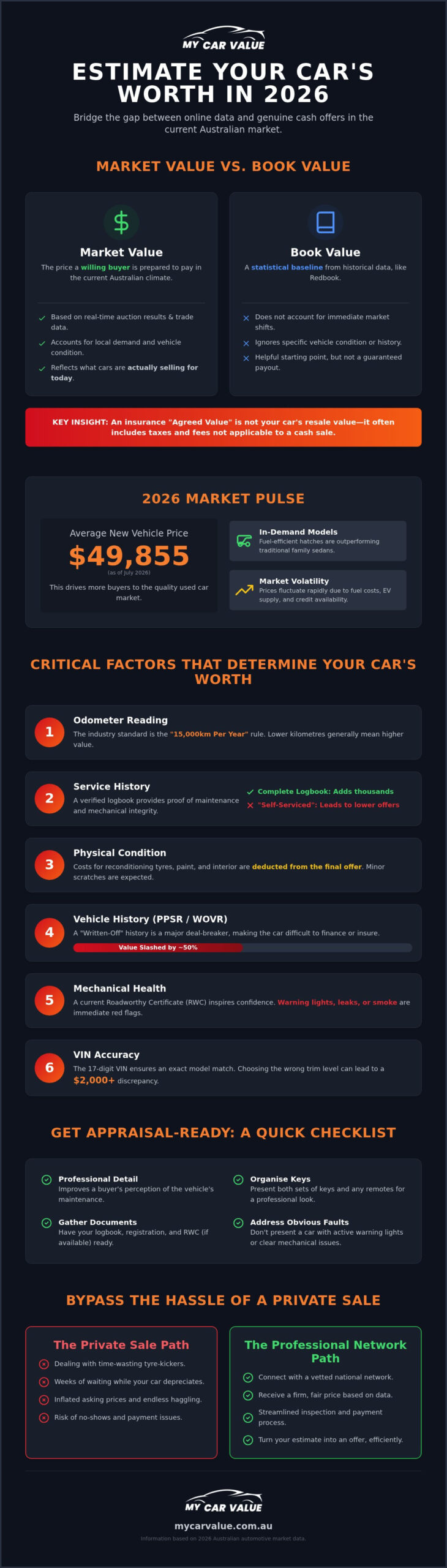
Market value isn’t a fixed number found in a manual. It’s the price a willing buyer is prepared to pay in the current Australian climate. While you might use a tool to estimate car worth, the result is often a range rather than a single figure. This differs significantly from “Book Value,” typically sourced from providers like Redbook. Book value serves as a statistical baseline based on historical data; it doesn’t account for immediate spikes in local demand or the specific condition of your vehicle.
Understanding the vehicle valuation process also requires distinguishing between resale worth and “Agreed Value.” Insurance companies use agreed value to set a coverage limit. This figure often includes taxes and fees that don’t apply to a standard cash sale. Consequently, an insurance statement is rarely an accurate reflection of what you’ll receive in a trade-in. Online estimates are helpful starting points, but they remain a basis for negotiation rather than a guaranteed payout.
The Difference Between Asking Price and Realised Value
Private classifieds are often filled with inflated asking prices that don’t reflect actual transactions. Sellers frequently list cars at a premium to leave room for haggling. Professional buyers ignore these outliers. They rely on real-time auction results and trade data to see what vehicles are actually selling for today. Chasing a high private price also carries a hidden cost: the tyre-kicker factor. You might spend weeks waiting for a buyer who never shows up, while your car’s value continues to depreciate. Professional valuations cut through this noise by focusing on realised sales data.
Why 2026 Market Trends Affect Your Estimate
Current demand has shifted. In 2026, fuel-efficient hatches are outperforming traditional family sedans in the second-hand market. As the average transaction price for new vehicles reached $49,855 in July 2026, more Australians are turning to the used market for affordability. This increased competition for quality used stock can inflate your estimate car worth if you own a desirable, late-model vehicle. Conversely, as 2027 models arrive, older stock faces downward pressure on MSRP and resale value.
Market Volatility in the 2026 Australian automotive sector is defined as the rapid fluctuation in vehicle prices caused by shifting fuel costs, new EV supply chains, and changing consumer credit availability.
Critical Factors That Determine Your Car’s Worth
Your odometer reading remains the primary indicator of wear in the Australian market. Professional appraisers still rely on the “15,000km per year” rule to determine if a vehicle is overworked or under-utilised. If you want to accurately estimate car worth, you must also look at the logbook. A complete service history from a licenced mechanic adds thousands to a valuation. In contrast, “self-serviced” vehicles lack the professional paper trail needed to verify mechanical integrity, often leading to lower offers.
Physical condition and background checks are equally vital. Minor scratches are expected, but the cost of reconditioning tyres, paint, and interior leather will be deducted from your final price. More importantly, your PPSR and WOVR status can be a deal-breaker. A vehicle with a “written-off” history typically sees its estimate slashed by 50% or more, as it becomes nearly impossible to finance or insure for a new owner. While many Online Estimators provide a baseline, these specific local variables dictate the final cash offer.
Mechanical Health and Interior Presentation
A current roadworthy certificate (RWC) provides immediate confidence to any buyer. It proves the car is legally fit for the road and removes the risk of hidden repair costs. Presentation also plays a massive psychological role. Spending money on a professional detail can significantly improve a buyer’s appraisal of the vehicle’s maintenance. Avoid presenting a car with obvious deal-breakers like oil leaks, smoking exhausts, or warning lights on the dash, as these signal deep-seated neglect.
The Role of Vehicle Identification Numbers (VIN)
Accuracy starts with decoding your vehicle identification number. This 17-digit code is the only way to ensure an exact model variant match. Choosing the wrong trim level—such as a base model instead of a high-spec luxury edition—can lead to a $2,000 discrepancy in your estimate car worth. Professional tools use the VIN to verify factory-fitted options like sunroofs or premium sound systems, which hold more value than aftermarket additions that might actually detract from the car’s appeal.
If you are ready to move beyond a guess, use a tool designed to Value My Car based on these critical real-world factors.
Professional Valuers vs Online Estimators: Which is More Accurate?
Speed defines the digital age. A vehicle market value calculator provides an instant figure in seconds. It’s efficient. It strips away the initial stress of wondering where to start. However, an algorithm lacks eyes. It cannot see the small dent in the rear quarter panel or the pristine condition of the interior leather. To accurately estimate car worth, you must recognise that these automated tools often provide a “safe” range. They skew lower to protect the potential buyer from overpaying for a vehicle that might have hidden issues.
A computer treats every 2021 Toyota HiLux with 60,000km the same. A professional valuer does not. They see the value in a well-maintained ute that has clearly spent its life on the bitumen rather than being thrashed on a mine site. They recognise the “human element” of care that an algorithm simply misses. This makes using an Australian-specific tool vital. Global valuation models don’t account for our unique local demand for 4x4s or the specific premium placed on certain fuel-efficient models in the current market.
When to Use a Free Car Valuation Calculator
Free calculators are ideal for initial research. They help you set realistic expectations for a trade-in or private sale. If you own a standard, high-volume model, these tools are remarkably effective. They do struggle with rare models or vehicles with heavy aftermarket modifications. Always value your vehicle online before visiting a buying centre. It gives you a data-backed baseline so you don’t walk into a negotiation blind.
The Advantage of Professional Used Car Buyers
Digital estimates are just numbers on a screen. Professional used car buyers provide the certainty of a real transaction. They bridge the gap between a vague “price range” and a confirmed bank transfer. By leveraging a national network, these professionals can find a buyer who specifically wants your niche vehicle. This ensures your final price reflects real-world demand rather than just a database average. It turns an estimate into a concrete result with minimal friction.
How to Organise Your Vehicle to Maximise an Appraisal
Most online tools provide a broad price range. Reaching the top end of that estimate car worth requires deliberate preparation. A professional buyer looks for reasons to deduct value; your goal is to remove those obstacles before the inspection begins. Start by fixing small, visible defects. A cracked tail-light or a broken plastic trim piece might only cost $50 to replace, but an appraiser will often deduct triple that amount for the “inconvenience” of fixing it themselves. These small fixes offer the highest return on investment for any seller.
Next, gather all physical hardware associated with the vehicle. Locating the spare key and the original remote is essential. Many modern vehicles require coded keys that cost over $400 to replace. If you only provide one key, expect a direct reduction in your offer. Finally, address your PPSR status. Ensure any existing finance is either cleared or that you have a formal payout letter ready. A buyer cannot finalise a deal while a financier holds an interest in the car.
Documentation and History Verification
Transparency builds trust. Organise your receipts for major recent repairs like timing belts, new tyres, or transmission services. These documents prove you haven’t neglected the car’s mechanical health. Use a car service history check to ensure your records are up to date and easily accessible for the buyer. Double-check that the VIN and engine numbers on the vehicle match your registration papers exactly to avoid delays during the final inspection.
The “First Impression” Checklist
A clean car suggests a cared-for car. Remove all personal items, rubbish, and child seats to help the buyer envision the vehicle as part of their showroom stock. While a full detail is helpful, don’t over-clean the engine bay. A sparkling clean engine can sometimes look suspicious, suggesting you’re trying to hide an active oil leak. Aim for “honest and tidy” instead. Check your tyre tread depth and ensure all dashboard warning lights are addressed. If a sensor is triggered, fix it now; otherwise, the buyer will assume the worst-case mechanical scenario.
Turning Your Estimate into an Offer with My Car Value
A digital estimate car worth is a powerful starting point, but it doesn’t pay the bills. The My Car Value platform bridges the gap between raw data and a cleared bank transfer. We’ve simplified the transition from “curious” to “sold” by removing the traditional friction points of the automotive industry. Instead of listing your car and waiting for calls, you submit your details and connect with a vetted network of professional Australian buyers. This system ensures you receive an offer based on real-world demand rather than a theoretical average.
Transparency is the foundation of our process. When both the seller and the purchaser see the same data, trust follows. You won’t face the stress of being low-balled or dealing with aggressive negotiation tactics. Our professional buyers provide immediate liquidity, a critical factor that private classifieds simply cannot offer. This speed allows you to settle existing finance, pay off rego, or put a deposit on your next vehicle without delay.
The Streamlined Connection Process
Many sellers consider car auction alternatives because they want a faster result than a private sale. Our platform handles the heavy lifting by identifying reputable buyers who are actively looking for your specific make and model. After you receive your initial estimate car worth, the next step is a real-world appraisal. This is a fast, methodical verification of the car’s condition. Once the professional inspection is complete, you receive a firm offer. There is no guesswork. There are no tyre-kickers.
National Reach, Local Expertise
We operate a national network that understands the specific nuances of the Australian market. Sellers in major hubs like Sydney, Melbourne, and Brisbane benefit from a competitive environment where multiple professional buyers vie for quality stock. This reach ensures that even if your vehicle is a niche model, we can find the right buyer for it. Our expertise in local 2026 market trends means your valuation reflects current demand in your specific region.
Stop guessing what your vehicle is worth. Submit your details today for a real-world appraisal and experience the relief of a streamlined, professional sale. Value My Car today and turn your estimate into a firm cash offer.
Secure Your Best Market Price Today
Accurately determining your car’s value in 2026 requires looking beyond generic book prices. You’ve learned that market value is driven by immediate local demand and the specific condition of your vehicle. By organising your service history, gathering all spare keys, and addressing minor defects, you position yourself at the top end of any valuation range. Moving from a digital estimate to a firm offer doesn’t have to be a source of stress or uncertainty. This guide has shown that preparation and the right data are your best tools for a successful sale.
When you use a trusted platform to estimate car worth, you bypass the frustration of tyre-kickers and inconsistent pricing. You gain access to a professional Australian network that values transparency and speed. This methodical approach ensures you receive a fair price based on real-time data and professional valuations. You can finally skip the private sale stress and focus on your next vehicle purchase instead. It’s a modernised way to handle a traditional task with total clarity.
Take the guesswork out of your next vehicle sale and move forward with the confidence of a professional.
Frequently Asked Questions
How is car worth estimated in Australia?
Car worth is estimated by analysing real-time market data, historical sales, and the specific condition of your vehicle. Factors include the make, model, and year, along with the odometer reading and service history. In the Australian market, demand for specific body types, like SUVs or 4x4s, also influences the final figure. Professional platforms use these variables to bridge the gap between digital estimates and real-world cash offers from professional buyers.
Is Redbook value the same as market value?
No, Redbook value is a statistical baseline based on historical data, while market value is the price a willing buyer pays in the current climate. Redbook provides a helpful guide for insurance or finance purposes, but it cannot account for immediate local demand or your car’s unique presentation. To accurately estimate car worth, you must look at current realised sales data rather than relying solely on theoretical book figures.
Does a PPSR check affect how much my car is worth?
A PPSR check directly impacts your car’s value by revealing its financial and accident history. If a vehicle is listed on the Written-Off Vehicle Register (WOVR), its worth can drop by 50% or more. Similarly, unresolved finance must be settled before a sale can proceed. Professional buyers always conduct these checks to ensure transparency and to verify that the vehicle is fit for resale in the Australian market.
Can I get a car valuation if I still have finance owing?
You can certainly get a valuation while finance is still owing on your vehicle. You will need to obtain a formal payout letter from your financier to show the exact amount required to clear the debt. Professional buyers often handle the payout process directly with your lender as part of the transaction. This ensures the title is cleared and the remaining balance is paid to you as equity.
Why is my trade-in offer lower than the online estimate?
Trade-in offers are often lower because dealers must account for reconditioning costs and their own profit margin. Online tools provide a generic estimate car worth based on data, but a physical inspection might reveal issues like worn tyres or paint chips. Additionally, automated calculators often use a “safe” lower range to protect buyers from unforeseen mechanical problems that only a professional appraisal can identify.
How much does a professional car valuation cost?
The cost of a professional car valuation depends on its purpose. Formal appraisals for insurance, legal matters, or classic cars typically range from $650 to over $1,500. However, if you are looking to sell, many digital platforms offer free market estimates to help you understand your vehicle’s current worth. These tools are designed to provide immediate clarity and connect you with professional buyers without the need for an expensive field appraisal.
What documents do I need to get an accurate car worth estimate?
To receive an accurate estimate, you should provide your registration papers, a complete service logbook, and any receipts for recent major repairs. You will also need your Vehicle Identification Number (VIN) to ensure the correct model variant is identified. If the car has existing finance, have your payout letter ready. Providing these documents upfront ensures transparency and helps professional buyers offer a firm price rather than a broad range.
How long is a car valuation quote valid for?
Most car valuation quotes are valid for seven days. The automotive market is highly volatile, with prices fluctuating based on supply, demand, and new model releases. If you wait longer than a week, you may need to refresh your estimate car worth to reflect the most current data. Acting quickly on a fair offer helps you avoid further depreciation and ensures a streamlined transition from an estimate to a sale.