

Paperwork to Sell a Car in Australia: The Complete 2026 Seller’s Checklist
A folder full of the right documents is more than just a legal requirement; it’s a value-multiplier that proves your car’s worth and protects you from future liability. Many sellers dread the administrative side of a sale, fearing they’ll miss a state-specific roadworthy rule or remain on the hook for the buyer’s future speeding fines. It’s a valid concern, especially with the 2026 shift toward fully digital transfer systems across different jurisdictions. You want a clean break and the best possible price without the stress of chasing missing signatures or dealing with post-sale legal headaches.
We understand that navigating the paperwork to sell a car australiawide can feel like a minefield of conflicting regulations. This checklist provides everything you need to master the documentation process, from PPSR reports to state-specific notices of disposal. We’ll show you exactly how to organise your records to justify a higher price and explain how professional used car buyers can streamline the entire transfer for you. Before you start gathering forms, the smartest first step is to use a “Value My Car” service to establish your market baseline. This guide ensures your ownership transfer is fast, legal, and completely stress-free.
Key Takeaways
- Understand why correct documentation is your best defence against post-sale fines and legal disputes, ensuring a clean break once the keys are handed over.
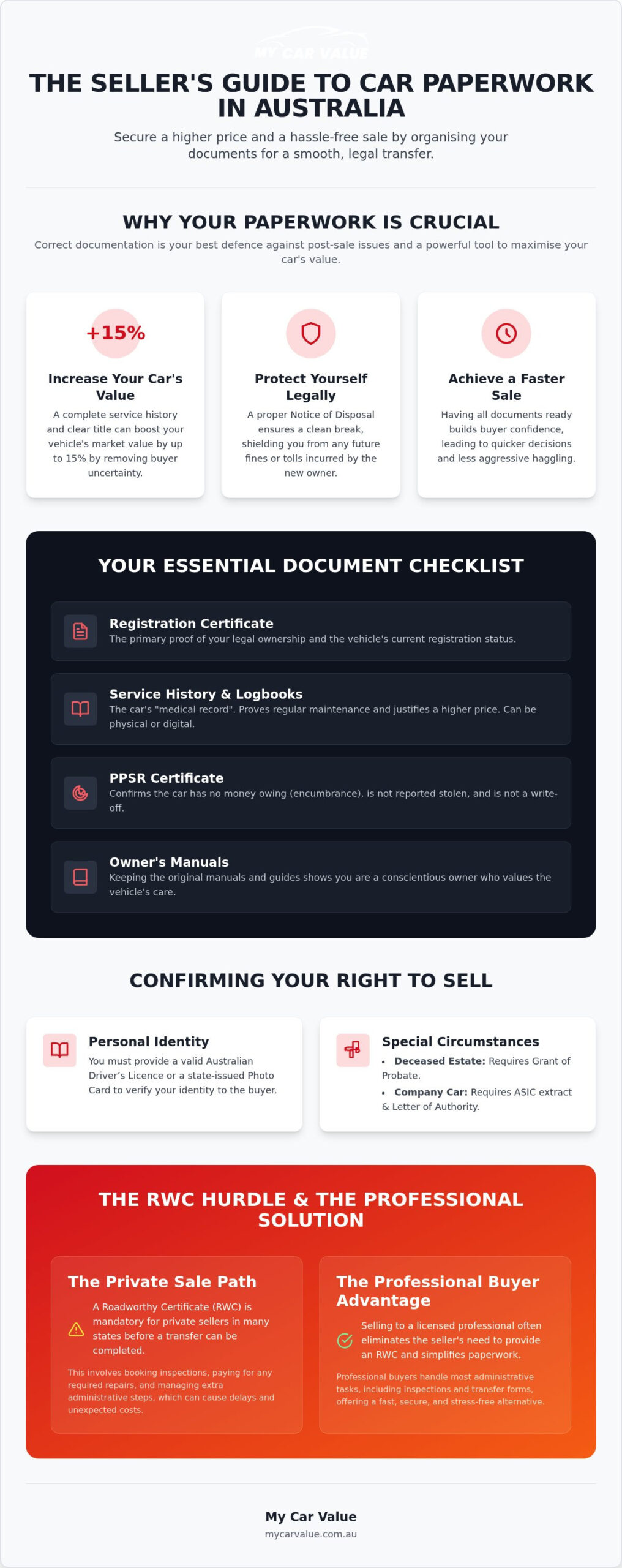
- Learn how to organise the essential paperwork to sell a car australiawide to potentially boost your vehicle’s market value by up to 15%.
- Identify which states mandate a Roadworthy Certificate (RWC) before a private sale can proceed and where inspections are optional.
- Master the process of selling a car under finance, including how to coordinate payout letters with your bank for a seamless ownership transfer.
- Discover how connecting with professional used car buyers can eliminate the need for roadworthy inspections and most of the administrative heavy lifting.
Why Getting Your Paperwork Right is Crucial for Your Sale
Preparing the correct paperwork to sell a car australiawide is your primary insurance policy against post-sale complications. It serves two vital functions: facilitating a legal transfer of ownership and shielding you from future liability. Without a formal paper trail, you risk being held responsible for traffic infringements, parking fines, or motorway tolls incurred by the new owner. A “clean sale” ensures a definitive break between your ownership and the buyer’s responsibility.
Documentation also acts as a direct value-multiplier. Organised records can increase your vehicle’s market value by up to 15% compared to a car with missing history. Professional used car buyers prioritise vehicles with clear administrative trails because it reduces their processing time and risk. By having everything ready, you eliminate the threat of “buyer’s remorse” or legal disputes that often arise when details about the car’s history are vague or undocumented.
Most buyers will verify your claims by searching the Personal Property Securities Register (PPSR). This register tracks whether a vehicle has money owing on it or if it has been written off. Proactively providing this information, along with your service logs, proves you’re a transparent seller. This transparency is the most effective way to justify a premium price and secure a fast, reliable transaction.
Proof of Ownership and Identity
You must demonstrate a legal right to sell the vehicle before any money changes hands. A current registration certificate is the standard proof of ownership. You’ll also need a valid Australian Driver’s Licence or state-issued Photo Card to verify your identity to the buyer. If you’re selling a vehicle from a deceased estate, you’ll need to provide the Grant of Probate. For cars registered under a company name, ensure you have a current ASIC extract and a formal letter of authority on company letterhead to prove you’re authorised to sign the transfer forms.
Maximising Value Through Documentation
A thorough paper trail justifies a higher “Value My Car” estimate by removing the “fear of the unknown” for the purchaser. When a buyer sees every receipt, logbook stamp, and repair invoice, they feel confident that the car has been maintained to a high standard. This psychological assurance often leads to a quicker agreement on price without aggressive haggling. In the 2026 used car market, complete transparency serves as the primary currency for building buyer confidence and accelerating a sale.
The Essential Documents Every Australian Seller Needs
Gathering the necessary paperwork to sell a car australiawide is the first step toward a successful transaction. While many sellers focus solely on the physical condition of the car, the documentation often carries equal weight in a buyer’s mind. Four primary documents form the foundation of any successful sale in 2026. These records prove you have maintained the vehicle and possess the legal authority to transfer it.
- Registration Certificate: This is your primary proof of current vehicle status. It confirms the car is registered in your name and shows the expiry date.
- Service History and Logbooks: This acts as the car’s medical record. A stamped logbook proves you haven’t skipped essential maintenance intervals.
- Owner’s Manuals: While seemingly minor, original manuals signal a conscientious owner who values the vehicle’s long-term care.
- PPSR Certificate: This document confirms the car has no “encumbrance” or money owing, is not reported stolen, and has no written-off status.
Organising these documents before you list the car prevents delays. It also helps you achieve a better Value My Car outcome by providing immediate answers to buyer questions. If you are missing any of these items, you should take steps to replace them before the first viewing.
The Role of the Logbook in 2026
Digital service records are now the standard across Australia. Most modern manufacturers have transitioned away from physical books to cloud-based maintenance logs. If your physical logbook is missing, contact the dealerships or mechanics where the car was serviced. They can provide a digital history printout or a summary of all work completed. Distinguishing between a “full service history” and “partial records” is vital. A full history proves the car met every manufacturer requirement on time. Partial records suggest gaps in care, which often results in a lower valuation due to perceived mechanical risk.
Interpreting Your PPSR Report
Smart sellers run their own PPSR check before the first viewing. This report is your best defence against claims of hidden history. Pay close attention to the Vehicle Identification Number (VIN) and Chassis number. You must ensure the numbers on your paperwork to sell a car australiawide match the physical plates on the vehicle exactly. Discrepancies here are a major red flag. Professional Used Car Buyers will always verify these details; having a clean, matching report ready accelerates the process and proves you are a reliable seller.
Navigating State-Specific Requirements: RWC and Inspections
Navigating the paperwork to sell a car australiawide requires understanding that every state operates its own registry with unique rules. While core documents like proof of ownership remain constant, the requirement for mechanical inspections varies significantly across borders. Failing to provide the correct certificate can stall a sale or lead to registration being cancelled by the state authority. Before you spend money on inspections, use a “Value My Car” service to ensure the vehicle’s market price justifies any required repairs.
The most critical administrative step for any seller is lodging a Notice of Disposal or a Notice of Change of Ownership. Submit this immediately after the keys are handed over. This document tells the state authority you are no longer responsible for the vehicle. Without it, you remain legally liable for any speeding fines or toll charges the new owner racks up before they complete the transfer. Most states now allow you to lodge this online for free through their respective transport portals.
When is a Roadworthy Certificate Mandatory?
In Victoria and Queensland, a Roadworthy Certificate (RWC) or Safety Certificate is mandatory for most private sales of registered vehicles. In Queensland, the government-set fee for this inspection is $102.70 as of July 2026. The validity periods for these documents are strict. A Victorian RWC is valid for 30 days, while a Queensland Safety Certificate lasts for two months or 2,000 kilometres, whichever comes first. In New South Wales, a “Pink Slip” is required for vehicles more than five years old. If you are selling an unregistered or interstate vehicle in NSW, you will need a more comprehensive “Blue Slip” inspection.
- VIC: Mandatory for private sales; 30-day validity.
- QLD: Mandatory for private sales; 2-month or 2,000km validity.
- NSW: Pink Slip for cars over 5 years; Blue Slip for interstate transfers.
- WA, SA, TAS, ACT: Generally not required for registered private sales.
Transfer of Registration Forms
The shift toward digital transfers has simplified the process. Portals like myVicRoads, Service NSW, and DoTDirect in Western Australia allow both parties to complete the transfer on their smartphones. If you are using paper forms, ensure you fill out the Vehicle Plate Number, VIN, and Odometer reading accurately. Common mistakes that lead to rejected transfers include mismatched sale dates or signatures that don’t match the registry’s records. Always take a photo of the completed and signed form before handing it to the buyer. This provides a digital backup if the buyer fails to lodge their side of the paperwork to sell a car australia within the required 14-day window.
Managing Finance, PPSR Checks, and Sales Receipts
Managing the financial paperwork to sell a car australiawide involves more than just checking your bank balance. If your vehicle is “encumbered,” it means a lender has a registered interest in the asset. You cannot legally transfer clear title to a buyer until the loan is settled in full. This process requires precise coordination between you, your bank, and the purchaser to ensure the security interest is removed from the national register.
Start by requesting an official payout letter from your finance provider. This document states the exact amount required to close the account and remains valid for a set period, usually seven to ten days. Providing this to a buyer builds immediate trust. It shows exactly how much of their payment must go to the bank to release the security interest. If you are taking a deposit to hold the car during this phase, always issue a formal receipt that specifies if the amount is refundable.
Dealing with Outstanding Car Loans
The most efficient way to handle a financed vehicle is through professional used car buyers. These experts understand the mechanics of a “Three-Way” transaction. They settle the outstanding balance directly with your lender and pay you the remaining equity in one seamless move. This eliminates the risk of you accidentally breaching your loan contract or mishandling the payout. Selling an encumbered car without disclosing the finance to a private buyer is a serious legal risk that can lead to the sale being voided or potential fraud charges.
Creating a Legally Binding Bill of Sale
A formal Bill of Sale is your primary protection in a private deal. Even though many states now offer digital transfers, a physical or digital receipt signed by both parties is essential for your records. This document should clearly state the vehicle’s VIN, engine number, final sale price, and the exact odometer reading at the time of handover. It acts as the final proof of the date and time responsibility shifted to the buyer.
Include an “As Is, Where Is” clause in your receipt. This phrase clarifies that the buyer has inspected the vehicle and accepts its current condition, which helps protect you from future mechanical claims. Ensure both parties sign two copies so you can keep one for your files. You must retain this copy for at least five years. This provides a permanent record of the transaction if you ever need to dispute a late fine or an insurance claim involving the vehicle’s past ownership.
Simplifying the Admin: Selling to Professional Buyers
Managing the paperwork to sell a car australiawide often feels like a full-time job. Between coordinating roadworthy inspections and verifying finance payouts, private sellers can spend weeks stuck in administrative limbo. Professional buyers offer a streamlined alternative by assuming the majority of these responsibilities. Because these buyers are licensed motor dealers, they possess the authority to process ownership transfers instantly, often bypassing the friction points that stall private transactions.
One of the most significant advantages is the “One-Stop” transfer process. In many Australian states, selling to a licensed dealer removes the immediate requirement for the seller to provide a Roadworthy Certificate (RWC). Dealers typically purchase vehicles in their current condition and handle the necessary safety inspections and repairs themselves. This single shift can save you hundreds of dollars in mechanical fees and days of logistical hassle.
The Professional Buyer Advantage
Professional buyers are experts at navigating complex legal hurdles like PPSR encumbrances and remaining finance. They work directly with your lender to settle outstanding balances, ensuring the paperwork to sell a car australiawide is completed correctly the first time. This expertise translates to speed; most transactions move from an initial valuation to a confirmed sale within 24 hours. You also eliminate the “tyre-kicker” factor, as you deal only with verified professionals rather than unvetted individuals from private classified sites.
- Instant Payouts: Funds are typically cleared via Osko or bank transfer as soon as the paperwork is signed.
- No RWC Required: Save time and money by selling the vehicle in its current state to a licensed professional.
- Liability Protection: Dealers ensure the Notice of Disposal is processed immediately, protecting you from future fines.
Your First Step: Getting an Accurate Valuation
Before you begin gathering physical documents, you must establish a realistic market baseline. Use a vehicle market value calculator to understand your car’s worth in the current 2026 market. Having an accurate, data-driven figure allows you to negotiate with confidence and ensures you don’t undersell your asset. Once you have your quote, prepare your digital registration details and service history to facilitate a fast, online offer.
When the deal is finalised, ensure you hand over the keys, the logbooks, and the current registration papers. Keep your signed Bill of Sale and a confirmation of the lodged Notice of Disposal for your permanent records. This ensures a clean break and total peace of mind.
Ready to skip the stress? Value My Car now and connect with professional buyers today.
Finalise Your Sale with Confidence
Mastering the paperwork to sell a car australiawide ensures you walk away from the deal with total peace of mind. Organising your service logs and PPSR reports early justifies a higher price and proves your vehicle’s history to potential buyers. Always lodge your Notice of Disposal immediately after the handover to stop future fines or tolls from appearing in your name. While private sales involve significant administrative effort, connecting with a professional buyer network strips away the complexity. These experts handle the ownership transfers and settle any remaining finance on your behalf.
Take the first step by securing an instant, data-driven valuation that reflects the current 2026 market. You’ve done the hard work of maintaining your vehicle; now make the final transfer as seamless and stress-free as possible.
Frequently Asked Questions
Do I need a Roadworthy Certificate (RWC) to sell my car in Australia?
It depends on your state’s specific laws. In Victoria and Queensland, a valid Roadworthy Certificate or Safety Certificate is mandatory for most private sales of registered vehicles. New South Wales requires a “Pink Slip” for cars older than five years. Other jurisdictions, such as Western Australia and South Australia, generally don’t require an inspection for a private sale. Check your local transport authority’s 2026 guidelines to ensure you have the correct paperwork to sell a car australiawide.
Can I sell a car that still has money owing on a loan?
You can sell a car with an active loan, but the finance must be settled to transfer a clear title. The most efficient way is to coordinate a payout letter from your lender. Professional used car buyers often simplify this by paying the bank directly and giving you the remaining equity. This “three-way” transaction ensures the security interest is removed from the PPSR correctly and protects you from legal liability regarding encumbered assets.
What paperwork do I need to give a buyer for a private car sale?
You should provide the buyer with the current registration certificate, a complete service history, and a signed Bill of Sale. Include the vehicle’s VIN, engine number, final price, and the exact odometer reading. Providing a recent PPSR report is also recommended to prove the car isn’t stolen or written off. Always keep a copy of every document for your own records to verify the transaction date if any disputes arise later.
How do I notify the government that I have sold my car?
Lodge a Notice of Disposal or Notice of Change of Ownership through your state’s transport portal immediately after the sale. Use services like myVicRoads, Service NSW, or DoTDirect to complete this process online. This is the most critical step for the seller. It ensures you aren’t held responsible for any speeding fines, parking infringements, or motorway tolls the new owner might incur before they officially transfer the registration into their name.
Is a handwritten receipt enough when selling a car privately?
A handwritten receipt is legally binding, but it must contain specific details to protect you. Ensure it includes the date, sale price, VIN, odometer reading, and the buyer’s full name and signature. You should also include an “As Is, Where Is” clause. This clarifies that the buyer accepts the vehicle’s current condition. While digital forms are becoming the standard in 2026, a well-documented physical receipt remains a vital piece of paperwork to sell a car australiawide.
What happens to my insurance and rego when I sell the vehicle?
Registration usually stays with the vehicle and transfers to the new owner, though you should check specific rules if selling interstate. Your comprehensive or third-party insurance does not transfer automatically. Contact your insurer to cancel your policy or move it to a new vehicle as soon as the sale is finalised. You may be eligible for a pro-rata refund on your premium if you have several months of coverage remaining on the policy.
Do I need to provide a PPSR report to the buyer?
You aren’t legally required to provide a PPSR report, but doing so builds significant trust with buyers. A clean report proves your car has no money owing, no stolen status, and hasn’t been written off. If you don’t provide one, most savvy buyers will run their own check via the official government website for a $2.00 fee. Proactively showing this document can justify a higher sale price by removing any doubts about the car’s history.
What documents are required when selling a car to a professional buyer or dealer?
Selling to a dealer or professional used car buyer requires less effort than a private sale. You typically only need your current registration certificate, a valid Australian Driver’s Licence, and the vehicle’s service logbooks. If there is still money owing on the car, you must also provide a current payout letter from your finance provider. These professionals usually handle the Notice of Disposal and registration transfer paperwork on your behalf, significantly reducing the administrative burden.