
Decoding Vehicle Identification Number: The Ultimate Australian Guide (2026)
What if a single character in your car’s serial number could be the difference between a fair deal and a $5,000 loss? Your 17-digit VIN is not just a random sequence; it is a digital fingerprint that holds the key to its entire history and true market value. Most Australian drivers find these long strings of numbers and letters confusing. Many even fear accidentally buying a vehicle with a hidden “written-off” history. By mastering the process of decoding vehicle identification number strings, you can remove that uncertainty. It’s frustrating to wonder if your car is the specific model variant you think it is, especially when you are trying to organise a sale.
This guide will show you exactly how to read your car’s VIN in 2026. You’ll learn to verify engine specs, confirm build dates, and protect yourself from costly mistakes. We’ll break down each character section and explain how to use this data to secure a more accurate valuation. By the end of this article, you’ll have the confidence to use VIN data like a professional. This ensures you get the best possible outcome when it’s time to sell your car and provides total transparency for any potential buyer.
Key Takeaways
- Master the process of decoding vehicle identification number sequences to verify your car’s build date, engine specs, and manufacturer origin.
- Locate your 17-digit VIN in seconds by checking the lower passenger-side windscreen or the driver’s side B-pillar compliance plate.
- Avoid common transcription errors by learning which specific characters are never used in a standard Australian VIN.
- Identify how a verified VIN uncovers hidden features and premium factory packs that can boost the professional offer you receive for your car.
- Use your decoded data to streamline the valuation process and secure a transparent price from professional used car buyers.
What is a Vehicle Identification Number (VIN)?
Every car on Australian roads carries a unique fingerprint. This 17-character string is the Vehicle Identification Number (VIN). It functions as the vehicle’s DNA. It contains specific data about its origin, engine type, and production sequence. Unlike a number plate that changes when you move states or buy a custom plate, the VIN stays with the car for its entire life. It is the single most important identifier for any motorised vehicle.
In Australia, the transition to the standardised 17-digit format occurred in 1989. Before this change, manufacturers used various chassis number formats that were often difficult to track across state lines. The modern system ensures that every digit is critical for maintaining an accurate car history. It allows insurance companies, registration authorities, and manufacturers to identify the exact vehicle for safety recalls. For example, the massive Takata airbag recall relied entirely on VIN data to notify affected Australian owners quickly and accurately.
The Difference Between a VIN and a Chassis Number
You might hear Australian rego authorities use these terms interchangeably, but they aren’t always the same. Older Australian vehicles, particularly those built before 1989, often have shorter chassis numbers. These lack the global standardisation of a modern VIN. The shift to 17 digits improved vehicle security significantly. It made it much harder for thieves to “re-birth” stolen cars because the coded information is deeply integrated into the car’s build data. If your car was built after 1989, it definitely has a 17-digit VIN recorded on its compliance plate.
Why Decoding is Essential for Australian Sellers
If you are planning to sell your vehicle, decoding vehicle identification number strings is a vital step in your preparation. It protects you against identity fraud and “car cloning.” This is where criminals use a legitimate VIN on a stolen car to hide its true identity. Professional buyers use this data to ensure your car service history check matches the physical vehicle sitting in your driveway. It provides a layer of security that protects both the seller and the buyer.
Accuracy matters for your bank balance. A decoded VIN confirms the exact trim level and optional factory extras that might not be obvious to the naked eye. Whether it’s a specific performance pack or a luxury interior upgrade, decoding vehicle identification number data ensures these features are included in your final valuation. It turns a “standard” car into a high-value asset by proving its authentic specifications to a buyer. This transparency builds trust and speeds up the entire sale process.
The Anatomy of a 17-Digit VIN
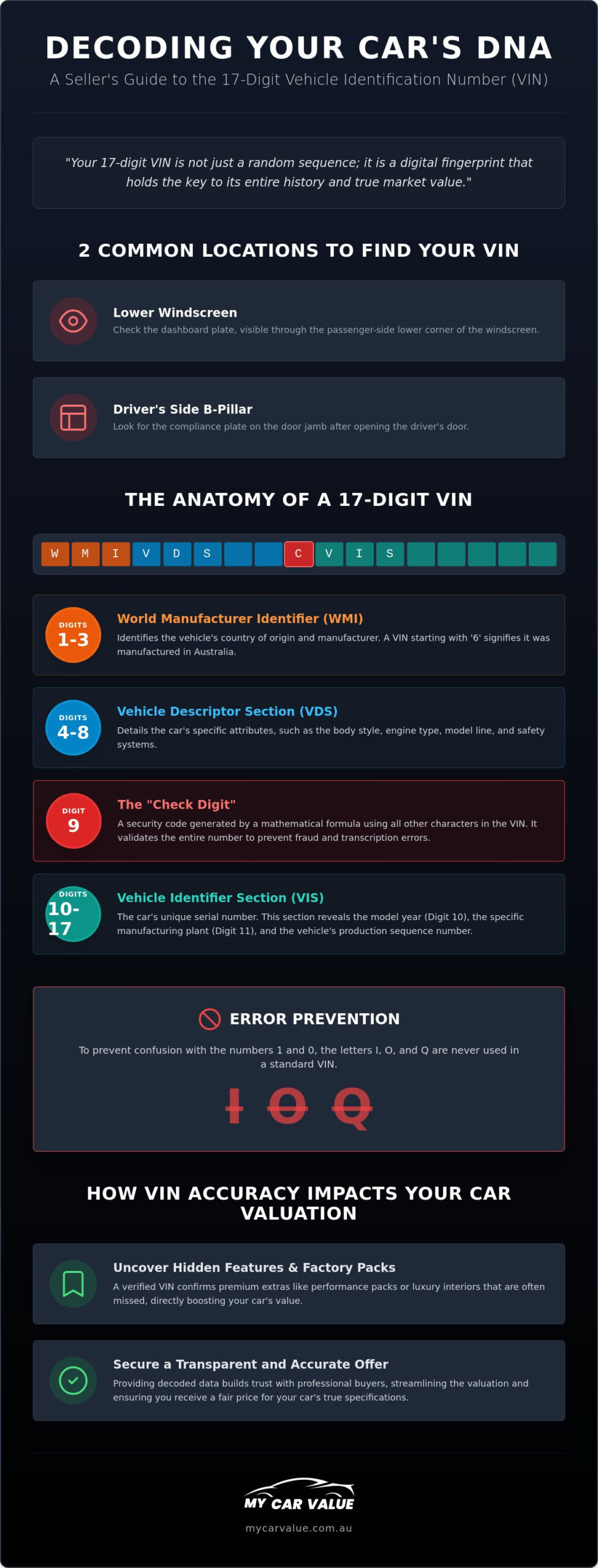
A 17-digit VIN follows a strict international standard. It is not a random sequence of numbers. Each character holds a specific meaning that tells the story of the car’s creation. When you start decoding vehicle identification number strings, you will notice that the letters I, O, and Q are never used. This is a deliberate safety measure to prevent confusion with the numbers 1 and 0. This level of clarity is essential for registration and insurance accuracy across all Australian states.
The 9th character serves a unique purpose as the “Check Digit.” It uses a complex mathematical formula to validate the entire string. If even one number is transcribed incorrectly, the check digit will fail. This prevents data entry errors during the registration process. This structured approach allows you to get an accurate valuation by ensuring the vehicle data is legitimate from the very first step.
World Manufacturer Identifier (WMI): Digits 1-3
The first three digits identify the origin of your car. Digit 1 represents the geographic region. For example, a VIN starting with 6 indicates the vehicle was manufactured in Australia. Digits 2 and 3 pinpoint the specific manufacturer, such as Toyota, Ford, or Mazda. Manufacturers producing fewer than 500 vehicles per year may share a WMI. In these cases, the 12th, 13th, and 14th digits are used to further identify the specific builder. This ensures that even low-volume custom builds remain traceable.
Vehicle Descriptor and Identifier Sections: Digits 4-17
The Vehicle Descriptor Section (VDS) covers digits 4 through 8. These characters reveal the body style, engine type, and braking systems. This is where decoding vehicle identification number data becomes highly practical. It allows you to confirm if a car has the specific performance engine or safety features advertised by a seller. You can verify the “DNA” of the car without relying on a verbal description.
Digit 10 identifies the Model Year. In Australia, this is often different from the physical build year. A car built in November 2025 might be classified as a 2026 model year. Understanding this distinction is vital for resale value. The final seven digits (11-17) form the Vehicle Identifier Section (VIS). This is the unique serial number for that specific unit. It often includes factory codes to show which assembly line it rolled off.
For imported cars or older vehicles that pre-date the 1989 standard, you might encounter a “Surrogate VIN.” The Department of Infrastructure issues these when a standard 17-digit code is missing. If you are looking at a Japanese import, the original chassis number is often replaced by one of these local identifiers to allow for Australian registration. Always verify these against the physical stamps on the vehicle to ensure full transparency during a sale.
How to Locate and Decode Your VIN in Australia
Locating your VIN is the first practical step toward decoding vehicle identification number data. In Australia, manufacturers place this 17-digit code in several accessible areas. Start by looking at the lower passenger side of the windscreen. On most modern cars, the VIN is visible through a small transparent window in the glass. If it is not there, open the driver’s door and inspect the “B-pillar.” This is the vertical strut where the door latches. You will usually find a metal compliance plate or a durable sticker containing the VIN, build date, and Gross Vehicle Mass.
If the exterior locations are obscured, pop the bonnet. Check the firewall, which is the metal partition between the engine bay and the cabin. The VIN is often stamped directly into the metal here or on the suspension tower. For a digital backup, always refer to your official state registration papers or your insurance policy. These documents must match the physical VIN on the car. Any discrepancy between your rego papers and the vehicle’s stamped number is a major red flag that requires immediate investigation.
Where to Find the VIN on Different Vehicle Types
Finding a VIN on a motorcycle or trailer requires a different approach. For bikes, check the head stem near the handlebars or the frame rails under the seat. Australian trailers and caravans typically have the VIN stamped on the drawbar or a dedicated plate on the main chassis rail. If you are dealing with a used car and the main plates are missing, check “hidden” locations. These include the floor pan under the driver’s seat, inside the spare tyre well, or even tucked within the rear wheel arches. If a VIN plate is damaged or painted over, you may need to contact your state transport authority to organise a surrogate identifier.
Using NEVDIS to Verify Australian Data
Once you have located the number, the next step in decoding vehicle identification number sequences involves the National Exchange of Vehicle and Driver Information System (NEVDIS). This central database links your VIN to critical records across all Australian jurisdictions. It tracks whether a vehicle is currently stolen or has been written off by an insurer. Since July 2021, the Register of Approved Vehicles (RAV) has largely replaced physical compliance plates for new models, making online verification even more essential.
We recommend performing a Personal Property Securities Register (PPSR) check before you finalise any valuation or sale. The official Australian Government PPSR check costs just $2.00 and provides a basic data result. This report confirms if there is any outstanding finance on the car. It uses the NEVDIS data to provide a transparent history of the vehicle. This step ensures that the specifications you decoded match the legal status of the car on the national register.
How VIN Accuracy Impacts Your Car Valuation
Professional used car buyers require a 17-digit VIN before they can provide a firm, legally binding offer. Without it, they are essentially guessing. By decoding vehicle identification number data, buyers can verify exactly what they are purchasing. This transparency removes the “risk premium” often applied to cars with uncertain histories. If you want an accurate figure, ensure your vehicle market value calculator results are based on the specific data found in your VIN rather than just a generic make and model description.
Accuracy matters because the VIN reveals “hidden” value. It identifies rare engine codes or premium factory packs that might not be obvious during a quick visual inspection. For example, two cars might look identical on the outside, but the VIN could reveal that one has a more desirable performance transmission or an upgraded safety suite. Proving these features are factory-fitted increases buyer confidence and protects your final payout from being low-balled.
Validating Model Variants and Luxury Packs
The price gap between a “Base” model and a “Sport” or “Luxury” variant can be thousands of dollars. Many Australian sellers lose money by falling into the “generic model” trap. They list their car under a basic trim level because they aren’t sure of the exact factory designation. Decoding vehicle identification number characters allows you to prove your car has specific safety features, tech upgrades, or premium interior packs. Proving these features are authentic prevents buyers from treating your car as a standard model, ensuring you get every dollar your specific variant is worth.
The WOVR Check: Protecting Your Sale
A “Dirty” VIN can slash a vehicle’s value instantly. This refers to cars listed on the Written-Off Vehicle Register (WOVR). In Australia, there is a massive difference between a “statutory” and “repairable” write-off. A statutory write-off can never be registered again and is only good for parts. A repairable write-off has been fixed and cleared for road use, but it still carries a significantly lower market value.
Professional used car buyers always run a history check as part of their standard workflow. Being transparent about this history from the start helps build trust. If your decoded VIN shows a clean history, it acts as a certificate of health for your car’s value. If there is a history, knowing the details allows you to set a realistic price and avoid a deal falling through at the last minute.
Ready to see what your verified specs are worth? Value my car now to get a professional assessment based on your unique VIN data.
Ready to Sell? Use Your VIN to Get a Professional Offer
Mastering the process of decoding vehicle identification number strings is more than a technical exercise. It is the fastest way to transition from a car owner to a car seller. In the 2026 digital-first market, your VIN allows for instant data retrieval. This means professional buyers don’t need to ask a hundred questions. They see the factory specs, the safety rating, and the origin immediately. This speed turns a weeks-long ordeal into a streamlined transaction. It moves you from uncertainty to a concrete financial outcome in record time.
Moving from decoding to selling takes three simple steps. First, locate your 17-digit code as described in the previous sections. Second, enter this number into a professional valuation tool. Third, receive a firm offer based on the verified data. The My Car Value network prioritises verified VIN data because it removes the guesswork. When a buyer knows exactly what they are bidding on, they can offer a more competitive price. We facilitate these connections across every Australian state. This ensures you can sell with confidence whether you are in a metro centre or a regional town.
Skip the Private Sale Stress
A verified VIN eliminates the typical frustrations of the private market. You won’t need to deal with endless “is this still available” messages or “tyre kickers” who don’t understand your car’s value. By providing a clear, decoded history, you give professional buyers the certainty they need to make a top-dollar offer. Professionals value their time as much as you do. They look for the specific engine codes and luxury packs that your VIN proves are authentic. This efficiency ensures you avoid the “generic model” trap that often leads to lower offers in private classifieds. It is a pragmatist’s approach to a traditionally stressful task.
Get Your Accurate Market Valuation Today
To get started, simply prepare your 17-digit VIN and your current odometer reading. These two pieces of data are the foundation of an accurate quote. Whether you are looking to sell your car in Sydney or need a professional offer in Melbourne, our process remains seamless and consistent. We handle the heavy lifting by matching your vehicle’s DNA with buyers who want exactly what you have. Once you have secured your offer, make sure you understand how to transfer car registration in NSW to complete the handover correctly and avoid costly late fees.
Take the first step toward a hassle-free sale by using your decoding vehicle identification number data to secure a real-world valuation today. It is the smartest way to ensure you get a fair price without the traditional stress of the second-hand market. Let the data do the talking and enjoy the relief of a transparent, data-driven sale. Your car’s unique 17-digit code is the key to unlocking its true market value right now.
Maximise Your Car’s Value with Data-Driven Transparency
Your 17-digit VIN is more than just a serial number. It is the most powerful tool you have for protecting your car’s market value. By mastering the process of decoding vehicle identification number data, you ensure that every factory extra and premium feature is accounted for during a sale. You now know how to locate this unique identifier and why verifying it against national records is essential for a transparent transaction.
Don’t leave your final payout to chance or rely on generic model descriptions that lead to lower offers. My Car Value provides fast, transparent, and data-driven valuations. We are trusted by thousands of Australian sellers and provide access to a national network of professional buyers who value verified data. This streamlined approach removes the stress of private sales and ensures you get a fair price based on your car’s authentic DNA.
Take the final step toward a successful sale today. Get a Professional Valuation for Your Car Now and move forward with total confidence. It is the smartest way to turn your vehicle’s history into a competitive financial offer.
Frequently Asked Questions
Can I decode a VIN for a car made before 1981?
Standardised 17-digit strings were not mandatory globally until 1981. For Australian vehicles, the shift to this format occurred in 1989. Cars built before these dates use shorter, non-standardised chassis numbers. You cannot use modern decoding vehicle identification number tools for these older models. Instead, you must refer to manufacturer-specific records or heritage certificates to verify their original specifications.
Why does my Australian VIN start with the number 6?
The number 6 is the international region code for Oceania. Every vehicle manufactured in Australia starts with this digit. The second character then identifies the specific country within that region. For example, a VIN starting with 6F indicates the car was built in Australia. This allows global authorities and buyers to track the geographic origin of any vehicle instantly.
Is it safe to share my VIN with a potential buyer or valuation site?
It is safe and necessary to share your VIN with legitimate valuation sites and serious buyers. The VIN is already visible to the public through the windscreen. Professional buyers need it to verify the car’s history and specs. However, don’t provide photos of your registration papers or driver’s licence to unverified private enquirers. This protects you from potential identity theft while still allowing for a transparent sale.
What should I do if the VIN on the car doesn’t match the rego papers?
A mismatch between the physical VIN and your registration papers is a serious issue. Stop any potential sale immediately. Contact your state transport authority, such as VicRoads or Transport for NSW, to resolve the discrepancy. It might be a simple clerical error from a previous transfer. It could also indicate a more serious problem like vehicle cloning or a stolen status. If you are selling in New South Wales, understanding the correct process to transfer car registration in NSW will help you navigate these administrative steps with confidence.
Can a VIN tell me the exact date my car was built?
No, the 17-digit VIN does not usually show the exact day or month of production. The 10th character identifies the model year, which often differs from the build date. To find the exact production date, check the physical compliance plate on the door pillar or under the bonnet. Dealers can also retrieve the specific “birth date” by decoding vehicle identification number serial sequences in their private databases.
Does the VIN show the colour or interior trim of the car?
The 17-digit string itself does not contain specific codes for paint or upholstery. However, the final seven digits, known as the VIS, act as a serial number that links to the manufacturer’s build sheet. When a dealer or professional buyer enters your VIN into their system, they see the exact factory colour and trim options. This ensures your valuation reflects any premium interior upgrades or custom paint finishes.
What is a “Surrogate VIN” and do I need one?
A surrogate VIN is a unique identifier issued by Australian transport authorities. You need one if your vehicle’s original VIN is missing, damaged, or was never issued. This is common with some grey imports. These numbers often start with “AUD” or a state-specific prefix. Without a valid surrogate VIN, you won’t be able to register the vehicle or secure a professional market valuation.
How do I check if a VIN has a financial interest (money owing) against it?
You must perform a Personal Property Securities Register (PPSR) check to see if money is owing on a car. The official government check costs $2.00 and requires your VIN. This report will show any “registered security interests” held by banks or finance companies. Never purchase or sell a vehicle without confirming it is free of debt, as the debt stays with the car, not the previous owner.