
Commercial Van Valuation Australia: The 2026 Seller’s Guide
Your work van is worth more than the odometer suggests, but most dealers will still try to price it like a standard passenger car. You’ve invested in custom shelving, refrigeration, or specialised fit-outs to make your vehicle a functional asset. It’s frustrating when trade-in offers ignore these additions and treat your high-utility tool as just another high-kilometre liability. You deserve a price that reflects the actual work your vehicle is capable of performing, rather than a generic book value.
Securing an accurate commercial van valuation australia wide doesn’t have to involve endless private enquiries or insulting offers. This 2026 guide provides a clear path to valuing your vehicle correctly and connecting with professional buyers who specialise in commercial stock. You’ll learn how to document your fit-outs for maximum impact and navigate the sale process with minimal downtime for your business. We cover everything from current market shifts to the specific data points that professional buyers prioritise when making an offer. Follow these steps to turn your workhorse into a fair return without the stress of a private listing.
Key Takeaways
- Understand why business utility and payload capacity drive value differently than standard passenger car metrics.
- Learn how to secure a precise commercial van valuation australia by documenting engine hours and maintaining a comprehensive service history.
- Identify the limitations of statistical book values and how to leverage current market demand for a higher price.
- Maximise your offer by performing a ‘commercial clean’ and organising essential PPSR and repair documentation before your assessment.
- Eliminate business downtime by connecting directly with professional buyers who understand the specific worth of specialised fit-outs.
What Defines Commercial Van Valuation in Australia?
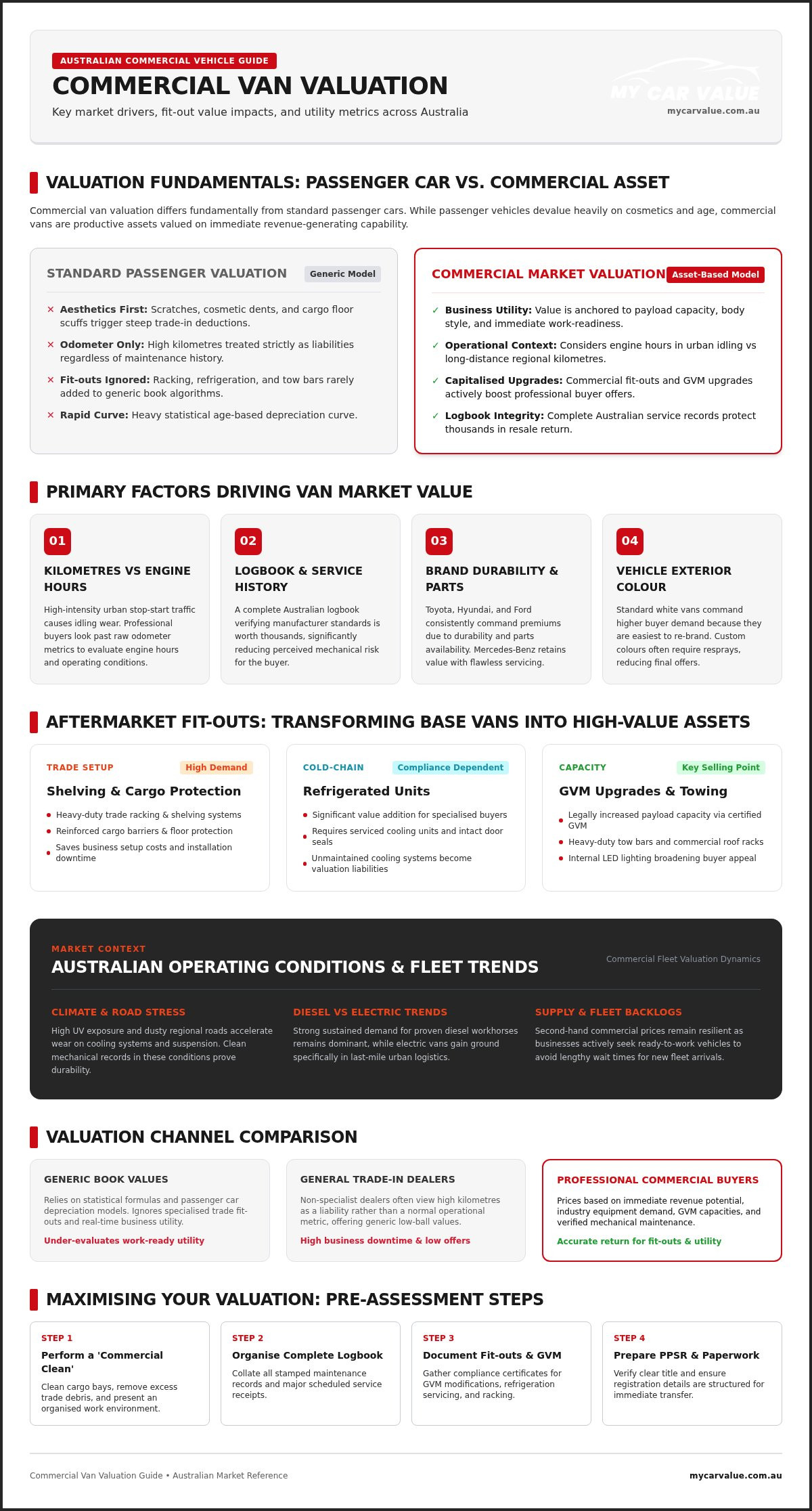
Commercial van valuation in Australia differs fundamentally from standard passenger vehicle assessments. While a family car is valued on comfort features and modern tech, a van is a productive asset. Its worth is tied to utility, payload capacity, and immediate business readiness. A vehicle that can start a delivery shift or a trade job tomorrow holds a premium over one requiring repairs. Understanding commercial van classifications helps clarify how different body styles and weight ratings influence these professional assessments.
Work vans follow a unique depreciation curve. While a family SUV might lose value rapidly based on age, a well-maintained van can retain significant worth due to its earning potential. However, the Australian climate plays a major role in long-term value. Constant exposure to high UV levels and dusty regional roads can accelerate wear on cooling systems and suspension. A vehicle that has survived these conditions with a clean mechanical record proves its durability to buyers who know the local terrain.
General dealers often provide low-ball trade-in offers because they don’t specialise in commercial inventory. They view high kilometres as a liability rather than a standard operational metric. In contrast, professional buyer market value reflects the vehicle’s capacity to generate revenue. This is why a precise commercial van valuation australia depends on finding a buyer who understands the specific demands of your industry rather than a generic algorithm.
Utility vs. Aesthetics in the Commercial Market
In the commercial sector, a minor dent or a scratched cargo floor rarely devalues a vehicle significantly. Buyers prioritise a pristine logbook over perfect paintwork. A van with a complete service history suggests reliability and minimal future downtime. Fit-for-purpose features like heavy-duty shelving or reinforced flooring often add more value than cosmetic upgrades. Different industries also view value through different lenses. A courier needs high internal volume, while a plumber looks for racking and security features.
Understanding the 2026 Australian Van Market
The 2026 landscape shows a strong preference for proven diesel workhorses, though electric van options are gaining ground for last-mile urban logistics. Recent supply chain shifts have kept second-hand prices resilient as businesses avoid long wait times for new fleet arrivals. Market value in the commercial context is the price a professional buyer is willing to pay for a vehicle’s immediate revenue-generating potential. Professional buyers now look beyond the odometer to assess how a van has been used and maintained for its specific task.
Factors That Drive Your Van’s Market Value
Determining a fair commercial van valuation australia involves looking beyond the odometer. While kilometres are the standard metric, professional buyers also scrutinise engine hours. A delivery van idling in city traffic for hours might have more mechanical wear than a regional courier with higher kilometres. Engine hours offer a more accurate reading for vehicles used in high-intensity urban environments. If your van has spent its life in stop-start traffic, be prepared to discuss its maintenance schedule to offset the perceived wear.
A complete Australian logbook is essential. It proves the vehicle has been maintained to manufacturer standards. This documentation is worth thousands at the point of sale because it reduces risk for the buyer. Reliability also follows brand lines. Toyota, Hyundai, and Ford vans consistently command higher prices due to their reputation for durability and the availability of spare parts. Brands like Mercedes-Benz also hold value well, provided the service history is impeccable. Colour matters too. Standard white vans are easier for new owners to re-brand. Custom colours often require a respray, which can lower your final offer significantly in a competitive market.
The Value of Aftermarket Fit-outs
Professional buyers value fit-outs that save a business time and setup costs. Quality shelving, racking, and cargo barriers turn a base vehicle into a functional workspace. If you have specialised refrigeration equipment, ensure it has been serviced regularly and the seals are in good condition. Cold-chain units add significant value to the right buyer. However, they can become a liability if the cooling system is poorly maintained or lacks recent compliance checks. Small additions like heavy-duty tow bars, roof racks, and internal LED lighting also broaden your buyer pool, making the sale faster and more profitable.
Payload and Towing Capacities
Gross Vehicle Mass (GVM) upgrades are a major selling point for trade buyers. If you have legally increased your van’s payload capacity, highlight this during your assessment. It allows the next owner to carry more equipment without legal or safety risks. Be transparent about your towing history. Heavy-duty usage impacts the transmission, cooling, and braking systems over time. Verifying these specs helps establish a realistic market price. You can check your van’s value to see how these specific factors influence your model’s worth in today’s market.
Comparing Valuation Methods: Redbook vs. Real-World Offers
Redbook serves as a vital statistical baseline for Australian finance and insurance providers. It uses historical sales data to predict what a vehicle should be worth under normal conditions. However, a book value is not a commitment to buy. It’s a theoretical figure that often fails to capture the immediate urgency of the used van market. When you need a commercial van valuation australia, relying solely on static data can leave money on the table.
Real-world offers are driven by current supply and demand. If a specific model is in short supply in 2026, professional buyers will often pay well above the “book” price to secure stock. Digital facilitators bridge this gap by connecting sellers with multiple professional insights simultaneously. This approach uses real-time auction results and industry demand metrics rather than outdated spreadsheets. It turns a static estimate into a dynamic, actionable price.
Why Statistical Data Isn’t a Cash Offer
Automated valuation tools often create a “Value Gap” because they can’t see the specific condition of your vehicle or the quality of your fit-outs. These calculators provide a helpful starting point, but they remain averages. In 2026, market volatility means that prices for diesel and electric vans can shift within weeks based on new tax incentives or fuel price changes. You can use this Vehicle Market Value Calculator to establish your baseline, but remember that a real offer requires a professional eyes-on assessment to be accurate.
The Professional Buyer Advantage
Professional buyers assess commercial assets with a different logic than traditional dealerships. A dealer might see a high-kilometre van as a wholesale risk, whereas a specialised buyer sees a reliable workhorse ready for its next contract. This understanding leads to more competitive offers and a significantly faster transaction. While private sales can drag on for months, our network of Used Car Buyers focuses on speed. They move from valuation to cash in bank quickly, allowing you to upgrade your fleet without missing a single day of work. This efficiency is the cornerstone of a modernised, data-driven sale process.
Preparing Your Van for a Professional Valuation
Preparation is the final hurdle in securing a competitive commercial van valuation australia wide. A professional buyer sees a clean, well-documented vehicle as a lower risk. This translates directly into a firmer, higher offer. While a work van isn’t expected to be showroom-perfect, presenting it as a ready-to-work asset is essential. Start by gathering every piece of evidence that proves your maintenance history.
Documentation and History
Paperwork is your strongest leverage during a valuation. Ensure your logbooks are up to date and physically present in the glovebox. You should also compile a folder of recent repair receipts to show that major components like timing belts or clutches have been addressed. Verifying your VIN and Chassis number allows for an accurate PPSR report, which confirms the vehicle has no financial encumbrances. Reviewing a Car Service History Check can help you identify any gaps in your records before the buyer does. Be transparent about the vehicle’s status on the Written-Off Vehicles Register (WOVR). A prior history of repairable damage will affect the price; hiding it will likely kill the deal entirely.
The Final Presentation
The “Commercial Clean” is more intensive than a standard car wash. You must remove all company decals and signage. Use a heat gun or professional adhesive remover to avoid “ghosting,” where the sun has faded the paint around your old stickers. Inside the cargo area, clear out all old stock, debris, and mounting hardware. A buyer needs to see the condition of the floor and shelving clearly. Ensure the registration is current; professional buyers cannot legally test drive an unregistered vehicle on public roads. This small detail prevents a major delay in the sale process.
GST management is a critical step for business sellers. If you are an ABN holder and the van was used for business purposes, you must declare if your asking price includes GST. This clarity ensures the tax invoice is handled correctly and prevents disputes during the final payment. Mechanical transparency is equally vital. If there is a known oil leak or a worn suspension bush, mention it upfront. Building trust early in the process leads to a smoother transaction and faster payment.
How to Sell Your Van Fast with My Car Value
Selling a work vehicle shouldn’t feel like a second job. My Car Value acts as the heavy lifter, connecting you with professional buyers who understand the specific utility of your van. Our platform follows a methodical three-step process: Value, Connect, and Sell. This structure removes the guesswork and the typical friction found in traditional sales channels. By providing a transparent commercial van valuation australia wide, we empower business owners to make informed decisions without the usual stress. You don’t need to be a market expert to get a fair price; you just need the right connection.
Transparency is the core of our facilitator service. We don’t just provide a generic number; we provide a gateway to a national network of professional buyers. These buyers are looking for specific commercial assets and are prepared to pay for quality. This system ensures that your van’s unique features, from specialised refrigeration units to custom racking, are properly assessed by someone who understands their worth. The process is designed to be fast, impartial, and focused on results.
Moving Beyond the Private Classifieds
Private listings often lead to a cycle of low-ball offers and time-wasting weekend viewings. These “tyre-kickers” rarely understand the value of commercial fit-outs and often lack the funds for an immediate purchase. Professional buyers operate differently. They value speed and reliability just as much as you do. While a standard dealership might offer a low trade-in price to protect their margins, specialised buyers are often more competitive because they have a direct need for your specific model. You can learn more about this in our Sell My Car guide, which explores the most efficient ways to offload a vehicle in the 2026 market.
Your Next Steps to a Fair Valuation
Getting started is straightforward. Use our “Value My Car” tool to get an instant market pulse. This initial estimate provides a data-driven baseline based on current Australian market trends. To attract the best professional offers, be as detailed as possible about your vehicle’s condition and aftermarket additions. The more information you provide, the faster our network can work for you. Don’t let your van sit idle while its value depreciates. Take the first step toward a transparent, professional transaction and secure a competitive price with minimal downtime for your business.
Maximise Your Return in the 2026 Market
Navigating the Australian used market in 2026 requires a sharp focus on your vehicle’s revenue-generating potential. You’ve learned that a successful commercial van valuation australia depends on more than just the odometer; it’s about fit-out quality, engine hours, and a pristine service history. By preparing your documentation and addressing the GST requirements for ABN holders, you position your asset as a low-risk, high-utility tool for the next owner.
Moving beyond the limitations of statistical book values allows you to tap into real-world demand from professional buyers who value business readiness. This approach ensures a fast, transparent transaction that keeps your business moving without the downtime of private listings. Our national network ensures you receive competitive offers based on current auction data and industry needs.
Take the guesswork out of your next fleet upgrade. You’ve done the hard work maintaining your vehicle, so ensure you secure the financial return your workhorse deserves.
Frequently Asked Questions
How does GST affect my commercial van valuation?
GST applies if you sell a van registered under an ABN. You must declare whether your asking price is GST-inclusive. Professional buyers require a valid tax invoice to process the transaction correctly. This transparency ensures you understand the net return after your tax obligations are met. Failing to account for GST early in the process can lead to disputes and delays during the final payment stage.
Do aftermarket fit-outs like shelving add value to my van?
High-quality fit-outs such as shelving, racking, and cargo barriers add tangible value. These features turn a base vehicle into a functional business asset, saving the next owner thousands in setup costs. To secure a precise commercial van valuation australia, document all specialised equipment, including refrigeration units and power inverters. Professional buyers prioritise vehicles that are ready for immediate work, making these additions a strong selling point in the used market.
Is Redbook value accurate for high-kilometre work vans?
Redbook serves as a statistical baseline but often misses the nuances of the commercial sector. For high-kilometre workhorses, the mechanical condition and service history are far more influential than a generic odometer reading. Professional buyers rely on real-time auction data and current supply levels to formulate their offers. This data-driven approach often results in a more competitive price than a theoretical book value derived from standard passenger car trends.
What documents do I need to sell a business-registered van in Australia?
Selling a business-registered vehicle requires specific documentation to ensure a legal transfer. You must provide the current registration certificate, a complete service history, and a valid tax invoice if you are an ABN holder. Additionally, include proof of identity and any receipts for recent mechanical repairs. Having these documents organised before your valuation speeds up the process and builds trust with professional buyers across the country.
Can I sell a van that still has a company wrap or decals on it?
You can sell a van with decals, but it often reduces the final offer. Buyers must factor in the labour and time required to strip the signage and polish the paintwork. Removing company wraps yourself presents the vehicle as a neutral asset ready for its next brand. This preparation prevents “ghosting” effects on the exterior and suggests the vehicle has been professionally maintained throughout its business life.
How much does a PPSR check impact the final offer from a professional buyer?
A PPSR check is a critical component of any professional valuation. If the report reveals an outstanding security interest or a history on the Written-Off Vehicles Register, it will heavily impact the buyer’s risk assessment. Most professional buyers won’t proceed with a purchase until any financial encumbrances are cleared. Proactively checking your PPSR status ensures there are no surprises that could derail your sale or lead to a lower offer.
Why is my trade-in offer so much lower than the online valuation?
Trade-in offers are typically lower because dealerships factor in their own overheads, including reconditioning, storage, and profit margins. Online valuations often reflect private sale prices, which don’t account for the speed and security of a professional transaction. Using a digital facilitator connects you with buyers who specialise in commercial stock. These professionals understand the utility of your van and can often offer more than a general dealer trade-in.
What is the most popular commercial van for resale value in Australia in 2026?
The Toyota HiAce and Hyundai Staria-Load remain the benchmarks for resale value in 2026 due to their proven durability. Ford Transit models also perform well, especially those with high GVM ratings and specialised fit-outs. While electric options are emerging in urban environments, diesel workhorses still command a premium in the used market. Buyers prioritise brands with extensive Australian service networks and a steady supply of affordable spare parts.