

Red Book Valuation: The 2026 Guide to What Your Car is Really Worth
Your Red Book valuation is a benchmark, not a bank cheque. Many Australian drivers assume a digital estimate is a guaranteed price, yet the 2026 market often tells a different story. It is common to feel overwhelmed by conflicting data or the fear that a dealer might underpay for your vehicle. You want a straightforward process that respects your time and provides a fair market price without the typical stress of selling. We agree that transparency should be the standard, not the exception, when you are ready to move on to your next car.
This guide explains exactly how a red book valuation functions in today’s environment and how to turn that data into a concrete cash offer. You will discover the difference between trade-in, private, and retail prices so you can negotiate with total confidence. We will also outline how our Value My Car service simplifies this process by connecting you with professional used car buyers. Expect a logical breakdown of how to move from a screen estimate to a real-world result. You deserve a selling experience that is fast, accurate, and entirely transparent.
Key Takeaways
- Learn why a red book valuation serves as the industry-standard baseline for insurers and dealers rather than a guaranteed sale price.
- Understand the critical variables, including specific vehicle variants and 2026 kilometre averages, that dictate your car’s data-driven estimate.
- Discover how to bridge the gap between historical data and real-time market value by accounting for the typical three to six month data lag.
- Prepare your vehicle for sale by organising logbooks and conducting a PPSR check to prove clear title and maximise your final return.
- Transition from a static estimate to a concrete cash offer by connecting with professional used car buyers through a streamlined digital platform.
Understanding Red Book Valuation in the Australian Market
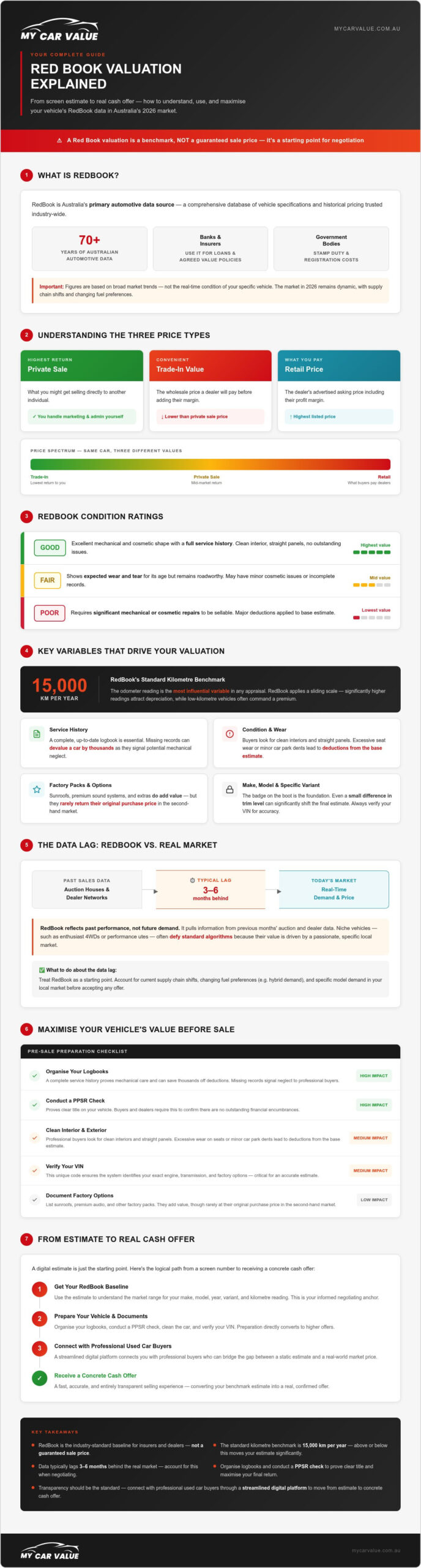
RedBook is the primary data source for the Australian automotive industry. It provides a comprehensive database of vehicle specifications and historical pricing that spans decades. When you search for a red book valuation, you are accessing a benchmark used by professionals nationwide. Dealers, financiers, and insurance companies rely on this data to establish a consistent starting point for negotiations and policy settings. It’s vital to remember that these figures are based on broad market trends rather than the specific, real-time condition of your individual vehicle.
The Authority of RedBook Data
RedBook has tracked Australian automotive trends for over 70 years. This longevity makes it the preferred tool for banks and insurance providers. When you apply for a car loan or set an ‘Agreed Value’ on your insurance policy, the provider typically references this dataset to mitigate risk. It’s also a standard reference for government bodies when calculating stamp duty and registration costs. Similar to how international markets use vehicle valuation guides to stabilise trade, RedBook provides the necessary structure for the local Australian market.
Decoding the Price Ranges
RedBook categorises values based on three main condition levels: Good, Fair, and Poor. These rankings help sellers understand where their car sits compared to others of the same age.
- Good: The vehicle is in excellent mechanical and cosmetic shape with a full service history.
- Fair: The car shows expected wear and tear for its age but remains roadworthy.
- Poor: The vehicle requires significant mechanical or cosmetic repairs to be sellable.
You’ll also see a ‘Private Sale’ price and a ‘Trade-in Price Guide’. The Private Sale figure reflects what you might get selling to another individual. This is usually higher because you are doing the marketing and administrative work yourself. Trade-in Value is the wholesale price a dealer is willing to pay before adding their margin.
In 2026, the Australian market remains dynamic. Supply chain shifts and changing fuel preferences mean that a static red book valuation is merely a starting point. While the data is robust, it cannot always capture a sudden surge in demand for a specific model this week. Sellers must treat these numbers as a guide, not a final offer.
How RedBook Estimates are Calculated in 2026
Calculating a vehicle’s worth requires a deep dive into specific data points. A red book valuation isn’t a random guess; it’s the result of a complex formula that starts with the ‘badge on the boot’. The make, model, year, and specific variant are the primary building blocks. Even a small difference in trim level can significantly shift the final estimate. In the 2026 market, these details are more critical than ever as buyers look for specific features like hybrid drivetrains or advanced safety tech.
Data Points That Drive the Number
The odometer reading is perhaps the most influential variable in any appraisal. RedBook uses a standard benchmark of 15,000 kilometres per year to determine an ‘average’ usage level. If your 2026 reading is significantly higher, the algorithm applies a sliding scale of depreciation. Conversely, low-kilometre vehicles often command a premium. Beyond the dash, several other factors move the needle:
- Service History: A complete, up-to-date logbook is essential. Missing records can devalue a car by thousands because they signal potential mechanical neglect.
- Condition and Wear: Professional buyers look for ‘clean’ interiors and straight panels. Excessive wear on seats or minor car park dents will lead to deductions from the base estimate.
- Factory Packs: Optional extras like sunroofs or premium sound systems do add value, but they rarely return their original purchase price in the second-hand market.
The Algorithm vs. The Forecourt
It’s important to understand that RedBook operates as an aggregator of historical sales data. It pulls information from auction houses and dealer networks to see what similar cars sold for in previous months. This means the numbers reflect past performance rather than future demand. Niche vehicles, such as enthusiast 4WDs or performance utes, often defy these standard algorithms because their value is driven by a passionate, specific local market. To ensure your data is as accurate as possible, always verify your VIN. This unique code ensures the system identifies your exact engine, transmission, and factory options. If you are curious about how these factors influence your specific vehicle, you can Value My Car to get a clearer picture of its current standing.
RedBook vs. Market Value: Closing the Gap
Market value represents the actual amount a buyer is prepared to pay for your vehicle in the current week. While a red book valuation provides a reliable historical baseline, market value is a moving target influenced by national supply and demand. The primary reason for the discrepancy is the ‘Lag Factor’. RedBook data often reflects sales trends from three to six months ago. In a fast-moving 2026 economy, this delay can create a gap between your expectations and reality. To get a precise reading on current trends, you can use a Vehicle Market Value Calculator to see how today’s conditions affect your car’s worth.
Aesthetics and local demand also play a significant role. A white or silver SUV typically sells faster and for a higher price than a bright yellow one. This occurs even when both vehicles share the same red book valuation. Buyers in the second-hand market often prioritise neutral colours and popular configurations. These preferences can push the market value well above the static estimate found in a digital guide.
Why Your Quote Might Differ from Dealer Offers
If you take your car to a dealership, the offer you receive will almost certainly be lower than the private sale guide. Dealers must account for reconditioning costs, detailing, and their own profit margins. They also consider their current inventory. If a dealer already has three identical models on the lot, their offer will drop to avoid overstocking. Additionally, private selling carries a ‘Tyre Kicker’ tax. You might list at the RedBook price, but individual buyers will often haggle aggressively. This leads to a lower final result than you anticipated.
Real-Time Demand in 2026
Resale volatility for electric vehicles (EVs) is a major factor in 2026. Rapid technological advancements and shifts in government incentives mean that EV values can fluctuate significantly month-to-month. Traditional data models sometimes struggle to keep pace with these changes. Similarly, sudden spikes in fuel prices can drive a surge in demand for hybrids and small hatchbacks. Large petrol-hungry 4WDs may see their market value dip during these periods. Understanding these real-time shifts is the key to timing your sale for the best possible return.
How to Maximise Your Vehicle’s Value Before Sale
A red book valuation provides the baseline, but your preparation determines the final figure. Moving from a data estimate to a successful transaction requires more than just a clean dashboard. In the 2026 Australian market, professional buyers look for transparency and proof of maintenance. If you want to secure the top end of your price guide, you must treat your car as a business asset that needs to be presented at its absolute best.
Documentation and Transparency
A clear PPSR report is the most effective tool for a fast sale. It confirms the vehicle is clear of debt, has no write-off history, and isn’t on the stolen vehicle register. Providing this report to a buyer removes friction and builds immediate trust. You should also gather every piece of relevant paperwork. This includes your original purchase receipt, spare keys, and all service invoices. Proving a ‘one owner’ status is particularly valuable, as it implies a consistent history of care that professional buyers find highly attractive.
Your logbook is your vehicle’s resume. Missing stamps suggest neglect, which leads to lower offers. Review our Car Service History Check to ensure your records are in order before the appraisal. If you have minor mechanical issues, decide whether to fix them or disclose them. Generally, fixing visible issues like a cracked tail light or a worn set of tyres provides a better return on investment than accepting a large deduction during the negotiation.
Physical Presentation Tips
The psychological impact of ‘kerb appeal’ cannot be ignored. A professional detail makes a car look and feel younger than its odometer suggests. This creates an emotional sense of value that data points cannot replicate. While a red book valuation accounts for the car’s age and model, it cannot factor in the pristine condition of a well-kept interior. Professional buyers often follow specific patterns during an inspection:
- The Bonnet and Boot Rule: Buyers check the engine bay for signs of oil leaks and the boot for structural integrity or missing spare tyres. Clean these areas thoroughly to signal the car has been well-maintained.
- Bodywork: Address small dents and scratches where the cost of repair is lower than the potential price drop.
- Electronic Health: Ensure the infotainment system, parking sensors, and safety cameras are all functioning perfectly. A single faulty sensor can trigger a warning light that significantly devalues the car during a professional appraisal.
Beyond Estimates: Connecting with Professional Used Car Buyers
A red book valuation is a solid foundation, but it is ultimately a theoretical number. To convert that data into liquid cash, you must engage with the actual market. Professional used car buyers represent the most logical choice for sellers who prioritise speed and security. Choosing this path provides the ‘Relief Factor’ of skipping unreliable private inquiries or low-ball trade-in offers. We act as your savvy intermediary, taking the data from your initial estimate and turning it into a concrete connection with a buyer who understands your vehicle’s true worth.
The traditional route of private classifieds is increasingly fraught with friction. You often face weeks of ‘tyre kickers’ and failed appointments. Our Sell My Car Guide outlines why this legacy system is failing modern Australian sellers. Instead of waiting for the right person to browse an ad, you can leverage a professional network that values efficiency as much as you do. This approach ensures you aren’t left guessing if a buyer will actually show up or if their finance will be approved.
The My Car Value Process
Our platform is a reliable tool that does the heavy lifting for you. It simplifies a complex process into a few logical steps. Follow this sequence to move from inquiry to offer:
- Step 1: Use our digital platform to generate an accurate valuation based on your specific vehicle data and 2026 market trends.
- Step 2: We instantly connect you with our vetted network of industry professionals who are actively looking for stock.
- Step 3: Review your offers and secure a competitive price without the stress of public listings or dealer negotiations.
Why Professional Buyers Win in 2026
The 2026 automotive market demands speed and accuracy. Professional buyers provide immediate settlement and guaranteed payment. This removes the risk of a personal cheque bouncing or a private buyer’s finance falling through at the last minute. In many professional purchase cases, you can bypass the need for a roadworthy certificate (RWC) or intensive detailing. This saves you hundreds of dollars and several days of administrative hassle. It is a pragmatic approach that values your time and provides immediate clarity on your car’s exit price.
Secure Your True Market Price Today
A red book valuation provides a reliable industry benchmark, but the 2026 Australian market requires an agile approach to achieve the best result. You now have the tools to understand your car’s data-driven worth and the practical steps needed to maximise its physical and documented value. By focusing on transparency and preparation, you position yourself to negotiate from a place of authority. Moving beyond static estimates allows you to capture real-time demand rather than relying on historical averages.
We provide a modernised path that strips away the complexity of traditional selling. Our platform connects you with a national network of professional buyers who offer transparent, data-driven valuations. This streamlined process ensures you skip the stress of private sales and tyre kickers. You don’t have to settle for a legacy system when a faster, impartial alternative is available. You deserve a selling experience that is fast, accurate, and entirely transparent.
Take the next step with confidence and turn your vehicle’s data into a concrete result today.
Frequently Asked Questions
Is a Red Book valuation free for Australian car owners?
A basic red book valuation for general vehicle specifications is often free to view online. If you require a detailed certificate for a specific vehicle including its odometer reading and condition, a fee usually applies. Many Australian sellers prefer using the Value My Car service on our platform because it provides a transparent market estimate without a direct cost. This helps you establish a baseline before connecting with professional used car buyers.
How often does RedBook update its vehicle pricing data?
RedBook typically updates its pricing data on a monthly basis to reflect the latest auction results and dealer sales figures. This frequency helps maintain accuracy in a shifting market. In 2026, staying updated is crucial as economic shifts can change demand for specific models rapidly. While monthly updates are the standard, they can still lag behind real-time market spikes. This is why we recommend checking current buyer demand alongside your historical data.
Can I use a RedBook valuation to negotiate with a car dealer?
You can certainly use these figures as a starting point for negotiations. Dealers respect the data as an industry standard, but they’ll also factor in their own reconditioning costs and current stock levels. Bringing a printed guide shows you’ve done your research and understand the wholesale market. It positions you as an informed seller. If the dealer’s offer is significantly lower, you can use our network to find a more competitive price elsewhere.
What is the difference between RedBook and Glass’s Guide in Australia?
RedBook is widely accessible to the public and focuses on historical data and consumer-facing estimates. Glass’s Guide is primarily a professional tool used by dealers and manufacturers for real-time trade-in valuations. Both are respected authorities in Australia, but they may use different algorithms to calculate worth. While RedBook is excellent for general research, Glass’s often reflects the immediate wholesale prices dealers are paying on the forecourt. Both serve as vital benchmarks for the industry.
Why is my car’s trade-in value so much lower than the RedBook private price?
The private price reflects what an individual might pay, whereas the trade-in value accounts for a dealer’s business costs. Dealers must cover GST, detailing, mechanical repairs, and a warranty for the next owner. They also take on the risk of the car sitting in stock for months. This margin is why trade-in offers are lower. If you want to bridge this gap, our platform connects you with buyers who value efficiency and transparency through our Sell My Car solutions.
Does a Red Book valuation include optional extras like a sunroof or towbar?
A standard red book valuation includes factory-fitted options that were part of the original vehicle variant. Aftermarket additions like a specific towbar or custom wheels aren’t always factored into the base algorithm. These extras might add appeal to a private buyer but rarely increase the wholesale value significantly. You should list all factory packs clearly when seeking a quote. This ensures the data match is as accurate as possible for your specific build.
What happens if my car isn’t listed in the RedBook database?
If your vehicle is a grey import, a rare enthusiast model, or a brand-new release, it might not appear in the database immediately. Niche cars often defy standard algorithms because their value depends on a very specific buyer group. In these cases, historical data isn’t as reliable as real-time demand. Our network of professional used car buyers can manually assess these unique vehicles. This ensures you get a fair price based on current market interest rather than a missing data point.
How do kilometres affect my car’s RedBook value in 2026?
Kilometres are one of the most powerful variables in the valuation formula. RedBook uses a benchmark of 15,000 kilometres per year to define an average car. If your 2026 reading exceeds this, the value drops on a sliding scale to account for increased wear and tear. Low-kilometre cars conversely attract a premium. It’s the first thing professional buyers check, so ensure your odometer reading is accurate when you start the valuation process to get a realistic quote.