
Car Valuation Calculation: How to Determine Your Vehicle’s Real Worth in 2026
More than 51% of used vehicles sold in Australia during the first half of 2026 required a price reduction before the deal was finalised. This data highlights a massive gap between what sellers expect and what the market actually pays. You’ve likely felt the frustration of seeing one price on a screen only to receive a much lower offer from a dealer. It’s hard to trust a car valuation calculation when every website gives you a different result.
Stop guessing and start using the same data the professionals use. We’ll show you how to master the mechanics of professional car valuation to ensure you never settle for less when selling your vehicle in the Australian market. This transparency strips away the stress and puts you back in control of the sale. You don’t have to settle for low-ball offers when you understand the logic behind the numbers.
This guide examines the specific variables affecting 2026 values, including current depreciation rates and real-time market demand. Follow this logical progression to establish a realistic price range and clear a fast path to a professional sale.
Key Takeaways
- Master the car valuation calculation by using real-time 2026 market data instead of outdated depreciation schedules.
- Identify the core variables like service history and registration that significantly increase your final offer.
- Recognise the gap between theoretical book values and the actual cash offers available in today’s market.
- Prepare your vehicle with a professional checklist so you don’t lose value during the appraisal.
- Connect with professional used car buyers to skip the stress of private listings and secure a transparent sale.
The Science of a Modern Car Valuation Calculation
A modern car valuation calculation is a multi-variable data analysis process. It moves far beyond the old method of checking a static price guide. In 2026, the Australian automotive market has entered a post-supply chain stabilisation phase. This means the wild price swings of previous years have flattened. Accuracy drives the market. Data precision is now the most important factor in determining what your vehicle is actually worth. Professionals don’t rely on what people hope to get for their cars; they look at what buyers actually pay.
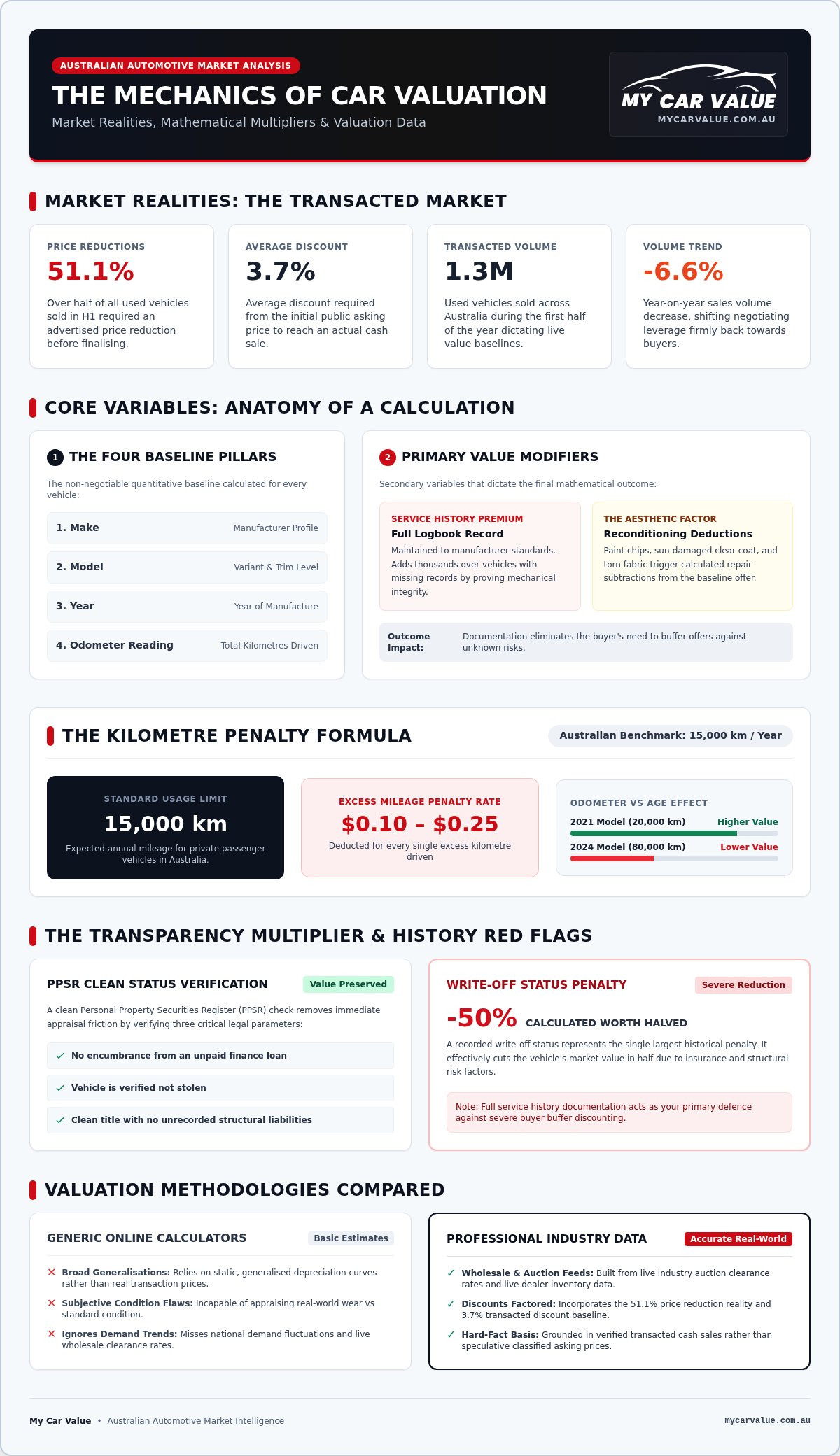
Real-time market demand acts as a primary multiplier in these calculations. If 1.3 million used vehicles sold in the first half of 2026, the data from those specific transactions dictates the current worth. We’ve seen a 6.6% year-on-year decrease in sales volume, which shifts the power back to buyers. Understanding this data allows you to set a price that attracts professional interest instead of letting your car sit idle on a classified site.
Why Automated Calculators Often Miss the Mark
Basic online algorithms often fail because they rely on broad generalisations. They ask for your year, make, and model, then apply a standard depreciation curve. These tools cannot account for the subjective nature of “average condition.” Your version of well-maintained might look different to a professional appraiser. Additionally, these calculators often ignore national demand trends. A vehicle that is popular across Australia will hold its value better than a niche model with limited buyer interest. Relying solely on a generic tool often leads to unrealistic expectations and missed sale opportunities.
The Role of Professional Data Sets in 2026
Professional buyers utilise industry-only auction data and wholesale trends to build their offers. They study various car valuation methodologies to understand how live dealer inventory and auction clearance rates impact current prices. This data is far more reliable than public listings. In mid-2026, statistics showed that 51.1% of used vehicles had their asking prices reduced before a sale. Professional data sets capture these 3.7% average discounts, providing a realistic view of the transacted market. This level of data transparency builds trust. It ensures that the offer you receive is grounded in hard facts rather than guesswork.
Core Variables: What Drives the Mathematical Outcome?
A precise car valuation calculation relies on four pillars: make, model, year, and odometer reading. While these provide the baseline, the “Service History Premium” often determines the final figure. A full logbook proves the vehicle was maintained according to manufacturer standards. This documentation can add thousands to the value compared to a car with missing records. Professional buyers prioritise mechanical integrity because it reduces their risk of future repairs. They also weight the “Aesthetic Factor” heavily. Significant paint chips, sun-damaged clear coats, or torn interior fabrics aren’t just cosmetic issues; they indicate how the previous owner cared for the machine. Professional buyers calculate the cost of reconditioning these defects and subtract that amount from the baseline offer.
The Odometer vs. Age Debate
Mileage often carries more weight than the year of manufacture in the secondary market. A 2024 model with 80,000 kilometres on the clock might be worth less than a 2021 model that has only travelled 20,000 kilometres. In the Australian market, the benchmark for “standard kilometres” is approximately 15,000km per year. Exceeding this figure triggers a heavier depreciation penalty, often calculated at a rate of $0.10 to $0.25 for every excess kilometre. Depreciation is the largest hidden cost in any valuation formula. If you want to see how these factors apply to your specific vehicle, you can Value My Car online to get a clearer picture of your current standing.
The Transparency Multiplier: PPSR and History
Transparency acts as a value multiplier by reducing buyer friction. Providing a clean PPSR check removes immediate red flags. This report confirms the car isn’t stolen, doesn’t have an encumbrance from an unpaid loan, and hasn’t been previously written off. A “Write-off” status is a significant penalty that can effectively halve the calculated worth of a vehicle. This is why researching the FTC guide on researching trade-in values can help you understand how history impacts equity and your ability to negotiate.
Beyond legal status, the car service history check is your strongest tool for protecting your price. It transforms a subjective appraisal into a data-backed transaction. When you present a complete history, you eliminate the buyer’s need to “buffer” their offer against unknown mechanical risks. This clarity ensures the car valuation calculation remains in your favour and reflects the true condition of the vehicle.
Valuation Methods: Redbook vs. Real-World Offers
A professional car valuation calculation often reveals a significant gap between paper estimates and bankable cash. Book value is a statistical average based on historical data. Market value is what a buyer will actually pay you today. Trade-in valuations typically sit 15% to 25% below the private retail market. This discount reflects dealer wholesale acquisition margins, reconditioning costs, and statutory warranty obligations. The professional buyer model has emerged as the middle ground. It provides a faster exit than a private sale while offering more transparency than a traditional dealership trade-in.
In 2026, fuel price sensitivity heavily influences these calculations. Hybrid and electric vehicles (EVs) are seeing much faster turnover than in previous years. Used EV sales grew by 54.6% in the first half of 2026. Their average time on the market dropped to under 40 days by June. This increased liquidity has stabilised residual values for secondary EVs. Meanwhile, older internal combustion SUVs are facing steeper depreciation curves as buyers prioritise running costs. Understanding these shifts ensures your expectations align with current buyer demand.
Understanding the Redbook Benchmark
Redbook serves as the historical authority for Australian vehicle pricing. It provides standardised ranges based on theoretical mileage and standard trim levels. Banks and insurers rely on these guides to determine agreed value policies. However, these benchmarks often lag 30 to 60 days behind the actual market pulse. They don’t account for sudden shifts in dealer floor inventory or local auction clearance rates. While Redbook is a useful statistical anchor, professional buyers focus on real-time telemetry to formulate their offers. They look at what cars are selling for this week, not what they were worth last month.
The “Fast Sale” vs. “Top Dollar” Calculation
Chasing the absolute “top dollar” in a private sale often comes with hidden holding costs. You must factor in the price of professional detailing, ongoing registration, and classified advertising fees. There is also the cost of your time spent managing enquiries and tyre-kickers. Using a vehicle market value calculator helps you set a realistic baseline before you list your car. A professional offer can often be more profitable when you factor in these holding costs and the immediate transfer of liability. It removes the risk of the market cooling further while you wait for a private buyer who may never arrive.
Maximising Your Calculated Value: A Seller’s Checklist
Preparing your vehicle before an appraisal directly influences the final car valuation calculation. Small investments in time and presentation often yield significant returns. Professional buyers look for reasons to reduce their offer; your goal is to remove those obstacles. A vehicle with six months of registration remaining is more attractive than one about to expire. Buyers view “rego” as a cash equivalent in their internal maths. Similarly, original equipment like floor mats, spare keys, and the factory tool kit signal that the car was treated as a valued asset. Minor cosmetic repairs, such as fixing a small bumper scuff or a windscreen chip, often provide a 2x return on investment by preventing larger price deductions later.
Presentation and First Impressions
A professional detail creates a psychological advantage that a standard driveway wash cannot match. Clean door shuts, a degreased engine bay, and polished headlights suggest a higher level of mechanical care. Odours are a critical variable in the valuation formula. Professional buyers mathematically deduct the cost of ozone treatments or deep steam cleaning for cars that smell of cigarette smoke or pets. Remove all personal items, including dash cams and phone mounts. This allows the buyer to see the asset clearly without the distraction of clutter, making the transaction feel more professional and straightforward.
Documentation and Proof
Your paperwork is the physical evidence of your car’s history. Organise your logbooks, recent service receipts, and current registration papers in a clear folder. The presence of two working keys is a specific value-add. Replacing a modern smart key can cost between $200 and $500; if you only have one, the buyer will likely deduct that full replacement cost from their offer. Perform a DIY pre-sale inspection to identify any warning lights or fluid leaks. Addressing these small issues before the professional appraisal prevents “price chipping” and ensures your car valuation calculation remains as high as possible.
The My Car Value Advantage: Streamlined Calculations
My Car Value acts as the expert facilitator for Australian sellers in a complex market. We strip away the uncertainty of a traditional car valuation calculation by connecting you with a national network of professional used car buyers. This platform serves as the antidote to the stress and wasted time associated with private classifieds. Instead of waiting for weeks for a single genuine enquiry, you access a streamlined system designed for speed and transparency. We do the heavy lifting by leveraging real-time market data to ensure your offer reflects current 2026 demand. It is the most efficient bridge between vehicle data and a bankable sale.
How Our Process Works for You
Our workflow moves with purpose to get you from an initial inquiry to a concrete solution quickly. Follow these steps to secure your price:
- Step 1: Enter your vehicle details to receive a data-backed sell my car estimate. This isn’t a vague guess; it’s a fast, transparent calculation based on your car’s specific variables.
- Step 2: We match your vehicle with reputable buyers who are actively looking for your specific make and model. This targeted approach increases the competitiveness of the offers you receive because the buyers already have a specific need for your stock.
- Step 3: Secure a firm offer and finalise the transaction without dealing with tyre-kickers or low-ballers. This methodical progression ensures you maintain momentum and avoid the friction of traditional selling methods.
Why Professional Buyers are the Smart Choice in 2026
Dealing with licensed professionals provides a level of security that private sales simply cannot match. You avoid the risks of fraudulent payments or uninsured test drives from strangers. Professional transactions also offer “same-day” potential. Once the physical appraisal confirms your digital data, the sale can be finalised immediately. This efficiency is vital in a cooling 2026 market where values can shift week to week. By choosing a professional path, you lock in a price and transfer liability instantly. It is the most pragmatic way to turn your automotive asset into cash with minimal effort. You stay in control of the process while we provide the tools for a successful outcome.
Secure Your Vehicle’s Future Worth
Determining your car’s true value in 2026 doesn’t have to be a guessing game based on outdated guides. You now understand that a professional car valuation calculation relies on real-time market telemetry and specific vehicle variables. By prioritising a complete service history and maintaining original equipment like spare keys, you protect your equity against common price deductions. Transparency is your greatest tool in a cooling market, and having the right data puts you in the driver’s seat.
Trusted by thousands of Aussie sellers, My Car Value provides a direct path to a national network of professional buyers. You don’t have to navigate the stress of private listings or settle for a disappointing trade-in offer. We offer access to no-obligation, transparent market data so you can make an informed decision with total confidence. Skip the tyre-kickers and move straight to a professional result that respects your time and your vehicle’s worth.
Take the guesswork out of your sale and move forward with clarity. Your vehicle represents a significant investment, and the right data ensures you receive the return you deserve.
Frequently Asked Questions
How is a car valuation calculation different from a dealer trade-in quote?
A car valuation calculation provides a broad market perspective based on national data sets and historical sales trends. In contrast, a dealer trade-in quote is a specific cash offer influenced by that dealer’s current inventory levels and reconditioning costs. Dealers typically offer 15% to 25% below the retail market value to account for their wholesale margins. A calculation gives you the benchmark needed to negotiate or find a better professional buyer.
Does a car valuation calculation take into account aftermarket modifications?
Most standard algorithms ignore aftermarket modifications or may even penalise the final figure. While you might have spent thousands on custom wheels or audio systems, professional buyers often view these as liabilities that narrow the resale audience. The exception involves functional additions like bull bars or tow kits on utility vehicles, which can hold some value. Generally, a car valuation calculation focuses on the factory-standard specification to ensure a broad market appeal.
Why does my car’s calculated value change so quickly in 2026?
The Australian used car market has shifted into a post-supply chain stabilisation phase in 2026. Values fluctuate rapidly because professional databases now incorporate real-time telemetry from auction houses and dealer floors. If a high percentage of similar models recently required price reductions to sell, your calculated value will drop to reflect that trend. Fuel price sensitivity also causes sudden shifts in demand for specific categories like large SUVs versus more efficient hybrid models.
Can I get a car valuation calculation for a vehicle with a blown engine?
You can obtain a calculation for a non-running vehicle, but the result will reflect its value as a salvage or parts asset. Professional buyers calculate the cost of a full engine replacement and subtract this from the healthy market baseline. For many older models, this repair cost exceeds the car’s total worth. In these cases, the valuation focuses on the scrap weight and any high-demand components that remain in good condition.
How much does a missing service logbook affect my car valuation calculation?
A missing logbook can reduce your car valuation calculation by 5% to 10% immediately. Professional buyers view incomplete records as a high-risk indicator of potential mechanical neglect. Without proof of regular maintenance, a buyer must buffer their offer to cover possible hidden defects. Providing a full service history check remains the most effective way to protect your price and prove the vehicle’s integrity during a professional appraisal process.
Is a free online car valuation calculation actually accurate?
A free online car valuation calculation serves as an excellent statistical starting point. However, its accuracy depends on whether the tool uses static book values or live market feeds. To get a bankable result, you need a service that connects your data with professional buyers who understand current demand. While the initial estimate provides a range, the final accurate figure is only confirmed once a professional evaluates the specific condition and history of your vehicle.
Does the colour of my car impact the valuation calculation in Australia?
Colour significantly impacts resale liquidity and the final mathematical outcome. Neutral tones like white, silver, and grey remain the safest choices because they appeal to the widest range of Australian buyers. High-visibility or niche colours like bright green or purple often attract a smaller audience. This lower demand forces professional buyers to reduce their offers to account for the longer time the vehicle might sit on their lot before finding a new owner.
How do professional buyers calculate their offers compared to private sellers?
Professional buyers use a methodical approach based on immediate liquidity and reconditioning deductibles. They calculate an offer that allows for a fast transaction while covering their statutory warranty obligations. Private sellers often base their prices on asking prices seen online, which are frequently higher than actual transacted values. Dealing with professionals ensures a transparent, data-driven experience that skips the uncertainty and long waiting periods associated with the private classified market.