

Chassis Number and VIN Number: The Complete Australian Guide to Identifying Your Vehicle
What if the 17-digit code hidden on your dashboard is the only thing standing between a record-breaking sale and a total legal nightmare? Most Aussie car owners feel a surge of stress when asked for their vehicle’s identification details. It’s common to feel confused about the difference between a chassis number and vin number, particularly if you’re worried that a mismatched digit signals a dodgy history. You aren’t alone if you’ve spent twenty minutes squinting at an engine bay trying to find a compliance plate that isn’t there.
We understand that you want a straightforward process without the technical headache. This guide promises to strip away the complexity by showing you exactly where these identifiers live on your car and how to use them to secure an accurate market valuation. We will explain the shift from pre-1989 chassis stamps to the modern 17-character VIN system used in Australia today. You’ll learn how to identify your vehicle’s DNA, conduct a proper PPSR check, and prepare your car for a fast, confident sale in the local market.
Key Takeaways
- Understand the vital distinction between a chassis number and vin number to recognise why modern Australian vehicles use a standardised 17-digit identifier.
- Locate your vehicle’s identification codes quickly using our guide to common physical spots like the windscreen, door jamb, and engine firewall.
- Learn how decoding the 17-digit VIN reveals factory-fitted extras and engine specs that often lead to a higher valuation.
- Use your VIN to fetch real-time market data, ensuring you get a fair offer from professional used car buyers.
- Gain the confidence to conduct a PPSR check and prove your vehicle’s history is clear of financial encumbrances or write-off records.
What is the Difference Between a Chassis Number and VIN Number?
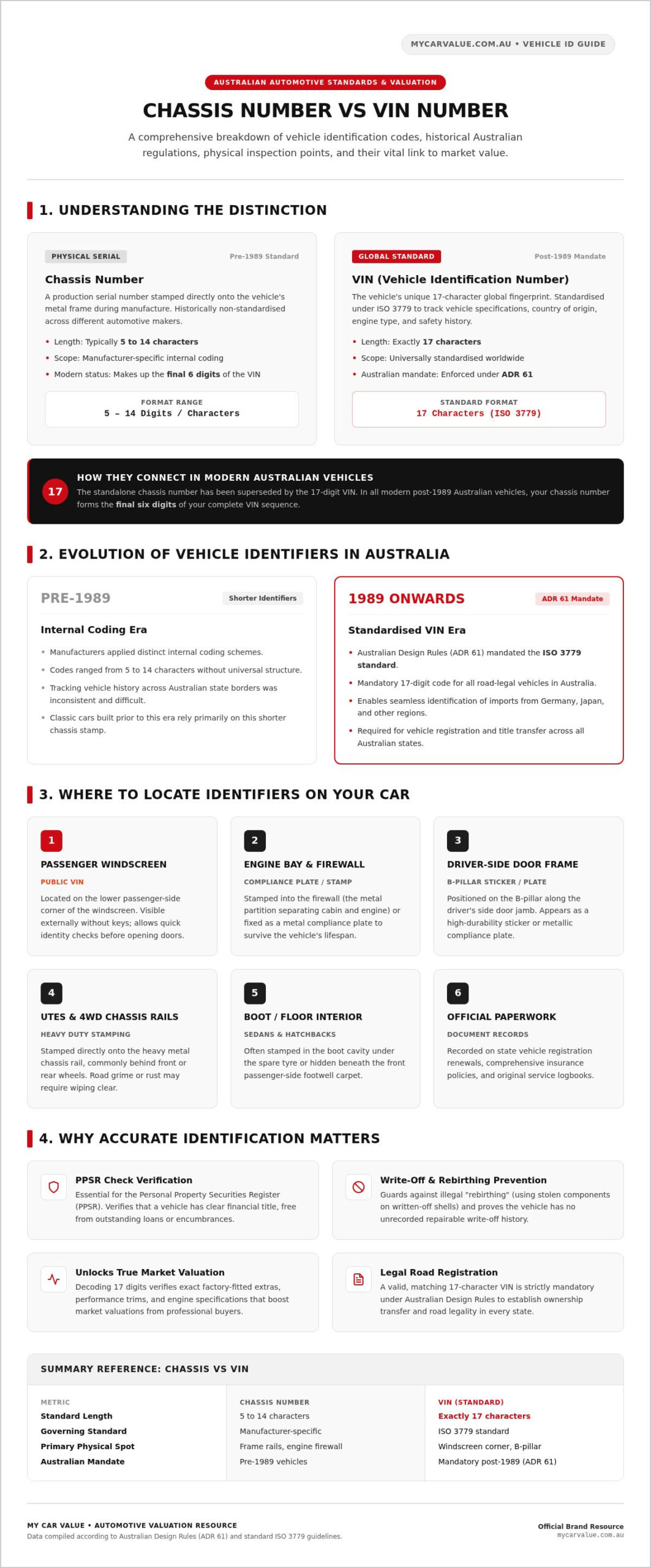
Understanding the terminology is the first step to a successful car sale. While many Australians use the terms chassis number and vin number interchangeably, they aren’t exactly the same. Think of the VIN (Vehicle Identification Number) as your car’s global fingerprint. It’s a unique 17-character sequence that identifies everything from the factory location to the engine type. This number is standardised across the world to ensure every vehicle is distinct.
Technically, a chassis number is a serial number stamped onto the vehicle’s metal frame during production. In modern cars, this serial number makes up the final six digits of the VIN. For vehicles manufactured decades ago, the chassis number was often the only identifier available. Today, the VIN has superseded the standalone chassis number to provide a more comprehensive data profile for regulators and insurers.
The Evolution of Vehicle Identifiers in Australia
The way we identify cars in Australia changed significantly in the late eighties. Before 1989, manufacturers used their own internal coding systems. These chassis numbers were shorter, usually between 5 and 14 characters, and lacked a global standard. This made tracking a vehicle’s history across state lines difficult and inconsistent. If you’re selling a classic car built before this era, you’ll likely only have this shorter chassis code to work with.
In 1989, the Australian Design Rules (ADR 61) mandated the shift to the ISO 3779 standard. This change introduced the 17-digit VIN we use today for all road-legal vehicles. This shift was designed to create global consistency. It allows a car built in Germany or Japan to be easily identified and registered within the Australian system. For any vehicle built post-1989, a full 17-digit VIN is required for it to be registrable and road-legal in any Australian state.
Why These Numbers Matter for Aussie Sellers
Accuracy is vital when you’re ready to sell. A valid VIN is the primary tool used to prevent identity fraud and “rebirthing,” where stolen parts are used to build a seemingly legal car. It provides a transparent link to the Personal Property Securities Register (PPSR). Buyers use this register to check for “hidden” histories that could devalue the car or make it illegal to own.
A PPSR check confirms if your car has any outstanding finance or a history as a repairable write-off. Without a correct 17-digit code, you cannot prove clear title to a potential buyer. Providing this data upfront builds immediate trust. It shows you’re a serious seller with nothing to hide. The VIN is the mandatory 17-character code required for all Australian vehicle transactions since 1989.
Where to Find Your Chassis and VIN Number on Your Car
Finding the correct identification numbers on your vehicle doesn’t have to be a scavenger hunt. Most modern cars feature a ‘Public VIN’ located at the lower corner of the windscreen on the passenger side. This allows anyone to view the number from outside the vehicle without needing keys. It’s the fastest way to verify a vehicle’s identity before you even open the door.
For a more permanent record, look for the compliance plate. This is typically a small metal plate or a high-durability sticker located in the engine bay or on the driver’s side door frame (the B-pillar). If you can’t find it there, check your official documentation. Your state’s registration renewal notice, insurance policy, and service logbooks all list the chassis number and vin number for easy reference. Cross-referencing these digital and physical records ensures the data is consistent across the board.
Physical Locations on Different Body Styles
Depending on what you drive, the physical location of the number can vary. Utes and 4WDs often have the number stamped directly onto the chassis rail. You’ll usually find it behind the front or rear wheels. Be prepared to wipe away some road grime to see it clearly. For sedans and hatchbacks, manufacturers often hide the number in the boot under the spare tyre or beneath the front passenger carpet.
The engine bay remains a primary location for most vehicles. Look at the firewall, which is the metal partition separating the engine from the cabin. The number is often stamped into the metal here to ensure it survives the life of the vehicle. If you’re struggling to locate it, a quick look at your owner’s manual usually provides a diagram of these specific locations.
What to Do if the Number is Unreadable
Environmental factors like rust or heat can make a physical number difficult to read. Rusted chassis rails on older 4x4s are a common issue in Australia. If a compliance sticker has faded or peeled, you can still verify the vehicle through the National Exchange of Vehicle and Driver Information System (NEVDIS). This database tracks every registered VIN in the country and is the source of truth for PPSR checks.
Treat a tampered or ‘restamped’ number with extreme caution. If the digits look uneven or the metal around the number appears ground down, it’s a major red flag. Professional used car buyers will often reject a vehicle with a suspicious identification history. A mismatched chassis number and vin number usually indicates the car has been ‘rebirthed’ or has a hidden accident history that hasn’t been disclosed.
Decoding the 17 Digits: What Your VIN Actually Says
Your vehicle’s 17-digit identification string is more than just a random sequence. It is a structured code that tells the story of its origin, specifications, and authenticity. Understanding the logic behind your chassis number and vin number allows you to verify a car’s specifications instantly. The first three characters represent the World Manufacturer Identifier (WMI). For example, 6T1 identifies a Toyota manufactured in Australia, while WBA indicates a BMW from Germany. These digits confirm the country of origin and the brand responsible for the build.
Characters four through eight form the Vehicle Descriptor Section (VDS). This part of the code describes the engine type, model series, and body style. The ninth character is the check digit. Authorities use a mathematical formula to verify this digit, ensuring the VIN is genuine and hasn’t been tampered with. The final section, digits 10 through 17, is the Vehicle Identifier Section (VIS). This is where you find the specific production details that make your car unique.
Identifying the Model Year vs. Build Date
A common point of confusion for Aussie sellers is the difference between the model year and the build date. The 10th character in the VIN is the model year code. This letter or number tells you if your car is technically a 2025 or 2026 model according to the manufacturer’s cycle. However, the physical build date stamped on the compliance plate might be several months earlier. This happens when a car is manufactured late in one year but sold as the following year’s model. This distinction is crucial because it directly impacts your car valuation. Buyers often pay more for a later model year, even if the build date is nearly identical.
Australian Manufacturing Codes
Australia has a rich history of local manufacturing that is reflected in these codes. While local production has ceased, thousands of Holden, Ford, and Mitsubishi vehicles with Australian WMIs remain on our roads. The first character ‘6’ in a VIN signifies an Australian-manufactured vehicle, while ‘J’ denotes Japan. Spotting these codes helps you identify a “grey import” compared to an Australian-delivered vehicle. Grey imports are cars brought into Australia outside of the manufacturer’s official distribution network. They often have different specifications or safety features, which can complicate insurance and parts sourcing. Checking the chassis number and vin number is the only way to be certain of a vehicle’s original market destination.
The Critical Link Between Your VIN and Your Car’s Value
Your car’s 17-digit code is the most powerful tool you have to secure a fair price. An accurate vehicle market value calculator relies entirely on this data to function correctly. Without the correct chassis number and vin number, any valuation you receive is just an educated guess. Precise data fetching allows the system to pinpoint premium factory options like panoramic sunroofs, upgraded sound systems, or advanced driver assistance safety packs. These features often add thousands to your car’s worth but are frequently missed in generic manual entries.
Professional buyers use your VIN to access the Personal Property Securities Register (PPSR) instantly. This check reveals if there’s any outstanding finance or if the car has been recorded as a write-off. Providing an accurate chassis number and vin number from the start prevents the dreaded “valuation drop.” This occurs when a seller receives a high initial quote based on generic info, only for the price to plummet once the buyer uncovers the true vehicle history during the final inspection. Transparency saves you time and ensures you only deal with serious, firm offers.
PPSR, WOVR, and Resale Price
A vehicle’s status on the Written-Off Vehicle Register (WOVR) is a critical factor in determining resale price. Statutory write-offs cannot be re-registered in Australia, while repairable write-offs typically suffer a 20% to 40% reduction in market value compared to clean-titled cars. Transparency is your best strategy to avoid awkward negotiations later. By providing your VIN early, you allow for a clean history check that builds immediate trust with potential buyers. For more tips on proving your car’s worth, read our car service history check guide to see how full documentation maximises your final offer.
Getting an Accurate Quote First Time
Relying on just the “Year, Make, Model” is a common mistake that leads to inaccurate quotes. Two cars of the same model can have vastly different wholesale values based on their specific trim level and production sequence. My Car Value uses your unique VIN to provide a precise reflection of the current Australian market conditions. Expert buyers in Sydney and Melbourne rely on this granular data to place competitive bids. This data-driven approach ensures the price you’re quoted is a realistic reflection of what professional buyers are willing to pay today.
How to Use Your VIN to Sell Your Car Fast with My Car Value
Once you have identified your chassis number and vin number, you are ready to turn those 17 digits into a firm financial offer. The transition from identifying your car to selling it should be seamless and transparent. We have designed a methodical four-step process to help you bypass the usual stress of the second-hand market. This approach values your time and relies on data rather than guesswork.
- Step 1: Locate your 17-digit VIN using the physical spots we identified earlier, such as the base of the windscreen or the door pillar.
- Step 2: Enter the VIN into the My Car Value platform to trigger an instant, data-backed valuation that reflects current Australian market trends.
- Step 3: Review your precise market value and get connected with our curated network of professional used car buyers.
- Step 4: Finalise the inspection, skip the private sale ‘tyre-kickers’, and close the deal with total confidence.
The My Car Value Advantage
We specialise in simplifying the ‘Sell My Car’ journey for busy Australians who want a fair price without the hassle of classified ads. Our platform acts as a savvy intermediary, doing the heavy lifting by matching your vehicle data with buyers who are ready to act. Because our system understands the nuances of the local used car market, we can offer a level of accuracy that generic calculators simply can’t match. When you provide your chassis number and vin number upfront, you eliminate the risk of price re-negotiations. This accuracy leads to a faster, stress-free payment process because the buyer knows exactly what they are bidding on before they even see the car in person.
Ready to Value Your Car?
Take the first step toward a successful sale by using our professional valuation tool. It is the smartest way to leverage your vehicle’s data to secure a competitive offer. We ensure your information is used solely to facilitate a professional connection with our buyer network. Whether you are looking to sell my car in Brisbane or you need a reliable valuation in Perth, our system is ready to assist. Stop wondering what your car is worth and get a clear, impartial figure today. Our technology empowers you to make informed decisions with minimal effort, providing a clear path forward in a crowded marketplace.
Unlock Your Vehicle’s True Value Today
Identifying your vehicle’s DNA is the smartest way to protect your interests during a sale. You now know that the distinction between a chassis number and vin number is more than just technical jargon; it’s the key to market transparency. By locating these codes on your windscreen or engine bay, you eliminate the risk of identity fraud and ensure your PPSR history is crystal clear. This preparation allows you to present a verified vehicle to the market, attracting serious offers from professional buyers who value accuracy.
Our platform specialises in expert Australian market valuations that recognise the specific factory options hidden within your VIN. We streamline the entire process, connecting you with a national network of professional used car buyers who are ready to act. You don’t have to deal with the stress of private classifieds or the frustration of inaccurate quotes.
Take the guesswork out of your car’s worth. Start your fast, transparent, and stress-free selling journey right now.
Frequently Asked Questions
Is the chassis number the same as the VIN in Australia?
Technically they are distinct, though many Aussies use the terms interchangeably. A VIN is a standardised 17-character global identifier required for all vehicles built after 1989. The chassis number is often considered a subset of the VIN, specifically the final six digits that represent the production sequence. For vintage cars manufactured before 1989, a shorter chassis number was the primary way to identify the vehicle before international standards were adopted.
Where is the VIN number on a Toyota Hilux or Ford Ranger?
For a Toyota Hilux, look at the driver’s side chassis rail, often visible through the front wheel arch. You will also find it on the compliance plate on the centre door pillar. On a Ford Ranger, the number is typically stamped on the driver’s side chassis rail toward the front or rear. Both models also feature a public VIN visible through the lower corner of the windscreen on the passenger side for quick identification.
Can I find my VIN number online using my rego?
Yes, you can access your VIN online through your state’s transport authority website, such as Service NSW or VicRoads. By entering your number plate, you can perform a free registration check that displays the vehicle’s make, model, and VIN. Note that some authorities mask the middle characters of the VIN for security purposes. Your full 17-digit code is always available on your official registration renewal notice or insurance policy documents.
What happens if my VIN number has only 11 digits?
An 11-digit number indicates that your vehicle was likely manufactured before the 1989 Australian mandate for standardised 17-character codes. These shorter identifiers are common for classic cars and vintage models that used manufacturer-specific sequences. If your car is a modern model and only has 11 digits, it may be a grey import or have a non-standard history. In these cases, you should verify the vehicle’s identity through a specialist or a PPSR search.
Does a mismatched VIN and chassis number mean the car is stolen?
A mismatch is a significant red flag that requires immediate investigation. While it doesn’t always mean a car is stolen, it often suggests “rebirthing,” where parts from different vehicles are combined to hide a car’s true identity. This can also happen after a major unauthorised repair where a second-hand chassis rail was used. Professional buyers will rarely touch a vehicle with inconsistent identifiers, as it usually indicates a hidden history or potential legal issues.
How do I do a free VIN check in Australia?
You can perform a basic free VIN check through any Australian state transport portal by using the vehicle’s registration plate. This confirms the rego status and basic vehicle details. However, for a comprehensive history, including financial encumbrances or write-off records, you must use the official PPSR website. While not free, an official PPSR search costs only $2.00 and provides a government-backed certificate that is essential for any safe used car transaction.
Why do I need a VIN for a car valuation?
Providing your VIN is the only way to get a 100% accurate market valuation. It allows platforms like My Car Value to fetch specific data about your car’s factory-fitted options, trim level, and engine specifications. Without it, a valuation is based on generic model data, which often ignores premium features that add significant value. Using a combined chassis number and vin number lookup ensures the final offer reflects the true specifications of your individual vehicle.
Where is the chassis number located on a caravan or trailer?
On most Australian caravans and trailers, the chassis number is stamped onto the drawbar or the A-frame near the coupling. You will usually find it on the kerbside (left-hand side) of the frame. Manufacturers also attach a compliance plate to the front of the caravan or inside the front tunnel boot. If the trailer is older, the number might be stamped directly into the metal frame, so you may need to clear away paint or rust to read it.