
Car Sales Valuation: How to Determine Your Vehicle’s True Market Worth in 2026
The asking price on an online classified listing is rarely what a car actually changes hands for; it is merely an optimistic opening bid. If you are trying to pin down an accurate car sales valuation in Australia, sorting through inflated forecourt listings, lowball trade-in appraisals, and time-wasting tyre-kickers can feel exhausting. You deserve to know what your vehicle is genuinely worth in cash today, backed by real transactional data rather than forecourt guesswork or dealership pressure.
We designed this guide to strip away that confusion and show you how vehicle appraisals truly function across the country. You will discover how mechanical condition, mileage, and logbook servicing directly influence your baseline market value, unpack the real valuation gap between private sales and trade-in offers, and explore a straightforward pathway to sell directly to verified professional buyers. Here is how to turn an accurate, data-backed appraisal into a competitive sale without the usual classified hassles.
Key Takeaways
- Understand why cleared transactional figures reveal your true car sales valuation, unlike inflated online asking prices.
- Discover the critical mechanical, historical, and odometer metrics modern valuation algorithms assess when calculating baseline value.
- Compare the real financial and time trade-offs between private advertising, dealership trade-ins, and direct wholesale pathways.
- Learn practical preparation steps, from service documentation to minor detailing, that prevent valuation deductions at inspection.
- See how connecting directly with verified professional buyers eliminates public classified hassles and secures a streamlined exit.
What Is a Car Sales Valuation and Why Does It Matter?
A true car sales valuation estimates what a buyer will actually pay for your vehicle in cleared funds today. Many sellers look at public classifieds and assume those numbers represent true value. They don’t. An objective appraisal tracks completed market clearances, stripping out the optimism that inflates asking figures across public platforms.
Relying on guesswork exposes you to costly risks. Overpricing your vehicle leads to stagnant listings, continuous price drops, and buyer disinterest. Conversely, underestimating your vehicle leaves you vulnerable to predatory dealer trade-in tactics designed to maximise their forecourt margins. A data-backed baseline establishes firm ground before entering any transaction.
The Distinction Between Asking Price and Realised Market Value
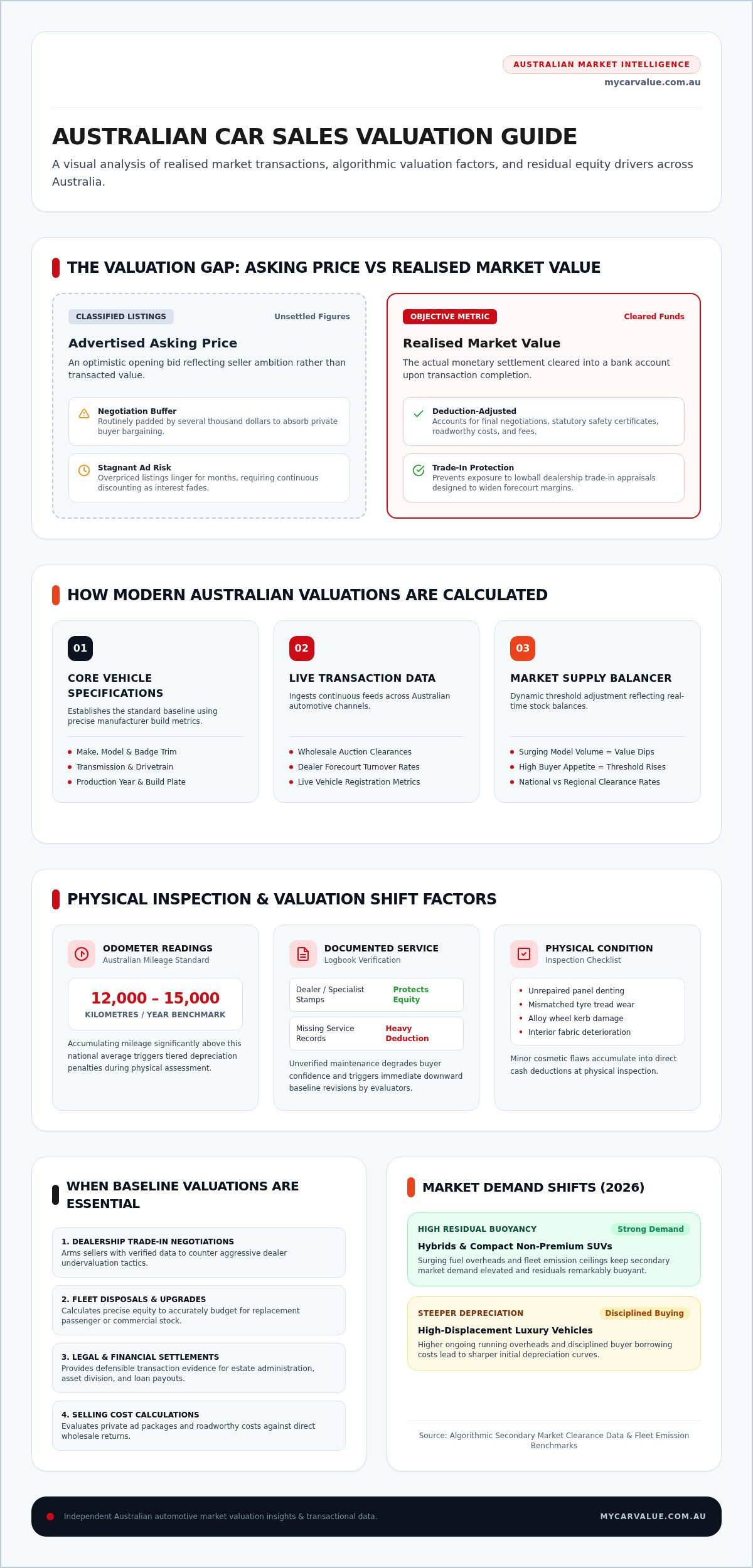
Classified advertisements reflect seller ambition. Private owners routinely pad their listing figures by several thousand dollars to absorb inevitable buyer haggling. These advertised numbers do not represent cleared bank transfers. Realised market value measures the final transacted sum once negotiations conclude, roadworthy responsibilities settle, and fees deduct. Outdated listings that linger online for months only distort price expectations, masking real-time shifts in secondary automotive demand.
Key Circumstances Requiring a Professional Car Sales Valuation
Securing an independent baseline is critical across several practical scenarios:
- Dealership Trade-In Negotiations: Walking onto a showroom floor armed with verified data prevents aggressive sales teams from undervaluing your asset to pad their margins.
- Vehicle Upgrades and Fleet Disposals: Calculating precise equity helps business operators and private motorists budget accurately for replacement stock.
- Financial and Legal Settlements: Official asset division, estate administration, and loan payouts demand defensible market evidence rather than informal estimates.
- Selling Cost Calculations: Establishing fair value upfront prevents you from spending money on private listing packages, statutory safety checks, and detailing if wholesale exit routes offer a cleaner net return.
Knowing your vehicle’s baseline eliminates transaction anxiety. It provides the clarity needed to choose the most profitable, stress-free route forward.
How Modern Australian Car Sales Valuations Are Calculated
Static valuation books with multi-month publishing lags no longer reflect Australian automotive trading. Modern appraisal models run on algorithmic data feeds. These engines continuously ingest wholesale auction clearances, dealer forecourt turnover rates, and live vehicle registration metrics to establish an accurate baseline.
Calculations begin with core build specifications: make, model variant, badge trim, transmission, and production year. The algorithm then adjusts this initial figure against real-time supply volumes across the country. If nationwide inventory for a specific model surges, values adjust downward; if buyer demand outpaces available stock, clearance thresholds rise.
Core Mechanical and Historical Factors That Shift Valuation
Algorithms set the initial baseline, but individual vehicle condition dictates final monetary clearance. Evaluators make substantial downward deductions during physical inspections for unverified maintenance or excessive wear. Key condition markers include:
- Odometer Readings: Average Australian passenger vehicles accumulate roughly 12,000 to 15,000 kilometres per year. Accumulating mileage significantly higher than these benchmarks triggers tiered depreciation penalties.
- Documented Servicing: Missing scheduled dealer or specialist workshop stamps degrades buyer confidence. Review our detailed car service history check guide to see how maintaining verified logbooks safeguards resale equity.
- Cosmetic and Structural Integrity: Unrepaired panel denting, mismatched tyre tread wear, curbing on alloy wheels, and interior fabric deterioration directly reduce final offers.
External Market Forces Influencing Valuations in 2026
Secondary vehicle values react swiftly to changing economic conditions. Surging fuel overheads have accelerated buyer appetite toward hybrid models and compact non-premium SUVs, keeping their residual values remarkably buoyant. Conversely, high-displacement luxury models face steeper initial depreciation as buyer borrowing costs stay disciplined.
New regulatory frameworks, including Australia’s fleet emission ceilings, also influence supply balances. As distributors rebalance new model allocations, late-model used alternatives gain immediate liquidity. Rather than relying on out-of-date printed pricing guides, sellers can use an algorithmic tool to Value My Car with precision, tracking live clearance movements across the nationwide marketplace.
Comparing Valuation Outcomes: Private Sale, Dealership Trade-In, and Wholesale
Every disposal pathway yields a distinctly different car sales valuation. The gross figure shown on a screen rarely matches the actual cash left in your pocket after settlement. Understanding the operational trade-offs between private advertising, dealer trade-ins, and wholesale disposal prevents costly miscalculations.
Private sales deliver the highest theoretical top-line figures, but they carry heavy administrative friction and holding costs. Dealership trade-ins sit at the lower end of the pricing spectrum because retail dealers must factor in reconditioning expenses, detailing, statutory warranty risks, and forecourt profit margins. Wholesale channels bridge this divide by providing clean, rapid settlement based strictly on current secondary trade liquidity.
The True Cost of Chasing Maximum Private Sale Valuation
Capturing that higher private sale price tag demands substantial investment before money ever changes hands. Sellers must fund mandatory roadworthy or safety inspections, rectify roadworthy defects, pay upfront listing portal fees, and maintain vehicle registration while waiting for buyers. According to industry transaction data, used vehicles take an average of roughly 46 to 51 days to clear across dealer and private listings.
Holding a car for weeks introduces real holding costs: insurance premiums, ongoing loan interest, and continued market depreciation. Private sellers also shoulder the friction of filtering lowball messages, accommodating weekend test drives, and navigating payment security risks. If you want to bypass the classified grind entirely, evaluating professional car auction alternatives offers an immediate pathway to liquidate without private market hazards.
Deconstructing the Dealership Trade-In Appraisal
Dealership trade-in evaluations operate under strict financial mechanics. A dealer will deduct wholesale reconditioning costs from the outset, including workshop overheads, mandatory tyre or brake replacements, and cosmetic paint repairs. They must also retain a 12% to 20% gross retail margin to make floor space profitable.
Showrooms routinely blur these calculations during changeover negotiations:
- Inflated Allowances: Sales consultants may offer an attractive trade-in figure by quietly removing standard manufacturer discounts from the new car invoice.
- Changeover Padding: Focusing solely on the “changeover price” hides whether your vehicle received a realistic car sales valuation or was discounted to subsidise dealership finance targets.
- The Unbundled Rule: Always separate transactions. Negotiate your new vehicle purchase price in isolation first, then demand an independent, standalone valuation for your existing car.
Actionable Steps to Maximise Your Vehicle’s Sales Valuation
Pre-inspection preparation directly influences what an appraiser records on their assessment sheet. Strategic, cost-effective adjustments eliminate easy excuses for downward deductions and protect your baseline return. Presenting an orderly vehicle backed by verifiable records changes the tone of the appraisal immediately.
Inspectors look for signs of neglect. Addressing minor issues beforehand signals that the car has enjoyed meticulous care throughout its lifecycle, defending your position during final appraisal reviews.
Documentation and Paperwork That Defend Your Asking Value
Paperwork provides tangible proof of vehicle health. Gather every receipt for major scheduled maintenance, including timing belts, transmission servicing, battery replacements, and suspension overhauls. Keep your logbook neatly tucked in the glovebox alongside all original manufacturer handbooks.
Equally critical is establishing clear title status. Settle any lingering finance obligations early, or have current payout letters ready to confirm encumbrance details. Establishing this transparency upfront removes friction from the settlement process. To set an accurate benchmark before presenting your paperwork, check your specifications against an independent vehicle market value calculator.
Cost-Effective Aesthetic and Mechanical Refurbishments
Extensive panel repainting rarely returns its cost, but low-friction detailing consistently pays dividends. Focus your budget on high-impact visual and functional touchpoints:
- Targeted Paint and Dent Correction: Use mobile paintless dent removal to eliminate small car-park dings, and machine-polish light clear-coat swirl marks.
- Cabin Decontamination: Steam clean upholstery, detail high-touch areas like steering wheels and gear shifters, and permanently neutralise interior odours rather than masking them.
- Basic Consumables: Top up screenwash and engine fluids, ensure tyre pressures meet placard guidelines, and replace blown exterior indicator or brake bulbs.
- Both Original Keys: Always supply two operational factory keys. Modern proximity remotes carry substantial replacement overheads, and appraisers apply automatic deductions to your car sales valuation if a spare key is missing.
Converting Your Valuation into a Fast, Secure Sale with Professional Buyers
Securing an accurate appraisal is only the first step; executing the transaction without unnecessary friction is what truly counts. Traditional classified pathways often turn a promising valuation into weeks of fielding ambiguous messages and managing stranger visits. Modern vehicle sellers increasingly bypass these hurdles by connecting directly with verified industry buyers. My Car Value streamlines this entire transition, transforming an independent market appraisal into concrete trade offers without showroom pressure or listing overheads.
Knowing your car sales valuation gives you leverage. Partnering with a dedicated network gives you execution speed.
The Streamlined Digital Valuation and Sale Journey
Establishing an authentic market baseline begins online. You enter core vehicle specifications, odometer metrics, and condition history into our independent valuation engine. Rather than leaving you stranded with a theoretical number, the platform routes your vehicle profile directly to licensed vehicle purchasers actively seeking inventory.
Review our comprehensive guide to sell my car efficiently to discover how structured digital workflows eliminate guesswork at every step. This approach keeps you completely in control. You evaluate genuine market offers in a transparent environment without showroom sales tactics or compulsory changeover purchases.
Why National Buyer Matching Delivers Optimal Value and Speed
Broadcasting your vehicle across a verified buyer network delivers clear transactional benefits over public classified portals:
- Zero Public Exposure: Keep your personal contact details, residential address, and daily schedule private.
- Guaranteed Liquidity: Verified trade buyers purchase vehicles continuously, removing the prolonged waiting periods typical of peer-to-peer selling.
- Defensible Pricing: Dealing with accredited businesses ensures your car sales valuation translates into realistic, enforceable payment terms.
Working alongside vetted professional used car buyers guarantees prompt settlements and orderly collections. You skip the administrative hassle of handling roadworthy roadblocks, chasing unverified bank transfers, or bargaining with casual shoppers.
Turning an appraisal into cleared funds should be straightforward and methodical. By replacing classified fatigue with targeted trade connections, you capture the genuine market worth of your vehicle while saving valuable personal time.
Turn Real Market Data into a Confident Sale
Determining your car sales valuation with precision removes the stress from selling. By focusing on verified transactional data rather than hopeful advertised asking prices, you protect your baseline equity from the start. Organising your logbook history, keeping both factory keys handy, and understanding physical condition metrics ensure you enter negotiations in total control.
You don’t have to endure weeks of classified tyre-kickers or settle for an uncompetitive dealership trade-in appraisal. Accessing an objective market valuation tailored to Australian conditions gives you direct, zero-friction connectivity to a national network of verified used car buyers, completely free from listing fees or sales obligations.
Equip yourself with transparent market evidence today and take the straightforward path to a rewarding sale.
Frequently Asked Questions
How accurate are online car sales valuation tools in Australia?
Digital valuation engines provide a reliable baseline by tracking nationwide wholesale clearance data and secondary market trends. They offer an objective starting point without showroom pressure. However, an algorithm cannot inspect paint depth, tyre wear, or mechanical condition. Your online figure establishes a solid benchmark, but final settlement figures adjust once a physical assessment confirms overall vehicle health.
What is the main difference between red book value and market valuation?
Traditional price guides often rely on rolling historical averages, creating a slight time lag behind fast-moving market shifts. A modern market valuation tracks live supply volumes, daily forecourt clearance rates, and current buyer demand. This distinction ensures you benchmark your vehicle against live economic conditions rather than historical transactions that may no longer reflect secondary market realities.
Does having a full service history actually increase my car valuation?
Yes, maintaining an up-to-date, stamped logbook protects your car sales valuation and prevents substantial downward deductions. Evaluators view missing maintenance records as an immediate mechanical liability, assuming scheduled component replacements were neglected. Complete documentation from licensed workshops confirms proper preventative care, placing your vehicle in the highest appraisal tier and accelerating transaction speed.
Why is a trade-in valuation consistently lower than a private sale price?
Dealership trade-in appraisals incorporate mandatory commercial overheads, including mechanical reconditioning, professional detailing, statutory warranty obligations, and retail profit margins. When a dealer takes your vehicle, they assume the holding costs and depreciation risk until it sells. Private buyers absorb that risk themselves, which is why classified listings display higher gross asking figures before final negotiations.
Can I get an accurate car sales valuation if my vehicle still has finance owing?
Yes, existing finance does not alter the underlying car sales valuation of the vehicle itself. Independent valuation tools calculate market worth based purely on make, model, age, mileage, and condition. If you choose to transact through verified professional buyers, they liaise directly with your credit provider to clear the outstanding payout, transferring any remaining balance directly to your account.
How much value does a car lose after an accident or panel repair?
Depreciation after an accident depends heavily on repair quality and whether damage reached structural components. Professionally repaired cosmetic scrapes supported by insurer paperwork have minimal impact on appraisal figures. Conversely, structural repairs or entries on national written-off registers trigger significant deductions, as trade buyers and dealerships must price in heightened resale resistance and statutory disclosure requirements.
How quickly can I sell my vehicle after receiving a market valuation?
You can finalise a sale within days when connecting directly with verified trade buyers. While public classifieds often drag out over several weeks of messaging and weekend inspections, professional buyers review vehicle specifications immediately. Once you accept an appraisal offer and complete a routine physical inspection, payment and vehicle handover proceed without traditional classified friction.