

Alternatives to Selling Your Car Privately: A 2026 Australian Guide
How many weekends are you willing to sacrifice to strangers who never intend to buy your vehicle? In 2026, the Australian used car market moves faster than ever, yet the traditional private sale remains a slow, high-risk chore. You likely dread the inevitable low-ball offers, the security concerns of dodgy test drives, and the frustration of cleaning your car for “tyre kickers” who simply don’t show up. It’s a process designed to drain your time and your patience.
We agree that your time is too valuable to spend on a part-time job you didn’t ask for. You deserve a secure transaction that puts money in your bank account immediately without the ongoing liability or paperwork headaches of a private deal. This guide explores the most effective alternatives to selling car privately in Australia, focusing on professional efficiency and transparency. We’ll examine how professional buying services and modern wholesale networks have simplified the journey. You will learn how to bypass the stress and move on to your next car with total confidence. Let’s look at the smarter ways to sell today.
Key Takeaways
- Identify the hidden costs of private listings, including mandatory safety certificates and security risks, to see if the effort truly pays off.
- Compare the “one-and-done” convenience of dealer trade-ins against the potential for higher returns through other modern channels.
- Explore how professional used car buyers offer the most efficient alternatives to selling car privately, typically finalising sales and payments within 24 hours.
- Assess the risks and fees associated with Australian car auctions to determine if this high-stakes route suits your specific vehicle type.
- Use a logical framework to choose a selling method based on your car’s condition and how quickly you need the funds in your bank account.
Why Private Selling Isn’t Always the Best Choice
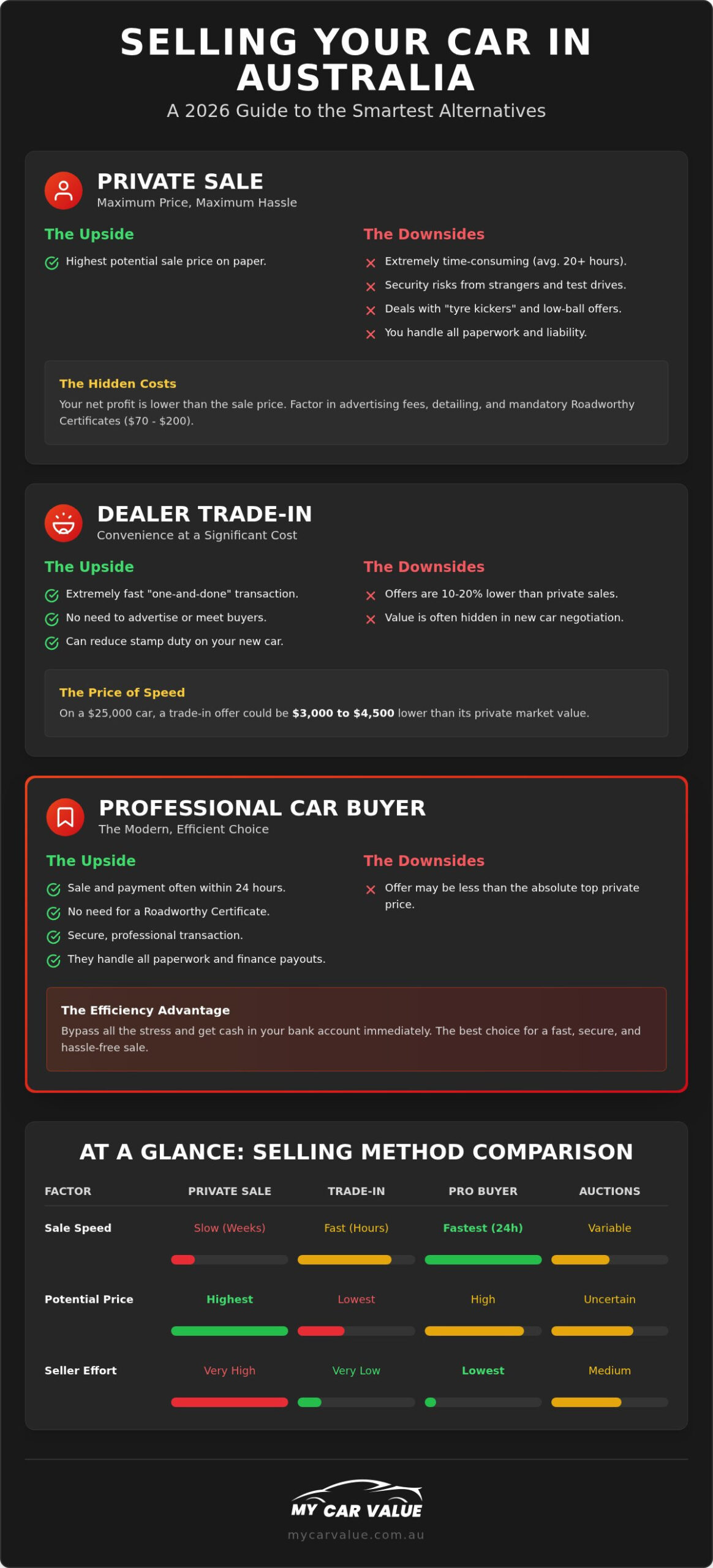
Private selling often looks like the most profitable route on paper. Most sellers focus solely on the potential “top dollar” figure without accounting for the friction involved. However, the 2026 market presents unique challenges that make alternatives to selling car privately increasingly attractive. Beyond the listing price, you must consider the “hidden costs” that chip away at your final take-home amount. These expenses include advertising fees on major classified sites and professional detailing to ensure the car is market-ready. In states like Victoria and Queensland, you also face the mandatory cost of a Roadworthy Certificate (RWC) or Safety Certificate, which typically ranges from $70 to $200 depending on your location.
Security is another major factor. Inviting strangers to your home for inspections and test drives carries inherent risks. Verifying bank transfers and managing the transfer of registration paperwork adds layers of administrative stress. Then there is the “tyre kicker” factor. You might spend three weekends washing the car and waiting for enquiries only to be met with low-ball offers or people who never show up. When you calculate the value of your lost free time, that perceived price premium often vanishes. Your weekends are worth more than the few hundred dollars you might save by doing the heavy lifting yourself.
The Reality of the 2026 Australian Used Car Market
Buyers today are more informed and cautious than ever. They expect a comprehensive overview of the used car market and total transparency regarding a vehicle’s history. With record new car sales in mid-2026 creating a surplus of trade-ins, the used market has shifted. Prices for used SUVs and utes have softened by approximately 12.6% year-on-year. In this volatile environment, holding out for a private buyer for weeks can actually result in a lower sale price than accepting a professional offer today. Speed is often your best financial strategy.
Calculating Your Net Profit vs. Sale Price
It is vital to distinguish between sale price and net profit. If you sell privately for $25,000 but spend $500 on repairs for an RWC, $200 on ads, and 20 hours of your time, your actual return is much lower. A professional used car buyer might offer a slightly lower gross figure, but they handle the paperwork and take the car as is. Often, this results in more cash in hand and immediate relief from ongoing liability. You bypass the $2 PPSR search fee and the headache of registration transfers entirely.
The Dealer Trade-In: Convenience at a Cost
Trading in your vehicle at a dealership is the most common of the alternatives to selling car privately. It offers a “one-and-done” transaction. You drive your old car to the showroom and leave in a new one. This path eliminates the need to manage listings or wait for individual buyers. While convenient, this speed comes with a financial trade-off. Dealers must account for reconditioning and profit margins. On average, dealer trade-in offers sit 10% to 20% lower than private sale prices. For a $25,000 vehicle, this can mean a gap of $3,000 for a small hatchback or up to $4,500 for a family SUV. According to the official government guide to selling cars, you should weigh this convenience against the potential for a higher price elsewhere.
There are hidden financial perks to this method. In many Australian states, trading in can reduce the stamp duty on your new vehicle purchase. The trade-in value is subtracted from the purchase price of the new car. You only pay duty on the net difference. However, watch out for “smoke and mirrors” during the negotiation. A dealer might offer an inflated price for your trade-in but refuse to discount the new car’s retail price. Always negotiate the two figures separately to ensure you’re getting a genuine deal. If the numbers don’t add up, it pays to Value My Car through an independent platform first.
When a Trade-In Makes Financial Sense
A trade-in is highly effective if your vehicle is encumbered. Dealers are experts at handling finance payouts. This removes a significant administrative burden from your shoulders. It also simplifies the financing of your new car by using your current equity as an immediate deposit. If your car is older or has high kilometres, a dealer may simply send it to wholesale. Don’t expect a premium offer in those cases. The primary value here is the total lack of paperwork headaches for the seller.
Tips for Maximising Trade-In Value
Preparation still matters even when you aren’t selling to a private buyer. Presenting a complete car service history check proves you’ve maintained the vehicle. This gives the dealer more confidence in its resale value. Fix minor cosmetic issues like small dents or faded trim to boost the first impression. Before you walk into the showroom, use a vehicle market value calculator to establish a realistic baseline. Knowing the numbers beforehand prevents you from accepting an under-valued offer on the spot.
Professional Used Car Buyers: The Modern Alternative
Professional used car buyers represent the fastest-growing segment in the Australian automotive market. Since 2023, these services have seen a 34% growth as sellers prioritise speed over the grind of private listings. Unlike a dealership trade-in, which is often a secondary part of a new car purchase, professional buyers exist solely to purchase stock. This specialisation allows them to offer a streamlined, data-driven process that can see a sale completed in under 24 hours. It is one of the most effective alternatives to selling car privately because it provides immediate cash flow for your next project without the typical “listing period” that can stretch for weeks.
It’s important to distinguish between direct buyers and facilitated networks. A direct buyer makes an offer to purchase the car themselves for their own inventory. A facilitated network acts as a savvy intermediary, connecting you with multiple professional purchasers simultaneously. This competition often results in a higher net return because you aren’t limited to a single buyer’s valuation. You get the benefit of a professional marketplace working on your behalf.
How Professional Buyer Networks Work
A professional used car buyer operates within a high-volume ecosystem. They can often beat dealer trade-in offers because they don’t carry the massive overheads of a physical retail showroom. The inspection process is built for efficiency. A representative typically visits your home or office to conduct a brief, objective assessment. They focus on mechanical integrity and current market demand. This is a purely commercial transaction, stripped of the emotional haggling found in the private market.
Why Transparency is the Professional Seller’s Best Tool
Transparency is your greatest asset when dealing with pros. Providing a recent ppsr check proves your vehicle has a clear title and no recorded write-off history. This small step, which costs just $2 in 2026, builds immediate trust and accelerates the offer process. When you provide an accurate description of your car’s condition, buyers can provide firm, non-negotiable final offers. This eliminates the “tyre kicker” phase entirely. Most professional services also include “no-fuss” collection, meaning you don’t even have to drive the car to a drop-off point. This aligns with official government advice on selling cars, which suggests exploring all professional avenues to ensure a secure and legally compliant transaction.
Car Auctions: Is the High-Risk Route Worth It?
Car auctions provide a high-stakes environment where the final sale price is determined by the room’s energy on the day. This is one of the more volatile alternatives to selling car privately. Unlike professional buyer networks that provide a fixed offer based on market data, auctions rely on competitive bidding. This “As-Is” format is the primary route for unique, damaged, or older vehicles that many dealerships refuse as trade-ins. However, sellers must account for a complex fee structure that can significantly diminish the final return. Major Australian auction houses like Pickles and Manheim charge various premiums, including entry fees and a commission on the hammer price. For vehicles over $2,000, these commissions typically range from 1.5% to 1.65%.
Risk management is critical when using this method. Setting a realistic reserve price ensures you don’t lose the vehicle for a figure far below its wholesale worth. If the bidding fails to meet your reserve, you still pay “no-sale” fees and transport costs. in the current 2026 market, where used car prices for SUVs and utes have softened by 12.6%, an auction can be a gamble. You might find a room full of bargain hunters rather than serious buyers. This uncertainty makes auctions a less predictable choice for those needing a guaranteed financial outcome.
Types of Vehicles Best Suited for Auction
Auctions excel for specific vehicle categories. Classic cars, rare imports, and high-performance enthusiast models often spark bidding wars that exceed standard market valuations. Commercial fleets and ex-government vehicles also move well in this space due to established wholesale interest. For standard passenger cars, however, the car auction alternatives like professional buyer networks often provide more certainty. Standard models are currently flooding the market, making them less likely to stand out in a crowded auction catalogue.
The Auction Timeline: What to Expect
The process begins with vehicle drop-off and a professional appraisal. Once listed, your car might wait a week or more for the scheduled event. After the hammer falls, the timeline to receive funds isn’t always immediate. It can take several business days for the auction house to process the buyer’s payment and transfer the net amount to your bank account. If the car fails to meet the reserve, you must decide whether to lower your expectations for the next event or collect the vehicle and try a different method. This lack of immediacy can be a major drawback if you need funds for a new purchase today.
How to Choose the Right Selling Method for Your Vehicle
Selecting the best path depends on three variables: time, money, and effort. If you need funds in your bank account within 24 hours, the professional buyer route is unbeatable. If you are upgrading and want to simplify the transaction, the dealer trade-in is a logical choice. However, if your vehicle is a rare enthusiast model, an auction might yield the highest return. By exploring alternatives to selling car privately, you regain control over your schedule. You no longer have to wait for the “right” buyer to appear in your driveway. Instead, you choose the method that fits your current life situation. Assess your car’s condition honestly. A “fixer-upper” with mechanical issues is often rejected by dealers but may find a home at a wholesale auction. Conversely, a “dealership quality” vehicle with low kilometres will attract the strongest offers from professional buying networks.
The “Value vs. Effort” Decision Matrix
Use a methodical approach to filter your options. Start by defining your baseline. Use a sell my car guide to see where your specific make and model sits in the 2026 market. This prevents you from flying blind during negotiations. First, obtain an accurate market valuation to understand the ceiling price. Second, get a firm quote from a professional buyer. This represents your “floor” price, the guaranteed amount you can get without any effort. Finally, compare this to a dealer trade-in offer. If the dealer’s price, plus the stamp duty savings on your new purchase, exceeds your floor price, take the trade-in. If not, the professional buyer remains your most efficient exit strategy.
Final Preparation for a Seamless Sale
Efficiency requires preparation. Gather your rego papers, complete service logs, and all spare keys. A missing key can cost hundreds of dollars to replace and often reduces a professional offer. Conduct a final PPSR check to ensure no surprise finance encumbrances or write-off records stall the transaction. This transparency builds immediate trust with professional buyers and auction houses alike. Finally, define your car’s value proposition in one sentence. For example: “One owner, always garaged, with full manufacturer service history.” This clarity helps buyers make fast decisions. By following this structured approach, you ensure a secure, high-speed transaction that respects your time and maximizes your return.
Take Control of Your Car Selling Journey
The 2026 Australian car market moves too fast for the slow, high-friction world of private listings. You’ve seen how the hidden costs of safety certificates and time-wasting enquiries can quickly erode a perceived price premium. Whether you choose the convenience of a dealer trade-in or the competitive bidding of an auction, your priority remains a secure and efficient transaction. Exploring modern alternatives to selling car privately ensures you keep more of your time while still achieving a fair market price. Success comes down to using the right tools to benchmark your vehicle and bypass the traditional stress of the marketplace.
Our platform bridges the gap between your driveway and a successful sale. We provide free, data-driven market valuations and connect you with an Australia-wide network of professional buyers. This secure and streamlined process does the heavy lifting for you. It allows you to focus on your next vehicle purchase instead of managing strangers at your home.
You don’t have to settle for the frustration of “tyre kickers” and low-ball offers. Make a savvy move today and experience a faster, safer way to sell.
Frequently Asked Questions
Is it better to trade in or sell my car to a professional buyer?
The best choice depends on your immediate needs. A trade-in is ideal if you want to reduce the stamp duty on a new purchase and prefer a single transaction at a dealership. Professional buyers are often a superior choice if you aren’t buying a replacement immediately or want to compare multiple offers. Professional buyers focus entirely on purchasing stock, which often leads to a more transparent and faster transaction than a dealership trade-in.
Do I need a Roadworthy Certificate (RWC) to sell to a professional buyer?
No, you generally don’t need a Roadworthy Certificate when selling to a licensed professional buyer or dealer. While private sales in Victoria and Queensland require these certificates, which cost between $70 and $200, professional buyers purchase vehicles in their current condition. This saves you the inspection fee and the risk of paying for expensive repairs. It’s a significant advantage for those looking to sell quickly without upfront costs.
How long does it take to get paid when using a car-buying service?
Most professional car-buying services finalise payments within 24 hours of a successful inspection. Once you accept the offer, funds are typically transferred via Osko or Electronic Funds Transfer (EFT). This speed is a major benefit compared to private sales, which can take weeks to secure a buyer and clear a bank transfer. It provides immediate cash flow for your next project or vehicle purchase without any waiting period.
Can I sell my car if it still has money owing on it?
Yes, you can sell an encumbered vehicle to a professional buyer. They will contact your finance provider to obtain a payout figure and settle the debt directly on your behalf. If the car’s value exceeds the debt, you receive the difference as a cash payment. If the value is lower, you simply pay the shortfall to the buyer. This process is much safer than managing a payout during a private transaction.
What is the safest alternative to selling a car privately in Australia?
Using a professional buyer network is the safest of the alternatives to selling car privately. You eliminate the security risks of strangers visiting your home and the danger of fraudulent payments or “dodgy” test drives. These transactions occur with a licensed business entity, ensuring a transparent paper trail and immediate, verified payment. It removes the uncertainty and ongoing liability associated with unregulated private deals in the 2026 market.
Will a professional buyer buy my car if it has mechanical issues?
Yes, many professional buyers specialise in purchasing vehicles regardless of their mechanical condition. While a dealership might refuse a “fixer-upper” as a trade-in due to low demand, professional networks have the resources to repair or wholesale vehicles with issues. You should provide an accurate description during the valuation process to ensure the final offer remains firm. This is often the most efficient way to offload a vehicle needing repairs.
How do I know if an online car valuation is accurate?
An accurate valuation must be based on real-time market data rather than static price guides. Look for services that consider current demand and the softening prices for SUVs and utes seen in mid-2026. While a guide provides a baseline, a firm offer from a professional buyer is the only true measure of market value. Using a data-driven platform ensures your valuation reflects the latest wholesale trends across the Australian market.
What documents do I need to sell my car without a private ad?
You will need your current registration papers, a valid photo ID like a driver’s licence, and a complete service history. If the vehicle is under finance, bring a recent payout letter from your lender. Providing a $2 PPSR certificate is also helpful to prove the title is clear and speed up the process. These documents allow professional buyers to verify ownership and finalise the sale quickly, often on the same day.