

Factors Affecting Car Valuation in Australia: The 2026 Seller’s Guide
Did you know that 48.4% of new vehicles sold in Australia are now electrified? This massive shift in the 2026 market is fundamentally changing how we price every vehicle on the road. Understanding the specific factors affecting car valuation Australia wide is no longer as simple as checking the odometer. With the New Vehicle Efficiency Standard (NVES) now in full swing, your petrol or diesel car’s worth is being weighed against a rapidly evolving landscape of fuel efficiency and buyer demand.
Selling a car often feels like a guessing game where the rules keep changing. It’s easy to feel uncertain about fair market value or fear being low-balled by a dealer who sees a different number than you do. This guide will show you exactly how to determine your vehicle’s true market value in the current climate and how to prepare your car to maximise your return. We will break down the impact of 2026 emissions standards, the role of PPSR transparency, and how starting with a Value My Car assessment provides the clarity you need to negotiate with confidence.
Key Takeaways
- Learn how the 2026 New Vehicle Efficiency Standard (NVES) and shifting fuel costs are redefining demand for petrol and electrified vehicles.
- Identify the specific factors affecting car valuation australia wide, including the critical distinction between a vehicle’s model year and its actual age.
- Understand why a clean PPSR report is non-negotiable and how resolving outstanding finance before a sale prevents unnecessary delays.
- Discover the “easy win” mechanical fixes and detailing choices that significantly boost your final appraisal figure.
- Explore why connecting with professional used car buyers offers a faster, more secure alternative to the uncertainty of private classifieds.
The 2026 Australian Automotive Landscape: What Drives Value Now?
The Australian car market in 2026 is unrecognisable compared to the start of the decade. Supply chains have finally stabilised, meaning the days of paying inflated premiums for three-year-old cars are largely over. Today, the primary factors affecting car valuation australia include how well a vehicle aligns with the New Vehicle Efficiency Standard (NVES). High-emission vehicles now face steeper depreciation curves as buyers prioritise fuel efficiency and lower running costs over raw engine power.
Market value is no longer a static figure found in a printed book. It’s a moving target influenced by real-time auction data and international shipping costs. If a new model launch is announced, the value of the previous generation can drop overnight. This volatility makes it essential to use a data-driven tool like Value My Car to get an up-to-the-minute assessment based on actual Australian sales results. Professional buyers use your Vehicle Identification Number (VIN) to track these trends and ensure your offer reflects current stock levels across the country.
Supply vs Demand in the Post-Shortage Era
New car availability now dictates second-hand prices across the country. When you can walk into a showroom and drive away within weeks, used car premiums vanish. However, some popular models still command an “instant gratification” premium if wait times for new orders exceed three months. Market equilibrium in 2026 occurs when new car delivery times drop below three months, effectively capping the resale price of near-new used vehicles. This shift has returned power to the buyer, making transparency more important than ever for sellers who want a fair price.
Fuel Economy and Segment Shifts
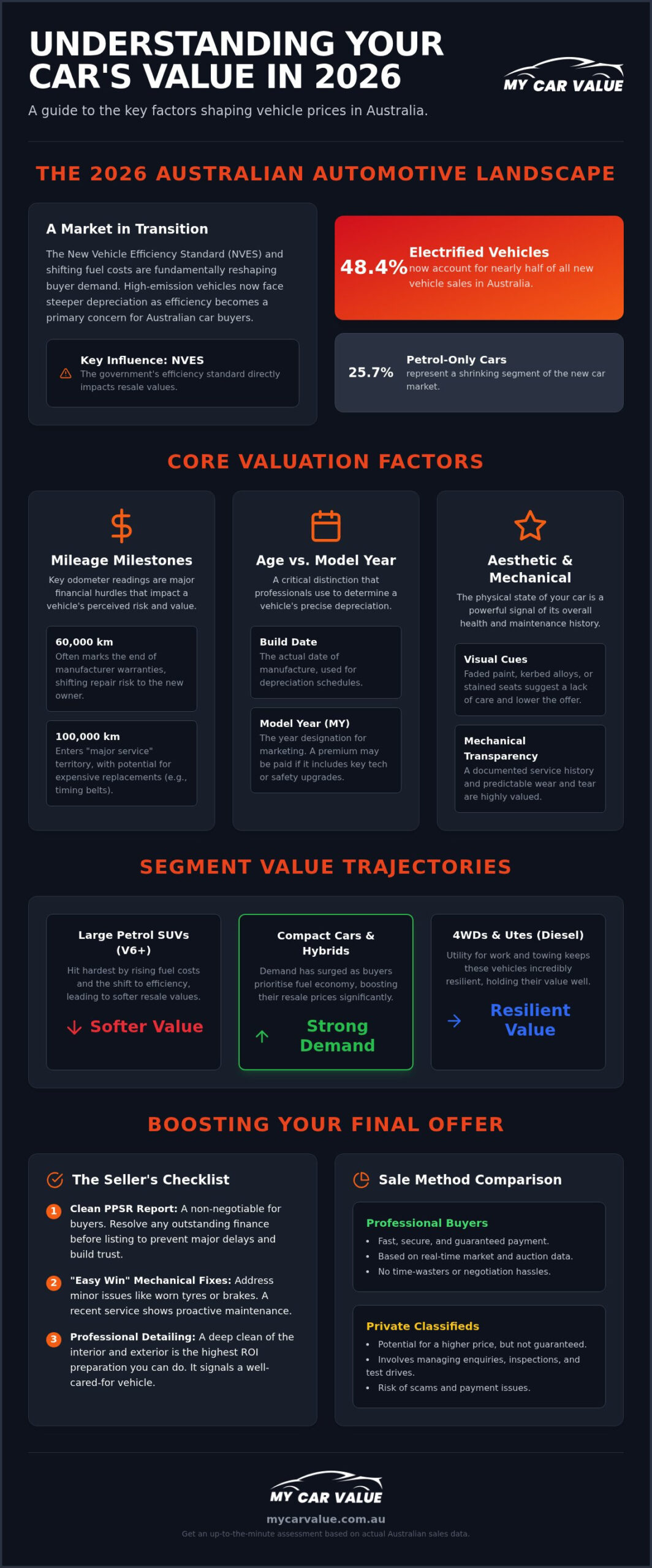
Rising fuel costs have split the market into two distinct camps. Large petrol-only SUVs are no longer the default choice for families, leading to softer resale values for older V6 models. Instead, demand has surged for compact cars and hybrids that offer better economy. July 2026 data shows that electrified vehicles now account for 48.4% of all new car sales. This trend directly impacts the resale value of older petrol models, as petrol-only cars now make up just 25.7% of the new car market. Understanding these factors affecting car valuation australia is vital for setting realistic expectations.
Despite the shift toward electrification, 4WDs and utes remain incredibly resilient. Australian buyers still value the utility of a diesel Hilux or Ranger for work and towing. These vehicles often maintain their value better than passenger cars because their practical application is harder to replace with current electric technology. Understanding these segment-specific trends is the first step toward a successful sale in a modernised marketplace.
Core Vehicle Factors: The Foundations of Your Valuation
While market trends dictate the ceiling of what you can earn, the physical reality of your vehicle sets the floor. Every professional appraisal begins with the core data points that define a car’s lifecycle. These foundational factors affecting car valuation australia include the odometer reading, the build date, and the overall mechanical transparency of the vehicle. Buyers look for a predictable ownership experience, so any deviation from “standard” wear and tear will immediately trigger a price adjustment.
Understanding the distinction between Age and Model Year (MY) is critical for a precise valuation. A car manufactured in late 2024 may be marketed as a 2025 Model Year because it contains the updated features of the newer series. Professional buyers prioritise the build date for depreciation schedules but will pay a premium for the MY designation if it includes significant tech or safety upgrades. Your first step should always be to Value My Car using these specific details to see how they influence the current market price.
Aesthetic condition serves as a powerful signal for mechanical health. A car with faded paint, stained upholstery, or kerbed alloys suggests a lack of preventative maintenance. Even if the engine is perfect, these visual cues create “buyer friction” that lowers the final offer. Most professionals assume that if a seller didn’t care for the exterior, they likely didn’t care for the drivetrain either.
Mileage Milestones and Depreciation Curves
In Australia, the 60,000km and 100,000km marks are major psychological and financial hurdles. The 60,000km milestone often coincides with the end of many manufacturer warranties, shifting the risk of repair from the brand to the new owner. Once a car crosses 100,000km, it enters “major service” territory. This is where expensive items like timing belts, water pumps, and suspension bushings often require replacement. Professional buyers calculate the remaining component life based on these milestones, meaning a car at 95,000km is often valued significantly lower than one at 85,000km because of the looming maintenance bill.
The Logbook: Your Car’s Financial Resume
A completed logbook is the most valuable document in your glovebox. A “Full Dealer History” proves that the car has been maintained to factory standards using genuine parts, which preserves the highest possible value. Conversely, a “Partial History” or a missing logbook creates a black hole of risk. Missing just one major service can slash thousands off a valuation because the buyer must assume the worst about the engine’s internal health. You can use a car service history check to organise your records and prove your vehicle’s worth. This transparency, combined with a clean report from the Personal Property Securities Register (PPSR), ensures you enter negotiations with an unshakeable foundation.
Transparency and Risk: PPSR, VIN, and History Checks
Digital transparency is the cornerstone of the 2026 Australian used car market. While a shiny exterior and low kilometres are attractive, they mean nothing without a clean digital history. Professional buyers prioritise data over appearances, using several national databases to verify a vehicle’s past. These digital factors affecting car valuation australia act as the final filter for any offer. If the data trail shows red flags, the valuation will plummet or the sale will be rejected entirely.
The Personal Property Securities Register (PPSR) is the primary tool used to verify a vehicle’s legal standing. For a small fee of $2.00, a buyer can see if a car has a “clear title” or is burdened by financial encumbrance. If you still owe money to a bank or lender, the car is encumbered. Most professional used car buyers require this debt to be settled before or during the transaction. Selling a car with hidden debt is not just difficult; it’s a legal dead end that stops a sale in its tracks.
Understanding Your PPSR Status
A clear PPSR report confirms three things: no money is owing, the vehicle hasn’t been reported stolen, and it isn’t listed as a statutory write-off. Professional buyers use these reports to mitigate risk and ensure they aren’t purchasing a liability. A PPSR check is the non-negotiable first step in valuation for any serious transaction. Providing a current Certificate of Roadworthiness further validates the vehicle’s status and safety, adding another layer of transparency that buyers across Australia value.
The Impact of Accident History
Accident history is recorded on the Written-Off Vehicle Register (WOVR). It’s vital to distinguish between minor cosmetic repairs and structural entries. A car listed as a “Repairable Write-Off” has been professionally fixed and inspected, but it will always carry a lower market value than a car with no WOVR history. Statutory write-offs can never be re-registered in Australia. They have zero resale value beyond their parts.
Transparency about past repairs actually builds trust with buyers. If you have receipts for professional smash repairs, present them early. It proves the work was done correctly and safely. To understand how these history markers might influence your price, use a vehicle market value calculator to set realistic expectations before the official check occurs. Verifying that the physical specs match the digital identity tied to the VIN ensures no surprises during the final appraisal. This verification is one of the most significant factors affecting car valuation australia today.
Presentation and Preparation: Boosting the Final Figure
Presentation is the most controllable of all factors affecting car valuation australia. While you can’t change your car’s age or mileage, you can influence a professional buyer’s perception of its worth. A vehicle that looks and smells like new suggests a history of careful ownership. Personal clutter and road grime force a buyer to look closer for hidden faults. Small investments in preparation often yield a significant return on the final offer price.
Mechanical “easy wins” are often overlooked. If your car has a squeaky belt or a blown headlight bulb, fix it before the appraisal. These minor issues cost very little to rectify but can lead a buyer to suspect larger, more expensive mechanical problems. Pay close attention to your tyres and brakes. If the tread is near the legal limit or the rotors are warped, a professional buyer will deduct the full retail cost of replacement from your valuation. Replacing them yourself with quality mid-range parts can often preserve more of your car’s equity.
The ROI of Cosmetic Repairs
Deciding when to spend money on a professional detailer is a matter of return on investment. A basic home wash is rarely enough to secure a top-tier price. Professional detailers use clay bars and paint correction to remove oxidation and fine scratches that a standard sponge misses. If you want to maximise your sell my car return, focus on the interior. A scent-free, spotless cabin with steam-cleaned carpets removes the psychological barrier of “someone else’s mess,” making the car much easier for a buyer to price aggressively.
Documentation and Accessories
Organised paperwork acts as a final layer of security for the buyer. Gather all service receipts, owner’s manuals, and warranty documents into a single folder. One of the most significant value-drivers is the presence of both sets of keys. Replacing a modern proximity key can cost upwards of $500, so missing the spare is an automatic deduction. Ensure all original accessories like floor mats, cargo blinds, and tow bars are in the vehicle. Finally, verify that all factory recalls have been addressed. A car with an open safety recall is a liability that many professional buyers will avoid until it’s rectified.
Professional Buyers: The Efficient Way to Realise Value
Private sales often promise a higher retail price, but they rarely account for the hidden costs of time and security risk. In the 2026 market, the gap between a private listing and a professional offer has narrowed. Professional used car buyers focus on volume and stock turnover rather than individual profit margins. This shift is one of the key factors affecting car valuation australia wide. Dealing with a professional means you avoid the “tyre kicker” frustration and the constant no-shows associated with classifieds.
The speed of the transaction is the primary benefit of this approach. A private sale can take weeks to finalise, often involving multiple inspections and failed finance applications. A professional buyer operates with immediate liquidity. You can move from an initial valuation to cash in your bank account within 24 to 48 hours. This efficiency is essential for sellers who need to fund their next vehicle purchase or clear debt without delay. It strips away the complexity of a typically stressful process.
The Advantage of a Professional Network
Using a platform like My Car Value connects you to a national network of licensed motor vehicle traders. This creates immediate competitive tension for your vehicle. Different buyers have different needs. One trader might be looking for a specific SUV to fill a stock gap, while another specialises in fuel-efficient hybrids. Because they have specific orders to fill, they are often willing to pay a premium for the right car. Dealing with licensed professionals also ensures you are protected by Australian industry regulations and secure payment methods.
Next Steps: How to Value Your Car Today
Ready to see what your car is worth? Start by using the online valuation tool to get an accurate market assessment. You don’t need to be a mechanic to provide the right details. Just ensure you have your VIN, current odometer reading, and a honest summary of the car’s condition. These are the primary factors affecting car valuation australia that buyers look for first. Accurate data leads to a more precise initial estimate.
The process transitions quickly from an online estimate to a firm, professional offer. Once you submit your details, the system matches your car with buyers who are actively looking for that specific make and model. This modern approach puts you in control while the professionals do the heavy lifting. It’s a reliable, fast, and impartial way to navigate a crowded marketplace. Start your valuation today and experience a faster way to realise the true value of your vehicle.
Take Control of Your Car’s Value in 2026
The Australian automotive market has shifted toward transparency and efficiency. Success in today’s landscape requires more than just a clean car; it demands an understanding of how the New Vehicle Efficiency Standard and digital history checks influence your final price. By focusing on complete logbook records and addressing minor mechanical issues, you position your vehicle as a premium asset. Understanding the factors affecting car valuation australia ensures you don’t leave money on the table when it’s time to sell.
You can now bypass the uncertainty of private classifieds and the frustration of low-ball offers. Accessing a national network of professional used car buyers through a streamlined digital process provides the speed and clarity you need. Expert guidance on current market trends allows you to move from an initial estimate to a firm offer with complete confidence.
Take the guesswork out of your next sale. With the right preparation and professional connections, you can secure a fair price and move forward with your next vehicle purchase today.
Frequently Asked Questions
How much does a high odometer reading affect my car’s value in Australia?
A high odometer reading significantly reduces a vehicle’s market worth. In Australia, the 100,000km mark is a major psychological barrier that often triggers a steep drop in valuation. This is because many components require expensive maintenance at this stage. Professional buyers calculate the remaining life of the engine and transmission based on these figures. Low-kilometre cars always command a premium because they represent lower immediate risk for the next owner.
Does having a full service history really make a difference to the price?
A full service history is one of the most critical factors affecting car valuation australia wide. It acts as a financial resume, proving the vehicle has been maintained to factory standards. A car with a complete logbook can be worth thousands more than an identical model with missing records. Buyers view a skipped service as a red flag for potential mechanical failure. Always keep your receipts to justify a higher asking price.
What is the difference between Redbook value and market value?
Redbook provides a generalised guide based on historical data and average condition. Market value represents the actual price a buyer is willing to pay in the current economic climate. Real-world offers fluctuate based on local demand, new car wait times, and current fuel prices. While Redbook is a useful starting point, professional buyers use real-time auction data and stock levels to provide a more accurate and actionable valuation for your specific vehicle.
Can I sell my car if it still has finance owing on it?
Yes, you can sell a car with finance owing, but the debt must be settled during the transaction. This is known as financial encumbrance. Professional buyers will typically contact your finance provider to obtain a payout figure. They then pay the lender directly and give you the remaining balance. It’s a standard process that ensures the buyer receives a clear title, which is essential for a legal and transparent vehicle transfer.
How do aftermarket modifications impact my vehicle’s valuation?
Aftermarket modifications rarely increase a car’s value and often decrease it. While you may have spent thousands on custom wheels or performance parts, most professional buyers prefer factory-standard vehicles. Modifications can signal that the car has been driven hard or may have reliability issues. Unless the buyer is looking for a specific niche build, they will likely deduct the cost of returning the vehicle to its original manufacturer specifications.
Why is my car’s colour affecting the offers I receive?
Colour significantly impacts resale speed and value. Neutral tones like white, silver, and grey are the most popular in Australia because they are easier to maintain and appeal to a broader range of buyers. Bold or unusual colours like bright green or purple often receive lower offers because they are harder to sell on the second-hand market. Professional buyers prioritise safe colours that they can turn over quickly in their inventory.
What happens if my car is listed on the Written-Off Vehicle Register (WOVR)?
A listing on the Written-Off Vehicle Register (WOVR) has a permanent negative impact on valuation. Statutory write-offs cannot be re-registered and are only worth their scrap value. Repairable write-offs can be sold once fixed and inspected, but they typically fetch significantly less than a car with a clean history. This data is a permanent part of the vehicle’s record and is one of the primary factors affecting car valuation australia buyers check.
How long is a car valuation quote usually valid for in the Australian market?
Most professional car valuation quotes are valid for seven days. The Australian used car market moves quickly, with prices shifting based on weekly auction results and new model announcements. If you wait longer than a week, the buyer may need to re-appraise the vehicle to reflect any changes in market demand or stock levels. It’s best to act quickly once you receive a firm offer to ensure you lock in the current market price.