

Free Car Valuation Calculator: How to Estimate Your Vehicle’s Worth in 2026
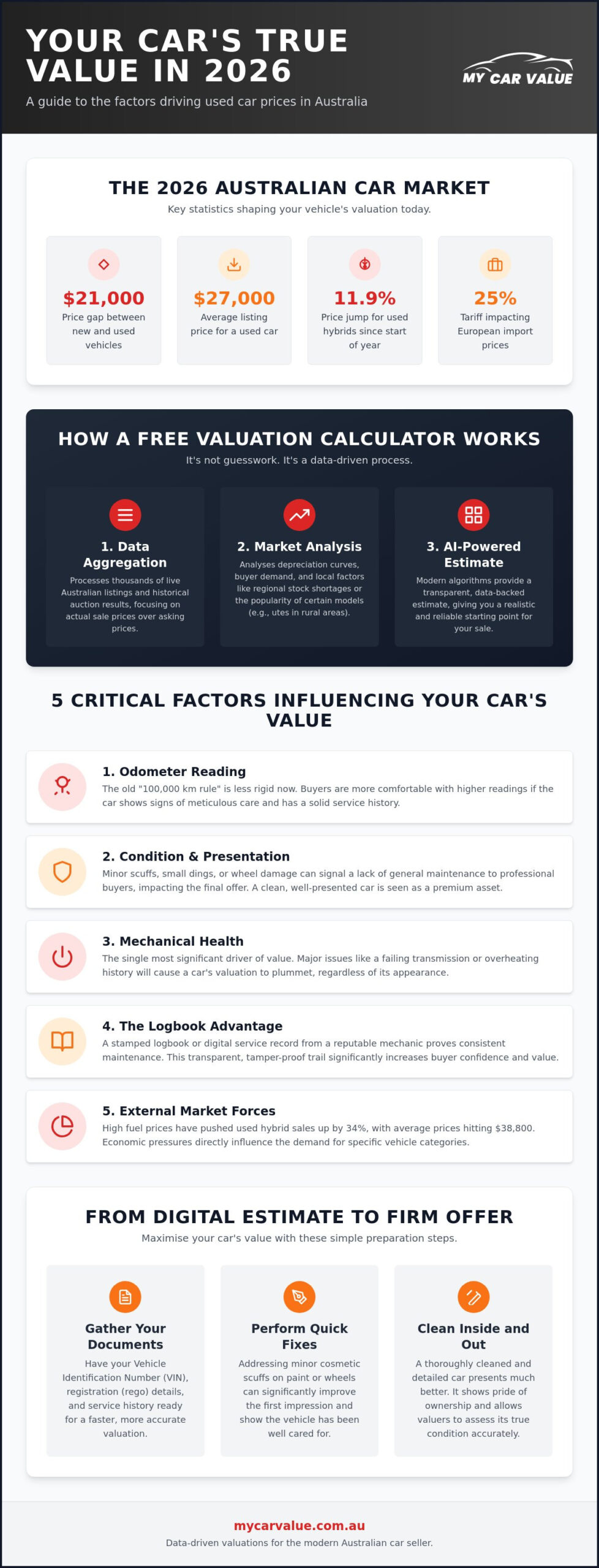
The price gap between new and used vehicles has widened to a staggering $21,000 in 2026. With the average used car listing price now approaching $27,000, you likely feel the pressure to get your asking price exactly right. It’s common to feel frustrated by conflicting estimates and the fear of being low-balled by dealers. Finding a reliable free car valuation calculator shouldn’t result in a flooded inbox or confusing jargon. You deserve a straightforward starting point that reflects the actual state of the market.
We’ll show you how to transform a digital estimate into a firm cash offer. This guide breaks down the factors driving value today, from the 25% tariff on European imports to the 11.9% price jump in used hybrids since the start of the year. You’ll gain a clear understanding of what your car is worth and how to bypass the typical stress of private sales. Expect a logical, step-by-step look at current market data that puts you back in control of the selling process.
Key Takeaways
- Understand how a free car valuation calculator uses real-time sales data and depreciation curves to pinpoint your car’s market value.
- Identify the critical 2026 value drivers, including how odometer readings and minor cosmetic scuffs impact your final price.
- Learn how to bridge the gap between an automated digital estimate and a firm cash offer from professional used car buyers.
- Discover the “Quick Fix” checklist and data gathering steps, like having your VIN and rego ready, to ensure maximum accuracy.
- Streamline your selling journey by connecting with reputable automotive purchasers across Australia without the hassle of private listings.
What is a Free Car Valuation Calculator and How Does It Work?
A free car valuation calculator is a sophisticated digital tool designed to estimate a vehicle’s current market worth by processing thousands of data points simultaneously. It isn’t a random number generator. Instead, it acts as a bridge between your car’s specific details and the broader economic environment. To understand the true value of your vehicle, you need to look at car valuation as a dynamic process rather than a fixed figure. These tools allow you to bypass the traditional stress of manual research by providing an instant, data-driven starting point.
The “maths” behind the screen involves intersecting three primary lines: historical sales data, current depreciation curves, and immediate buyer demand. In 2026, this calculation has become increasingly complex. Algorithms now account for real-time market shifts, such as the 25% tariff on European imports and the surging popularity of used hybrids. Local Australian factors, like shipping delays or regional stock shortages, also influence the final estimate. For instance, a dual-cab ute might hold its value better in rural Queensland than in a metro centre due to specific local utility demand. A reliable free car valuation calculator adjusts for these variables to give you a realistic price range.
The Role of Data Aggregation
These tools function by pulling information from thousands of live Australian listings and historical auction results. There is a critical distinction between an “asking price” and a “sale price.” While a private seller might list a sedan for $30,000, the actual transaction data might show similar models moving for $27,500. Reliable calculators prioritise actual sale figures to ensure your estimate is grounded in reality. This prevents you from setting unrealistic expectations based on optimistic classified ads. Market data is the backbone of any reliable calculator.
Why ‘Free’ Doesn’t Mean ‘Basic’
Gone are the days of flicking through physical Redbook charts to find a rough estimate. Modern valuation technology uses AI-driven estimates to provide a level of transparency previously reserved for professional dealers. This evolution empowers you to enter negotiations with a data-backed baseline. It levels the playing field for private sellers who otherwise might feel overwhelmed by technical talk. Using these tools provides the immediate clarity needed to decide whether to sell privately or seek a professional offer from used car buyers. It’s an efficient way to value your car without the typical pressure of a dealership floor.
5 Critical Factors That Influence Your Car’s Market Value
Your car’s value isn’t a static number found in a dusty guidebook. It’s a living figure influenced by several specific variables that change based on the current economic climate. While a free car valuation calculator provides a solid baseline, understanding these five factors helps you refine that estimate into a realistic expectation. In 2026, the widening $21,000 gap between new and used car prices has changed how buyers view older vehicles. Since the average age of vehicles on the road is increasing, a well-kept five-year-old car is now considered a premium asset.
The “sweet spot” for resale has moved. Previously, sellers aimed to offload vehicles before they hit 100,000 kilometres. Now, buyers are more comfortable with higher odometer readings if the car shows signs of meticulous care. Condition and presentation play a massive role here. Minor scuffs on alloy wheels or small dings in the door might seem trivial, but they signal a lack of general maintenance to professional buyers. Mechanical health remains the most significant driver of value. A car with a failing transmission or a history of overheating will see its valuation plummet, regardless of how shiny the paint looks after a fresh coat of wax.
The Logbook Advantage
Professional buyers prioritise vehicles with a consistent car service history. A stamped logbook from a reputable Australian mechanic proves that the vehicle has met its maintenance milestones. In 2026, digital service records are becoming the standard across the country. These records offer a transparent, tamper-proof trail that significantly increases buyer confidence. Having receipted history for major works, such as timing belt replacements or brake overhauls, adds even more weight to your final valuation. It turns a statistical estimate into a verified high-value listing.
External Market Forces
The 2026 economy has created unique pressures on specific vehicle categories. High fuel prices have pushed used hybrid sales up by 34% this year, with average prices for these models hitting $38,800 in mid-2026. Conversely, large, thirsty SUVs may face steeper depreciation if they lack modern fuel-saving technology. Seasonal demand also dictates your results. For example, 4WD values often spike in the months leading up to the holiday season as Australians prepare for touring. The 25% tariff on European imports announced in May 2026 has also made locally available used stock more valuable. Supply and demand is the ultimate price setter in the Australian automotive market.
Before you commit to a sale, it’s worth seeing how these factors impact your specific model. You can value your car online to get a clear picture of its current standing in the 2026 market.
Online Estimates vs. Real-World Offers: Navigating the Gap
An online estimate is a data-driven prediction. It is not a bank deposit. While a free car valuation calculator provides a vital statistical average based on thousands of Australian data points, it represents a starting point rather than a final cheque. The gap between a digital number and a real-world offer often stems from the difference between market theory and physical reality. Algorithms process data. They don’t process the specific nuances of your vehicle’s current state.
Calculators can’t “see” your car. An automated system can factor in your make, model, and year, but it cannot detect a faint engine rattle or the smell of stale tobacco in the upholstery. These subjective elements significantly influence what a buyer is willing to pay. In the 2026 market, where the average used car price sits near $27,000, even small physical discrepancies can lead to price adjustments of several thousand dollars. You should view your online estimate as a powerful negotiation tool. It gives you the evidence needed to justify your price, provided the car’s condition matches the data entry.
The price spectrum typically moves from the low end of a dealer trade-in to the higher, but more volatile, private sale price. Professional buyers sit in the middle. They offer a more realistic and certain outcome than a private listing, which often involves weeks of “tyre kickers” and low-ball messages. Using your valuation as a baseline allows you to identify which offers are fair and which are simply opportunistic.
Why the Price Might Vary
Several practical factors lead to adjustments during a physical inspection. Worn tyre tread, an expired rego, or upcoming major service requirements are common reasons for a lower final offer. It is also essential to understand the distinction between “Market Value” and “Liquidation Value.” Market value is what a patient seller might get after weeks of listing. Liquidation value is the price for an immediate, guaranteed sale. For a deeper look at these pricing tiers, consult our Vehicle Market Value Calculator pillar.
Professional Buyers: The Middle Ground
Many sellers find that used car buyers provide the most efficient path to a sale. These professionals offer more than a standard dealership trade-in without the safety risks and time-wasting associated with private classifieds. Connecting to a network of industry pros ensures you receive a firm offer based on current 2026 demand. Speed and certainty often outweigh the chance of a slightly higher private price that may never actually materialise. This streamlined approach turns your free car valuation calculator result into a concrete financial result with minimal friction.
How to Prepare Your Car for an Accurate Valuation
To get the most from a free car valuation calculator, you must provide precise data. Accuracy at the input stage prevents a “valuation gap” when you eventually meet a buyer. Start by gathering your vehicle’s specific identifiers. Using a generic “make and model” search often misses the nuances of your specific trim level or optional factory packs. In the 2026 market, these extras can add significant value to your final figure, especially for high-demand features like advanced safety tech or hybrid drivetrains.
Honesty is your best asset during this process. If you select “excellent condition” for a car with visible panel damage or a skipping transmission, the resulting estimate will be useless. Providing realistic data ensures the number on your screen translates into a firm offer. Timing also matters. Try to check the market mid-month when professional buyers are often looking to fill stock quotas. Avoid waiting until your rego is about to expire, as buyers will deduct that upcoming cost from their final offer.
The Technical Essentials
Locate your VIN on the compliance plate under the bonnet or at the base of the windscreen. This 17-digit code is the only way to ensure the algorithm identifies your exact build and specifications. You should also verify your PPSR status to confirm there is no outstanding finance or hidden written-off history. Understanding exactly which documents are needed to sell a car in Australia will save you from a last-minute scramble. Having your service logbook and spare keys ready also helps justify a higher condition rating in any free car valuation calculator.
Maximising Kerb Appeal
Presentation dictates the “Condition” grade you select. A professional detail often provides a much higher return on investment than a simple home wash. It removes interior odours and restores paint clarity that might otherwise lead a professional buyer to negotiate downwards. Address “easy wins” before the valuation. Replace streaky wiper blades, fix a blown headlamp globe, and ensure the tyres are correctly inflated. These small fixes suggest the car has been meticulously maintained. First impressions matter to humans and algorithms alike, as they set the baseline for the entire transaction.
Once you have your documents and car ready, you can value your car to see how these preparations have boosted your bottom line.
Beyond the Calculator: Selling Your Car with Confidence
A digital estimate provides the data, but transparency provides the result. Once you have used a free car valuation calculator to establish your vehicle’s worth, the next logical step is turning that figure into a tangible bank deposit. My Car Value bridges this gap by acting as an efficient facilitator. We help you move past the uncertainty of “what if” and into the reality of a firm offer. This process strips away the complexity of traditional selling, offering a clear path forward in a crowded 2026 marketplace.
Reducing the stress of the “Sell My Car” journey requires a commitment to honesty and speed. By connecting you with reputable automotive purchasers across Australia, our platform removes the need for stressful private listings. You no longer have to manage endless phone calls or invite strangers to your home. Instead, you follow a methodical progression that leads to a certain outcome. This data-driven approach ensures you receive a fair price that reflects the actual state of the market.
The My Car Value Process
Our workflow is designed for maximum efficiency. It follows a predictable sequence that respects your time and eliminates the friction typical of legacy systems.
- Step 1: Use the free car valuation calculator to get your baseline. This provides the essential market data needed to start the process.
- Step 2: Connect with our network of professional buyers for a firm offer. We do the heavy lifting by matching your vehicle with purchasers looking for your specific model.
- Step 3: Finalise the sale with zero stress. Once you accept an offer, the transaction moves quickly, allowing you to move on to your next vehicle without delay.
Why Choose Professional Buyers Over Auctions?
Selling at a car auction can feel like a gamble. While a high-energy bidding war sounds appealing, the reality often involves high seller fees and the risk of the vehicle not meeting its reserve. You are also at the mercy of whoever happens to be in the room on that specific day. In contrast, professional buyers offer immediate certainty. There are no commissions or hidden costs to worry about. My Car Value positions itself as the modern partner for Australian sellers, providing a direct path to payment that auctions simply cannot match.
Turning your 2026 valuation into a successful transaction requires a partner that values accuracy and transparency. We act as your savvy intermediary, ensuring the process remains smart, fast, and impartial. Take the final step and transform your digital estimate into a real-world result today.
Secure Your Best Price in the 2026 Market
Navigating the Australian automotive market in 2026 requires more than just a rough guess. You now have the tools to understand exactly what drives your car’s worth, from the impact of new import tariffs to the importance of a verified service history. By preparing your vehicle and providing precise data, you ensure your digital estimate reflects its true potential. A free car valuation calculator provides the immediate clarity you need to start the process with confidence and authority.
Moving from a digital number to a real-world result doesn’t have to be a stressful ordeal. Our platform removes the complexity of private listings and the volatility of auctions. We leverage accurate 2026 market data to connect you with a vast network of professional Australian buyers who value transparency and speed. This streamlined, no-hassle selling process ensures you get a fair outcome without the usual friction. It’s the savvy way to sell your car in a modern, data-driven environment.
Get your free car valuation and connect with professional buyers today. Take control of your sale and experience the relief of a fast, certain transaction.
Frequently Asked Questions
Is the online car valuation really free?
Yes, our free car valuation calculator is completely free to use for all Australian vehicle owners. You can access current market data without any upfront fees, hidden costs, or subscription requirements. This service provides a data-driven baseline estimate to help you understand your car’s worth before you commit to a sale. It is a zero-risk way to start your selling journey with a professional data set.
How accurate is a car valuation calculator in 2026?
Calculators in 2026 are highly accurate because they use real-time data aggregation from thousands of live Australian listings. They factor in recent market shifts, such as the 25% tariff on European imports and the rising demand for used hybrids. Accuracy depends on the data you input. Providing your specific VIN and an honest condition report ensures the estimate reflects the actual state of the market.
Do I need to provide my phone number for a valuation?
You typically provide contact details to receive your valuation and connect with professional buyers. This step is essential if you want to turn a digital estimate into a firm cash offer. While some tools offer a generic range without details, providing a number allows a specialist to verify your car’s specifics. This leads to a more certain and efficient transaction without the hassle of private listings.
What is the difference between Redbook value and market value?
Redbook functions as a historical guide based on standardised data, while market value reflects what buyers are paying right now. Market value is more dynamic and accounts for immediate supply and demand shifts. In 2026, market value is often higher than traditional guides due to the widening gap between new and used car prices. If you want to understand exactly how a vehicle red book value is calculated and why it can lag behind live market reality, our dedicated guide breaks down the key differences in detail. Using a free car valuation calculator helps you see these real-time price fluctuations.
Can I get a valuation for a car with a blown engine or mechanical issues?
You can get a valuation for a car with mechanical issues, but the estimate will be adjusted to reflect its condition. Professional buyers often look for vehicles with blown engines or major faults for salvage or repair purposes. Be transparent about the mechanical state when entering details. This ensures the offer you receive is realistic and avoids disappointment during the physical inspection stage.
How often should I update my car’s valuation estimate?
We recommend updating your estimate every 30 days to stay current with the fast-moving Australian market. Wholesale used vehicle prices increased by 2.1% in mid-2026, proving how quickly values can shift. Major economic changes or seasonal demand also impact your car’s worth. Regular checks ensure you don’t miss the “sweet spot” for your specific make and model before listing it for sale.
Will a car valuation tool tell me my trade-in price?
Most tools show a price range that includes trade-in, private sale, and professional buyer estimates. A trade-in price is usually at the lower end because the dealer assumes the risk and reconditioning costs. If you want a better result than a standard trade-in, connecting with professional used car buyers often yields a more competitive and certain offer. This provides a middle ground that values your time and your vehicle.
Does a valuation include the price of my aftermarket accessories?
Standard algorithms focus on factory specifications and may not fully value aftermarket accessories like bull bars or roof racks. These items are best assessed by a human professional rather than an automated tool. While the calculator provides the baseline for the base model, a professional buyer can adjust the final offer to include the value of these additions. Mention these extras clearly when speaking with a buyer to maximise your result.