

Vehicle Red Book Value: A Guide to Australian Car Valuations in 2026
What if the official number you’re relying on to sell your car is already six months behind the actual market? Most Australian car owners treat a vehicle red book value as the final word on what their car is worth, but the reality is often more complex. You are likely facing conflicting online data and the fear of being low-balled by dealers. It is frustrating to see a guide price that doesn’t match the real-world offers you are receiving right now.
We understand you want a fair price without the headache of endless negotiations. This guide clarifies how RedBook valuations are calculated and why they can lag behind live market reality in 2026. You will learn how to decode industry terminology and set realistic expectations for your car’s worth. We provide a clear path to move from a digital estimate to a firm sale quickly. We’ll show you how to compare historical data against real-time buyer demand to ensure you stay in control of the process and get a result that reflects the true market.
Key Takeaways
- Understand that RedBook is a trusted benchmark for insurers and lenders, but it primarily tracks historical sales trends rather than live demand.
- Learn why a vehicle red book value can lag behind the current market by several months, affecting the accuracy of your initial research.
- Discover how specific factors like a complete service history or a popular colour can push your car’s actual worth above the standard guide price.
- Identify the critical differences between a theoretical “book” value and the firm offers provided by professional used car buyers.
- Find a streamlined method to bridge the gap between valuation data and a fast, secure bank transfer for your vehicle.
What is Vehicle Red Book Value and How Does it Work?
RedBook is Australia’s primary provider of automotive data. It has tracked vehicle pricing trends for over 70 years. While many people think of it as a single price tag, it is actually a massive database of historical sales trends. A vehicle red book value serves as a benchmark for the industry. It helps banks, insurance companies, and dealerships understand what a car was worth in the recent past. This data informs their financial risks and pricing strategies.
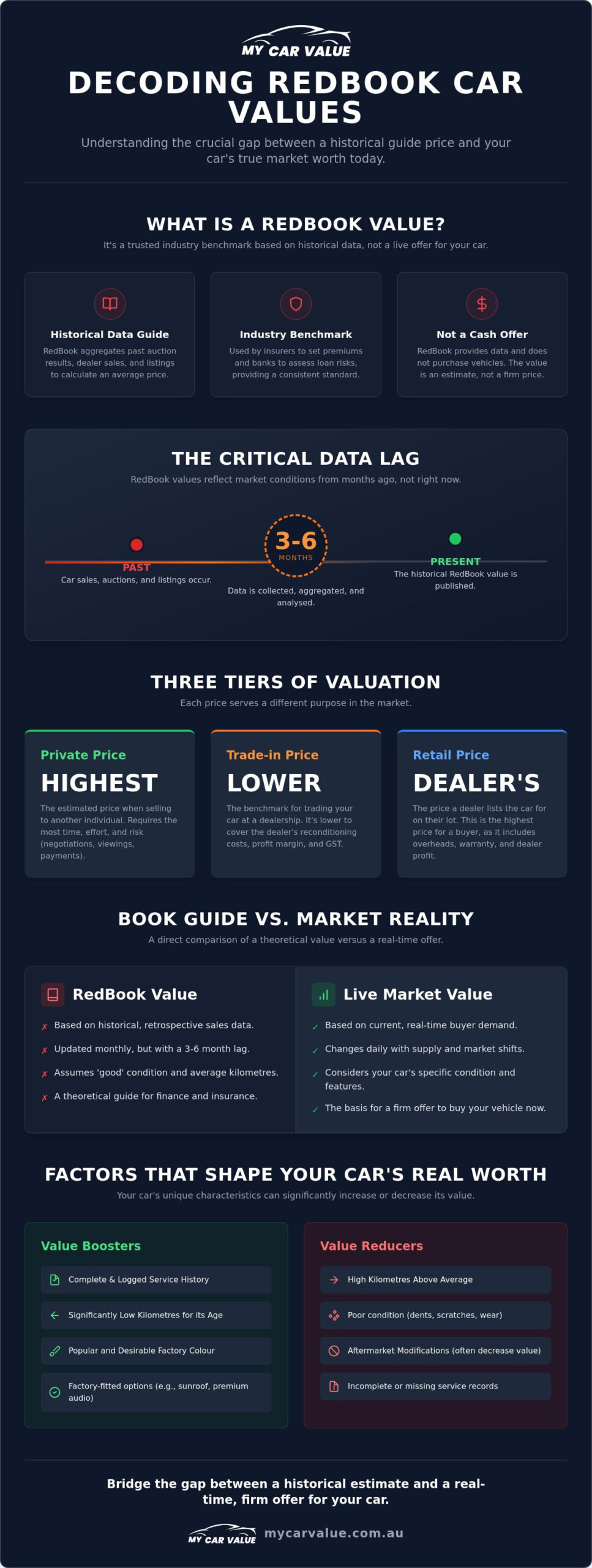
It is vital to understand that RedBook does not purchase vehicles. They provide the information that professional car valuation process experts use to make decisions. Their figures come from a mix of auction results, dealer sales records, and classified listings. Because this data needs to be collected and analysed, there is often a lag of three to six months between a sale happening and it appearing in the guide. This means the “book” price is a reflection of the past rather than a live offer for the present.
The Three Main Valuation Categories
RedBook breaks down pricing into three distinct tiers. The Private Price represents what you might expect when selling to another individual. This is usually the highest figure but requires the most effort. The Trade-in Price is the benchmark dealers use when you buy a new car. It is lower because the dealer must cover reconditioning, GST, and profit margins. Finally, the Retail Price is the amount a dealer would list the car for on their lot. It includes their overheads and a warranty, making it the most expensive category.
Why Australian Insurers Rely on RedBook
Australian insurance companies use this data to set premiums and settle claims. When you take out a policy, you often choose between “Agreed Value” and “Market Value.” If you select market value, the insurer will likely use RedBook data to determine the payout if your car is written off. This ensures a consistent standard across the industry. In total loss settlements, the vehicle red book value acts as a neutral starting point. However, your payout might still differ from a real-world sale price. Insurers look at the average condition for a car of that age. If your vehicle was in better or worse condition than the statistical average, the final figure will shift. Understanding these nuances helps you manage expectations when dealing with a claim or preparing to sell.
How RedBook Valuations are Calculated in 2026
RedBook valuations aren’t pulled from thin air. They result from complex data modelling. A vehicle red book value relies on a vast network of historical inputs. This includes national auction results and reported dealer sales. By aggregating thousands of transactions, RedBook identifies the average price point for every make and model in Australia. They also account for factory-fitted features. A sunroof or upgraded sound system might add a few hundred dollars to the guide, but aftermarket modifications rarely impact the official book price.
The Role of Kilometres and Condition
RedBook assumes your car is in “Good” condition. This means it has a full service history and no major cosmetic damage. The calculation also uses a “standard kilometres” benchmark based on the vehicle’s age. In Australia, this is typically between 12,000 and 15,000 kilometres per year. If your odometer shows significantly higher numbers, the algorithm applies a steep deduction. Conversely, very low kilometres can boost the vehicle red book value, though this is capped by historical averages. Cars in “Fair” or “Poor” condition will always sit well below the quoted figures.
In 2026, the data weighting has shifted to reflect new automotive technologies. The rapid adoption of Electric Vehicles (EVs) means battery health and software versions now influence the calculation more than ever. Older internal combustion engine vehicles are seeing different depreciation curves as fuel prices and environmental regulations change. RedBook adjusts its models to reflect these macro trends, but the process remains inherently retrospective.
Static Data vs. Real-Time Market Shifts
The biggest challenge with traditional guides is the data lag. Research shows that RedBook’s valuation data can lag behind the live market by 3 to 6 months. While they update their database monthly, they cannot capture a sudden surge in demand for a specific model that happened yesterday. Supply chain disruptions or a sudden influx of new stock can change prices in days. To get a more current estimate, you should use a vehicle market value calculator. This tool looks at what is happening right now rather than what happened last quarter.
If you want to move beyond historical data and see what a buyer will actually pay, you can Value My Car through our platform to get a professional perspective that reflects today’s market conditions.
RedBook vs. Market Value: The Critical Differences
A book price is a prediction; a market offer is a reality. While a vehicle red book value provides a solid baseline for insurance, it often fails to account for immediate demand. RedBook looks at what happened months ago to create an average. Market value looks at what is happening today. If a specific model suddenly becomes popular due to a fuel price drop or a new safety rating, the market value will spike. The “book” will take months to catch up. This gap is where many sellers feel frustrated when they receive offers that don’t match their online research.
Location plays a massive role in these discrepancies. Australia is a vast market with regional needs. A rugged 4WD might command a premium in Perth or Brisbane compared to the inner-city streets of Sydney. National data tends to average these peaks and troughs out. This creates a “middle-of-the-road” figure that might not reflect the high demand in your specific postcode. When you want to sell my car, you need to focus on who wants your vehicle right now, not what a national average suggests.
Comparison of Valuation Sources
- RedBook: This is the gold standard for long-term depreciation tracking and insurance policies. It provides a safe, conservative estimate for financial institutions.
- Professional Buyer Quotes: These represent immediate, guaranteed liquidity. These offers are based on live auction data and current inventory needs, providing the most accurate “real-world” price.
- Private Classifieds: This route offers the potential for a maximum price but carries the highest risk. It requires significant time, effort, and the patience to deal with “tyre-kickers” who may never show up.
Why “Book Value” Can Be Misleading
The vehicle red book value is a data-driven guide, but it is blind to certain physical realities. It cannot see your car’s “curb appeal” or the meticulous way you’ve maintained the interior. A car with a perfect service history and premium tyres is worth more to a buyer than a neglected one, even if the “book” says they are identical. Additionally, static data cannot account for urgent market shortages. If a manufacturer stops producing a popular model, the market value can exceed the book value almost overnight. Professional buyers track these micro-shifts daily to ensure their offers remain competitive and fair.
Factors That Influence Your Car’s Real-World Worth
A technical vehicle red book value is just the starting point. In the real world, buyers look for physical evidence of care. A vehicle that looks good on paper but has bald tyres and no registration will never achieve its full potential. Small details matter. For instance, remaining registration (REGO) is essentially cash in hand for the next owner. Similarly, premium tyres with deep tread can save a buyer over $1,000, making your car a much more attractive proposition than a similar model with worn rubber.
Colour and specification also play significant roles. “Hero colours”, the specific shades used in a manufacturer’s launch advertising, often command a premium. Popular metallic greys and whites remain safe bets for resale. Conversely, niche colours can sit on the market longer, driving down the final price. High-spec trim levels like the GT or Luxury variants also hold their value better than entry-level models. These features are often baked into the vehicle red book value, but current market demand for specific aesthetics can push your price even higher.
The Importance of a Car Service History Check
A verifiable logbook is your most powerful tool. It proves the car has been maintained according to manufacturer standards. This transparency protects your car valuation by removing the risk for the buyer. Professional buyers specifically look for one-owner cars with a full history because they are easier to resell with confidence. For a deep dive into how to prepare your records, read our car service history check guide. Mechanical integrity is non-negotiable in 2026. Any minor leaks or warning lights will result in price deductions that far exceed the cost of the actual repair.
Aftermarket Modifications: Value Add or Value Loss?
Many owners believe that adding bull bars, high-end stereos, or custom wheels increases worth. In reality, these rarely boost the official book value. Most professional buyers prefer vehicles in their original factory state. Modifications can actually shrink your pool of potential buyers, as they may not suit everyone’s taste. If you have the original parts, returning the vehicle to stock is often the smartest financial move. Selling as is with heavy modifications usually means accepting a price closer to the base model’s value.
Get a professional market offer in Sydney today
Beyond the Book: Getting a Firm Offer with My Car Value
Researching your vehicle red book value is a smart first step. It provides a ballpark figure and helps you understand historical trends across Australia. However, a digital estimate cannot pay your bills or clear your garage. The challenge for many owners is moving from “knowing the value” to “getting the cash.” My Car Value bridges this gap. We take your research and turn it into a concrete financial outcome by connecting you with a national network of used car buyers who are ready to act immediately.
Selling a car privately in 2026 is often a high-friction process. It involves creating listings, managing dozens of inquiries, and waiting for people who may never arrive. It carries risks that a professional transaction simply doesn’t have. By choosing a professional route, you eliminate the uncertainty of “guide prices.” You replace them with a firm offer based on current market demand. This approach is designed for speed and security. It ensures the funds arrive in your account without the typical stress of a legacy sales system.
Turning Data into Dollars
The transition from data to a sale is straightforward and methodical. First, submit your vehicle details through our online platform. We perform a tailored market assessment that looks at your specific make, model, and condition. Unlike a generic vehicle red book value, this assessment considers what professional buyers are paying right now in cities like Melbourne or Adelaide. You skip the “tyre-kickers” entirely. Within a short timeframe, you receive a competitive offer from a vetted industry professional. If you accept, the process moves quickly to a final inspection and secure payment.
The My Car Value Advantage
Our platform acts as a savvy intermediary that does the heavy lifting for you. We have simplified a complex process into a few logical steps. This creates a sense of momentum, moving you from an inquiry to a solution in record time. The benefits are clear:
- Transparency: We eliminate hidden fees and the need for awkward middle-man haggling.
- Efficiency: Our system is built for the modern Australian who values their time above all else.
- Confidence: Your offer is backed by real-time market demand and a vetted network of professionals.
You don’t need to spend your weekends hosting inspections or answering repetitive questions. We provide a clear path forward in a crowded marketplace. This empowers you to make informed decisions with minimal effort. Once you have finished your research, let us handle the logistics of the sale so you can focus on what comes next.
Secure Your Best Market Offer Today
A vehicle red book value provides a reliable industry benchmark, but it’s only one piece of the puzzle. While it tracks historical trends, your car’s true worth is determined by immediate demand and verifiable maintenance. Successful sellers use data to set expectations but rely on live market insights to close the deal. You’ve now learned how to decode the “book” and identify the factors, such as battery health or logbook history, that drive real-world premiums in 2026.
The transition from research to a bank transfer should be seamless. Our platform connects you with a national network of professional buyers who understand the current pulse of the Australian market. You don’t have to deal with the frustration of private listings or the ongoing hassle of tyre-kickers. We provide a clear, data-driven path to a fast and secure sale that values your time and provides immediate clarity.
Take control of your car’s value and move forward with confidence.
Frequently Asked Questions
Is RedBook value the same as the price I will get from a dealer?
No, a dealer offer is rarely identical to the guide price. Dealers use the trade-in tier as a baseline but adjust for their specific inventory needs and reconditioning costs. While the vehicle red book value provides a statistical average, a dealer must account for GST and profit margins. Expect the physical offer to fluctuate based on the dealer’s current floor stock and local demand for your specific model.
How often does RedBook update its vehicle valuation data?
RedBook updates its database on a monthly cycle. This regular cadence helps track long-term depreciation trends and new model releases across the Australian market. However, these monthly snapshots cannot capture daily market volatility or sudden supply chain shifts. While the data is refreshed frequently, the three-to-six-month lag in sales reporting means the figures often reflect the recent past rather than the immediate present.
Why is my car insurance valuation different from the RedBook price?
Insurance valuations often differ because providers apply their own internal risk filters and policy conditions. If you have an “Agreed Value” policy, the figure is locked in at the start of your term regardless of market shifts. Market value policies use RedBook as a neutral foundation, but insurers may adjust for specific regional data or the average condition of similar vehicles in their claims database at the time of a total loss.
Can I get a RedBook valuation for free in Australia?
Yes, you can access basic RedBook-powered estimates for free through various Australian automotive websites and partner platforms. These tools provide a simplified range based on your car’s make, model, and year. For a more detailed, official certificate often required for legal or financial purposes, RedBook traditionally charges a fee for a comprehensive valuation report. This paid service provides a more specific breakdown of your car’s historical standing.
Does RedBook account for aftermarket accessories like tow bars?
RedBook typically does not account for aftermarket modifications like tow bars, bull bars, or custom roof racks. Their data models focus on factory-fitted features and standard specifications provided by the manufacturer. While these additions might add practical value for a private buyer, they rarely increase the official vehicle red book value. In some cases, niche modifications can even narrow your pool of professional buyers who prefer stock-standard vehicles.
What happens if my car is in better condition than the RedBook average?
The guide price remains a statistical average, but your car’s physical condition allows you to negotiate at the higher end of the range. If your vehicle has a perfect service history and pristine interior, it will command a premium from professional buyers. RedBook assumes “Good” condition. Moving beyond that requires physical inspection to prove the car’s superior state, which often results in a higher final offer than the standard book estimate.
How do professional buyers use RedBook data compared to market data?
Professional buyers use RedBook as a conservative sanity check but rely on live auction results for their final offers. They track real-time bidding data and current stock shortages to determine what they can pay today. While RedBook provides a useful historical anchor, professional buyers prioritise “live market” movements. This allows them to offer more for high-demand models that the historical data hasn’t yet caught up with.
Is a RedBook valuation enough to sell my car privately?
A RedBook valuation is a helpful starting point, but it isn’t enough to set a competitive private listing price. You must also research current classified ads to see what similar cars are actually selling for in your area. Private buyers compare your car against live listings, not just historical guides. Use the valuation to set your floor price, but adjust your asking price based on immediate local competition and demand.