

Second Hand Car Values Online: The Ultimate 2026 Australian Guide
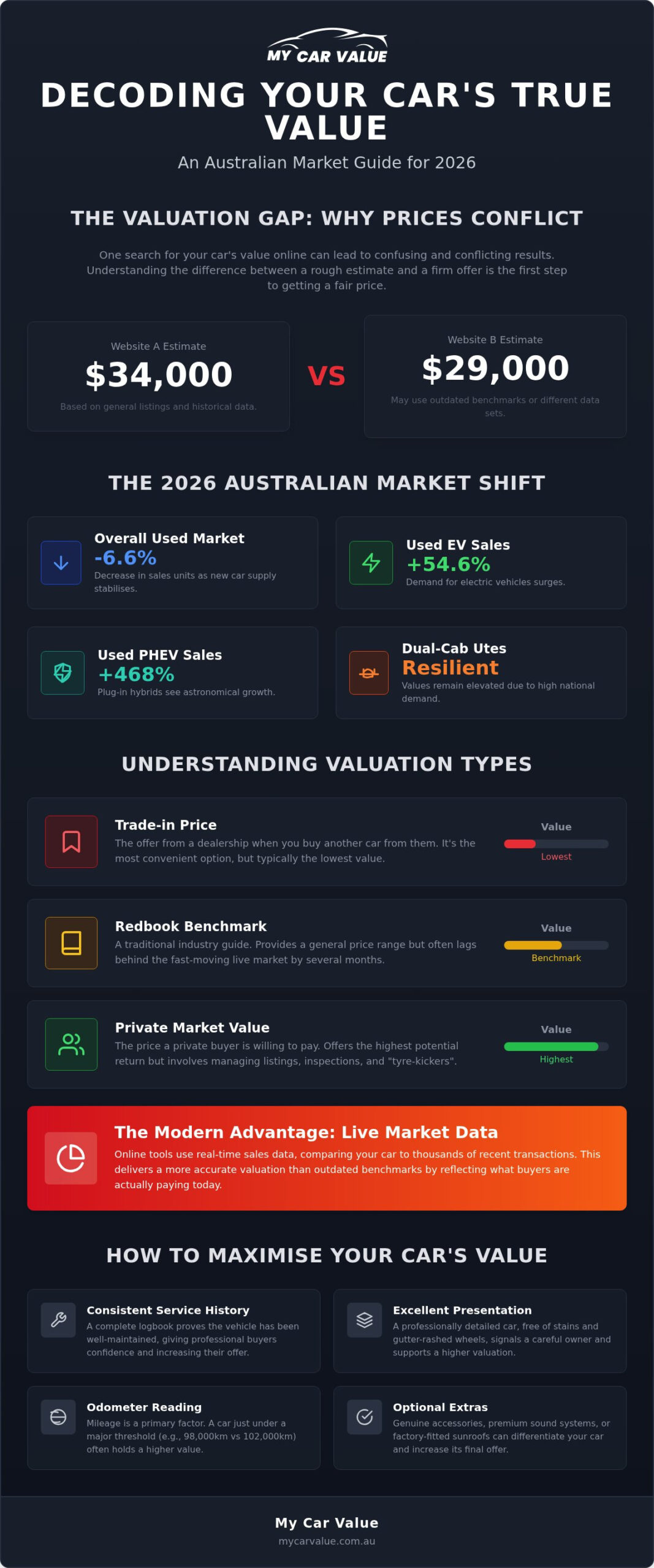
Why does one website claim your SUV is worth $34,000 while another insists it’s barely $29,000? This discrepancy is more than just a minor annoyance; it’s a hurdle that stops many Australians from getting a fair deal. When you search for second hand car values online, you’re often met with conflicting data that creates more questions than answers. It’s exhausting to navigate the gap between a “book value” that’s six months out of date and the reality of what a buyer will actually pay you today.
We understand that you want a transparent process without the anxiety of private listings or the frustration of “tyre-kickers” wasting your weekend. This guide provides the clarity you need to determine your vehicle’s true worth in the 2026 market. You’ll learn how to use digital data to your advantage and transition from a rough estimate to a firm, professional offer. We’ll break down the difference between trade-in and market prices, helping you secure a realistic price range and the confidence to close the deal quickly.
Key Takeaways
- Understand how the 2026 stabilisation of new car supply chains directly affects used car depreciation and current market values.
- Learn why live market data delivers more accurate second hand car values online than traditional benchmarks that often lag by several months.
- Define the critical differences between Redbook benchmarks, private market value, and trade-in prices to strengthen your negotiation position.
- Identify the specific maintenance records and presentation techniques that help you secure the highest possible price from professional buyers.
- Discover how to bypass the risks of private sales by connecting directly with a vetted network of professional used car buyers.
Decoding Second Hand Car Values Online: The 2026 Australian Landscape
Market value isn’t a fixed number. It’s the price a willing buyer pays a willing seller at a specific moment. In 2026, the Australian market has shifted. New car supply chains have finally stabilised, meaning buyers no longer face two-year waits for a new vehicle. This increased supply has cooled the used car market, causing prices to soften from the record highs of previous years.
Understanding the process of car valuation is essential to set realistic expectations. Today, second hand car values online serve as the primary benchmark for every negotiation. Whether you are talking to a private buyer or a dealer, they will be looking at the same live data you are. Australian-specific data is non-negotiable. International estimates don’t account for our local taxes, shipping costs, or unique vehicle specifications.
Why Market Values Shift Across Australia
Fuel costs and technology shifts are the biggest drivers of value in 2026. While the overall used market saw a 6.6% decrease in sales units during the first half of the year, demand for electrified vehicles is surging. Used EV sales grew by 54.6%, while Plug-in Hybrids (PHEVs) skyrocketed by over 468%. If you own a fuel-efficient hybrid, your car’s value is likely holding steady compared to thirstier alternatives.
Dual-cab utes remain another resilient segment. High national demand for these vehicles keeps their values elevated despite the broader market softening. Professional buyers monitor these trends closely. They often look for specific stock to fill gaps in their inventory. This means your car’s worth isn’t just about what’s on the odometer; it’s about what the market needs right now.
The Difference Between Estimates and Firm Offers
It’s easy to confuse an online estimate with a guaranteed payout. An estimate is a data-driven range based on historical sales and current listings. It tells you what you might get under ideal conditions. In contrast, a firm offer is a specific price a professional buyer is prepared to pay after assessing your car’s condition.
Using a vehicle market value calculator provides a necessary baseline for these discussions. It helps you understand where your car sits in the current market before you engage with buyers. This transparency ensures you aren’t flying blind when evaluating second hand car values online. Transitioning from a digital range to a bank transfer requires moving beyond general estimates toward a professional assessment.
How Online Valuation Tools Calculate Your Vehicle’s Worth
Calculating the worth of a vehicle has moved from manual logbooks to sophisticated digital algorithms. These tools aggregate data from multiple sources, including private listings and wholesale auction results. To determine second hand car values online, a system must weigh what people are asking against what they are actually receiving. This ensures the final figure isn’t inflated by unrealistic seller expectations or outdated benchmarks.
The Role of Real-Time Sales Data
Algorithms work by comparing your specific vehicle against thousands of similar listings currently active or recently closed. The most recent used car market report shows that sales volumes and stock levels are constantly in flux. This volatility is why “sold” prices are a much better indicator of value than “asking” prices. In a softening market, the gap between an initial listing price and the final bank transfer can be significant. Market transparency is the key to a fair sale in 2026.
Why Odometer Readings and Condition Matter Most
Data tools use specific “thresholds” for mileage to categorise vehicles. A car with 98,000km often holds a higher value than one that has just ticked over to 102,000km. These psychological and mechanical milestones heavily influence second hand car values online. Beyond the odometer, cosmetic condition plays a major role in the digital calculation. Algorithms are programmed to deduct value for visible wear, such as gutter-rashed wheels or stained carpets. However, they also prioritise mechanical excellence, especially if you can prove a consistent service history.
Precision is vital when using these tools. If you enter vague details, you’ll receive a vague range. Providing exact specifications, including optional extras and genuine accessories, allows the algorithm to be more aggressive with its valuation. Our Value My Car service does the heavy lifting for you. It translates complex market trends into a clear, reliable number that you can actually use. This moves you away from guesswork and toward a transparent, professional transaction.
Redbook vs. Market Value vs. Trade-in: Comparing the Numbers
Researching second hand car values online often leads to three distinct figures: Redbook, market value, and trade-in. Redbook serves as the industry’s historical benchmark. Insurers and financiers rely on it for technical accuracy and long-term data trends. It’s an excellent tool for verifying your vehicle’s exact specifications, but it frequently lags behind the fast-moving 2026 market by several months.
Market value represents the price your car might fetch in a private sale. While this is usually the highest number you’ll see, it’s a “gross” figure that doesn’t account for listing fees, detailing costs, or the time spent meeting strangers. Trade-in price is typically the lowest. Dealers offer this because they must cover reconditioning, GST, and their own profit margin. A “Professional Buyer Price” provides the middle ground. It offers more than a dealership trade-in without the stress of the private market.
Redbook vs. Real-World Market Prices
Redbook data is a vital starting point for any seller. Use it to confirm your car’s exact trim level and standard features to ensure your listing is accurate. However, don’t expect these figures to match the “street price” exactly. In the current climate of increased stock levels, real-world prices can drop faster than traditional guides can update. Use these benchmarks to set a baseline before approaching used car buyers who operate on live, daily market data.
Why Trade-in Quotes Differ from Online Estimates
A dealership’s quote is never just about your car’s worth. It’s a calculation of their business overheads. Dealers must pay for professional detailing, mechanical inspections, and a statutory warranty for the next owner. This “convenience fee” is why trade-ins often feel underwhelming compared to second hand car values online.
If you want to move quickly but find the dealer’s offer too aggressive, professional buyers are the logical alternative. They specialise in high-volume turnover rather than showroom margins. This allows them to bridge the gap between a low trade-in and a high-stress private sale. They handle the “heavy lifting” of paperwork and inspections while providing a price that reflects the vehicle’s current market demand.
Maximising Your Return: Steps to Support Your Online Valuation
Securing the best second hand car values online requires more than just a lucky algorithm result. In a market where 51.1% of used vehicles currently see price reductions before they sell, you must provide evidence that your car deserves a premium offer. Professional buyers look for transparency. If you can prove the car has been maintained through a consistent car service history check, you remove the risk for the buyer. This clarity translates directly into a higher firm valuation.
Documentation and History Essentials
A current PPSR report is non-negotiable if you want a top-tier price. This document proves the vehicle has a “clear title” with no outstanding finance or encumbrances. Professional buyers prioritise these clean records because they allow for a faster, safer transaction. Organise your service invoices and receipts in a chronological folder. While the digital estimate provides the baseline, these physical documents justify the final figure. Don’t forget to gather all spare keys and original manuals; missing keys can lead to significant deductions from your final payout.
Quick Fixes that Boost Second Hand Appeal
Presentation remains vital even for valuations that start with photos. Algorithms and professional inspectors both penalise poor cosmetic condition. A professional detail is often worth more than its cost at the point of sale because it removes the “work” for the next owner. Focus on high-impact areas that professional buyers check first:
- Tyres: If your tread is low, replacing them before an inspection can prevent a buyer from negotiating a much larger discount.
- Personal Items: Remove dash cams, phone mounts, and seat covers. This helps the buyer see the vehicle’s original condition and potential without distraction.
- Minor Repairs: Be transparent about small scratches or chips. Building trust through honesty regarding minor wear often leads to a more stable negotiation than hiding defects.
By following these steps, you ensure that the second hand car values online you see in your initial research actually reflect the money that ends up in your bank account. Professionalism on your end encourages a professional response from the buyer, moving you closer to a fast and fair sale.
From Valuation to Sale: Connecting with Professional Used Car Buyers
Once you have researched second hand car values online, the final hurdle is turning that data into a bank deposit. Private classifieds are the traditional route, but they come with significant friction. Between paying listing fees and managing tyre-kickers who never show up, the process is often a drain on your time. There are also security risks involved in meeting strangers for test drives. My Car Value acts as an expert facilitator. We do the heavy lifting by connecting you with a vetted network of industry professionals who are ready to buy.
In a softening 2026 market where used vehicle sales have decreased by 6.6%, finding a reliable buyer quickly is essential. Our platform removes the guesswork. We provide a bridge between your digital estimate and a concrete transaction, ensuring you don’t get stuck with a depreciating asset while waiting for a private sale that may never happen. This transition from research to sale is designed to be as fast and transparent as the valuation itself.
The Efficient Alternative to Car Auctions
Car auctions are often viewed as a quick exit, but for private sellers, they remain a gamble. You have little control over the final hammer price. High commission fees and transport costs can quickly eat into your returns. Direct professional offers provide the certainty that the auction floor lacks. By choosing Car Auction Alternatives, you secure a firm price before the vehicle even leaves your driveway. This removes the “wait and see” anxiety that defines the auction experience.
How My Car Value Streamlines the Process
We have modernised the transition from valuation to sale. Enter your vehicle details to receive an accurate market valuation based on live 2026 data. You are then matched with professional buyers from our national network. Once you accept a firm offer, the transaction is finalised. Our network has a national reach, ensuring you get a competitive offer regardless of your location. Whether you are looking for buyers in Sydney or need a connection in Perth, we bridge the gap between your driveway and a professional inventory. We handle the vetting of buyers so you don’t have to. This streamlined path ensures that your research into second hand car values online leads to a successful, stress-free outcome.
Secure Your Vehicle’s True Value in 2026
Navigating Australia’s shifting automotive market requires a data-driven approach. You now understand how supply chain stabilisation and the rise of electrified vehicles have redefined the landscape. Relying on live market data rather than static benchmarks ensures you aren’t leaving money on the table. By prioritising transparent documentation and professional presentation, you move from general research into second hand car values online to a position of negotiation strength.
The transition from a digital estimate to a firm bank deposit doesn’t have to be a source of anxiety. Our Australia-wide network of professional buyers offers a stress-free alternative to the “tyre-kicker” culture of private sales. You get transparent, data-driven valuations that reflect the current 2026 climate. This efficiency allows you to bypass the risks of private classifieds and the uncertainty of the auction floor. It’s about moving forward with confidence and clarity. Take the final step and convert your car’s worth into a concrete transaction today.
Frequently Asked Questions
Is it free to check second hand car values online in Australia?
Yes, you can check second hand car values online for free using the My Car Value platform. We provide a transparent digital estimate to help you understand your vehicle’s worth without any upfront costs. This initial figure serves as a vital baseline for your negotiations. It allows you to skip the expense of professional appraisals while still gaining access to live market data that reflects current Australian demand.
How accurate are online car valuation calculators in 2026?
Online calculators are highly accurate when they utilise live market data rather than historical logs. In the first half of 2026, the Australian market saw a 6.6% decrease in sales units, making real-time accuracy essential. Most calculators now account for the 3.7% average discounts seen in recent months. However, the final accuracy depends on the precision of the details you provide, including optional extras and specific condition reports.
What is the difference between market value and trade-in value?
Market value is the price a private buyer might pay, which is typically the highest gross figure you will see. Trade-in value is what a dealership offers, which is usually lower to account for their GST, reconditioning costs, and profit margins. Our service helps you find a middle ground by connecting you with professional used car buyers. This provides a better return than a standard trade-in while maintaining speed and ease.
Does a car’s colour affect its second hand online value?
Yes, colour significantly impacts a vehicle’s resale appeal and final valuation. Popular, conservative shades like white, silver, and grey typically hold their value better because they appeal to a broader range of buyers. Niche or “hero” colours, such as bright purple or lime green, often result in a lower valuation. These unique shades usually stay on the market longer, which professional buyers account for when calculating second hand car values online.
How much does high mileage reduce my car’s worth?
High mileage reduces a car’s worth by increasing the perceived risk of mechanical failure and upcoming maintenance costs. Crossing major thresholds, such as 100,000km or 150,000km, often triggers a steeper drop in value. For example, a car with 95,000km is generally more desirable than one with 105,000km. Professional algorithms weigh these odometer readings against the vehicle’s age and service history to determine a fair market price for your specific model.
Can I get a valuation for a car with a blown engine or mechanical issues?
You can still obtain a valuation for a vehicle with mechanical issues, though the price will reflect the cost of necessary repairs. Professional buyers often look for “as-is” stock, calculating the value based on the car’s salvageable parts or its potential after a rebuild. Be completely transparent about the engine’s state when entering your details. This honesty ensures the offer you receive is firm and avoids any last-minute price drops during inspection.
Why is my Redbook value different from the price I see on listing sites?
Redbook provides a historical benchmark based on past sales, whereas listing sites show current “asking” prices. Asking prices are often inflated by 5% to 10% to allow for negotiation room. Additionally, Redbook data can lag behind the live market by several months. In a softening 2026 landscape, the price you see on the street often drops faster than traditional guides can update their records, leading to noticeable discrepancies in data.
How do I sell my car quickly once I have an online valuation?
The fastest way to sell is to transition from your online valuation to our network of professional used car buyers. Once you have your estimate, we match you with industry experts who are ready to make a firm offer. This bypasses the weeks of waiting associated with private listings. You get paid quickly, all paperwork is handled for you, and the entire process remains transparent from the initial click to the final bank transfer.