
Market Value of My Car: The 2026 Australian Seller’s Guide
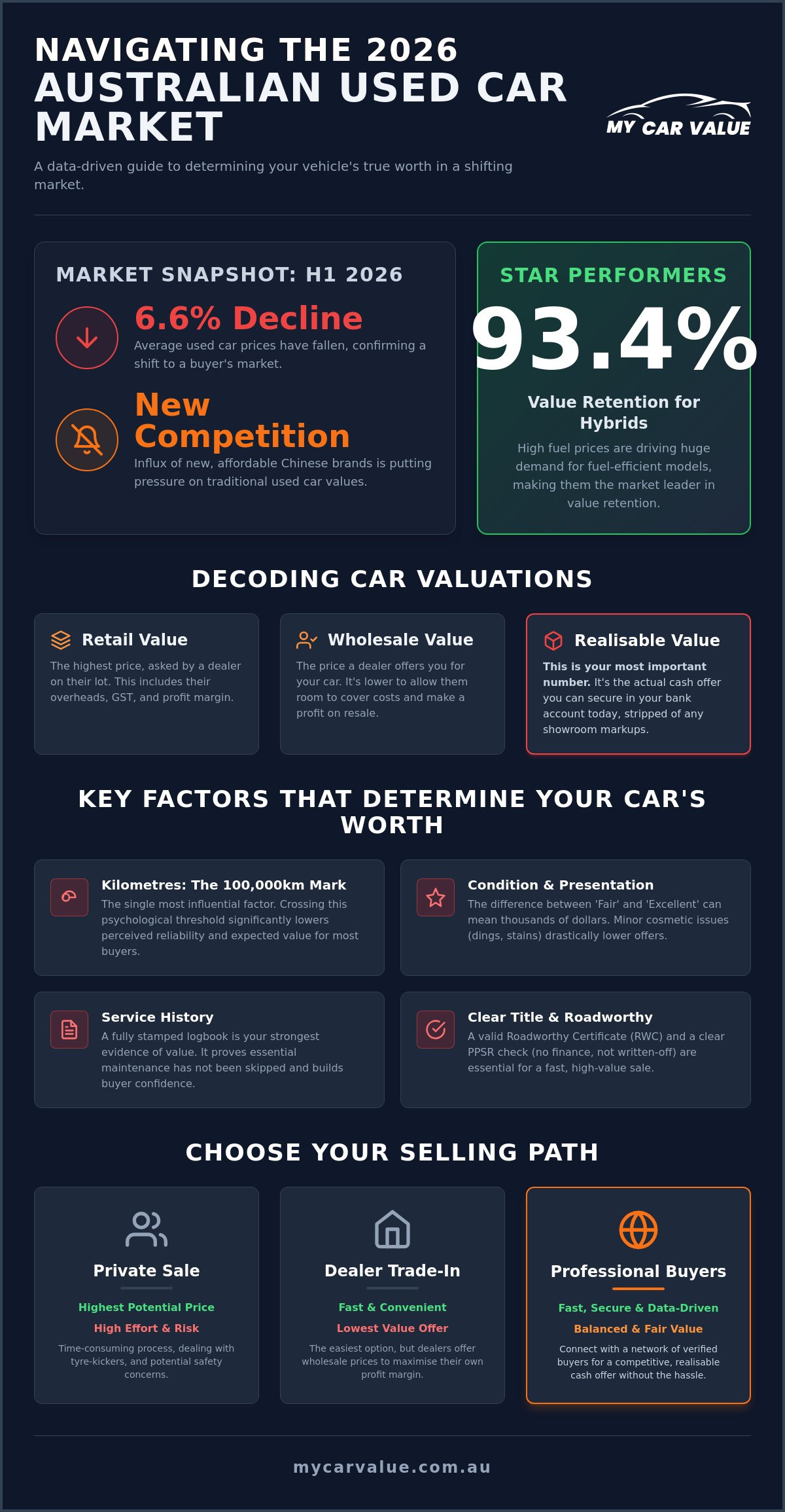
The Australian used car market has officially shifted into a buyer’s market in 2026. With prices declining by 6.6% in the first half of the year, many sellers are finding that traditional valuation methods are no longer accurate. It’s frustrating to deal with tyre-kickers or settle for an undervalued trade-in because you’re unsure of the real market value of my car. You deserve a transparent process that values your time as much as your vehicle.
This guide will show you exactly how to determine your vehicle’s true worth and navigate the current second-hand market with confidence. We’ll explore why hybrid vehicles are retaining 93.4% of their value while other segments face pressure from an influx of new Chinese brands. You’ll learn how to bypass the confusion of Redbook estimates and find a fast, secure way to sell. We provide the data-driven strategy you need to move forward without the typical stress of selling a car in Australia.
Key Takeaways
- Understand that market value is a fluid figure driven by real-time Australian supply and demand.
- Identify how the 100,000km milestone and vehicle condition impact the market value of my car.
- Compare the trade-offs between high-effort private sales, low-value dealer trade-ins, and professional buyer networks.
- Maximise your final sale price by organising paperwork and investing in professional detailing.
- Discover a faster way to sell by connecting with verified used car buyers through a data-driven platform.
What is the Market Value of My Car in Australia?
Market value is the estimated amount a willing buyer will pay for your vehicle in its current state. It isn’t a fixed number found in a dusty ledger. Instead, it’s a moving target. Local supply, buyer demand, and broader economic shifts dictate the price daily. The process of Car valuation involves looking at several distinct price points, each serving a different purpose in the Australian automotive landscape. You need to know which figure applies to your specific selling situation.
Understanding the difference between price types is essential for any seller. Retail value represents the high price a dealer asks on the lot. This includes their overheads, GST, and profit margins. Wholesale value is what that same dealer offers you for your car. They need room to “flip” the vehicle and cover their business costs. However, the most critical figure for you is realisable value. This is the actual cash offer you can secure in your bank account today. It strips away the fluff of showroom markups and tells you what the market is truly willing to pay.
Why Online Estimates Vary
You’ve likely noticed that different websites provide wildly different numbers. This happens because each algorithm prioritises different data sets. Some tools focus on historical sales from six months ago. Others look at live listings on classified sites. These often reflect what sellers hope to get rather than what they actually receive. Redbook serves as a respected industry benchmark, but it remains a guide. It cannot account for the specific service history or the actual condition of your tyres. A professional assessment always provides more accuracy than a generic algorithm when determining the market value of my car.
The Role of 2026 Market Trends
The 2026 automotive landscape is undergoing a massive transformation. As more Australians transition toward electric vehicles, the resale value of traditional petrol and diesel cars is facing new pressure. High fuel prices are driving a surge in demand for smaller, fuel-efficient models and hybrids. Research shows used hybrids retained a remarkable 93.4% of their value in May 2026. Additionally, the rebound of new car supply chains means there are more fresh options available. This makes buyers much more selective about the market value of my car when they compare older models against affordable new arrivals from brands like BYD and MG.
Key Factors Determining Your Car’s Worth
The odometer reading remains the single most influential factor for buyers. In Australia, the 100,000km mark carries significant psychological weight. Once a vehicle crosses this threshold, its perceived reliability drops, and many buyers expect a steep discount. In the 2026 market, high-kilometre vehicles are penalised more heavily than in previous years as buyers seek newer technology and longer warranties. Keeping kilometres low is a primary way to protect your resale price.
Condition and presentation create the first impression. The difference between a car classified as “fair” versus one in “excellent” condition can represent thousands of dollars. Minor cosmetic issues like car park dings, stained upholstery, or faded paint significantly lower the market value of my car. A well-maintained vehicle suggests the mechanical components have been cared for too. Taking the time to fix small issues before a sale often pays for itself in the final offer.
Your service history is your strongest evidence of value. A fully stamped logbook proves that you haven’t skipped essential maintenance. Beyond mechanical health, current registration and a valid Roadworthy Certificate (RWC) provide immediate peace of mind. According to Consumer Affairs Victoria, providing these documents is often a legal requirement or a major selling point that speeds up the transaction. Buyers pay more for a car they can drive away immediately without hidden costs.
The Impact of Vehicle History and PPSR
Professional buyers always perform a PPSR check before finalising an offer. This search confirms if the vehicle has a “written-off” status on the Written-off Vehicle Register (WOVR). A car with a history of major damage will see its value slashed, regardless of its current appearance. Ensuring you have a clear title with no outstanding finance is vital. If you want to see how these factors affect your specific model, you can Value My Car online to get a realistic starting point.
Optional Extras and Aftermarket Modifications
Factory options like leather seats or a sunroof generally increase the market value of my car. However, be wary of the “modification trap”. Expensive aftermarket parts like custom wheels or performance chips often decrease the potential buyer pool. Most buyers prefer a blank canvas. The exception is genuine accessories on popular Aussie utes. Items like towbars, bullbars, and snorkels often hold their value well because they add practical utility that the next owner likely needs.
Private Sale vs. Dealer Trade-In vs. Professional Buyers
Choosing the right selling method is just as critical as knowing the market value of my car. Each path offers a different balance of profit, speed, and effort. While a private sale often promises the highest “listed” price, the actual “realisable” value can be much lower once you account for time and costs. Conversely, a dealer trade-in provides unmatched convenience but usually results in the lowest financial return. Finding the “Goldilocks” zone requires understanding how professional buyers have modernised the process.
Traditional dealerships buy cars to “flip” them for a significant profit on their own lots. They have high overheads, including showroom rent and large sales teams. Professional Used Car Buyers operate differently. They use data-driven networks to match your car with specific demand across the country. This efficiency allows them to offer competitive prices that sit comfortably between a low-ball trade-in and a high-stress private sale. They prioritise a fast, secure transaction over the traditional haggling process.
Before deciding, it’s worth consulting a Used Car Valuation Guide to see how different selling channels view your vehicle. Professionals look at real-time demand, while private buyers often rely on emotion or bargain hunting. In a market that saw a 6.6% decline in the first half of 2026, the speed of a professional sale can save you from further depreciation losses.
The Real Cost of Private Selling
Private selling in 2026 isn’t just about placing an ad. You face listing fees, the cost of a professional detail, and the significant time investment of managing enquiries. The digital marketplace is also increasingly crowded with “tyre-kickers” and sophisticated scams. When you calculate the hourly rate of your own time spent waiting for strangers who don’t show up, the market value of my car in a private sale starts to look less appealing. Professional buyers offer an immediate, guaranteed payment that eliminates these risks entirely.
Why Trade-In Offers Are Often Underwhelming
Dealers often use your trade-in as a tool to subsidise the margin on the new car you’re purchasing. They subtract “reconditioning costs” for every minor scratch or service requirement, even if they don’t intend to fix them. To get a better deal, always negotiate the “new car price” and the “trade-in value” as two separate transactions. If their offer feels too low, remember that you aren’t obligated to trade in. Selling to a professional buyer separately often provides the extra cash you need to negotiate a better “cash price” on your next vehicle.
Steps to Maximise the Market Value of Your Car
Preparation is the most effective way to protect your investment. A small amount of effort before listing can significantly increase the market value of my car. Buyers and professional networks look for vehicles that appear cared for, as this suggests mechanical reliability. By following a methodical checklist, you remove the easy excuses a buyer might use to haggle your price down.
- Organise your paperwork: Gather your logbooks, recent service receipts, and both sets of keys.
- Invest in professional detailing: A high-quality detail can often add $1,000 or more to a final offer.
- Address minor repairs: Fix windscreen chips or small car park dents that suggest a history of neglect.
- Verify your VIN and PPSR status: Proactively checking these details ensures full transparency and builds immediate trust.
The “Logbook” Advantage
A consistent car service history is the best way to justify a premium price. If you’ve lost your original service book, don’t panic. Contact the service centres where you’ve had work done and ask for a printed history or a digital summary. Showing receipts for recent major work, such as a timing belt replacement or a fresh set of tyres, provides tangible proof that the next owner won’t face immediate expenses. This transparency justifies a higher market value of my car compared to similar models with missing records.
Visual Appeal and First Impressions
Curb appeal isn’t just for real estate. The first 30 seconds of an inspection often determine the final sale price. If a buyer sees a clean, odour-free cabin, they’re more likely to believe the engine has been maintained. Remove all personal items, including dash cams, phone mounts, and child seats. If you’re using an online valuation tool, take high-quality photos in soft, natural light. Focus on the wheels, the driver’s seat bolster, and the engine bay. These details signal to professional buyers that your vehicle is a “grade A” unit worthy of a top-tier offer.
Get an Accurate Valuation with My Car Value
Finding the market value of my car shouldn’t involve endless research and stressful negotiations. Most online tools give you a broad range that leaves you guessing. My Car Value changes this by combining data-driven estimates with direct connections to professional buyers. We act as a savvy intermediary, doing the heavy lifting so you don’t have to. Our system provides immediate clarity in a crowded and often confusing marketplace.
We’ve built a platform that functions as a reliable tool for every Australian seller. We understand that your vehicle represents a significant financial asset. Whether you’re selling a fuel-efficient hybrid or a rugged 4×4, our national network ensures you reach the right buyers. We focus on transparency and ease, creating an experience defined by relief and trust. You get a realistic valuation without the usual friction of the second-hand market.
How the My Car Value Process Works
Our methodical approach ensures you move from inquiry to offer in record time. We’ve simplified the legacy system into three logical steps designed for speed.
- Step 1: Establish your starting point. Use the vehicle market value calculator to get an initial baseline for your specific make and model.
- Step 2: Refine the data. Provide details about your car’s condition and service history to receive a more accurate, personalised valuation.
- Step 3: Connect and sell. We match you with professional buyers who are actively looking for vehicles like yours and are ready to make a firm offer.
Why Trust My Car Value?
Trust comes from independence. We are not a dealership, so we have no interest in undervaluing your car to increase our own retail margins. We provide an impartial assessment of the market value of my car based on what professional buyers are actually paying right now. This data-driven approach removes the emotion and guesswork from the transaction. You get a fair go without having to deal with “tyre-kickers” or low-ball trade-in offers.
Efficiency is our priority. In the 2026 market, where prices can fluctuate weekly, a fast sale is a smart sale. We help you skip the weeks of waiting associated with private classifieds. Our process is built for speed, accuracy, and reliability, ensuring you get a fair price and immediate payment. You remain in control of the process from start to finish while we facilitate the connection to the right buyer.
Take control of your selling experience now. With the right information and a reliable partner, you’ll find that selling your vehicle is simpler and more rewarding than you expected.
Frequently Asked Questions
How is the market value of my car calculated?
Market value is calculated by comparing real-time sales data of similar vehicles against current supply and demand. Factors include the car’s age, make, model, condition, and location. Algorithms process thousands of live listings and historical transactions to establish a baseline. This data ensures the final figure reflects what buyers are actually paying in the current month rather than an outdated estimate.
Does a high odometer reading always mean a low market value?
High kilometres generally reduce value, but the impact varies by vehicle type. A diesel LandCruiser with 200,000km often retains more value than a small petrol hatchback with the same distance. Buyers expect specific maintenance at high milestones. If you can prove major components like the timing belt or clutch were replaced, you can mitigate some of the price drop associated with high usage.
What is the difference between Redbook and market value?
Redbook provides a historical benchmark based on average sales, whereas market value reflects the live price a buyer will pay today. Redbook doesn’t account for real-time spikes in demand or the specific condition of your individual car. It’s a useful starting point for research. However, the true market value of my car is determined by current supply levels and immediate buyer interest in your specific region.
Can I sell my car if it still has finance on it?
You can sell a financed car, but the outstanding loan must be settled during the transaction. Professional buyers often handle this by paying the finance company directly and giving you the remaining balance. This ensures a “clear title” on the PPSR. Selling privately with finance is more difficult. Most buyers are wary of vehicles with “encumbrance” and prefer the security of an unencumbered sale.
How much does a PPSR report cost in 2026?
A standard PPSR search conducted directly through the Australian Government’s official website costs $2.00 as of July 2026. Be careful of third-party websites that charge significantly higher fees for the same information. This report is essential for verifying if a car is stolen, written off, or has outstanding debt. It provides a low-cost way to ensure transparency and build trust with potential buyers.
Will aftermarket modifications like a lift kit increase my car’s value?
Aftermarket modifications rarely return their full cost and can sometimes decrease the market value of my car. While a lift kit might appeal to a specific 4×4 enthusiast, it narrows your overall buyer pool. Most professional buyers and dealerships prefer factory-standard vehicles. They often view modifications as a sign of heavy off-road use, which can lead to lower offers compared to a stock vehicle in similar condition.
How long does a professional car valuation take?
A professional online valuation usually takes less than 60 seconds to generate an initial estimate. Once you provide specific details about the car’s condition and history, a refined offer is typically delivered within a few hours. This speed is a major advantage over private sales, which can take weeks of listing and inspections. The process is designed to move you from inquiry to cash as quickly as possible.
Do I need a Roadworthy Certificate (RWC) to sell to a professional buyer?
You generally don’t need a pre-obtained RWC when selling to professional used car buyers. These professionals are equipped to assess the vehicle’s safety and handle any necessary repairs themselves. This saves you the time and upfront cost of visiting a mechanic. In contrast, selling a car privately in most Australian states requires you to provide a current RWC to the buyer before the registration can be transferred.