
Best Way to Sell a Car in Australia: The 2026 Definitive Guide
With the Australian used car market hitting a projected $49.86 billion in 2026 and the average car loan reaching $34,282, you shouldn’t have to settle for a poor return. Finding the best way to sell a car in Australia often feels like a choice between two frustrating options: wasting weeks on unreliable private buyers or accepting a low-ball trade-in from a local dealer. Most sellers feel stuck between losing their time or losing their money.
We understand that you want a fair price without the typical marketplace drama. This guide provides a clear path to securing a high-value sale within 24 to 48 hours while avoiding the stress of complex state-based registration and PPSR requirements. You can achieve a transparent valuation based on real-time market data without the paperwork headache.
You will learn how to navigate the current market landscape, manage finance payouts, and leverage professional buyer networks to get the best result. We simplify the process so you can move on to your next vehicle with total confidence.
Key Takeaways
- Identify the shift towards digital valuation platforms and why they offer more security than traditional classifieds.
- Compare sales methods to see why professional buyer networks are the best way to sell a car in Australia for maximum efficiency.
- Streamline your sale by preparing essential documents like service histories and PPSR reports before you list.
- Accelerate your transaction timeline to receive a fair market payment within 24 to 48 hours.
- Leverage the ‘Value My Car’ tool to establish a transparent, real-time valuation for your vehicle.
Navigating the Australian Used Car Market in 2026
The Australian used car market reached a massive valuation of $49.86 billion in 2026. This growth is driven by a high demand for SUVs, which account for over 74% of transactions, and a surge in used EV sales that recently doubled in a single month. Despite this activity, many owners still rely on outdated valuation methods. The best way to sell a car in Australia in this high-demand climate is to look past traditional classifieds. Sellers are moving toward digital valuation platforms that offer immediate clarity instead of weeks of uncertainty.
A significant gap exists between an “asking price” and “real-world market value.” Many sellers see high prices on listing sites and assume their vehicle is worth the same. In reality, those prices are often aspirational. The actual sale price is usually lower after long negotiations. Modern transparency requires looking at actual transaction data. This shift helps you avoid the frustration of setting an unrealistic price that sees your car sitting on the driveway for months.
Market Value vs. Trade-in Value
Local dealerships in cities like Sydney or Melbourne calculate trade-in offers based on tight profit margins and reconditioning costs. They must cover rent, staff, and GST. Factors like high kilometres and a patchy service history will quickly drive their offers down. Market value represents the price an informed buyer is willing to pay in the current economic climate, balanced against the immediate supply of similar models across the country.
The Rise of Digital Facilitators
Digital platforms have replaced the frustration of social media listings. Tools like “Value My Car” provide a data-driven starting point that reflects what professional used car buyers are actually paying. This approach eliminates the “tyre kickers” and ensures transparency from the first click. By using real-time data from the global used car market, sellers can bypass the guesswork. For many, the best way to sell a car in Australia involves using these smart intermediaries to filter out the noise. Owners in Perth and Adelaide are increasingly opting for these facilitators to manage the heavy lifting. This shift ensures you aren’t just getting a guess, but a valuation backed by current supply and demand metrics.
Private Sale vs. Dealer Trade-in vs. Professional Buyers
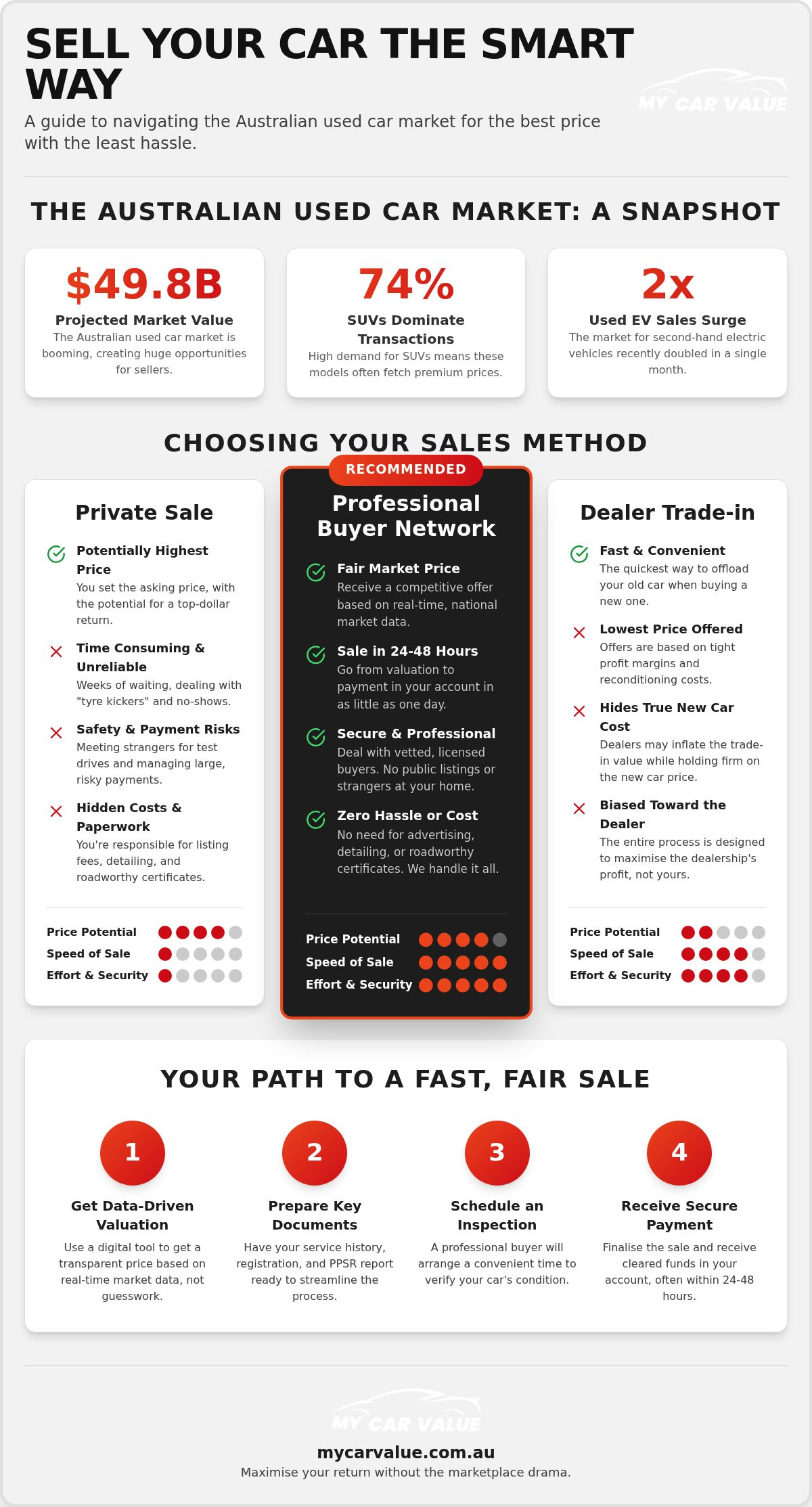
The 2026 market offers more than just two paths. Most sellers believe they must choose between the high effort of a private listing or the low return of a dealer trade-in. This binary choice is outdated. While the market is active, your chosen method dictates how much of your vehicle’s value stays in your pocket. Professional buyer networks have emerged as a dominant third option, providing a balance of speed and competitive pricing without the traditional drawbacks.
Every method carries hidden costs that impact your final “walk-away” figure. Private sales often require a professional detail and mechanical repairs to attract serious interest. In many states, you must provide a safety certificate before a transfer. For example, a Roadworthy Certificate (RWC) in Victoria typically costs between $150 and $250 for a standard passenger car. In Queensland, you can expect to pay between $75 and $110. Even in NSW, where a pink slip is capped at approximately $47, the time spent at a mechanic adds up. You can review the specific administrative requirements in the official government selling guide to ensure you remain compliant during the transfer.
The Reality of Private Classifieds
Selling privately is often touted as the best way to sell a car in Australia to get the highest price. The reality is frequently different. You will likely face a barrage of “Is this still available?” messages and low-ball offers from anonymous accounts. Premium listing fees on major Australian car sites can cost over $100, and there is no guarantee of a sale. Safety is another concern. Meeting strangers for test drives and managing large bank transfers carries inherent risks that many modern sellers prefer to avoid. If your time is worth more than a few hundred dollars in potential upside, the private route often fails the cost-benefit test.
The Trade-in Trap
Dealerships prioritise convenience, but this comes at a significant financial cost. Dealers often use your trade-in to mask the true cost of your new vehicle. They might offer a seemingly high trade-in price while refusing to budge on the new car’s retail sticker. It’s a numbers game designed to protect their margins. To get a fair deal, you should always separate your sale from your next purchase. Professional Used Car Buyers offer an alternative by providing a transparent, standalone price for your vehicle based on live market data. This allows you to walk into a dealership as a “cash buyer,” which often puts you in a much stronger negotiating position. Before you commit to a dealer’s offer, check your car’s true value to see what a professional network can offer instead.
Why a Professional Buyer Network is the Most Efficient Choice
Professional buyer networks have redefined the market by shifting the power back to the seller. Instead of you chasing a single buyer, the network brings multiple Used Car Buyers to you. This competition ensures you receive a price that reflects current demand rather than a single dealer’s inventory needs. For many, this has become the best way to sell a car in Australia because it combines the high-value potential of a private sale with the speed of a trade-in. You aren’t just getting one offer; you’re accessing a pool of professionals who are ready to buy.
Transaction speed is a major factor. You can move from an initial valuation to cash-in-hand within 24 hours. This efficiency is possible because professional buyers are equipped to handle large volumes of transactions daily. Unlike private sales, selling to a licensed motor dealer often removes the immediate requirement for a roadworthy certificate (RWC). Commercial buyers typically purchase vehicles in “as-is” condition. They have the internal resources to manage reconditioning and safety inspections themselves. This saves you the stress of visiting a mechanic and the potential cost of repairs just to pass an inspection.
Streamlining the Connection
My Car Value acts as the facilitator, matching your specific vehicle with industry professionals who are actively looking for that make and model. A national network provides a distinct advantage. A buyer in Perth might value a specific SUV model more highly than a buyer in Melbourne due to local stock shortages. This data-driven matching ensures your car goes to the buyer who values it most. It’s about finding the right home for your car without you needing to make dozens of phone calls.
Financial Security and Ease
Security is paramount when dealing with high-value assets. Dealing with a private individual involves the risk of fraudulent bank transfers, bounced cheques, or lengthy holding periods for funds. Professional networks operate with licensed motor dealers who provide guaranteed electronic funds transfers (EFT). You receive your payment instantly, often before the car even leaves your driveway. If you are looking for the Sell My Car for Cash experience, this method offers the highest level of protection. You can walk away knowing the paperwork is handled and the money is cleared. It’s a clean, professional break that lets you focus on your next vehicle purchase immediately.
Step-by-Step: Preparing Your Vehicle for a Successful Australian Sale
Preparation is the bridge between a low-ball offer and a premium result. While professional buyer networks handle much of the heavy lifting, your own groundwork dictates the speed and final value of the transaction. Taking the time to organise your documentation is the best way to sell a car in australia without unnecessary delays. Start by gathering all physical assets, including spare keys, the owner’s manual, and every mechanical receipt you’ve kept since you bought the car.
The Power of a Full Service History
An up-to-date logbook is your strongest negotiating tool. It provides documented proof that the vehicle has been maintained according to manufacturer standards, which directly impacts resale value. If you’ve lost your records, conduct a Car Service History Check to reconstruct your vehicle’s timeline. Presenting a neat folder of mechanical records builds immediate trust with any purchaser. It shows that there are no looming maintenance costs, often adding hundreds or even thousands to the final price.
Visual presentation matters just as much as mechanical health. A basic professional detail can significantly increase the perceived value of your vehicle. Focus on the “touch points” like the steering wheel, gear shifter, and door handles. Remove personal items and ensure the car is vacuumed and washed. This small investment suggests that the car has been cared for aesthetically, which usually mirrors how it has been treated mechanically.
Legal Compliance and PPSR
Before you list or contact a buyer, verify your vehicle’s status. A Personal Property Securities Register (PPSR) report reveals if there’s money owing on the car or if it has ever been declared a total loss. A clear PPSR report is non-negotiable for a fast sale because it provides legal certainty that the vehicle is free from encumbrance and has no recorded history of being written off or stolen. If finance is still owing, obtain a current payout letter from your lender to show transparency to the buyer.
State requirements vary significantly across the country. In Victoria, a Roadworthy Certificate (RWC) is typically valid for 30 days and costs between $150 and $250. In New South Wales, a safety inspection or “pink slip” is required for most vehicles over five years old and is capped at approximately $47, while Queensland safety certificates generally range from $75 to $110. Once the sale is complete, lodge your Notice of Disposal immediately with Service NSW, VicRoads, or your local authority. This step is critical as it transfers liability for fines and tolls to the new owner and allows you to cancel your insurance and claim any remaining registration refunds.
Maximising Your Return with My Car Value
Choosing the right partner is the final step in securing a premium price. My Car Value simplifies this by acting as your professional advocate. We’ve built a system that removes the guesswork, making it the best way to sell a car in Australia for owners who value their time. Our platform does the heavy lifting by filtering through a national network of professional purchasers to find the one that fits your vehicle’s specific profile. This network creates a competitive environment where buyers must offer fair market value to win your business. You bypass the trade-in trap and avoid the safety risks of private sales in one move.
Getting Your Accurate Valuation
Success starts with a realistic number. Our Vehicle Market Value Calculator uses live market data to provide a precise starting point. Traditional methods like manual Redbook estimations often rely on historical averages that don’t account for sudden market shifts. For instance, the 2026 market shows that SUVs account for 74.18% of transactions, a nuance that static guides often miss. Our data-driven approach offers immediate clarity by analysing what buyers are actually paying right now. To get a firm offer, you must be honest about your vehicle’s condition. Small details like paint chips, tyre tread depth, or service gaps matter. Providing accurate information ensures the quote you receive is the amount you actually get paid, preventing awkward renegotiations at the point of inspection.
Ready to Sell?
Our network spans the entire country, offering professional support from the east coast to the west. Whether you’re selling in Sydney, Melbourne, or Brisbane, we connect you with reputable purchasers ready to act. You don’t need to visit multiple dealerships or manage dozens of low-quality social media leads. Once you enter your details, we handle the professional matching. This streamlined process is designed for the modern Australian seller who wants results, not a hobby. We’ve removed the friction from the traditional sales model, allowing you to move from an online valuation to a cleared bank transfer in less than 48 hours.
Take Control of Your Next Car Sale
Selling your vehicle in 2026 doesn’t have to be a source of frustration. By moving away from the uncertainty of private listings and the low returns of dealer trade-ins, you can secure a result that reflects your car’s true market value. Focus on gathering your service history and obtaining a clear PPSR report to build immediate trust with potential purchasers. These steps ensure you remain in the driver’s seat throughout the transaction.
Leveraging a network of professional buyers remains the best way to sell a car in australia for those who prioritise efficiency. You get the benefit of accurate real-time market valuations and the security of dealing with licensed professionals Australia-wide. This modern approach skips the private sale stress and puts money in your bank account faster.
You’ve done the research and prepared your vehicle for success. Now it’s time to let the experts handle the heavy lifting so you can move on to your next adventure with confidence.
Frequently Asked Questions
What is the fastest way to sell a car in Australia?
Selling to a professional buyer network is the fastest way to offload your vehicle. Unlike private listings that can take weeks, these networks often complete the entire process within 24 to 48 hours. You receive a valuation, an inspection, and a cleared electronic funds transfer almost immediately. This method is widely considered the best way to sell a car in australia for those who need a quick, secure transaction without the marketplace drama.
Do I need a Roadworthy Certificate (RWC) to sell my car?
You usually need a Roadworthy Certificate (RWC) if you are selling your vehicle to a private individual in states like Victoria or Queensland. However, many professional buyers and licensed motor dealers buy vehicles in “as-is” condition. This means you can skip the mechanical inspection and the potential cost of repairs. Always check your specific state’s transport authority requirements to ensure you remain legally compliant during the transfer process.
Is it better to trade in my car or sell it to a professional buyer?
Selling to a professional buyer is generally better than a trade-in if you want to maximise your financial return. Dealerships often offer lower trade-in prices to protect their profit margins on the new car you are buying. By selling your vehicle as a standalone transaction, you walk into the dealership as a “cash buyer.” This gives you significantly more leverage to negotiate a better discount on your next vehicle purchase.
How do I ensure I get a fair price for my used car?
Using a real-time, data-driven valuation tool is the most effective way to ensure you receive a fair market price. Static guides often fail to account for rapid shifts in supply and demand or specific model popularity. By using the Value My Car tool, you access current transaction data from across the country. Being honest about your car’s condition during the appraisal process ensures you receive a firm offer that reflects its actual worth.
What paperwork do I need to sell my car privately in Australia?
You need your current certificate of registration, a complete service history, and a signed bill of sale to finalise a private transaction. It’s also vital to provide the buyer with any spare keys and the owner’s manual. Once the money has cleared, you must lodge a Notice of Disposal with your state’s transport authority. This document is essential as it legally transfers the responsibility for any future fines or tolls to the new owner.
What happens to my insurance and registration after the sale?
You must notify your insurer immediately to cancel or transfer your policy once the sale is finalised. The registration itself stays with the vehicle and transfers to the new owner, but you are responsible for lodging the disposal notice. This step ensures you aren’t held liable for the new owner’s driving. You may also be eligible for a pro-rata refund on your registration if you choose to cancel it before the sale.
How does a PPSR check affect my car’s value?
A clear PPSR report proves your vehicle has no finance owing and no history of being stolen or written off. While it doesn’t increase value beyond the market average, it prevents the value from plummeting due to buyer uncertainty. Most professional purchasers won’t even consider a vehicle without a clear title. Providing this report upfront demonstrates transparency and is a key part of the best way to sell a car in australia quickly.
Can I sell a car that still has finance on it?
You can sell a car with finance owing by obtaining a formal payout letter from your lender. This document states exactly how much is needed to clear the debt. When selling to a professional buyer, they will typically pay the lender directly and give you the remaining equity. This simplifies a complex legal process and ensures the encumbrance is removed from the PPSR immediately, protecting both the seller and the buyer.