
Ultimate RWC Guide for Australian Sellers (2026)
A failed roadworthy inspection is the fastest way to kill a car sale and drain your bank account. Most Australian sellers dread the rwc process, fearing hidden mechanical issues or a “fail” notice that sends repair costs spiralling. You want a straightforward sale without the bureaucratic headache, but the rules change depending on whether you are in Melbourne, Brisbane, or Sydney. It’s frustrating to navigate state-specific regulations while trying to get the best possible return on your investment.
This guide cuts through the confusion to help you master the roadworthy process and secure a higher price for your vehicle. We provide the exact 2026 requirements for every state, from the $52 eSafety Checks in NSW to the $102.70 Safety Certificates in Queensland. You will learn exactly what inspectors look for, how to avoid common pitfalls, and when it makes more sense to skip the repairs and sell to a professional buyer instead. We have simplified the details so you can get your car ready for the market with total confidence.
Key Takeaways
- Understand that an rwc is a mandatory safety document issued by licensed testers, though validity periods and costs differ significantly across Australian states.
- Prepare for the inspection by checking safety essentials like tyres, brakes, and suspension systems to avoid failing on easily fixable issues.
- Recognise the “With RWC” advantage, which allows you to list your car for a higher price and appeal to a broader range of private buyers.
- Minimise your out-of-pocket expenses by performing a pre-inspection DIY check on basic components like lights and windscreen wipers.
- Discover how professional buyers can simplify the sale by managing the roadworthy process for you, eliminating the need for upfront repair costs.
What is an RWC? Understanding the Roadworthy Certificate in Australia
An rwc is a legal document that confirms your vehicle meets the minimum safety standards required to be driven on Australian roads. While many people search for this acronym during the Rugby World Cup, for a car seller, it represents the final hurdle before a successful transfer of ownership. It isn’t a guarantee of the car’s overall mechanical health, but rather a verification that the vehicle is safe for the driver and other road users. A roadworthy certificate is issued only after a thorough inspection of essential safety components by an authorised provider.
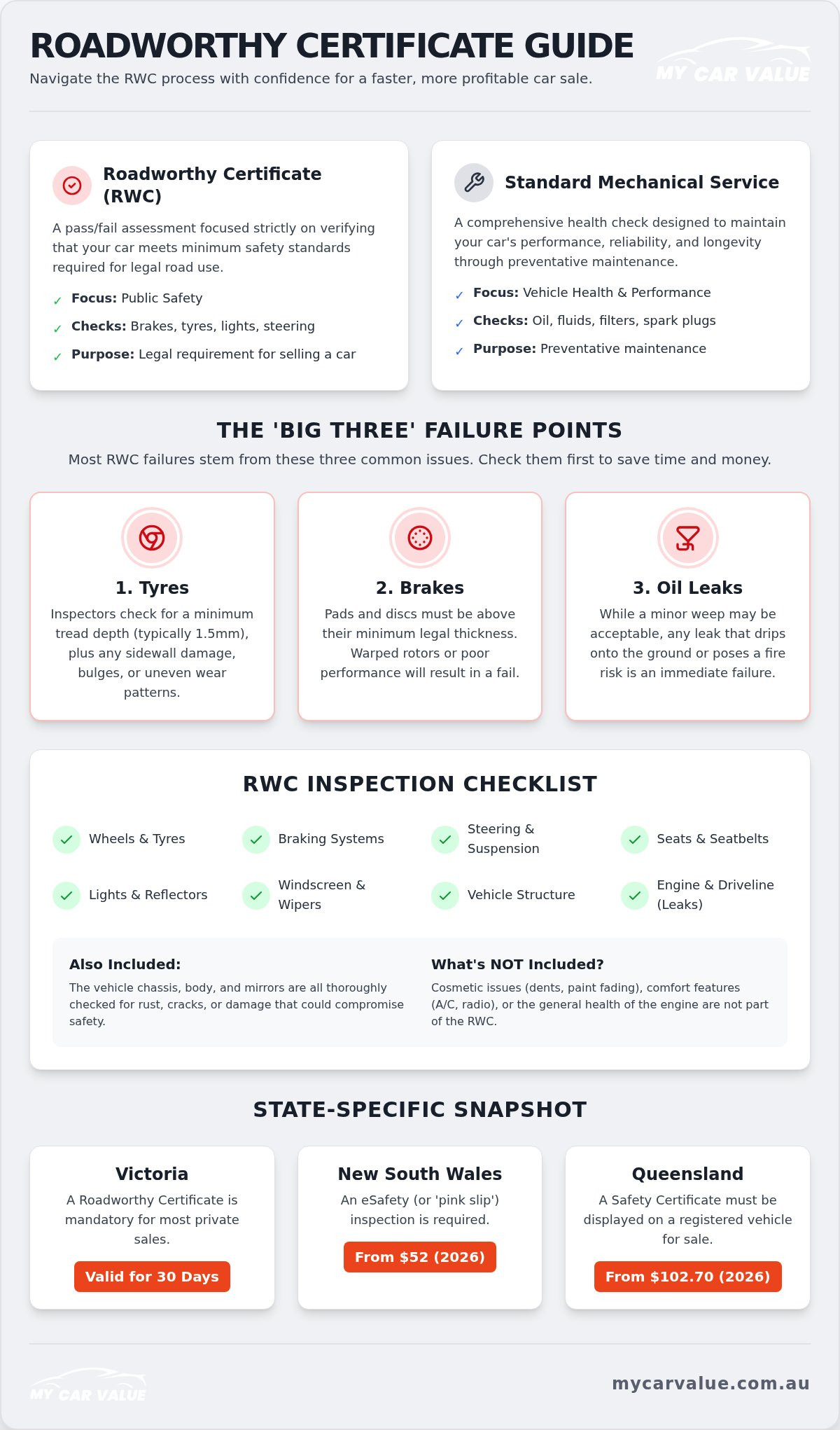
You’ll generally need to obtain this certificate when you’re selling a registered car, re-registering a vehicle that’s been off the road, or clearing a police-issued defect notice. Because Vehicle inspection regulations in Australia vary by state, the specific triggers depend on your location. For example, Victorian sellers must provide a certificate that’s less than 30 days old to the buyer. In contrast, other territories may only require inspections for older vehicles or specific registration transfers. The core purpose remains consistent across the country: removing dangerous vehicles from the road to prevent accidents caused by mechanical failure.
RWC vs. A Standard Car Service
Don’t confuse a roadworthy inspection with a standard mechanical service. A service focuses on the car’s longevity and performance, covering items like oil changes, spark plugs, and air conditioning filters. An rwc inspection is strictly about safety. Your car could have a pristine engine and a fresh oil change but still fail the inspection because of a small chip in the windscreen or a worn wiper blade. Conversely, a car with a noisy air conditioner or a rough idle might still pass a roadworthy check as long as its brakes, tyres, and steering are fully functional. It’s a pass/fail assessment based on safety, not a comprehensive health check.
Who Can Issue a Roadworthy Certificate?
Not every mechanic can sign off on your roadworthiness. Only Licensed Vehicle Testers (LVTs) have the legal authority to conduct these inspections and issue the final certificate. A Licensed Vehicle Tester is a qualified professional or workshop officially accredited by the state’s transport department to verify that a vehicle complies with current safety regulations. You can usually identify these centres by the official government signage displayed at their premises or on their website. Always verify that the workshop’s accreditation is current before booking your appointment. This ensures your certificate is legally valid and will be accepted by the relevant transport authority during the sale process.
What Does an RWC Inspection Actually Cover?
An inspection is a comprehensive safety audit designed to verify that a vehicle is structurally sound and safe for public use. The tester examines the chassis and body for rust, cracks, or previous poor repairs that could compromise the car’s strength in a collision. According to the Official Victorian RWC guidelines, the vehicle must be free from any wear or damage that would make it unsafe for normal road use. This includes checking that all seats and seatbelts are secure and function correctly.
Visibility is a major priority during the assessment. Your windscreen must be free from cracks or chips in the driver’s line of sight, and the rest of the glass must meet transparency standards. Mirrors must be secure and clear, while wiper blades must effectively clear the glass without streaking. Lighting is equally critical. Every bulb, from the high beams to the small light above your rear number plate, must function perfectly. If a single indicator bulb is blown, your rwc will be denied until it’s replaced.
The “Big Three” Failure Points
Most cars fail on three predictable areas. First, tyres are the leading cause of rejection. Testers look for a minimum tread depth (typically 1.5mm) and check for sidewall bulging or uneven wear patterns. Second, brake performance is tested on a road trial or a brake roller. If your pads are below the legal thickness or the rotors are warped, you’ll need repairs. Finally, excessive oil leaks are a common deal-breaker. A small weep is often acceptable, but a leak that drips onto the ground or poses a fire risk will result in an immediate failure.
Items Not Included in the Check
It’s helpful to know what the inspector ignores to avoid wasting money on unnecessary fixes. Cosmetic issues like paint fading, minor car park dents, or seat stains won’t affect your rwc status. Comfort features are also exempt. You can pass even if your air conditioning is broken, your radio is dead, or your cruise control is temperamental. The engine’s general health, such as a noisy lifter or a worn clutch, is generally not part of the safety check unless it directly impacts the vehicle’s emissions or safe operation.
Understanding these requirements allows you to address small issues before the official inspection. If the potential repair list looks too long or expensive, you might prefer to get an accurate car valuation and sell to a professional buyer who handles the roadworthy themselves. This saves you the stress of multiple workshop visits and unexpected bills.
Selling Your Car: Should You Get an RWC First?
Deciding whether to get an rwc before listing your car is a strategic choice that affects your final profit. Providing a certificate upfront removes the biggest barrier for potential buyers. Most people are hesitant to buy a car that might require thousands of dollars in repairs just to get it on the road. By handling the inspection yourself, you signal that the vehicle is safe and ready for immediate transfer. This transparency often leads to a faster sale and allows you to justify a higher asking price.
In many Australian states, the legal responsibility for providing a certificate falls on the seller. If you’re selling in Melbourne, for instance, you’ll need to get a roadworthy certificate to complete the transfer of registration. Selling “as is” without a certificate isn’t just a marketing choice; it’s often a legal hurdle that prevents you from selling to the general public. It drastically limits your pool of buyers to those willing to take a significant risk or those looking for a bargain project car.
A valid certificate also has a direct impact on your car valuation. It transforms your vehicle from an “unknown quantity” into a market-ready asset. When a buyer sees a current rwc, they aren’t just seeing a piece of paper; they’re seeing an insurance policy against immediate safety issues. This confidence translates into stronger offers and less room for aggressive price haggling. It proves your car is worth the investment because the hard work of verifying its safety is already done.
Selling to Private Buyers vs. Dealers
Private buyers typically demand a certificate because they lack the technical expertise to assess a car’s safety themselves. However, selling this way requires you to manage the inspection, repairs, and paperwork. If you want to avoid this effort, professional used car buyers often purchase vehicles in their current state and handle the roadworthy process internally. This path trades a slightly lower sale price for a massive reduction in stress and time spent at the mechanic.
Calculating the Cost-Benefit of Repairs
You must calculate if the repair costs will actually be recovered in the sale price. If your car needs $2,000 worth of suspension work to pass but only gains $1,500 in market value, you’re better off selling it as it stands. Use a vehicle market value calculator to compare your car’s worth in its current condition versus its potential value with a certificate. This data-driven approach ensures you don’t over-invest in a vehicle that won’t give you a return on your repairs.
How to Get a Roadworthy Certificate: A Step-by-Step Guide
Obtaining an rwc starts with preparation. Don’t book an inspection until you’ve checked the basics yourself. Small faults like a blown indicator bulb or a worn wiper blade lead to an immediate failure. These are cheap to fix at home but expensive if they force a re-inspection. Walk around your vehicle and test every exterior light, including the high beams and the small bulb above your rear number plate. Check your tyre tread against the wear indicators and ensure your windscreen washers are topped up and spraying correctly. This simple DIY check saves time and prevents unnecessary stress on the day of the test.
Once you’re confident the basics are covered, book your vehicle into an authorised inspection centre. On the day of the inspection, ensure the car is clean, especially in the engine bay and underbody, as excessive dirt can hide leaks or structural cracks. Bring your driver’s licence and any previous repair invoices if you’ve recently had safety work completed. The process typically takes between 60 and 90 minutes. The tester will either issue the certificate immediately or provide a rejection report if the car fails to meet the required standards.
The 14-Day Rule for Repairs
If your car fails, you don’t necessarily have to pay for a full second inspection. Most states provide a 14-day window to rectify the issues listed in your rejection report. If you return to the same testing station within this period, the mechanic only needs to inspect the specific items that failed. This keeps your costs down and speeds up the final approval. Get a detailed rejection report and organise your repairs immediately. Waiting until the last minute risks missing the 14-day cutoff, which would force you to pay for a completely new rwc assessment from scratch.
Validity and Transfer
Timing your inspection is a critical part of your sales strategy. If you obtain the certificate too early, it might expire before you’ve finalised the deal with a buyer. You’ll also need to ensure the certificate is issued in the correct name to match the registration transfer documents. For Australian sellers in states like Victoria, a roadworthy certificate remains valid for 30 days from the date of issue.
Get a professional car valuation in Melbourne today
Maximising Your Car Value Without the RWC Hassle
The traditional path to selling a car often involves weeks of mechanical appointments and the constant fear of a failed inspection. For many Australian sellers, the cost and time required to secure an rwc simply don’t align with their busy schedules or financial goals. My Car Value streamlines this journey by connecting you with professional buyers who specialise in purchasing vehicles in their current condition. This approach removes the burden of upfront repair costs and the bureaucratic stress of dealing with transport authorities.
Choosing to sell my car through a professional network means you don’t have to spend a cent on tyres or brakes just to get a sale over the line. These buyers are equipped to handle the roadworthy process themselves after the purchase. They factor the vehicle’s condition into their offer, providing a transparent and fair price based on real-time market data. This is particularly beneficial for older vehicles where the cost of achieving a certificate might exceed the car’s actual market value gain.
Transparency is the key to a successful “as is” sale. When you provide an accurate description of your car’s condition, you receive a more reliable quote. Disclosing minor faults or known mechanical issues doesn’t necessarily devalue your car; it simply allows the buyer to calculate their own repair costs accurately. A professional valuation serves as your first step, giving you a clear benchmark of what your vehicle is worth in the current Australian market without the need for a pre-sale rwc.
The My Car Value Advantage
Our platform eliminates the need for multiple workshop visits. You can bypass the local mechanic and deal directly with professionals who understand the complexities of the secondary market. Whether you are selling in Brisbane, Adelaide, or Perth, our network provides fast and accurate valuations. We value your time as much as your vehicle, ensuring a logical and structured progression from your initial inquiry to a completed sale.
Next Steps for Your Sale
Start by obtaining your online valuation today to see where your car sits in the 2026 market. Once you have a figure, prepare your vehicle’s service history and perform a PPSR check to show clear title. These documents build trust with buyers and help finalise the transaction quickly. Don’t let the roadworthy process stall your plans. Use the My Car Value platform to find a knowledgeable partner who simplifies the heavy lifting for you.
Take Control of Your Car Sale
Navigating the rwc process doesn’t have to be a source of constant stress. You now understand that a roadworthy certificate is a critical safety benchmark that protects both you and the buyer. By preparing with a DIY check and understanding your state’s specific validity rules, you can approach the market with total confidence. Remember that you always have a choice. You can invest in repairs to attract private buyers or bypass the workshop entirely by selling to a professional network.
We provide accurate, data-driven market valuations to help you make the right financial decision. Our Australia-wide network of professional buyers ensures a no-stress selling process from start to finish. This streamlined approach values your time and removes the uncertainty of a failed inspection.
Get the best price for your vehicle without the unnecessary mechanical headaches. Your straightforward sale starts with a clear understanding of your car’s true worth.
Frequently Asked Questions
How much does an RWC cost in Australia in 2026?
The cost of an rwc depends on your state and the type of vehicle you own. In Queensland, the government sets a maximum fee of $102.70 for light vehicles as of July 2026. New South Wales caps the eSafety Check at $52; however, in Victoria and Tasmania, prices are not regulated and typically range between $150 and $250. Always confirm the inspection fee with your chosen licensed tester before booking your appointment.
Can I sell my car without an RWC?
Whether you can sell without a certificate depends entirely on your state’s regulations and the buyer’s status. In Victoria and Queensland, you generally cannot transfer a registered vehicle to a private buyer without a valid certificate. However, states like South Australia and Tasmania do not require them for private sales. You can also bypass this requirement by selling your car to professional used car buyers who manage the roadworthy process internally.
How long is a Roadworthy Certificate valid for?
Validity periods vary across the country, so timing your sale is important. In Victoria and the Australian Capital Territory, a certificate is valid for 30 days from the date of issue. Queensland offers a longer window of two months or 2,000km; whichever comes first. New South Wales pink slips are valid for six months. If your certificate expires before you finalise the transfer of ownership, you must pay for a completely new inspection.
What happens if my car fails the RWC inspection?
If your vehicle fails, the tester will provide a detailed rejection report listing the necessary repairs. You typically have 14 days to fix these issues and return the car to the same station for a re-inspection. During this window, you usually only pay a reduced fee for the tester to verify the specific repairs. If you miss this 14-day cutoff, you will likely be charged for a full inspection again.
Does an RWC cover the mechanical reliability of the engine?
No, a roadworthy inspection is not a comprehensive mechanical check or a guarantee of reliability. It only verifies that the vehicle’s essential safety components meet the minimum standards for road use. The inspector checks items like brakes, tyres, steering, and lights. They do not assess the condition of the engine, gearbox, or non-safety features like the air conditioning. For a full mechanical assessment, you should book a separate pre-purchase inspection.
Is a Roadworthy Certificate the same as a safety certificate?
Yes, these terms refer to the same basic requirement but vary by state. Queensland officially uses the term “Safety Certificate,” while Victoria and the ACT use “Roadworthy Certificate.” In New South Wales, the equivalent for registration renewal is called an “eSafety Check” or a “Pink Slip.” Despite the different names, they all serve the same purpose of ensuring a vehicle is safe for Australian roads.
Who pays for the RWC, the buyer or the seller?
In states where a certificate is mandatory for a sale, the seller is legally responsible for providing it and covering the cost. This ensures the vehicle is in a fit state to be transferred and driven by the new owner. While you can negotiate for the buyer to obtain the rwc, this usually requires selling the car unregistered. Providing the certificate yourself is the standard way to secure a higher market value and a faster sale.
Do I need an RWC if I am trading my car in to a dealer?
You generally do not need to provide a certificate when trading your vehicle to a licensed motor dealer. Dealers are authorised to manage the roadworthy process themselves and will factor the cost of any necessary repairs into their trade-in offer. This is a significant advantage if you want to avoid the time and expense of visiting a mechanic before selling. It simplifies the transaction and allows you to drive away in your new car immediately.