

Documents Needed to Sell a Car in Australia: The 2026 Master Checklist
Handing over your car keys without the right paperwork isn’t just a mistake; it’s a legal liability waiting to happen. You’ve found a buyer and agreed on a price, but the real work starts with the fine print. Most sellers feel a justified sense of dread regarding state-specific roadworthy rules or the fear of being held responsible for a stranger’s future tolls and fines. It’s a common frustration that can stall an otherwise quick sale. Understanding the specific documents needed to sell a car in Australia is the only way to guarantee a clean break and a professional transaction.
We’ve built this 2026 master checklist to strip away the complexity of the Australian used car market. You’ll get a clear, step-by-step breakdown of the mandatory forms, safety certificates, and disposal notices required in your specific state or territory. We’ll also show you how to leverage your service records to justify a higher asking price. From PPSR checks to digital transfer apps, this guide ensures you finalise your sale quickly, legally, and with total peace of mind.
Key Takeaways
- Confirm your legal standing by preparing the essential identification and registration papers required for every Australian car sale.
- Navigate state-specific compliance with our checklist of the mandatory documents needed to sell a car in Australia, including Roadworthy Certificates and transfer forms.
- Boost your resale price by organising a comprehensive service history and maintenance receipts that prove the vehicle’s long-term health.
- Protect yourself from post-sale fines and tolls by correctly lodging a Notice of Disposal and executing a formal Bill of Sale.
- Streamline the entire process by engaging with professional buyers who handle the complex paperwork on your behalf.
The Essential Identification and Ownership Documents
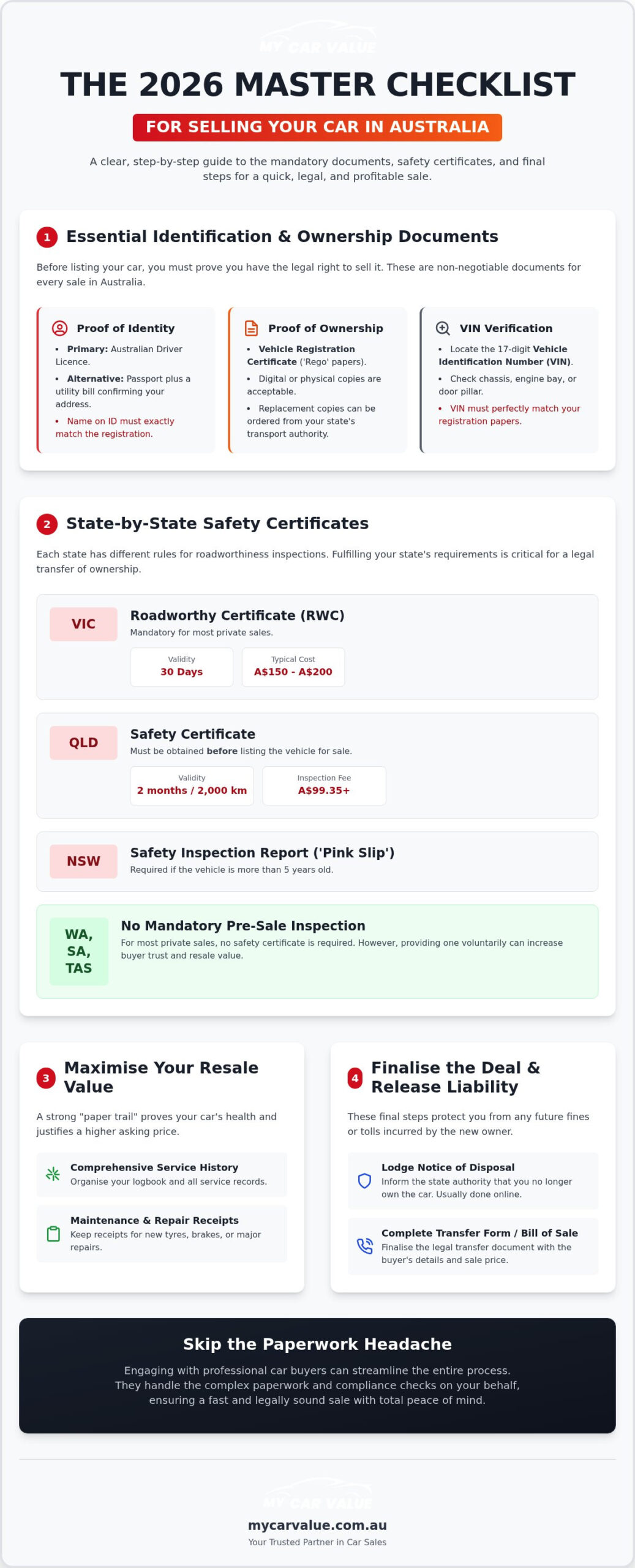
Before you list your car online or negotiate a price, you must prove you have the legal right to sell the vehicle. Your Australian Driver Licence is the most critical tool in this process. It serves as your primary photo ID and links your identity to the name recorded on the vehicle’s registration. If you don’t have a current licence, a passport combined with a secondary document confirming your address, such as a recent utility bill, is the standard alternative. Organising these records is a vital step when gathering the documents needed to sell a car in australia, as it prevents legal disputes during the transfer.
Verifying Your Identity as a Seller
State transport authorities require a high level of identity verification to prevent fraudulent sales. You’ll need primary identification, usually your licence, but secondary ID like a Medicare card or a bank card is often required for digital transfers. Ensure the name on your identification matches the name on the vehicle registration exactly. If you’ve recently changed your name through marriage or deed poll, you’ll need to update your records with the transport department before starting the sale. It’s also essential to have a current email and mobile number linked to your state transport account, such as Service NSW or myVicRoads, to facilitate the instant digital notification of disposal.
Locating Your Vehicle Identification Number (VIN)
The VIN is the unique 17-digit ‘DNA’ of your vehicle. You can typically find it stamped on the chassis, inside the engine bay, or on the driver’s side door pillar. This number must match your registration documents perfectly. Any discrepancy is a major red flag for buyers and can stop a sale in its tracks. Verifying this early ensures that the Australian vehicle registration plates currently on the car are legally tied to the correct chassis. If the numbers don’t align, you may have a clerical error that needs correcting before you can legally finalise the sale.
Your registration certificate, or ‘rego’ papers, confirms you are the current operator of the vehicle. If you’ve lost these papers, don’t panic. You can order replacements through your state’s transport website for a small fee. Most states provide a digital copy immediately, while physical papers are sent via post. Having a physical or digital copy ready for the buyer’s inspection builds trust and proves the vehicle isn’t stolen or unregistered.
Selling a car that was a gift or part of a deceased estate requires additional legwork. If you’ve inherited the car, you’ll need a copy of the Will or a letter from the executor of the estate to prove your authority to sell. For gifted cars, a signed letter from the original owner and a clear bill of sale will establish the necessary paper trail. These extra steps are a core part of the documents needed to sell a car in australia when the ownership isn’t a straightforward purchase.
State-by-State Compliance: Roadworthys and Transfer Forms
Selling a vehicle in Australia is rarely a uniform process because each state operates under its own transport authority. The specific documents needed to sell a car in australia vary significantly depending on your state or territory. While some jurisdictions prioritise safety inspections before the keys change hands, others operate on a ‘buyer beware’ basis. Understanding these nuances is the only way to ensure the transfer is legally binding and that you aren’t left holding the bill for the new owner’s speeding fines.
Mandatory Safety Inspections Across Australia
In Victoria and Queensland, safety is a non-negotiable prerequisite for a private sale. Victorian sellers must provide a Roadworthy Certificate (RWC) that is less than 30 days old. This typically costs between A$150 and A$200 for a car with no defects. In Queensland, a Safety Certificate is mandatory before you even list the car for sale; it remains valid for two months or 2,000 kilometres and carries a government inspection fee of A$99.35. Approved inspection stations may add a labour charge on top of this fee.
New South Wales uses a different system. If your car is more than five years old, you’ll need a Safety Inspection Report, commonly known as a ‘Pink Slip’. Conversely, Western Australia, South Australia, and Tasmania don’t require mandatory safety checks for most private sales. However, providing one voluntarily can help you secure a better price by building buyer confidence and proving the vehicle’s mechanical integrity.
The Transfer of Ownership Form
The shift toward digital platforms has simplified the transfer process in 2026. Most states now allow you to complete the transfer via online portals like Service NSW, MyVicRoads, or TMR QLD. To avoid processing delays, ensure the VIN, engine number, and sale date are entered exactly as they appear on the registration papers. Common mistakes, such as transposing digits in the VIN, can lead to the application being rejected or flagged for manual review.
Both parties must sign the transfer document or confirm the sale online. For the seller, the most critical step is lodging the Notice of Disposal (or its local equivalent) immediately. This document is your legal shield. It notifies the government that you are no longer the registered operator, protecting you from liability for tolls, parking infringements, or traffic fines. In NSW, you must submit this within 14 days to avoid liability, while WA requires notification within seven days. If you want to avoid this administrative burden, using a service like My Car Value connects you with professionals who handle the complex paperwork on your behalf.
Maximising Resale Value: The ‘Paper Trail’ that Buyers Crave
Legal compliance gets the sale over the line, but your documentation strategy determines the final price. While government forms are mandatory, the additional documents needed to sell a car in australia act as a powerful negotiation tool. A buyer sees a disorganised glovebox as a sign of neglect. Conversely, a neatly filed history of maintenance proves the vehicle’s mechanical integrity. You aren’t just selling a car; you’re selling the confidence that it won’t break down next week.
The Power of a Complete Service History
A complete service history is a certificate of health for your vehicle. Professional buyers and savvy private individuals use a car service history check to confirm that every maintenance interval was met on time. If your car uses a digital logbook, which is standard for many brands in 2026, download the full report from the manufacturer’s portal before your first viewing. For older models, ensure every physical stamp is legible and dated correctly.
Don’t stop at the logbook. Organise your repair and maintenance receipts chronologically in a dedicated folder. This includes invoices for ‘consumables’ like high-quality tyres, recent brake pad replacements, or a new battery. Showing a buyer a A$1,200 invoice for a major timing belt service performed six months ago removes a significant future cost from their mind. This transparency builds immediate trust and allows you to hold firm on your asking price.
Owner’s Manuals and Technical Guides
The original ‘glovebox library’ is a hallmark of a fastidious owner. Ensure the owner’s manual, warranty booklet, and any technical guides are present and in good condition. These documents are essential for the new owner to understand the vehicle’s features and safety systems. Include the radio security codes and the plastic tags for spare keys provided at the original point of sale. Losing these items can lead to expensive dealership visits for the buyer later on.
Modern electronic keys are notoriously expensive to replace, often costing between A$400 and A$900 depending on the brand. Proving you have a full set of spare keys and the associated code cards prevents a buyer from haggling your price down to cover a replacement. Use these records alongside a professional car valuation to set a firm, data-backed benchmark for your negotiations. If the vehicle is still under a factory warranty, have the original purchase contract ready to prove the remaining coverage is transferable.
Finalising the Deal: Bills of Sale and Liability Release
The moment you hand over the keys is the point of highest risk in a private transaction. Without a clear paper trail, you remain vulnerable to future disputes or legal liabilities. Consolidating the final documents needed to sell a car in australia protects your bank account and your legal standing. This stage is about moving from a verbal agreement to a binding contract that leaves no room for ambiguity or “he-said, she-said” arguments.
Crafting a Legally Sound Bill of Sale
A Bill of Sale is your primary proof that the transaction occurred and that ownership has shifted. It must be detailed and accurate to be effective. Include the sale date, the final price in A$, and the buyer’s full name, address, and signature. List the vehicle’s VIN and engine number to identify the specific asset being sold. Both parties should sign two copies of this document so each person retains an original record for their files.
Private sales in Australia are generally conducted on an “as is” basis, meaning the buyer accepts the car with all its faults. To protect yourself from future claims, include a “Sold as Seen” or “As Is” clause in the receipt. This signals that the buyer has inspected the vehicle and accepts its current condition at the time of handover. Keep your copy of this signed receipt for at least five years. It’s your only defence if the buyer later claims they didn’t receive the car or if the vehicle is involved in a crime shortly after the sale.
The PPSR Report: Transparency as a Selling Point
While a buyer often performs their own check, providing a fresh PPSR check is a gesture of total transparency. This report, which costs A$2 in 2026, confirms the vehicle has no outstanding finance, hasn’t been written off, and isn’t recorded as stolen. Presenting a Certificate of Clear Title at the point of sale eliminates the buyer’s biggest fear: losing the car to a repossession agent because of your old debt. A clear PPSR report is the ultimate ‘green light’ for a buyer.
This simple document can prevent a sale from collapsing at the last minute by proving you have the legal right to transfer ownership without encumbrance. Once the money is in your account and the receipt is signed, remember to cancel your insurance policy. Wait until the buyer has physically driven away to ensure you’re covered during the final handover process. Taking these final steps ensures the sale is as seamless as it is legally compliant.
Skipping the Paperwork Headache: The My Car Value Solution
Private selling often feels like a second job. Between managing tyre-kickers and gathering the legal documents needed to sell a car in australia, the process is notoriously slow and prone to error. Professional buyers offer a streamlined alternative that prioritises speed and legal certainty. They specialise in high-speed transactions where the administrative burden shifts from the seller to the buyer. This approach is ideal for those who value their time and want to avoid the risks associated with private cash transfers or fraudulent buyer profiles.
The Efficiency of Professional Used Car Buyers
Licensed used car buyers function as efficient facilitators in the Australian market. When you sell to a professional, they typically manage the Notice of Disposal and registration transfer paperwork on your behalf. This removes the stress of navigating government portals and ensures the vehicle is out of your name immediately. You won’t have to worry about receiving the new owner’s speeding fines in the post weeks after the sale is finalised.
One of the biggest advantages is the exemption from mandatory safety inspections in several jurisdictions. In states like Victoria or Queensland, you usually don’t need to provide a Roadworthy Certificate (RWC) or Safety Certificate if the buyer is a licensed motor vehicle dealer. This saves you the A$150 to A$200 inspection fee and the potential cost of expensive mechanical repairs required to pass. Our network spans major Australian hubs, including Melbourne, Brisbane, and Perth, ensuring you find a buyer who understands local regulations and handles the heavy lifting of the admin.
Next Steps: Get Your Valuation and Sell Today
Success starts with an accurate benchmark. Use the My Car Value platform to receive a data-driven valuation before you start gathering your records. This helps you understand which documents, like a full service history or recent repair receipts, are worth highlighting to maximise your offer. If you’re ready to bypass the stress of traditional listing sites, follow our ultimate guide to selling your car to move from ‘for sale’ to ‘sold’ in a fraction of the time. Professional buyers also handle the PPSR requirements themselves, removing another step from your to-do list.
Before you meet a buyer, ensure you have your final checklist ready:
- Current Australian Photo ID (Licence or Passport).
- Your most recent Registration Certificate.
- A complete Service Logbook and maintenance receipts.
- An accurate market valuation to benchmark your offers.
By choosing a professional route, you ensure a seamless, legally compliant transfer of ownership without the typical paperwork headache. It’s the fastest way to turn your car into cash while staying protected under Australian consumer law.
Finalise Your Sale with Confidence
Mastering the paperwork is the final hurdle to a successful car sale. You now have a clear roadmap for state-specific safety certificates, disposal notices, and the vital service history that justifies a higher price. Organising the documents needed to sell a car in australia ensures you remain legally protected from future fines while building immediate trust with your buyer. It’s the difference between a lingering liability and a clean break.
Transparency remains your greatest asset in the used car market. Accurate records and a clean PPSR report remove the friction that often stalls a deal. You’re now equipped to handle the administrative side of the sale with speed and precision. Skip the stress of private classifieds and leverage our national network for a faster, more reliable outcome. Our market-driven valuations provide the benchmark you need for a confident transaction.
You’ve done the hard work; now it’s time to finalise the deal and move on to your next vehicle with total peace of mind. Start your valuation now and experience a streamlined path to a successful sale.
Frequently Asked Questions
Do I need a roadworthy certificate to sell a car in my state?
Yes, if you are in Victoria or Queensland. Victorian sellers need a certificate less than 30 days old, while Queenslanders must have a Safety Certificate before listing the car for sale. NSW requires a Pink Slip for vehicles over five years old. In Western Australia, South Australia, and Tasmania, inspections aren’t mandatory for private sales. Always check your local transport authority for the most current regulations before finalising your paperwork.
Can I sell a car in Australia if I have lost the registration papers?
You can sell a car with lost papers, but you must order replacements first. Buyers will rarely complete a transaction without seeing the current registration certificate to prove ownership. Visit your state’s transport website, such as Service NSW or myVicRoads, to request a duplicate. Most authorities provide a digital copy instantly or mail a physical version for a small administrative fee. Having these documents ready is essential when gathering the documents needed to sell a car in australia.
What is a PPSR report and do I need to provide one to the buyer?
A PPSR report is a national certificate that confirms a vehicle has no outstanding finance, isn’t stolen, and hasn’t been written off. While buyers often conduct their own check, providing one yourself builds immediate trust. It costs A$2 in 2026 via the official government portal. Offering this report proves you have a clear title and are authorised to sell the asset without any hidden legal encumbrances.
Is a handwritten receipt enough when selling a car privately?
A handwritten receipt is legally acceptable if it contains all the necessary details. You must include the date, sale price, VIN, engine number, and the full names and signatures of both parties. To protect yourself, always add an “as is” clause to signify the buyer accepts the car’s current condition. While simple, this document serves as your primary proof of the ownership transfer and should be kept for at least five years.
Do I need to notify my insurance company immediately after the sale?
Notify your insurance provider as soon as the buyer drives away with the vehicle. You shouldn’t cancel the policy until the handover is physically complete to ensure you remain covered during the final inspection or test drive. Most Australian insurers allow you to cancel or transfer your policy online instantly. This prevents you from paying for a car you no longer own and protects you from liability for any post-sale accidents.
How do I prove I no longer own the car after I’ve sold it?
Lodging a Notice of Disposal with your state transport authority is the only way to prove you no longer own the car. This action officially removes your name from the registration and protects you from future tolls or traffic infringements. Submit this form online immediately after the sale. Keep a copy of your signed Bill of Sale as secondary evidence of the date and time the vehicle changed hands.
Can I sell a car that still has money owing on it?
You can sell a car with outstanding finance, but the loan must be paid out during the sale. Most buyers will require a payout letter from your lender to ensure the debt is cleared. You can arrange for the buyer to pay the lender directly and give the remaining balance to you. This ensures the PPSR status is updated to “clear” and protects the buyer from the risk of repossession.
What documents do I need if I’m selling to a professional used car buyer?
Selling to a professional used car buyer requires less paperwork than a private sale. You typically only need your driver’s licence, the current registration certificate, and your service logbooks. Professional buyers often handle the Notice of Disposal and PPSR checks themselves, which significantly reduces your administrative burden. This is the most efficient way to manage the documents needed to sell a car in australia while ensuring a fast, legally compliant transaction.