

Car Depreciation Calculator Australia: The 2026 Resale & Tax Guide
Your car loses value the moment it leaves the showroom, but that doesn’t mean you have to be a passive observer of your own financial loss. Most drivers feel a sense of dread when looking at trade-in offers, largely because finding a reliable car depreciation calculator australia can feel like a moving target. It’s frustrating to be caught between confusing tax rules and market estimates that don’t seem to match reality.
We’re here to strip away that complexity and provide immediate clarity. This guide helps you master the maths behind your vehicle’s value loss for both tax and resale success. Use these insights to estimate your car’s current worth accurately and identify the specific factors that help you maintain a higher value over time. You’ll gain the confidence to handle negotiations without the usual anxiety.
We’ll break down the essential differences between tax-effective depreciation and real-world market value. You’ll also get a clear plan to maximise your resale price and understand your 2026 tax deduction eligibility. This approach moves you from a position of uncertainty to one of informed control over your asset. Let’s start by simplifying the numbers.
Key Takeaways
- Master the primary inputs of a car depreciation calculator australia to understand how age and kilometres impact your vehicle’s base value.
- Identify the specific Australian vehicle types, like dual-cab utes, that defy standard depreciation curves and hold their value longer.
- Separate the technical tax methods used by the ATO from the real-world market factors that determine your actual resale price.
- Learn how to use proactive maintenance and detailed service records to maximise your car’s value before you decide to sell.
- Transition from theoretical estimates to concrete offers by comparing trade-in values, private sales, and professional buyer networks.
Understanding Car Depreciation in the Australian Market
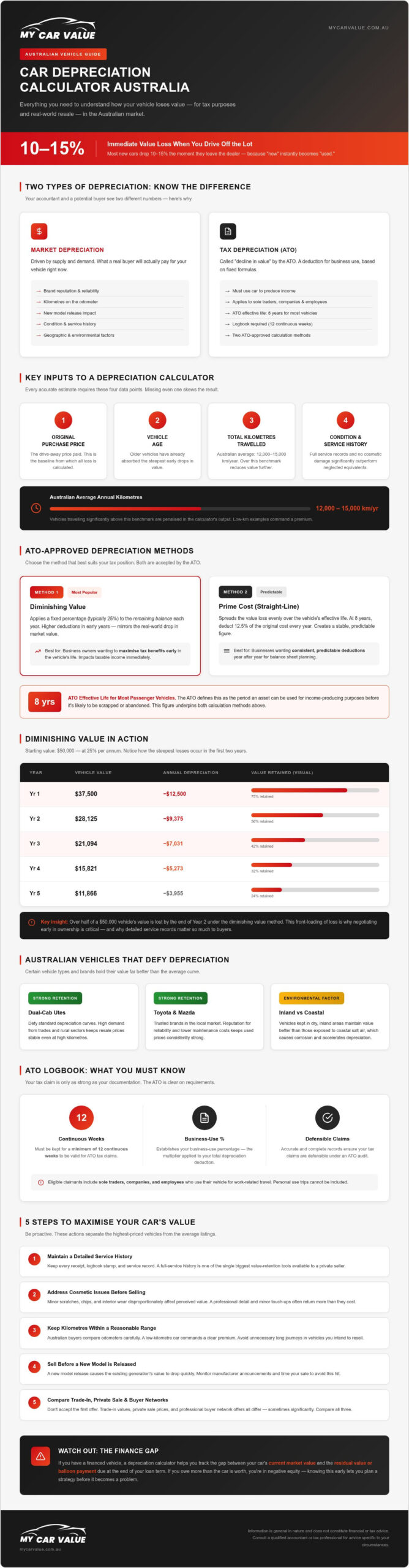
Car depreciation is the difference between your vehicle’s original purchase price and its current market value. It represents the largest ongoing cost of ownership, often outweighing fuel and insurance combined. In Australia, the “drive-away” factor is a harsh reality. Most new cars lose 10-15% of their value the moment they leave the dealer centre. This immediate drop occurs because the vehicle transitions from “new” to “used” status instantly, regardless of how few kilometres are on the clock.
Your accountant and a potential car buyer often see two different numbers. While one looks at tax law and fixed percentages, the other looks at the car’s condition and current demand. Understanding this gap is the first step toward protecting your equity.
Market Depreciation: What Your Car is Worth to a Buyer
Market value is dictated by the laws of supply and demand. When you use a car depreciation calculator australia, you’ll notice that certain vehicles retain value far better than others. Brands like Toyota and Mazda typically hold their value in the local market due to a strong reputation for reliability and lower maintenance costs. Local buyers trust these brands, which keeps prices stable in the used car market.
The release of a new model can cause the value of older versions to drop quickly. Buyers want the latest technology and safety features, making the previous generation less attractive. Environmental factors also matter. A vehicle kept in a dry, inland area often maintains its value better than one exposed to coastal salt air, which can lead to corrosion issues over time.
Tax Depreciation: Claiming Capital Allowances
Tax depreciation is what the ATO refers to as “decline in value” for business assets. This is a deduction you can claim if you use your car to produce income. The ATO defines effective life as the period an asset can be used by any entity for income-producing purposes before it is likely to be scrapped or abandoned. For most passenger vehicles, this is generally set at eight years.
To use a car depreciation calculator australia for tax purposes, you must be eligible to claim business expenses. This usually applies to sole traders, companies, or employees who use their car for work-related travel. Keeping an ATO-compliant logbook for a continuous 12-week period is essential. It establishes your business-use percentage and ensures your tax claims are accurate and defensible.
How an Australian Car Depreciation Calculator Works
A reliable car depreciation calculator australia uses specific data points to generate an estimate. It’s more than just looking at the year of manufacture. To get an accurate figure, you must input the original purchase price, the vehicle’s age, and the total kilometres travelled. Condition is the final, critical variable. A car with a full service history and no cosmetic damage will always outperform a neglected equivalent in any calculation.
Australian drivers average between 12,000 and 15,000 kilometres per year. This range is the benchmark for “normal” use. If your odometer shows significantly more, the calculator will penalise the value. Low-kilometre examples are highly sought after by professional buyers and often command a premium. For those with financed vehicles, these tools also help you track the gap between your car’s current worth and any residual value or balloon payment due at the end of your loan term.
The Diminishing Value Method Explained
The diminishing value method calculates loss by applying a fixed percentage to the remaining balance each year. It results in much higher deductions during the first few years of ownership. This method is popular for those who want to maximise their tax benefits early on, as it closely mirrors the rapid initial drop in market value. Most business owners prefer this approach for its immediate impact on taxable income.
| Year of Ownership | Vehicle Value (Starting at $50,000) | Annual Depreciation (at 25%) |
|---|---|---|
| Year 1 | $37,500 | $12,500 |
| Year 2 | $28,125 | $9,375 |
| Year 3 | $21,094 | $7,031 |
| Year 4 | $15,821 | $5,273 |
| Year 5 | $11,866 | $3,955 |
The Prime Cost (Straight-Line) Method
The prime cost method spreads the value loss evenly over the vehicle’s effective life. If the ATO determines an eight-year life, you simply deduct 12.5% of the original cost every year. Businesses prefer this for its predictability. It creates a stable, linear line on a balance sheet that makes long-term budgeting easier. While it’s simple to manage, it rarely aligns with real-world resale values, which tend to drop faster in the beginning.
Before you decide on a tax strategy, it’s helpful to Value My Car to see how these theoretical formulas compare to actual market offers. Seeing a real-world figure often provides the clarity needed to make a final decision.
Local Factors Influencing Australian Vehicle Value
Standard formulas often fail to account for the unique Australian landscape. While a generic car depreciation calculator australia provides a baseline, local demand for specific body styles can shift the numbers significantly. Dual-cab utes like the Toyota HiLux and Ford Ranger frequently defy standard depreciation curves. Their versatility as both workhorses and family vehicles keeps second-hand demand high, effectively slowing their value loss compared to smaller sedans or hatchbacks. This “ute premium” is a distinct feature of the local market.
Climate also plays a pivotal role. Vehicles frequently driven in coastal regions face salt air exposure, which can lead to premature corrosion. Conversely, cars from regional or outback areas often deal with fine red dust that permeates air filters and accelerates wear on suspension components. Professional buyers check for these environmental markers immediately. Fuel trends are also in a state of flux. While diesel remains the preference for long-distance towing, urban buyers are increasingly looking at hybrid and electric options. This shift is beginning to influence how different powertrains retain value over a three-to-five-year period.
The Impact of Kilometres and Usage
Usage patterns change the maths of depreciation. A low-km “city runabout” that has only navigated suburban streets is valued differently than a high-km regional vehicle. There is a strong psychological barrier at the 100,000km milestone. Once a car crosses this mark, many buyers perceive it as entering a high-maintenance phase, leading to a steeper drop in market value. Professional buyers often view long-distance regional kilometres more favourably than stop-start city driving, provided the maintenance records are impeccable.
Optional Extras and Modifications
Not all additions are equal. Functional modifications like bull bars, snorkels, and high-quality canopies often add value to 4WDs because they save the next owner the cost of installation. However, you should avoid the “personalisation trap.” Custom paint jobs, niche interior mods, or oversized wheels can actually shrink your buyer pool. Most buyers want a clean slate. Maintaining a complete record is the best way to prove your car’s worth; refer to our Car Service History Check Guide to see how documentation protects your investment. A full Australian service log can add thousands to a final valuation by providing proof of care.
Practical Steps to Minimise Your Car’s Depreciation
Minimising depreciation starts long before you decide to sell. Smart vehicle ownership begins with researching historical resale values before you even step into a dealership. While a car depreciation calculator australia provides a look at the future, examining three-year-old versions of your chosen car today reveals exactly how well it holds its worth. Opt for “safe” colours like white, silver, or grey. These shades consistently appeal to the broadest range of buyers in the Australian used market and avoid the niche-colour price penalty.
View maintenance as a financial investment rather than an expense. Keeping a detailed log of every oil change, tyre rotation, and brake service builds a narrative of professional care. Visual appeal is equally important. Regular professional detailing prevents paint oxidation and keeps the interior free from permanent stains. First impressions dictate the final price. If a buyer sees a pristine vehicle, they’re less likely to hunt for mechanical faults to justify a lower offer.
Timing is the final piece of the puzzle. Watch for news regarding “facelifts” or new generation releases from the manufacturer. Selling your car six months before the new model hits the showroom floor can save you thousands. Once the new version is visible on Australian roads, the value of the older model typically takes a sharp, permanent hit.
Professional Documentation and Transparency
Transparency is your strongest negotiation tool. Organise your paperwork into a tidy folder that includes all service records, manuals, and spare keys. Providing a clear PPSR check proves the car is debt-free and has no “written-off” history. This documentation removes the “risk discount” that buyers often apply to used cars. When a buyer trusts the history, they are more likely to pay the full asking price without hesitation.
Strategic Upgrades and Repairs
Don’t ignore the small things. A cracked windscreen, worn tyres, or a minor parking dent can cost you far more in resale value than the actual price of the repair. Buyers often overestimate repair costs and will try to knock thousands off the price for a few hundred dollars’ worth of work. Always use genuine parts for repairs. Showing a receipt for a genuine manufacturer battery or brake pads proves you haven’t cut corners on safety. Use a Vehicle Market Value Calculator to see how your car’s condition affects its current standing before you list it for sale.
From Calculator to Cash: Realising Your Car’s Value
A car depreciation calculator australia provides a necessary baseline, but it remains a theoretical starting point. While the maths helps you predict value loss, it cannot account for a sudden surge in demand for your specific model or a local shortage of used stock. Realising your car’s value requires moving beyond static formulas to engage with the actual market. You have three primary paths: the convenience of a dealership trade-in, the high-effort route of a private sale, or the streamlined approach of a professional buyer.
Trade-in offers are notoriously conservative. Dealers factor in reconditioning costs and their own profit margin, often leaving you with a lower figure. Conversely, private sales often promise a higher price but come with significant friction. You must manage listings, filter out insincere enquiries, and host strangers for inspections. For many Australian sellers, the professional buyer model offers the most logical balance. It provides a firm offer based on current data rather than a generic depreciation curve.
The Benefits of Professional Used Car Buyers
Choosing to work with Professional Used Car Buyers prioritises speed and certainty. You avoid the weeks of “tyre-kickers” and low-ball offers common in private classifieds. This method ensures safety. You deal with verified industry professionals across Australia who understand the local market. It is a methodical process designed to strip away the complexity of traditional selling, providing a secure transaction that respects your time.
How to Get an Accurate Market Valuation Today
Bypass the limitations of a generic car depreciation calculator australia by using live market insights. The My Car Value platform connects you with a professional buyer network that evaluates your vehicle based on its specific merits. Have your vehicle details ready, including the VIN, current odometer reading, and a transparent summary of its condition. This data allows for a competitive offer that reflects what buyers are actually paying right now. Stop guessing based on theoretical percentages and take the final step toward a real-world sale.
Maximise Your Vehicle’s Future Value
Understanding the decline in your car’s value is the first step toward smarter financial decisions. You’ve seen how Australian market factors, like the high demand for dual-cab utes and the impact of our local climate, create a unique environment for resale. While a car depreciation calculator australia serves as an essential guide for tax and planning, it’s only a starting point.
Focus on maintaining a transparent service history and timing your sale before new model releases to protect your equity. These practical steps ensure you aren’t left guessing when it’s time to trade in or sell. Transitioning from theoretical maths to real-world cash requires access to a national network of professional buyers and accurate, no-obligation market valuations.
Our streamlined process is designed specifically for Australians who value transparency and speed. You can bypass the stress of private sales and move forward with confidence. We handle the heavy lifting so you can focus on your next vehicle purchase.
Take control of your car’s value today and secure the best possible return on your investment.
Frequently Asked Questions
Is car depreciation tax deductible for individuals in Australia?
Depreciation is only tax deductible for individuals if the vehicle is used for income-producing purposes. You can’t claim deductions for private use or commuting between home and work. If you use your car for business travel, you’ll need to choose between the cents-per-kilometre method or the logbook method to claim the decline in value. Accurate record-keeping is essential to support these claims during tax time.
How much does a new car depreciate in the first year?
Most new cars lose between 10% and 15% of their value the moment they leave the dealership. By the end of the first year, total depreciation often reaches 20% to 30%. This sharp initial drop happens because the car’s status changes from “new” to “used” immediately. Luxury vehicles often experience even steeper first-year declines compared to popular, high-demand economy models or work utes.
What is the “effective life” of a motor vehicle according to the ATO?
The ATO generally sets the effective life of a standard passenger motor vehicle at eight years. This timeframe represents the period the asset can be used to produce income before it is likely to be scrapped or abandoned. You can choose to use the ATO’s determined effective life or make your own self-assessment if you believe your specific vehicle’s usage justifies a different duration.
Does a low-kilometre reading always mean less depreciation?
A low-kilometre reading generally results in less depreciation, but it isn’t the only factor. A vehicle with very low kilometres that lacks a consistent service history or shows signs of neglect can still lose significant value. Professional buyers look for a balance of low usage and impeccable maintenance. If a car sits idle for too long without care, mechanical issues can arise that offset any kilometre-based gains.
Can I use a car depreciation calculator for a used car I just bought?
You can certainly use a car depreciation calculator australia for a used vehicle. Simply enter your purchase price as the starting value and the car’s current age. This helps you forecast the expected value loss over your period of ownership. Understanding these future figures is vital for planning your next upgrade or determining if a specific used car represents a sound long-term investment.
Which car brands have the lowest depreciation rates in Australia?
Brands like Toyota and Mazda consistently show the lowest depreciation rates in the Australian market. Their reputation for reliability and the widespread availability of parts keep second-hand demand high. Additionally, dual-cab utes like the Ford Ranger and Toyota HiLux maintain their value exceptionally well due to their dual-purpose nature. These vehicles often defy the standard depreciation curves that affect typical passenger sedans or hatchbacks.
What is the difference between the diminishing value and prime cost methods?
The diminishing value method applies a fixed percentage to the vehicle’s remaining balance each year, resulting in higher deductions early on. In contrast, the prime cost method spreads the value loss evenly over the asset’s effective life. While prime cost offers predictable, stable deductions, the diminishing value method often aligns more closely with the actual market price drop seen in the first few years of ownership.
Does a PPSR report affect my car’s depreciation calculation?
A PPSR report doesn’t change the theoretical maths, but it has a massive impact on your car’s real-world market value. If a report shows the vehicle has been written off or has unpaid finance, the actual depreciation will be far higher than a standard car depreciation calculator australia suggests. Buyers will apply a significant risk discount or avoid the car entirely. Always ensure your vehicle has a clear title.