

Who Buys Used Cars? The Complete 2026 Australian Selling Guide
Why did more than 51% of Australian used car sellers in 2026 accept a price reduction before closing their sale? The answer usually lies in not knowing exactly who buys used cars for the best value in a softening market. You likely feel the stress of potentially being ripped off by a dealer or the frustration of wasting weekends on “tyre kickers” who never show up. It is a common struggle to find a balance between a fast sale and a fair price. You deserve a transaction that is secure, transparent, and free from the headache of complex legal paperwork like the Notice of Disposal.
This guide simplifies the entire process by identifying every type of buyer in the current Australian market. We promise to show you how to choose the best outlet for your specific vehicle to ensure you receive a price that reflects its true market value. We will compare professional buyers against private sales and explain how to use our Value My Car tool to gain an immediate advantage. You are about to learn how to move from a confusing marketplace to a successful, high-value sale with minimal effort.
Key Takeaways
- Identify the four primary buyer categories in the Australian market to determine which one aligns with your vehicle’s specific age, condition, and value.
- Understand exactly who buys used cars for the best price by comparing the convenience of licensed dealers against the potential higher returns of private sales.
- Learn how to avoid “tyre kickers” and low-ball offers by leveraging professional buying networks that offer secure, transparent transactions.
- Discover when to transition from the retail market to auto wreckers if your vehicle is damaged or nearing the end of its mechanical life.
- Use the My Car Value tool as a critical first step to establish an accurate market baseline before engaging with any potential buyer.
The Australian Used Car Market: Identifying the Main Buyer Types
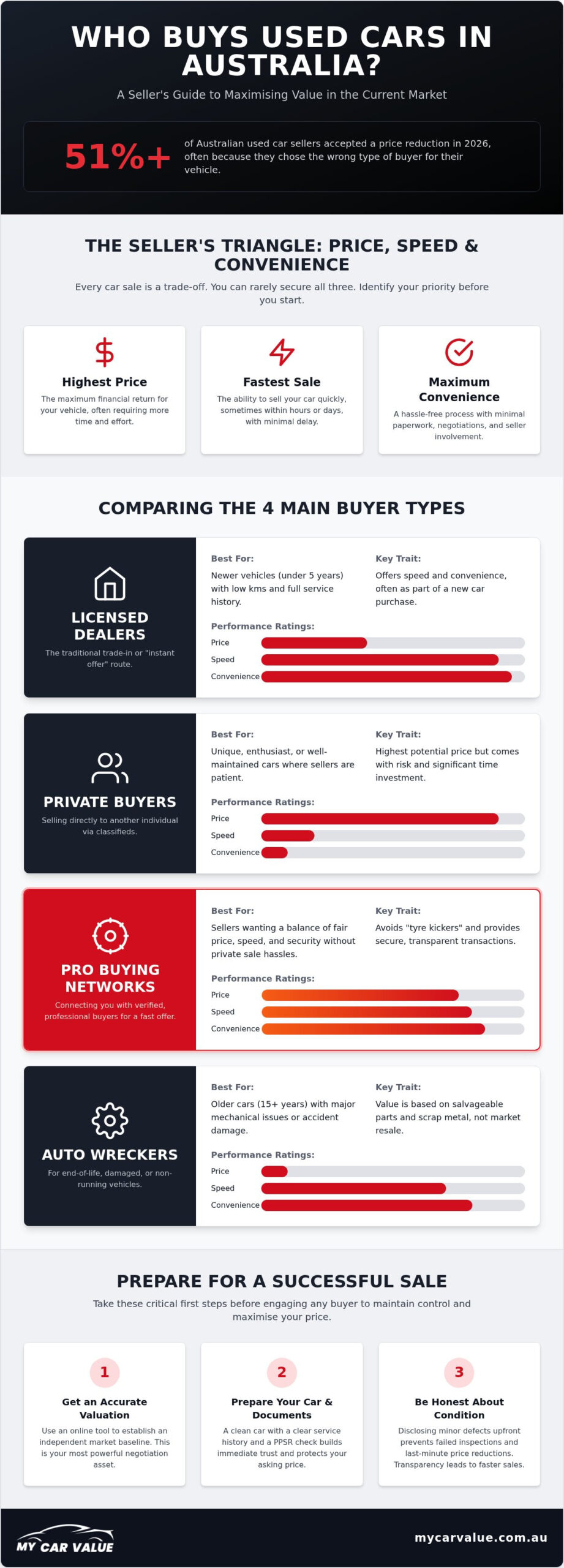
The landscape for selling vehicles in this country is diverse and requires a strategic approach. The Australian Used Car Market consists of four primary channels: licensed motor vehicle dealers, private individuals, professional buying networks, and auto wreckers. Determining who buys used cars effectively depends largely on your vehicle’s odometer reading and age. A five-year-old SUV with low kilometres is a prime candidate for a dealership or professional network. Conversely, a twenty-year-old sedan with significant mechanical issues is better suited for a wrecker.
You must distinguish between “Market Value” and “Trade-in Value” before you start negotiations. Market value represents what a private buyer might pay based on current demand. Trade-in value is typically lower because it accounts for the dealer’s overheads, reconditioning costs, and GST obligations. Before engaging any buyer, perform a PPSR check. While often viewed as a buyer’s tool, a Personal Property Securities Register report proves your car has no hidden finance or written-off history. This transparency protects your asking price and builds immediate trust.
The Three Pillars: Price, Speed, and Convenience
Every car sale involves a trade-off between price, speed, and convenience. You rarely secure all three at once. A private sale might net a higher price but demands significant time for viewings and carries the risk of dealing with unreliable “tyre kickers”. A dealer offers speed and convenience but usually at a lower price point. Rank these priorities before listing your car. Choosing the wrong buyer type often leads to wasted weekends and unnecessary emotional stress. Decide if you value your time more than the final few hundred dollars in the bank.
Preparing Your Vehicle for Professional Scrutiny
Transparency is your best tool for a fast transaction. Professional who buys used cars providers look for clear service histories and honest disclosures about minor defects. Use a vehicle market value calculator to set a realistic baseline before you start. Common mistakes, like hiding a known mechanical fault or presenting a dirty interior, cause professional buyers to walk away. Start with a clean car and a verified valuation to maintain momentum and ensure a secure sale.
Licensed Motor Vehicle Dealers: The Trade-in and Instant Offer Route
Dealers are the most traditional answer to who buys used cars in Australia. They offer the path of least resistance for sellers looking for speed. You drive in with your old car and drive out with a new one. This convenience comes with a financial trade-off. Dealers must account for reconditioning costs, showroom overheads, and profit margins. Modern “Instant Offer” platforms have evolved this model. These digital tools allow you to receive a firm price based on photos and a description. Unlike auctions, where the final price is uncertain and depends on whoever is in the room, an instant offer provides immediate certainty.
Licensed Motor Vehicle Dealers (LMVDs) generally focus on vehicles they can resell quickly to the public. They prefer popular makes like Toyota, Mazda, or Ford with low kilometres and full service histories. If your car is outside their specific “stock profile”, they may still buy it but will offer a lower price to cover the risk of wholesaling it. To ensure you are getting a fair deal from a dealer, use My Car Value to establish an independent price baseline before you start negotiations.
Understanding the Trade-in “Changeover” Price
Dealers often focus on the “changeover price” rather than the individual value of your used car. They might offer an inflated price for your trade-in while simultaneously reducing the discount on the new vehicle. It is a shell game. Always negotiate the new car price and the trade-in value as two separate transactions. This transparency ensures you aren’t paying for your own “high” trade-in offer through a more expensive new car. Ask the dealer for a “buy-only” price to see the true value they place on your vehicle.
Wholesalers vs Retail Dealers: Who Pays More?
Retail dealers buy cars to put on their showroom floor for public sale. Wholesalers buy cars to sell to other dealers. If your vehicle has high kilometres or minor damage, a retail dealer won’t want it on their lot. They will offer you a “wholesale” price and pass it on. In these cases, dealing with a specialist wholesaler or a professional buying network often yields a better result. These buyers have lower overheads and a broader network of contacts looking for specific parts or budget stock. Identifying who buys used cars in the wholesale market can save you from accepting a low-ball dealership trade-in.
Private Buyers: Maximising Return through the Classifieds
For many Australians, the quest to find who buys used cars at the highest price point leads directly to the private market. This channel is particularly effective for unique, enthusiast, or modified vehicles that don’t fit a standard dealership’s inventory. While Private Buyers often pay more than wholesalers, this premium comes with significant personal effort. You become the salesperson, the administrator, and the security guard for your own asset. It requires patience and a willingness to manage the entire process from listing to handover.
The digital age has changed the nature of private sales. While platforms provide massive reach, they also attract “tyre kickers” and “low-ballers” who have no intention of paying a fair price. You must also navigate strict legal requirements to protect yourself. In most states, you are responsible for providing a Roadworthy Certificate (RWC) to the buyer. You must also ensure the Notice of Disposal is lodged with your state’s transport authority immediately after the sale. Failing to lodge this notice leaves you legally liable for any fines, tolls, or accidents the buyer incurs after driving away.
The Hidden Costs of Selling Privately
Selling privately is never truly free. Calculate the value of your time spent answering repetitive enquiries and hosting weekend viewings. Major Australian car platforms charge listing fees that can exceed A$100 for premium ads. You also face the cost of repairs required to pass a roadworthy inspection. If your car needs new tyres, brake pads, or windscreen repairs to be legal, these expenses eat into your projected profit. Sometimes, the gap between a private offer and a professional buy-price is smaller than the cost of the repairs needed to sell it yourself.
Vetting Private Buyers to Avoid Scams
Vetting potential who buys used cars candidates is essential for your safety. Watch for red flags like buyers who claim to be “buying for a friend” or those who refuse to speak over the phone before visiting. When managing test drives, always check the person’s driver’s licence and accompany them in the vehicle. For payments, cash carries significant security risks. In 2026, instant bank transfers via Osko or PayID are the preferred standard. Always verify that the funds have cleared in your own banking app before handing over the keys. If a buyer pressures you or makes you feel uncomfortable, walk away from the deal immediately.
Auto Wreckers and Recyclers: Who Buys Damaged Cars?
When a vehicle is no longer roadworthy or the repair costs exceed its market value, you need to look beyond the retail market. Auto wreckers and recyclers are the specific demographic who buys used cars that are damaged, high-mileage, or mechanically failed. These buyers operate on a different valuation model than dealers. They assess a vehicle based on its scrap metal weight and the potential resale value of its functional components. A car with a destroyed front end might still contain a valuable transmission or interior trim that a wrecker can sell to repair shops. Identifying who buys used cars in the salvage market requires looking for licensed recyclers who provide transparent quotes based on current metal prices.
Understanding the Written-Off Vehicle Register (WOVR) status is vital in 2026. If your car has been declared a statutory write-off, it can’t ever be registered again in Australia. It must be sold for parts or scrap. Professional recyclers also carry the environmental responsibility of disposing of hazardous fluids like engine oil, brake fluid, and old fuel. Choosing a reputable recycler ensures your vehicle is processed according to Australian environmental standards, preventing toxic runoff into the soil.
Selling a Car with a Blown Engine or Transmission
Standard dealerships rarely accept “non-runners” because they can’t easily move them through their retail or wholesale channels. If your engine has seized or the transmission has failed, you need a specialist. These buyers often look for mechanical projects or specific models to dismantle. To get an accurate quote for a car that doesn’t drive, provide the VIN and a clear description of the mechanical failure. Many professional wreckers offer a fixed price based on the vehicle’s weight and the current market rate for scrap steel.
The “Cash for Cars” Model: What to Expect
The “cash for cars” industry provides a high level of convenience for owners of unwanted vehicles. Most reputable operators include free towing and pick-up as part of their service. When the tow truck arrives, ensure you receive a formal receipt of sale. You must also lodge your Notice of Disposal immediately to terminate your legal responsibility for the vehicle. Avoid “cowboy” operators who refuse to provide paperwork or try to negotiate the price down once they arrive at your driveway.
Professional Buying Networks: How to Connect with the Right Buyer Fast
Professional buying networks represent the modern middle ground in the Australian automotive market. They bridge the gap between the high-stress environment of private classifieds and the often underwhelming offers from traditional dealerships. If you are wondering who buys used cars with the best balance of speed and price, professional networks are the logical answer. These platforms connect you with a national network of used car buyers who are actively looking for stock. This internal competition ensures you receive a price that reflects current market reality rather than a single dealer’s specific inventory needs.
A professional valuation is your most powerful tool in any negotiation. It removes the guesswork and provides a firm baseline for your expectations. If you want to know who buys used cars for a fair price without the private sale headache, this network is your solution. The “Sell My Car” workflow is built for maximum efficiency. You start with a digital estimate, receive a verified valuation based on your car’s actual condition, and move directly to a secure transaction. This methodical approach eliminates the uncertainty and “tyre kicking” that usually plagues the selling process. It is a streamlined path designed for sellers who value their time as much as their vehicle’s equity.
The Efficiency of a Data-Driven Sale
Take the guesswork out of your next car sale and move forward with confidence.
Frequently Asked Questions
Who buys used cars for the most money in Australia?
Private individuals typically pay the highest retail price because they don’t have business overheads or profit margins to maintain. However, determining who buys used cars for the best overall value involves looking at professional networks. These platforms provide a competitive price without the advertising costs or time wasted on private viewings. While a private buyer might offer more on paper, the net return after repairs and fees often makes professional buyers more attractive.
Do I need a roadworthy certificate to sell to a professional buyer?
You usually don’t need a roadworthy certificate (RWC) when selling to a licensed professional buyer. Licensed dealers and buying networks are equipped to purchase vehicles in their current condition and perform necessary repairs in-house. This differs significantly from private sales, where an RWC is often a legal requirement before the transfer of registration. Selling without an RWC saves you time and the potential cost of mechanical repairs.
What is a Notice of Disposal and why is it important?
A Notice of Disposal is a formal notification to your state’s transport authority that you no longer own the vehicle. It is a critical step because it legally transfers responsibility for the car to the new owner. Once lodged, you are no longer liable for any speeding fines, parking tickets, or road tolls the buyer incurs. Failing to lodge this document immediately after the sale can lead to expensive legal and financial headaches.
Can I sell my car if it still has finance owing?
Yes, you can sell a vehicle with outstanding finance. Professional buyers regularly handle encumbered vehicles by coordinating directly with your finance provider. They will obtain a payout letter, pay the financier the exact amount owed, and then pay the remaining equity to you. This process ensures the finance is cleared correctly and the title is transferred without any hidden debt remaining against the vehicle’s record.
Who buys cars that are not running or are badly damaged?
Auto wreckers and specialist recyclers are the primary demographic who buys used cars that are non-runners or severely damaged. They value these vehicles based on the current market rate for scrap metal and the resale potential of individual parts. If your car has a blown engine or is a statutory write-off, a wrecker provides a fast solution. They typically include free towing and handle the environmental disposal of hazardous fluids.
How do I know if a car buyer is reputable?
A reputable buyer should hold a valid Motor Dealer Licence and provide a physical business address. Always verify their reputation by reading independent customer reviews on platforms like Google or Trustpilot. Professional buyers will offer a transparent valuation process and won’t pressure you into a sale. Ensure they use secure payment methods like Osko and provide a formal receipt of sale that includes their business details and ABN.
Is it better to trade in my car or sell it to a specialist buyer?
Specialist buyers often provide a better financial outcome than a traditional dealership trade-in. Dealers frequently use the trade-in value as a negotiating lever for the new car price, which can mask the true value of your vehicle. Specialist buyers focus solely on the used market and operate with lower overheads. This allows them to offer a price based on real-time data rather than a dealer’s specific showroom stock requirements.
What documents do I need to have ready before selling my used car?
You should prepare your current registration certificate, a valid driver’s licence, and the full service history of the vehicle. Having all sets of keys and any spare remotes ready will also increase buyer confidence. It is a good idea to have a recent PPSR report on hand to prove the car is not a write-off or under finance. These documents ensure the transaction remains fast and the title transfer is legally compliant.