

How to Transfer Car Registration in NSW: The 2026 Seller’s Guide
Missing the 14-day deadline to transfer car registration in NSW will cost you an extra $151 in late fees before the new owner even drives away. It is a steep penalty for a simple administrative oversight that many sellers overlook during the excitement of a sale. You want the handover to be seamless, yet the confusion surrounding stamp duty costs and the difference between various safety inspections often creates unnecessary stress. It is common to feel uneasy about remaining legally liable for a vehicle that is no longer in your driveway.
This guide provides the clarity you need to complete the transfer car registration nsw process with total confidence. We have stripped away the complexity to give you a direct path toward a clean break from your old vehicle. You will learn how to lodge your Notice of Disposal online, calculate precise stamp duty rates for 2026, and avoid the $193 late transfer fee. We also explain how the upcoming registration discounts and the 2.65% fee increase affect your bottom line. Follow these logical steps to ensure your paperwork is as fast and reliable as the car you just sold.
Key Takeaways
- Complete the transfer car registration nsw process within the 14-day window to avoid a $193 late fee and ensure you are no longer liable for future fines or tolls.
- Calculate your total costs accurately by understanding 2026 stamp duty rates and how the 2.65% fee increase affects your final payment.
- Confirm whether your vehicle requires a specific safety inspection or if the existing Green Slip insurance will automatically move to the new owner during the sale.
- Determine if you are eligible to use the Service NSW online portal or if your specific situation requires a visit to a service centre with physical documentation.
- Reduce administrative stress by using professional valuations to set a fair price and connecting with used car buyers who can manage the ownership transition for you.
What is a Vehicle Registration Transfer in NSW?
A vehicle registration transfer is the legal hand-over of a vehicle’s administrative identity from one party to another. This formal process updates the official records held by Transport for NSW to reflect the new owner. Whether you are selling a car, motorcycle, trailer, or caravan, completing this step is non-negotiable. It ensures the Vehicle registration in New South Wales database remains accurate and current. Without this update, the government still associates your name with the vehicle’s history and future actions.
Beyond simple paperwork, this process serves as the primary legal mechanism that shifts responsibility for fines, tolls, and legal liabilities from the seller to the buyer. Until the records are officially updated, you remain the person responsible for any traffic infringements or parking tickets incurred by the vehicle. It is the only way to prove you are no longer the registered operator of the asset.
The 14-Day Rule and Late Fees
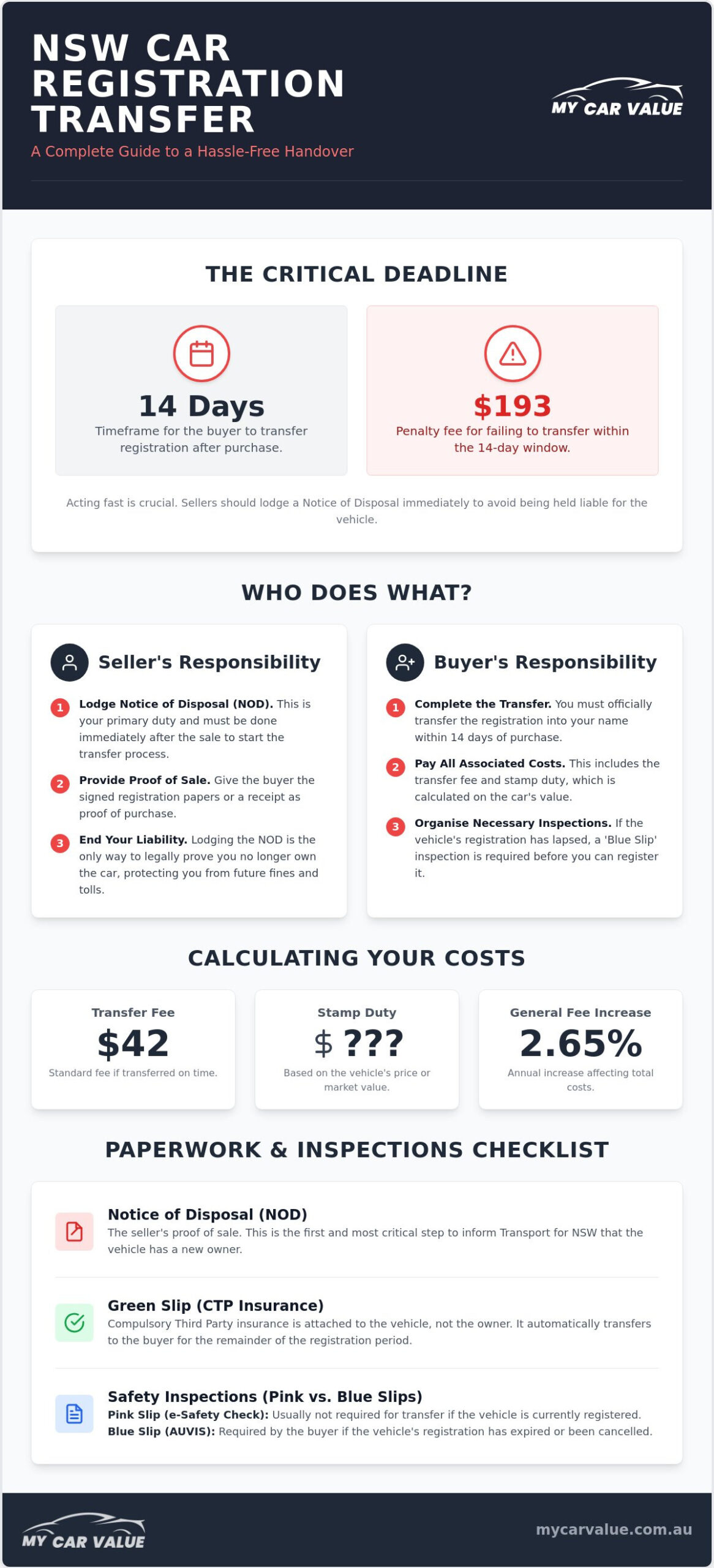
The NSW government enforces a strict 14-day window to transfer car registration nsw. If the buyer fails to lodge the transfer within this timeframe, they face a late transfer fee of $193. This is a significant increase from the standard $42 fee applied to prompt transfers. As a seller, you must not rely on the buyer to act quickly. Lodge your Notice of Disposal (NOD) immediately after the sale. This action provides a definitive date for the end of your ownership and protects you from the “liability gap.” This gap occurs when a car is sold but not yet transferred, leaving the seller vulnerable to the buyer’s driving behaviour and any subsequent fines that arrive in the post.
Who is Responsible: Buyer vs Seller
The transfer process is a dual-responsibility system that requires both parties to act. Your primary duty as the seller is to submit the Notice of Disposal. You can do this online through your MyServiceNSW Account or in person at a service centre. This signal tells the system that you no longer own the vehicle. Conversely, the buyer is responsible for completing the actual transfer and paying the associated costs, including stamp duty. These two actions link together within the Service NSW system to create a verified chain of ownership. If you fail to lodge the NOD, the buyer cannot easily complete their side of the transfer car registration nsw online. This failure often leads to administrative delays and potential legal friction between both parties.
Essential Requirements: Green Slips, Blue Slips, and Disposal Notices
To successfully transfer car registration nsw, you must understand the specific documents that trigger the change in ownership. The most critical document for a seller is the Notice of Disposal (NOD). This form acts as the primary signal to Transport for NSW that the sale has occurred. Once you lodge the NOD, the buyer can then proceed with their side of the transaction. Without it, the buyer cannot complete an online transfer. This creates a bottleneck that often leads to late fees and administrative frustration. You can use the NSW vehicle registration calculator to estimate the exact fees and stamp duty costs before you finalise the sale.
Green Slips and CTP Insurance
Compulsory Third Party (CTP) insurance, commonly called a Green Slip in NSW, is tied to the vehicle rather than the owner. When you sell your car, the existing CTP policy automatically transfers to the new buyer. There is no need to cancel your policy or for the buyer to purchase a new one until the current registration period ends. It is a seamless transition that protects all parties on the road. Sellers should provide the buyer with the current registration papers to confirm how much CTP time remains. If you are unsure of your vehicle’s current market worth for insurance or sale purposes, getting an accurate report to value my car ensures you are transacting at the right price point.
Blue Slips vs Pink Slips: When Do You Need Them?
Safety inspections often cause confusion during a transfer car registration nsw. Most vehicles already have a valid Pink Slip (e-Safety check) from their last registration renewal. If the car is currently registered in NSW, a new Pink Slip is not required for the transfer. However, if the registration has lapsed, the buyer will need a fresh inspection to move the vehicle into their name.
- Pink Slips: These are standard annual safety checks required for vehicles more than five years old to renew registration.
- Blue Slips: This is a more comprehensive inspection. You only need a Blue Slip if the vehicle is being brought in from interstate or if the NSW registration has been expired for more than three months.
Always verify the registration status before the handover. If the vehicle is unregistered, the transfer process becomes significantly more complex and expensive. Buyers must ensure the vehicle is roadworthy and has the correct clearances to avoid being stuck with a car they cannot legally drive. Checking these details early prevents the sale from stalling at the last minute.
Step-by-Step: How to Complete Your Transfer Online or In-Person
Moving car ownership records into a new name is now largely a digital process. Most private buyers and sellers can complete the transfer car registration nsw through the Service NSW website or mobile app. This method is the fastest way to avoid the $193 late fee. However; the system relies on specific eligibility criteria being met by both parties before the digital hand-over can occur. If the vehicle has a complex history or falls under specific categories, you will need to complete the process face-to-face.
Transferring Online via MyServiceNSW
The online portal is the most efficient way to manage a change of ownership. To use this service, the seller must have already submitted their Notice of Disposal (NOD). This action serves as the digital “unlock” that allows the buyer to proceed with the transfer. You also need a current NSW driver’s licence and an active MyServiceNSW Account. Follow these steps to complete the process:
- Log in to your account and select the ‘Transfer vehicle registration’ option.
- Enter the vehicle’s plate number and the exact date of purchase.
- Input the purchase price or the market value. The system uses the higher of the two to calculate stamp duty.
- Pay the $42 standard transfer fee and the calculated stamp duty using a credit or debit card.
Once the payment is confirmed, the system updates the registration records instantly. You will receive a digital receipt that serves as your proof of transfer until your new registration certificate arrives in the post.
When an In-Person Visit is Mandatory
Not every transaction qualifies for a digital transfer. You must visit a Service NSW centre if the vehicle weighs more than 4.5 tonnes or features special number plates. This is also required for transfers involving organisations, trusts, or deceased estates. These scenarios require manual verification of legal documents that the online system cannot yet process. Bring these items to ensure a smooth visit:
- A completed ‘Application for Transfer of Registration’ form signed by both parties.
- Proof of identity, such as your NSW driver’s licence.
- Proof of purchase, which can be a formal receipt or a contract of sale.
Before you commit to the purchase or finalise the paperwork, verify the car history to ensure there are no hidden encumbrances or finance interests. Checking these records prevents you from inheriting someone else’s debt or buying a vehicle with a clouded title. For deceased estates, you will also need to provide a copy of the Will or Letters of Administration. For business transfers, ensure you have the organisation’s ACN or an ASIC certificate ready for inspection. These extra steps provide the legal certainty required for high-value or complex assets.
Calculating Costs: Stamp Duty, Transfer Fees, and Market Value
The cost to transfer car registration nsw depends heavily on your timing and the vehicle’s worth. If you complete the paperwork within the 14-day window; the standard transfer fee is $42. Delaying past this fortnight triggers a penalty; raising the cost to a $193 late transfer fee. Beyond these flat administrative charges; the largest expense is Motor Vehicle Stamp Duty. Stamp duty is a tax on the vehicle’s value; not just the cash exchanged between the buyer and seller. It is calculated based on the “Higher of the Two” rule; meaning Transport for NSW looks at either the purchase price or the market value and taxes whichever figure is greater.
Understanding Stamp Duty Calculations
For passenger vehicles valued up to $45,000; the duty rate is $3 per $100 (or part thereof) of the value. If the car is a premium model worth over $45,000; the rate increases to $1,350 plus $5 per $100 for every dollar exceeding that threshold. While certain groups like eligible pensioners may receive concessions; or family transfers may qualify for specific exemptions; most private sales require full payment. Obtaining an accurate car valuation is essential for tax compliance. It provides a defensible figure that ensures you aren’t paying more than necessary while satisfying government requirements. Be aware that from 1 July 2026; general registration fees have increased by 2.65%; making it even more important to budget for these costs accurately.
Avoiding Overpayment on Taxes
Some sellers and buyers attempt to under-declare the purchase price to reduce the tax bill. This is a high-risk strategy that rarely succeeds. Transport for NSW regularly audits reported values against current market data. If the declared price is significantly lower than the expected market value for that specific make and model; they may reject the transfer or issue a reassessment notice later. This can lead to additional fines and interest charges. Using professional valuation tools helps you justify the declared value; especially if the car has high mileage; cosmetic damage; or mechanical issues that naturally lower its worth. This transparency prevents future legal headaches and ensures the transition of ownership is final and undisputed.
Streamlining Your Vehicle Transition with My Car Value
Selling a vehicle in New South Wales involves more than just a handshake and a bank transfer. It is a process that requires closing the administrative loop with Transport for NSW to protect your legal standing. My Car Value removes the friction from this transition by providing the data and connections you need to exit ownership cleanly. By integrating your transfer car registration nsw requirements into a broader sell my car strategy, you ensure that every legal obligation is met without the typical stress of private negotiations.
A professional valuation serves as the foundation for a successful transfer. As discussed in previous sections, the government audits declared values against market data. Starting your journey with a precise figure ensures you comply with tax obligations while remaining attractive to buyers. This data-driven approach prevents the “liability gap” and ensures the price you settle on is defensible during a Service NSW audit. It positions you as a transparent and prepared seller.
Professional Buyers vs Private Sales
One of the greatest risks in a private sale is the “ghost” buyer. This is an individual who takes delivery of the car but fails to lodge their side of the transfer within the 14-day window. Until they act, you may still receive their speeding fines and toll notices in the post. Engaging with professional used car buyers through our network eliminates this risk. These professionals manage the Notice of Disposal and transfer paperwork as part of their standard service. They understand the legal requirements and act immediately. This professional oversight provides an atmosphere of relief, knowing the administrative heavy lifting is handled by experts.
Getting Your Accurate Market Valuation
Accuracy is the enemy of administrative delay. When you provide incorrect vehicle details, the transfer car registration nsw process can stall or be rejected at the service centre. Our platform simplifies this through decoding your VIN. This tool extracts the exact specifications of your vehicle, ensuring the records submitted to Service NSW are 100% accurate. It removes the guesswork from identifying specific model variants that might affect the market value and subsequent stamp duty calculations.
Do not leave your legal liability to chance. Secure an accurate market valuation today and connect with buyers who value efficiency as much as you do. Start your sale with a professional valuation to ensure your registration transfer is fast, compliant, and final.
Secure Your Sale and Finalise Your Transfer Today
Completing a successful transfer car registration nsw requires a mix of prompt action and accurate data. You now understand that the 14-day window is a strict deadline; missing it results in a significant fee increase from $42 to $193. By lodging your Notice of Disposal immediately and using the 2026 stamp duty rates to calculate costs; you protect yourself from future liabilities and unexpected expenses. Accuracy is your best defence against government audits and ensures a clean break from your old vehicle.
My Car Value acts as your expert facilitator in this process. We provide accurate; data-driven market valuations that help you declare the correct figures to Transport for NSW. Trusted by thousands of Australian sellers; our platform also connects you with a network of professional used car buyers who can handle the administrative heavy lifting for you. This professional oversight ensures your paperwork is compliant and your liability ends the moment the keys change hands.
Take the next step toward a seamless vehicle transition. You have the knowledge to navigate the system with precision and the tools to ensure your sale is a total success. Move forward with confidence and close the loop on your ownership today.
Frequently Asked Questions
How long do I have to transfer car registration in NSW?
You have exactly 14 days from the date of purchase to lodge the transfer with Service NSW. If you miss this window, the standard $42 fee increases to a $193 late transfer fee. Sellers should lodge their Notice of Disposal immediately after the sale to ensure they aren’t held liable for fines or tolls during this transition period.
Can I transfer a NSW registration online if I bought the car from another state?
No, you cannot transfer an interstate registration online through the standard portal. You must register the vehicle in NSW as an original application. This requires a physical visit to a service centre and a Blue Slip inspection to verify the vehicle’s identity and safety standards. You will also need to surrender the interstate number plates at the time of registration.
What happens if the seller does not lodge a Notice of Disposal?
If the seller fails to lodge a Notice of Disposal, the buyer cannot complete the transfer car registration nsw online. The seller also remains legally responsible for any parking fines, speeding tickets, or tolls incurred by the new owner. It is in the seller’s best interest to submit the notice via their MyServiceNSW account the moment the vehicle changes hands to close their liability.
How much is the car registration transfer fee in NSW for 2026?
The standard transfer fee is $42 if paid within the 14-day legal timeframe. This fee is separate from the motor vehicle stamp duty, which is calculated based on the vehicle’s value. From 1 July 2026, general registration fees have increased by 2.65%, so always verify the final total using the official registration calculator before you finalise your payment.
Do I need a new Green Slip when I buy a second-hand car?
No, you don’t need to purchase a new Green Slip when buying a registered second-hand car in NSW. The existing Compulsory Third Party (CTP) insurance policy automatically transfers to you as the new owner. It remains valid until the current registration period expires. You will only need to buy a new policy when you are ready to renew the registration for another term.
What is the difference between purchase price and market value for stamp duty?
The purchase price is the amount you actually paid, while the market value is the estimated worth of the vehicle on the open market. Transport for NSW calculates stamp duty on whichever figure is higher. This rule ensures that taxes are paid fairly even if a car is sold at a significant discount to a friend or family member.
Can I keep my personalised number plates when I sell my car?
Yes, you can keep your personalised plates, but you must swap them for standard plates at a service centre before the sale. You’ll need to pay a plate replacement fee to receive new yellow or white plates. Once the new plates are attached, you can proceed with the transfer car registration nsw using the updated plate information while retaining your custom plates for a future vehicle.
Is a roadworthy certificate (Pink Slip) required for every transfer?
A Pink Slip is not required for a registration transfer if the vehicle is currently registered in NSW. Safety inspections are generally only mandatory for annual registration renewals for vehicles older than five years. If the registration has expired for more than three months, you will need a more comprehensive Blue Slip inspection rather than a standard Pink Slip to re-establish the registration.