

Car for Cash Myths: The 2026 Guide to Selling Your Vehicle in Australia
What if the fastest way to sell your vehicle was also the smartest way to secure its full market value? Many Australians still link the car for cash industry to scrap-yard removals and lowball offers. This outdated view is a mistake that often costs sellers both time and money.
Selling a car privately in 2026 has become a notorious grind. You are likely fed up with tyre kickers, endless messages, and the constant uncertainty of what your vehicle is actually worth. It is natural to feel wary of unscrupulous operators when you simply want a fair, transparent deal that reflects the current market.
This guide debunks the common myths surrounding modern vehicle buying services. You will learn how to secure a professional, high-value offer without the typical private sale stress. We will preview the latest Australian market trends, explain how to verify your car’s true worth, and show you the steps to a secure transaction with no paperwork or transport headaches.
Key Takeaways
- Understand that a professional car for cash model serves as a high-value wholesale acquisition tool for quality vehicles, moving far beyond the old scrap-metal stigma.
- Learn how to identify the “trade-in trap” and use real-time market data to ensure your vehicle’s value isn’t hidden in a new car’s price tag.
- Discover the specific preparation steps and logbook requirements that drive the highest possible offers from professional buyers in 2026.
- Calculate your “Total Return” by factoring in the cost of time, paperwork, and stress associated with traditional private marketplaces.
- Use impartial valuation tools to bridge the gap between private sellers and a national network of verified professional buyers for a secure transaction.
Debunking the “Scrap Only” Myth: What Car for Cash Really Means in 2026
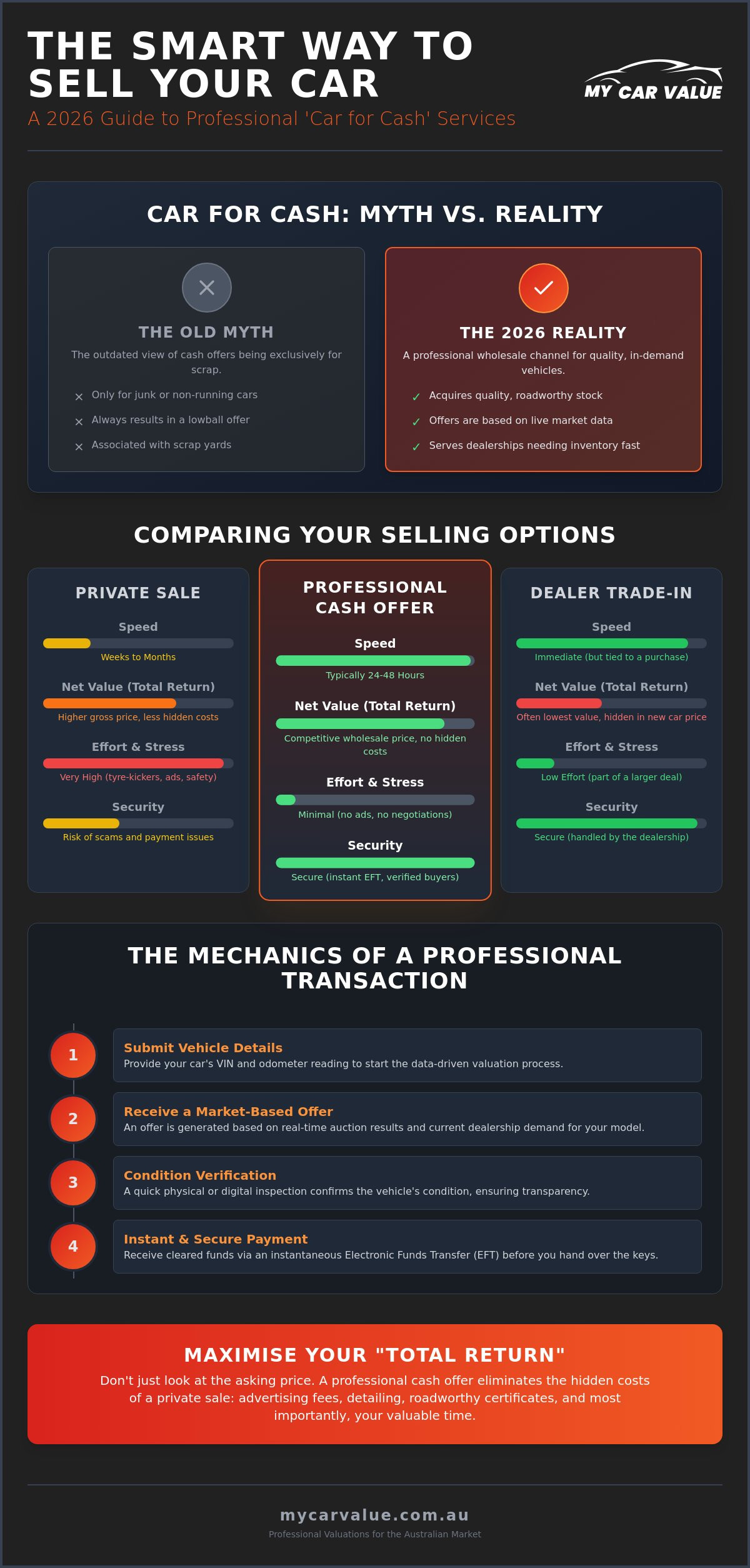
The phrase car for cash often conjures images of rusty tow trucks and oil-stained wrecking yards. That image is decades out of date. In 2026, this sector has transformed into a streamlined wholesale acquisition model. It functions as a professional channel for dealerships to restock their inventory quickly without the overheads of traditional auctions. While Car brokers in Australia often manage negotiations for a fee, a professional cash service offers a direct, digital-first alternative for those wanting immediate results.
Professional buyers are now looking for quality stock. They want well-maintained vehicles that can be turned around for resale. This shift is driven by a stabilising Australian used car market where predictable valuations are the new norm. If you own a late-model SUV or a reliable ute, you aren’t selling “junk.” You are providing high-demand inventory to a professional network that values speed and transparency over the slow grind of the retail market.
Myth 1: It is only for junk or non-running vehicles
Many owners believe their car is “too good” for a cash offer. This is a fundamental misunderstanding of the modern wholesale landscape. Professional buyers actively compete for popular Australian models in good condition. They aren’t looking for scrap metal; they are looking for their next floor-stock hero. Demand remains particularly high for specific categories. For example, utes and 4WDs in Perth often command prices 15-25% higher than in eastern states due to intense mining sector demand. Whether you have a luxury SUV in Sydney or a workhorse in Brisbane, the professional cash model covers the full spectrum of roadworthy, high-value vehicles.
Myth 2: You will always get a better price selling privately
Private marketplaces often show higher asking prices, but these figures are deceptive. They don’t account for the “Total Return” of your sale. When you sell privately, you must factor in advertising fees, professional detailing, and the cost of obtaining a roadworthy certificate. In states like Victoria, a Certificate of Roadworthiness must be less than 30 days old, adding a layer of logistical pressure.
The biggest hidden cost is your time. Consider the “time-adjusted value” of your vehicle. If you spend three weekends waiting for tyre kickers who never show up, you are losing money. A professional transaction is often completed within 24 to 48 hours. When you subtract the hidden expenses and the value of your lost weekends, the gap between a private asking price and a professional cash offer often disappears entirely.
The Mechanics of Professional Auto for Cash Transactions
A professional car for cash transaction operates with the precision of a financial trade. It is no longer about haggling on a driveway or waiting for a cheque to clear. Instead, the process follows a structured sequence that prioritises speed, data, and legal compliance. By using real-time market data, buyers can offer a price that reflects the actual state of the Australian market in July 2026. This is a far cry from the outdated book values used in the past.
The workflow is simple and direct. You provide your vehicle’s VIN and odometer reading to start. The buyer then runs this data against recent auction results and current dealership demand for your specific model. If the numbers align, they move to a verification stage. This usually involves a quick physical inspection or a digital review of high-resolution photos. Once the condition is confirmed, the transaction concludes with an instantaneous electronic funds transfer (EFT). You receive cleared funds before handing over the keys. This level of security is why many sellers are moving away from traditional private marketplaces.
Understanding the wholesale buyer mindset
Professional buyers look for “turnaround potential” rather than high individual profit margins. They operate on volume. A buyer would rather make a small, predictable profit on ten cars than a large, risky profit on one. This mindset allows them to move faster than a private buyer who might be emotionally invested or financially constrained. Because they manage the risk of used vehicles across a large national portfolio, they can afford to offer competitive prices for well-maintained stock. For a deeper look at this process, you can read more about Professional Used Car Buyers and how they facilitate these rapid sales.
Why transparency and PPSR checks matter
A Personal Property Securities Register (PPSR) check is the foundation of a secure sale. For a small official fee of $2.00, this search confirms that your vehicle has no outstanding finance, hasn’t been stolen, and isn’t a recorded write-off. Professional buyers prioritise these checks because a “clear title” allows for an immediate, higher offer. It removes the legal hurdles that often stall private sales.
Transparency is equally important for you as the seller. Following official government advice on selling a car ensures you meet all state-specific requirements, such as lodging a notice of disposal. PPSR transparency prevents legal headaches after the sale by proving the vehicle’s history is exactly as described. To start your own transparent selling journey, it is a good idea to value your car using a data-driven platform first.
Comparing Your Options: Cash Offers vs Trade-ins vs Private Sales
Most sellers fixate on the highest headline number they see online. This is a mistake. To find the best deal, you must calculate your “Total Return.” This is the final figure remaining after you subtract advertising fees, detailing costs, and the ongoing price of registration and insurance while the car sits unsold. A professional car for cash offer provides a baseline of certainty that private marketplaces simply cannot match.
Speed is a critical factor in the July 2026 market. With used car sales rising by over 17,700 vehicles in May 2026 alone, the volume of stock is high. If you need to liquidate an asset to fund a new purchase or cover an expense, waiting weeks for a private buyer is a financial liability. Cash buyers bypass the traditional finance hurdles that often cause private deals to collapse at the last minute. They offer a clean break that allows you to move on to your next vehicle immediately.
The hidden costs and risks of private classifieds
Private marketplaces are increasingly flooded with “lowballers” and sophisticated scams. Beyond the safety risk of meeting strangers at your home, there are logistical drains. You must keep the car roadworthy and insured throughout the listing period. For sellers in Sydney or Melbourne, professional networks offer a secure environment that eliminates these risks. Always refer to the NSW Government guidelines on selling a vehicle to ensure you meet your legal obligations, such as the notice of disposal, regardless of your chosen method.
Why trade-in offers are often lower than market value
Dealerships typically use “wholesale minus” pricing for trade-ins. They offer less than the true market value because they must account for their own reconditioning costs and floor-space margins. Dealers frequently “hide” the true value of your trade-in by adjusting the price of the new car you are buying, making it difficult to see if you are actually getting a fair deal. By opting for a separate sale to a cash buyer, you walk into a showroom with the bargaining power of a cash-in-hand customer. This transparency allows you to negotiate the best possible price on your next vehicle without the confusion of a bundled deal. Review our Car Trade-In Alternatives for a strategic approach to your next upgrade.
How to Organise Your Vehicle for a Top Cash Offer
Securing the highest possible car for cash figure depends on how you present the “data” of your vehicle. Professional buyers in 2026 use your Vehicle Identification Number (VIN) to pull accurate build data instantly. This ensures the quote reflects your specific trim level and factory options rather than a generic model average. Providing this number upfront removes guesswork and speeds up the valuation process. While cosmetic appearance matters, the 2026 Australian market now places a greater emphasis on mechanical dependability and service history authenticity.
Your service logbook is the most valuable document in your glovebox. A complete, stamped history proves you have maintained the vehicle according to manufacturer standards. This reduces the buyer’s perceived risk and often leads to a significantly higher offer. Buyers are looking for certainty. If you can prove the timing belt was changed on schedule or the transmission was serviced recently, you are in a much stronger negotiating position. If your vehicle has accumulated significant kilometres, understanding how to position it correctly is equally important — our guide to selling a car with high kms in Australia explains how to secure a fair price based on data-backed valuations rather than odometer stigma.
Essential documentation for a smooth transfer
Having your paperwork ready ensures the transaction can be completed in a single visit. You should organise these items before the buyer arrives:
- Proof of ownership: Your current registration papers or a purchase receipt.
- Identification: A valid Australian driver’s licence to verify the seller’s identity.
- All sets of keys: Modern transponder keys are expensive to replace, and having both sets adds immediate value.
- Documented service history: The physical logbook or a folder of digital receipts.
Wholesale buyers typically have their own mechanical teams and streamlined processes for reconditioning stock. Because of this, a current roadworthy certificate is often unnecessary to secure a firm cash offer. This saves you the time and expense of visiting a mechanic before the sale. For a comprehensive overview of every step involved, our checklist for selling to used car buyers walks you through the full process from documentation to final handover.
Simple presentation tips to boost value
Don’t waste money on an expensive professional detail. Professional buyers have their own contractors who can do this at a lower cost. Instead, focus on a basic “tidy up” to show the car has been respected. Remove all personal items from the glovebox, centre console, and door pockets. Vacuum the carpets and ensure the boot is clear of clutter. A clean interior suggests the mechanical components have been equally well-cared for. For more detailed preparation advice, check out our Sell My Car Guide. To see how these factors impact your specific model, you can Value My Car using our real-time data tool today.
Navigating the Australian Market with My Car Value
My Car Value acts as your impartial advocate in a crowded marketplace. We aren’t just another buyer. We are the bridge between your driveway and a verified professional network. By using a modern, digital-first approach, we strip away the complexity that typically makes selling a car stressful. Our platform focuses on transparency, ensuring you have the data needed to make an informed decision without the pressure of traditional haggle-based environments.
Efficiency is our core priority. We understand that your time is valuable. Our system replaces the old-fashioned scrap-yard stigma with a sophisticated wholesale model. You get the speed of a cash sale with the security of a professional business transaction. This methodical approach guides you through each step, moving from an initial valuation to a completed sale with minimal friction. It is a reliable tool designed to empower sellers in a volatile market.
Our network of professional used car buyers
Our network consists of rigorously vetted used car buyers across Australia. We don’t just let anyone join. Every buyer must meet high standards of transparency and professional conduct. This ensures you receive a competitive car for cash offer from a reputable industry professional rather than an unscrupulous operator. Whether you are in Brisbane or looking to capitalise on the high demand for 4WDs in Perth, our system connects you to the right people. It turns a complex national marketplace into a simple, local transaction.
Getting an accurate valuation before you sell
Knowledge is your strongest asset when dealing with professional buyers. Using a vehicle market value calculator before you engage is the best way to prevent lowball offers. Our platform uses live data from the July 2026 Australian market to give you a realistic figure based on actual sales, not just guesswork. You move from “What is it worth?” to “Money in the bank” in a few simple clicks.
We do the heavy lifting by aggregating market trends and buyer demand. This empowers you to walk into a sale with confidence, knowing exactly where your vehicle sits in the current economic climate. Start your journey today with a free, no-obligation valuation and discover the true worth of your vehicle. It is the smartest way to secure a professional, high-value offer without the private sale stress.
Secure Your True Market Value with Confidence
The professional car for cash model has evolved into a high-speed, data-driven alternative to the traditional private sale grind. You no longer have to settle for the scrap yard stigma or the uncertainty of a trade-in deal. By understanding the wholesale mindset and preparing your documentation, you bypass the typical headaches of tyre kickers and lowball offers. My Car Value provides the transparency you need to navigate the 2026 market with data-backed certainty.
Don’t leave your vehicle’s worth to chance. Access accurate Australian market data and our vetted network of professional buyers to ensure your transaction is both secure and profitable. Our no-obligation, transparent valuations put the control back in your hands. Get your free car valuation and connect with professional buyers today. Take the stress out of your next upgrade and start with a clear, realistic figure that reflects the true value of your car.
Frequently Asked Questions
Can I sell my car for cash if it is still under finance?
Yes, you can sell a financed vehicle to a professional buyer. The buyer calculates the “payout figure” by contacting your lender and settles that balance directly. Any remaining equity is then paid to you via electronic funds transfer. This process clears your debt and the vehicle’s title simultaneously, making it a secure way to exit a finance contract without the stress of private negotiations.
How much is my car worth if it does not have a current rego?
Your car still holds market value without current registration. Professional buyers often specialise in these cases because they can use trade plates or tow trucks to transport the vehicle. While the lack of rego might be factored into the final offer, it doesn’t prevent a sale. This is a major advantage over private sales, where most buyers require a current roadworthy certificate and active registration to test drive.
Is it safe to sell my car for cash to a professional buyer?
It is very safe when dealing with a vetted professional. Unlike private marketplaces where you might meet strangers at your home, professional buyers operate as legitimate businesses with registered ABNs. They use secure electronic funds transfers (EFT) so you receive cleared funds before the car is collected. This structured approach eliminates the risk of payment fraud or personal safety concerns often associated with the car for cash industry.
How long does the car for cash process typically take?
The process is designed for speed and usually takes between 24 and 48 hours. Once you provide your vehicle details and VIN, a digital valuation is generated almost instantly. If you accept the offer, a physical inspection and payment can often happen the same day or the following morning. This rapid turnaround is ideal for sellers who need to liquidate assets without the weeks of waiting required for private listings.
Do I need to clean my car before a professional buyer inspects it?
A simple tidy-up is all that is required. Remove personal rubbish, vacuum the carpets, and clear out the boot and centre console. You don’t need to pay for a professional detail or high-end wax. Buyers look past minor surface dust to evaluate the mechanical history and structural integrity. A clean, well-presented interior suggests a well-maintained vehicle, which helps support a strong market valuation.
What happens if my car is not in running condition?
If your car doesn’t run, it still has value for its parts or metal content. While the high-value wholesale offers discussed in this guide focus on quality stock for dealerships, many buyers in the car for cash network handle non-runners. Be honest about the mechanical state when requesting a quote. This ensures the buyer brings the correct towing equipment and provides an accurate price based on the vehicle’s salvage potential.
Is a cash offer the same as a trade-in price?
A cash offer is typically more transparent than a trade-in price. Dealers often inflate a trade-in offer while simultaneously reducing the discount on your new car, making it hard to see the true value. A separate cash sale gives you a clear, standalone figure. This allows you to negotiate as a cash buyer at the dealership, often leading to a better overall financial outcome on your next purchase.
How do I know if a cash for cars company is legitimate?
Verify the company by checking for a valid Australian Business Number (ABN) and a physical office or depot location. Look for transparent processes, such as the use of PPSR checks and official transfer paperwork. Legitimate operators won’t pressure you or use aggressive haggling tactics. Using an impartial facilitator like My Car Value ensures you only connect with reputable buyers who have been pre-screened for professional standards.