
Car Trade-In Alternatives: The 2026 Checklist for Australian Sellers
Why should you hand over thousands of dollars in vehicle equity just for the sake of a five-minute dealership transaction? It’s a common trap for Australian sellers who want to avoid the headache of private listings. If you’re looking for car trade-in alternatives, you likely want a better return than the insulting offer you received at the showroom. You deserve a price that reflects the true market value of your vehicle.
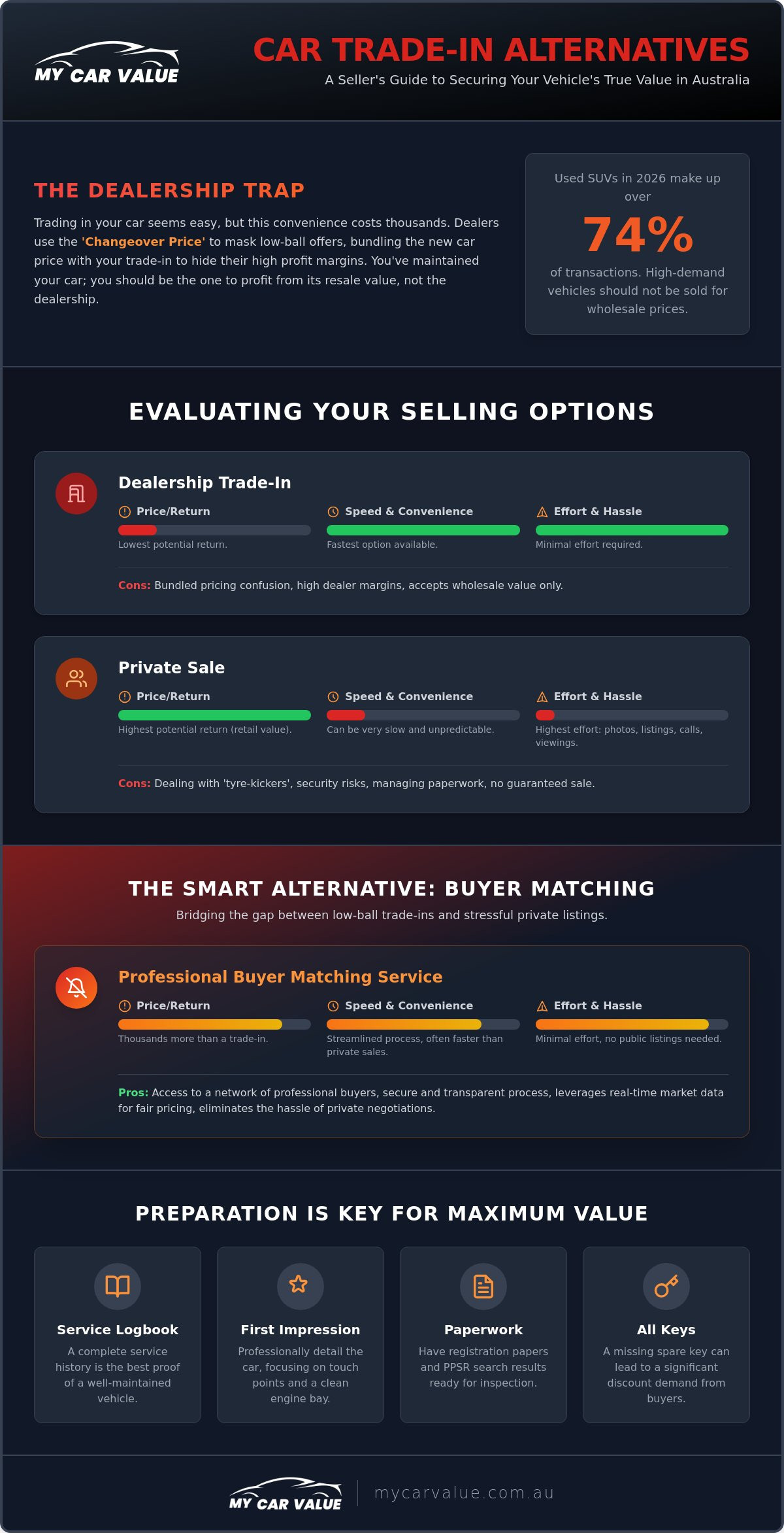
We understand the frustration of dealing with ‘tyre-kickers’ and the uncertainty of a shifting 2026 market where SUVs make up over 74% of used car transactions. This article provides a clear path to a better deal. You’ll discover the most effective ways to bypass low dealer offers and secure a fair price using our comprehensive alternatives checklist.
We’ve mapped out everything from managing the $2.00 PPSR search to leveraging professional buyer networks. This guide breaks down the legal requirements and market trends to ensure your sale is fast, transparent, and profitable. Let’s get your car sold for what it’s actually worth.
Key Takeaways
- Identify the ‘Changeover Price’ trap and learn why dealer margins naturally suppress your vehicle’s value.
- Maximise your sale price by mastering the ‘first 30 seconds’ of the buyer’s impression and organising your service logbook.
- Evaluate the top car trade-in alternatives like auctions and private sales to find the right balance of speed and profit.
- Learn how to separate your transactions and use real-time market data to gain the upper hand in negotiations.
- Explore a streamlined buyer matching process that bridges the gap between low-ball offers and stressful private listings.
Beyond the Dealership: Why Seek Car Trade-In Alternatives?
Trading in your car at a dealership feels like the easiest path. You drive in with your old vehicle and leave with a new one. However, this convenience comes at a steep price. Dealers are businesses with overheads, and they must buy low to sell high. When you accept a trade-in offer, you’re essentially paying a massive service fee for the dealer to take the car off your hands. It’s a high-priced convenience that drains your vehicle’s equity.
In the Australian market of 2026, the used car sector is valued at nearly USD 50 billion. With SUVs accounting for over 74% of transactions last year, high-demand vehicles shouldn’t be sacrificed for wholesale prices. Exploring car trade-in alternatives ensures you capture the value you’ve built in your vehicle rather than gifting it to a showroom. You’ve maintained the car; you should be the one to profit from its resale.
Dealers often use the “changeover price” to confuse sellers. They might offer a generous discount on the new car while simultaneously low-balling your trade-in. This shell game makes it difficult to see the true value of either transaction. Always negotiate the price of the new vehicle first. Only then should you discuss what your current car is worth. Separating these two transactions is the only way to ensure you aren’t being overcharged for the “ease” of the trade-in.
The Hidden Costs of Convenience
A dealership offer isn’t just a reflection of your car’s worth. It’s a calculation that subtracts reconditioning costs, GST obligations, and a healthy profit margin. Understanding how car valuation works helps you distinguish between wholesale and retail figures. If you sell to a dealer, you’re accepting the wholesale price. By looking at car trade-in alternatives, you move closer to the retail value, often pocketing thousands more. This is particularly true in major hubs like Sydney or Melbourne, where buyer demand remains aggressive.
Signs You Should Walk Away from a Trade-In
Don’t feel pressured to sign a contract just because you’re already at the dealership. Walk away if you notice these red flags:
- Bundled pricing: The dealer refuses to provide a standalone price for your vehicle.
- Low-ball estimates: The offer is thousands below what independent data suggests.
- High-demand stock: You’re trading a late-model hybrid or a popular SUV that the dealer will likely flip within 48 hours for a significant profit.
Settling for a poor offer leads to immediate seller’s remorse. Your car is a major asset. Treat the sale with the same professional scrutiny you used when buying it. There’s no reason to rush a transaction that costs you your hard-earned equity.
Checklist 1: Preparing Your Vehicle for Maximum Value
Preparation is the difference between a low-ball offer and a premium return. When you explore car trade-in alternatives, you are competing with professional dealerships. Your vehicle needs to look and feel as though it belongs on a showroom floor. A well-prepared car doesn’t just sell faster; it commands a higher price because it leaves no room for buyers to negotiate based on perceived neglect.
Start with your logbook. A complete, stamped service history is the single most effective way to justify a higher price in Australia. It proves you haven’t just driven the car; you’ve actively maintained it. A professional car service history check can prevent buyers from chipping away at your price during the final negotiation. If you can’t prove the oil was changed, a buyer will assume it wasn’t.
The “First Impression” Detailing List
Buyers form an opinion in the first 30 seconds of seeing your vehicle. Remove all personal items and rubbish immediately. Focus your cleaning efforts on “touch points” like the steering wheel, gear stick, and door handles. These areas provide a tactile sense of the car’s condition. A neutral, clean scent is far better than a heavy air freshener, which often suggests you’re hiding a smell. Carefully wipe down the engine bay to remove dust and oil film. This simple step signals to buyers that the mechanical components are cared for and respected.
Administrative Essentials for Australian Sellers
Paperwork is just as important as paintwork. Ensure your registration papers are ready and that you’ve located all sets of keys. Modern transponder keys are expensive to replace. Missing one is an easy excuse for a buyer to demand a $500 discount. It’s a small detail that has a significant impact on your final take-home figure.
Follow the Consumer Protection WA selling advice by verifying your vehicle’s status before listing. You should confirm your VIN against official records and ensure your PPSR certificate is clear. A $2.00 PPSR search is a small investment that builds immense trust with potential buyers. If you’re selling in Perth or elsewhere, having these documents ready speeds up the process and demonstrates your professionalism.
Addressing these small details yields a high return on investment. It transforms your vehicle from a “used car” into a “well-maintained asset”. Before you list, take a moment to Value My Car to set a realistic, data-driven starting point for your sale. This ensures you enter the market with confidence and a clear price target.
Checklist 2: Evaluating the Top Trade-In Alternatives
Most Australian sellers believe their only choice is a dealership trade-in or a long, painful private sale. This is a false choice. In 2026, the range of car trade-in alternatives has expanded. You can now choose a method that aligns with your specific priorities for speed, safety, and profit. Understanding the pros and cons of each channel allows you to make a data-driven decision rather than an emotional one.
Selling privately offers the highest financial return. You bypass all middleman margins and keep the full retail value for yourself. However, it requires significant effort. You must manage listings, filter out ‘tyre-kickers’, and host test drives with strangers. It remains the slowest route to a sale and carries the highest administrative burden. You are responsible for all paperwork and ensuring the transaction is secure.
Car auctions provide a fast exit. They are ideal for unique or high-demand vehicles that might spark a bidding war. The downside is unpredictability. You might secure a great price; alternatively, you could be stuck with a low result after paying high commission fees. It’s a gamble that suits some, but most sellers prefer more certainty before they let go of the keys.
Wholesale direct involves selling to independent yards for a quick cash exit. This is a fast process. You avoid the showroom pressure of a new car purchase. However, because these buyers intend to flip the car for profit, their offers usually mirror dealership trade-in values. It’s a convenience-first model that rarely maximises your return. Before assuming a quick cash sale means a low offer, it’s worth reading about car for cash myths that cost Australian sellers thousands — modern vehicle buying services have evolved significantly beyond the scrap-yard stereotype.
Comparing the “Big Three” Selling Channels
To choose the right path, evaluate these channels based on your primary goal:
- Speed: Professional buyers are the fastest. Trade-ins are quick. Private sales often take weeks or months to finalise.
- Price: Private sales yield the most cash. Professional buyers offer a fair middle ground. Trade-ins consistently sit at the bottom of the value scale.
- Safety: Professional buyers and dealerships are the safest. Private sales carry the highest risk of fraud, payment issues, or simple time-wasting.
The Rise of Professional Buyer Networks
Modern technology has changed how Aussies sell cars. Professional used car buyers now bridge the gap between low trade-ins and stressful private listings. These platforms connect your vehicle details to a dense network of vetted buyers simultaneously. This competition drives the price up without you having to manage a single enquiry. It’s a streamlined approach that values your time as much as your vehicle.
If you are selling in major hubs like Sydney or Melbourne, buyer networks are exceptionally dense. This density means more competition for your car. This model is the preferred choice for time-poor sellers who value a secure, transparent transaction. It removes the friction of traditional selling while protecting your equity from the high margins of a dealership trade-in.
If you decide the convenience of a dealership outweighs the higher returns of car trade-in alternatives, you must enter the showroom prepared. Walking in without data is a guaranteed way to lose thousands of dollars in equity. You need to treat the dealership like a business partner, not a friend.
Start by arming yourself with hard evidence. Use a vehicle market value calculator before you even set foot on a lot. This tool provides a realistic range based on current Australian sales data. It stops the dealer from setting the narrative. When they offer a figure, you can immediately counter with documented market trends. If you don’t know what your car is worth, you can’t negotiate effectively.
Never rely on a single dealership’s assessment. Get at least three quotes from different yards. Better yet, secure a written offer from a professional buyer first. This gives you a “floor” price. If the dealer can’t beat it, you already have a better exit strategy ready to go. Separate the transactions by negotiating the new car price first. Only introduce the trade-in once the purchase price is locked in writing.
Negotiation Tactics for the Modern Showroom
Ask for the “Actual Cash Value” (ACV) rather than a “trade-in allowance”. An allowance is often just a discount on the new car moved from one column to another. The ACV is the cold, hard cash the dealer is putting on the table for your vehicle. This clarity prevents the dealer from hiding a low-ball offer within a complex finance package.
Be transparent about your car’s condition. If there’s a scratch on the rear quarter panel or the tyres are near their limit, point it out early. This prevents the dealer from using these flaws as “surprises” to chip away at your price during the final paperwork. Use your professional buyer’s quote as leverage. Tell the salesperson you have a standing cash offer and ask if they can beat it. If they can’t, you’ve lost nothing by asking.
Timing Your Sale for Maximum Impact
Timing is critical in the Australian market. The End of Financial Year (EOFY) is a popular time to buy, but it can be the worst time to trade in. Dealers are often overstocked with used vehicles from other trade-ins, which lowers their appetite for your car. Conversely, selling just before a new model release is vital. Once the “new look” hits the showroom, your current model becomes the “old” version, and its value drops instantly.
Market Value is the price a willing buyer pays a willing seller in an open market. If the dealer’s offer sits significantly below this, it’s a sign to walk away. You should always have a “Walk Away” figure in mind based on your research. If they won’t meet it, don’t settle for less than you deserve. You can always Sell My Car through a channel that values your vehicle as much as you do.
The Smartest Alternative: My Car Value Buyer Matching
We’ve explored the high-effort world of private sales and the low-margin reality of dealer offers. For many Australian sellers, the ideal path lies in the middle. My Car Value provides a streamlined bridge between these two extremes. We offer the speed of a dealership with a financial return that mirrors the private market. This is the modern standard for car trade-in alternatives in 2026.
Our model works because it eliminates the friction of traditional selling. You don’t have to manage multiple listings or waste weekends waiting for people who never show up. Instead, we use a structured three-step process to get you moving:
- Valuation: Get a real-world figure based on live market data.
- Matching: We connect your vehicle with professional buyers who need your specific make and model.
- Secure Sale: Finalise the transaction with a vetted professional and receive secure payment.
Professional buyers often pay more than traditional dealers because they operate with significantly lower overheads. They don’t have massive showroom rents or hundreds of staff to support. These savings are passed directly to you. It’s a pragmatic, data-driven approach that ensures your car’s equity stays in your pocket rather than covering a dealer’s commission.
Start with an Accurate Valuation
Accuracy is the foundation of a successful sale. Our data-driven approach ensures your quote reflects real-world 2026 market conditions. We don’t rely on generic, outdated figures that ignore the recent surge in SUV demand or the impact of emerging brands on resale values. When you’re ready to see what your car is really worth, use our Value My Car tool. This gives you a concrete starting point for your next move, whether you’re in the heart of the city or the suburbs.
Connecting with Reputable Used Car Buyers National-wide
We do the heavy lifting by vetting every buyer in our network. This ensures you only deal with genuine industry pros who are ready to act. Whether you are looking to sell your car in Brisbane or need a quick, secure sale in Perth, our network has you covered. We provide a seamless transition from your initial valuation to cash in your bank account. For a deeper look at how professional used car buyers streamline the entire selling process, including paperwork and secure payments, our dedicated guide walks you through every step.
Choosing car trade-in alternatives shouldn’t be a gamble. By using a professional matching service, you remove the tyre-kickers and the stress of negotiation. You gain access to a competitive marketplace that values your vehicle accurately. It’s fast, it’s fair, and it’s built for the way Australians sell cars today.
Secure the Value You Deserve
Your vehicle is a significant asset; don’t let a dealership’s convenience fee drain its equity. By following this 2026 checklist, you’ve learned how to prepare your car for a premium return and how to navigate showroom tactics with confidence. Whether you choose to sell privately or use a professional matching service, exploring car trade-in alternatives ensures you remain in control of the transaction.
The Australian automotive market moves quickly. Success requires more than just a clean interior; it demands accurate data and a strategic approach to finding the right buyer. Our streamlined digital process removes the traditional friction of selling. You gain immediate access to a national network of professional buyers who value your car based on accurate 2026 market data. This eliminates the guesswork and the insulting offers often found at the trade-in desk.
Ready to move forward without the stress of tyre-kickers or low-ball valuations? Get an accurate valuation and find professional buyers today. Take the first step toward a faster, fairer, and more transparent sale. You’ve done the hard work of maintaining your vehicle; now it’s time to collect the reward.
Frequently Asked Questions
What is the best alternative to trading in my car at a dealership?
Professional buyer networks are the most efficient car trade-in alternatives for most Australian sellers. They bridge the gap by offering higher returns than dealers without the safety risks and time-wasting associated with private sales. You get a competitive price through a streamlined digital process that values your time. This method ensures you bypass the high overheads and low-ball offers typical of traditional showrooms.
Can I still get a good price if my car has high kilometres?
Yes, you can still secure a fair price for high-kilometre vehicles by providing a complete service history. Buyers in 2026 value transparency and proof of maintenance over a low odometer reading alone. A well-documented logbook justifies a higher value because it reduces the buyer’s risk of mechanical failure. Focus on presenting a clean, well-maintained vehicle to prove the kilometres haven’t compromised the car’s reliability.
How much more can I expect to get from a professional buyer compared to a trade-in?
Professional buyers typically offer significantly more than dealerships because they operate with lower overheads. While a dealer must factor in showroom rent and high staff costs, a professional buyer focused on volume can pass those savings to you. This often results in thousands of dollars back in your pocket. You are essentially removing the middleman’s high service fee for a much better financial return.
Do I need a Roadworthy Certificate (RWC) to sell to a professional buyer?
Generally, you do not need to provide an RWC when selling to a licensed motor dealer or professional buyer. In states like Victoria or Queensland, the buyer often handles the inspections and certificates as part of their reconditioning process. This saves you the time and upfront cost of visiting a mechanic before the sale. It makes the transition much smoother than a private sale where an RWC is mandatory.
Is it worth fixing minor dents before selling or trading in?
Minor cosmetic repairs usually offer a high return on investment by improving the buyer’s first impression. Small dents or scratches can be used as leverage to chip away at your price during negotiations. Fixing these affordable issues prevents buyers from overestimating the cost of repairs. It presents the vehicle as a “ready-to-go” asset, which helps you maintain your firm “Walk Away” figure during the final sale.
What happens if I still have finance owing on my car?
You can still sell a car with outstanding finance, provided the payout figure is settled during the transaction. Professional buyers coordinate with your finance provider to pay out the loan directly. Any remaining equity is then transferred to your account, ensuring a clean title transfer on the PPSR. This is a common and transparent process that professional networks handle daily, stripping away the complexity for the seller.
How long does the process take when using a professional buyer network?
The process is designed for speed and can often be completed within 24 to 48 hours. Once you receive your initial valuation and match with a buyer, an inspection is scheduled. If the vehicle matches the description, payment is usually processed immediately. This makes it one of the fastest car trade-in alternatives available, offering a secure and rapid exit without the weeks of waiting required for private listings.
Why is the dealer trade-in offer always lower than the online valuation?
Dealers must account for GST, reconditioning, and a profit margin when they buy your car. An online valuation often reflects the retail market price, whereas a dealer offers a wholesale price. They are essentially charging you a service fee for the convenience of an immediate, one-stop-shop transaction. By seeking alternatives, you are simply choosing to keep that service fee for yourself rather than gifting it to the dealership. If you’ve ever wondered whether a car for cash offer can genuinely reflect your vehicle’s true market value, the answer in 2026 is increasingly yes — provided you use a reputable, vetted buyer network.