
How to Estimate Car Worth in Australia: 2026 Market Guide
Why do three different websites give you three completely different prices for the same vehicle? It is a common frustration for Australians trying to estimate car worth in a market that shifts by the week. You need a realistic figure to plan your next move, not a vague range that leaves you vulnerable to lowball offers or unrealistic expectations.
We know the stress of navigating conflicting data and the dread of dealing with private listing time-wasters. This guide strips away that complexity. You will learn how to accurately determine your vehicle’s value by comparing professional valuation methods against the specific demands of the 2026 Australian market. Our goal is to provide immediate clarity so you can move forward with total confidence.
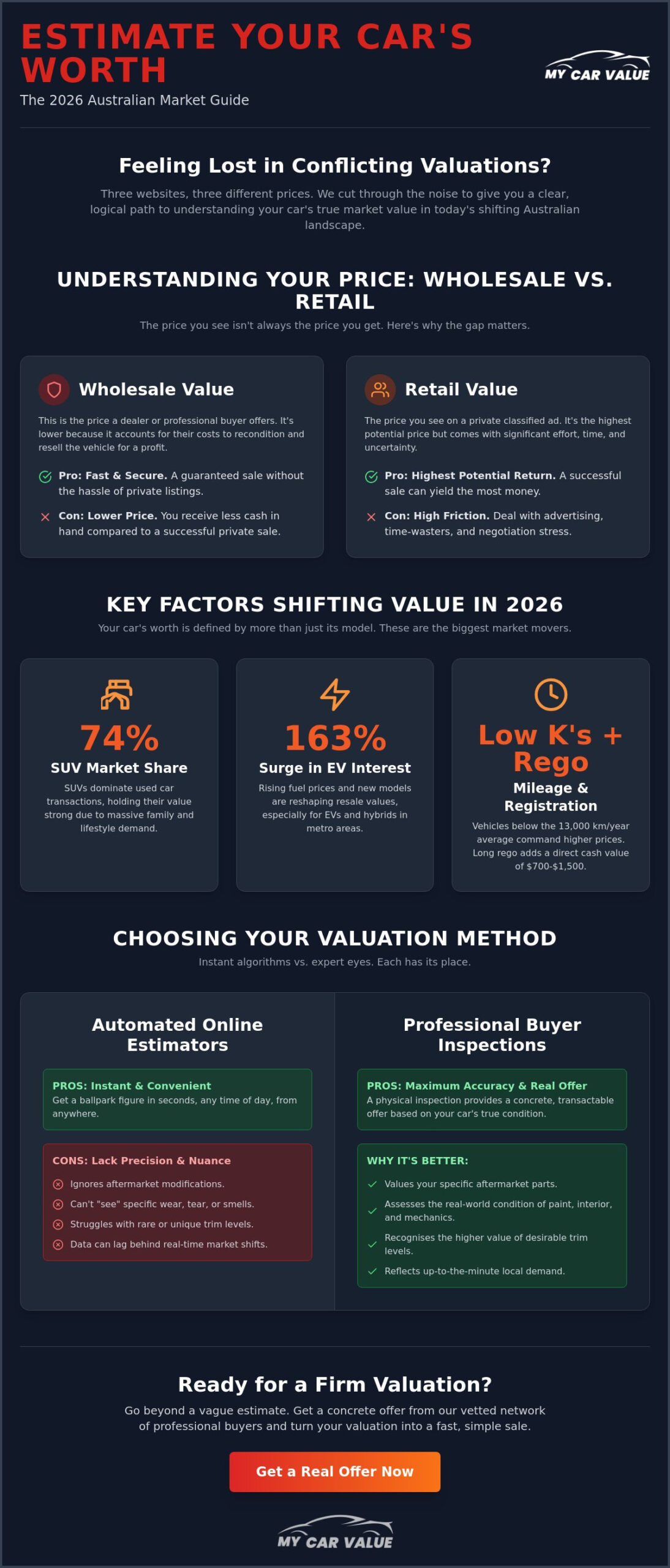
We examine how the 163% surge in electric vehicle interest and the rise of affordable Chinese brands are reshaping local resale prices. From updated Luxury Car Tax thresholds to the fact that SUVs now account for over 74% of used car transactions, we provide the data you need. Follow this logical path to secure a fair price and skip the usual market headaches.
Key Takeaways
- Distinguish between wholesale and retail figures to ensure your pricing strategy aligns with current Australian market realities.
- Learn how to accurately estimate car worth by balancing fast online algorithms with the precision of professional human appraisals.
- Factor in 2026 economic shifts, including fuel price volatility and the surge in SUV demand, to time your sale for maximum return.
- Prepare your vehicle to a showroom standard to justify a higher price point and eliminate easy negotiation excuses for buyers.
- Transition from a theoretical estimate to a concrete sale by bypassing private listing friction and accessing a vetted network of professional buyers.
Understanding the Basics: What Defines Your Car’s Market Value?
Market value is a simple concept in theory: it is the price a willing buyer pays a willing seller in an open, competitive market. In the real world, this figure is rarely a single, static number. When you try to estimate car worth, you are actually looking for a realistic price range. This range shifts based on current buyer demand, seasonal trends, and the specific economic climate of 2026. Treat any valuation as a baseline for negotiation rather than a final, guaranteed figure.
Understanding the vehicle valuation process is the first step toward a successful sale. It helps you see why a price on a screen might not match the cash in your hand. Your car’s value is also heavily influenced by its location. A compact EV might hold a higher value in a metropolitan hub like Sydney or Melbourne, whereas a rugged ute often fetches a premium in regional areas. Every detail, from the body type to the current fuel prices, plays a role in the final calculation.
Wholesale vs Retail: Why the Gap Matters
There is often a significant gap between what a dealer offers and what you see in private classifieds. This is the difference between wholesale and retail value. Dealers offer wholesale prices because they must factor in reconditioning costs, detailing, and a profit margin to keep their business running. While a private sale “retail” price looks higher on paper, it comes with high friction. You must manage the advertising, field calls from “tyre-kickers,” and organise test drives. Professional Used Car Buyers offer a middle-ground solution. They provide more than a standard trade-in while removing the weeks of stress and uncertainty associated with the private market.
The Role of the Odometer and Rego
Your odometer reading is one of the most powerful data points in any valuation. In 2026, the average Australian passenger vehicle travels approximately 13,000 kilometres per year. If your car has significantly lower mileage, it enters a higher value bracket. Conversely, “high k’s” suggest more wear on the engine and suspension, which pulls the estimate down.
Registration (rego) also acts as a tangible value-add. A car with ten months of remaining rego is more attractive than one about to expire, as it represents a direct saving of $700 to $1,500 for the new owner. To get an accurate history check, always have your VIN (Vehicle Identification Number) ready. This unique code confirms the car’s identity and ensures there is no hidden finance or accident history that could tank your valuation.
Comparing Valuation Methods: Online Calculators vs. Professional Appraisals
Online tools are the fastest way to get a ballpark figure for your vehicle. Most Australians start here because these calculators provide instant gratification. However, speed often comes at the cost of precision. To estimate car worth accurately, you must understand that an algorithm is only as good as the data it processed last month. In a 2026 market where SUV demand has hit 74% and used EV sales are doubling, static data often lags behind reality.
Platforms like Redbook serve as a respected industry baseline. They offer a helpful starting point for insurance purposes or general research. The limitation is that they cannot account for real-time auction spikes or specific local demand. Government resources also suggest you should find out your car’s market value by comparing similar models currently listed in your specific postcode. Triangulating data from multiple sources is the only way to build a realistic expectation before you enter negotiations.
The Pros and Cons of Automated Estimators
Automated tools offer unmatched convenience. You can get a number at midnight without talking to a soul. They work well for “cookie-cutter” models with high transaction volumes. The downsides are significant for anyone with a unique vehicle. Algorithms struggle with:
- Aftermarket modifications: Upgraded suspension or high-end alloys are often ignored.
- Specific wear and tear: A computer cannot smell cigarette smoke or identify a fading clear coat.
- Rare trim levels: Low-volume variants often get lumped in with base models, costing you thousands.
Why Professional Buyer Inspections Win for Accuracy
A physical inspection changes the conversation from a “maybe” to a “definitely.” Professional Used Car Buyers don’t just look at a screen; they listen to the engine and check the service log for consistency. They use live auction data from the previous 24 hours to see exactly what buyers in Perth or Adelaide are paying right now. This approach turns a vague digital estimate into a firm, written offer. If you want a figure backed by real-time data rather than historical averages, you can get a professional assessment that reflects current buyer appetite and your car’s actual condition.
Key Factors That Shift an Australian Car’s Worth in 2026
Market conditions in 2026 have introduced new variables that directly impact your vehicle’s bottom line. While previous years focused on supply chain shortages, today’s buyers are driven by running costs and interest rate sensitivity. High fuel prices have made fuel-efficient models and hybrids far more desirable. If you want to accurately estimate car worth, you must look beyond the badge and consider how these economic pressures shift demand in real-time. For example, the surge in used EV sales, which reached over 7,500 units in March 2026 alone, shows a clear pivot toward lower-emission transport.
Aesthetic choices also play a silent role in your valuation. The “colour tax” remains a reality in the Australian market. Despite the rise of bold new palettes, neutral tones like white, silver, and grey continue to dominate resale values. These colours are easier to maintain in the harsh Australian sun and appeal to the widest possible buyer pool. For those selling electric vehicles, a certified battery health report is now a critical factor. Much like a mechanical inspection for a petrol car, this data point provides the transparency buyers need to commit to a high-value purchase. You can use a car value estimator to see how these general trends apply to your specific model before diving into the finer details.
The PPSR and Vehicle History Report
A clear title is the foundation of any valuation. If a vehicle appears on the Written-off Vehicle Register (WOVR), its value can plummet by 50% or more, regardless of how well it has been repaired. Buyers also check the Personal Property Securities Register (PPSR) to ensure there is no “encumbrance” or money owing on the car. Selling a car with outstanding finance is a major red flag that complicates the estimate car worth process. Taking the time for understanding your PPSR car check ensures you can present a clean history to potential buyers, protecting your asking price from heavy negotiations.
Service History: The Logbook Advantage
A complete manufacturer service history is a powerful asset. In the 2026 market, a well-documented logbook can add between 10% and 15% to your final estimate. Many newer Australian models have shifted to digital logbooks, making it easier for professional buyers to verify maintenance records instantly. Consistency is key here. A single missed timing belt service can trigger a significant price drop because it represents a high-risk mechanical failure for the next owner. Keep your records organised to prove you’ve maintained the vehicle to the highest standard. For a deeper understanding of how all these factors combine, the definitive 2026 Australian guide to valuation of vehicles explains how the New Vehicle Efficiency Standard and the rise of Chinese brands are actively reshuffling resale values across the country.
How to Maximise Your Estimate Before Selling
Getting the best result when you estimate car worth requires more than just luck. It involves presenting your vehicle in a way that removes any excuse for a buyer to lower their offer. Small investments in time and presentation often create a thousand dollar difference at the point of sale. You want to move your car from being just another used vehicle to a standout example of its model. Buyers are looking for reasons to trust the car, and a well-prepared exterior is the first sign of a well-maintained engine.
The Psychology of the First Impression
A professional detail is not just a wash. It is a strategic move that often returns three times its cost in added sale value. Buyers make emotional decisions in the first thirty seconds of seeing a car. Focus heavily on high-touch areas like the steering wheel, gear knob, and driver’s seat bolsters. These spots show the most wear and signal how the car was treated daily. Remove all personal items and rubbish. A clean cabin allows a buyer to see themselves owning the car rather than feeling like a guest in your personal space.
Beyond a deep clean, replacing stained or worn-out flooring with custom-moulded Tru-Fit Carpets by Vision Auto is a practical way to restore a vehicle’s interior to a showroom standard, which can directly influence the final valuation.
Documentation and Accessories
Accessories matter more than many sellers realise. Locate your spare keys, parcel shelves, and original floor mats before showing the car. In the 2026 market, a missing second key can lead to an immediate $500 deduction from a professional buyer’s offer. Organise your receipts for recent tyres, brakes, or batteries to prove the car is ready for the road. When you present a clean, well-documented vehicle to Used Car Buyers in Sydney or Melbourne, you ensure a much faster turnaround. It signals that you are a serious seller with a quality asset.
Address minor “shopping centre” door dings and gutter-rashed alloys before seeking a final appraisal. These small flaws suggest neglect, even if the mechanicals are perfect. Timing is also critical for your bottom line. Try to sell your car with at least three months of rego remaining. Avoid listing it right before a major service interval, such as a timing belt replacement. A buyer who sees an upcoming $1,500 bill will simply subtract that from their offer. If you are ready to see what your well-prepared vehicle is truly worth, you can Value My Car today and get a realistic figure based on its current condition.
Beyond the Estimate: Turning Your Valuation into a Sale
Obtaining a realistic figure is only half the battle. The true challenge lies in converting that data into a bank transfer. Many Australians find that the gap between a digital estimate and a final sale is filled with frustration. Private listings often lead to a cycle of “tyre-kickers,” “low-ballers,” and “no-shows” who waste your weekends without ever making a serious offer. To estimate car worth effectively, you must have a clear path to exit the market quickly once you find the right price.
A professional sale removes these friction points. Instead of managing dozens of enquiries, you deal with a single, vetted entity. This streamlined approach moves you from an initial estimate to cash in your account within 24 to 48 hours. Professional buyers also handle the complex administrative side of the transaction. They manage the transfer of ownership and navigate the specific Roadworthy Certificate (RWC) requirements for your state, ensuring you aren’t left with a legal headache after the car is gone. If you want to understand every step involved, the ultimate 2026 guide to selling your car in Australia covers state-specific requirements and how to secure fast, competitive payment.
Why Professional Buyers Beat Private Classifieds
Selling privately introduces unnecessary security risks. Inviting strangers to your home for test drives is a concern for many. Furthermore, private buyers often rely on external finance approval, which can collapse at the last minute and leave you back at square one. Choosing professional Used Car Buyers ensures immediate payment and guaranteed security. If you are looking for efficiency, exploring Car Auction Alternatives is often a superior route to a fast, fair transaction.
The My Car Value Difference
We bridge the gap between static algorithms and real-world demand. Our approach uses real-time market data to ensure every estimate car worth we provide is competitive and grounded in 2026 auction trends. We maintain a national reach, providing a reliable solution for sellers in Brisbane and Perth who want to bypass the stress of the traditional used car market. We act as your advocate, doing the heavy lifting so you can make an informed decision with minimal effort.
Don’t let your valuation sit as a theoretical number on a screen. Take the logical next step and turn your vehicle’s value into a concrete result today. Estimate your car worth today with My Car Value and experience a faster, more transparent way to sell.
Take Control of Your Car Sale
You now have the tools to navigate the 2026 Australian automotive market with certainty. Understanding the difference between wholesale and retail figures is vital for setting realistic expectations. Combining a thorough PPSR check with a showroom-standard presentation ensures you protect your vehicle’s value against lowball offers. This data-driven approach is the most reliable way to estimate car worth before you commit to a final transaction.
Moving from a digital number to cash in your account doesn’t have to be a stressful ordeal. We provide a clear path forward by stripping away the complexity of private listings. Get a professional estimate of your car’s worth today. Our process is trusted by thousands of Aussie sellers. We offer access to a national network of professional buyers and provide no-obligation, transparent valuations. Skip the tyre-kickers and secure a fair price for your car this week.
Frequently Asked Questions
How accurate are online car value estimators in Australia?
Online estimators provide a helpful starting point but are rarely 100% accurate. These tools rely on historical data and cannot assess your vehicle’s physical condition or mechanical health. In a volatile 2026 market where SUV demand is at 74%, static algorithms often lag behind real-time buyer appetite. Use them as a ballpark range before seeking a professional appraisal.
Does a car’s colour really affect how much it is worth?
Yes, colour has a tangible impact on resale value in the Australian market. Neutral tones like white, silver, and grey remain the most popular because they are easier to maintain and reflect heat better in the local climate. Choosing a bold or unusual colour can lead to a “colour tax,” as it appeals to a smaller pool of potential buyers and often takes longer to clear.
What is the difference between Redbook value and market value?
Redbook provides a statistical benchmark based on historical sales averages, while market value is the actual price a buyer is willing to pay today. Redbook is excellent for insurance purposes or general research. However, true market value shifts weekly based on live auction trends, interest rates, and current fuel prices. You should cross-reference both to estimate car worth effectively.
Will a high odometer reading ruin my car’s resale value?
A high odometer reading won’t ruin your car’s value, but it will pull your estimate toward the lower end of the range. The 2026 Australian average is approximately 13,000 kilometres per year. If your car significantly exceeds this, buyers factor in the increased risk of mechanical wear. You can offset this impact by presenting a comprehensive, up-to-date service history.
Should I fix minor dents before getting a valuation?
Minor “shopping centre” dings and small scratches usually aren’t worth fixing yourself. Professional buyers can repair these issues at a much lower cost than a retail panel shop would charge you. You’ll get a better return on investment by spending that money on a high-quality professional detail to ensure the car looks its absolute best during the inspection.
How does a PPSR report affect my car’s worth?
A clear PPSR report is essential for maintaining your car’s full market value. If the report shows a “written-off” status, the value can drop by 50% or more immediately. A clean report proves to the buyer that the vehicle has no hidden accident history or outstanding finance. This transparency gives the buyer the confidence to offer a premium price.
Can I sell my car if it still has finance owing?
You can sell my car with finance owing, but the process is different from a standard sale. You must obtain a current payout letter from your lender to show the exact amount owing. A professional buyer will typically pay the lender directly to clear the title and then pay you the remaining balance. This is much simpler than trying to manage a financed sale privately.
What documents do I need to sell my car to a professional buyer?
You need your current driver’s licence, registration papers, and a complete service logbook. Having all sets of keys and any receipts for recent major repairs like new tyres or a battery is also vital. These documents allow the buyer to verify the estimate car worth and finalise the bank transfer, often within 24 to 48 hours.