
Repair or Sell Your Car in Australia? How to Decide in 2026
The next repair may not be the best move. If you’re weighing “repair or sell car australia”, compare what your car is worth now with what it might be worth after repairs, not just the workshop quote. A costly fix may improve buyer interest, but it won’t always make financial sense.
It’s understandable to hesitate when your car has faults, high kilometres or gaps in its service records. These details can affect buyer interest, but they don’t automatically mean you need to repair everything before selling. The right choice also depends on your car’s overall condition and how you’ll get around next.
This guide will help you weigh repair costs against your car’s realistic market value and consider whether fixing it is likely to improve its saleability. You’ll also learn which vehicle details matter to buyers and how your selling options compare. A valuation can give you useful context before you decide, while connections with professional used car buyers offer a practical option if selling looks like the better next step.
Key Takeaways
- Compare the next repair with your car’s condition, realistic value and your transport needs before choosing to keep or sell it.
- Set aside money already spent. Focus on whether the next repair makes practical sense.
- Weigh selling as-is against repairing before sale. Repairs may improve presentation, but they don’t guarantee a higher offer.
- Use a written repair scope and accurate vehicle details to make a more grounded repair or sell car australia decision.
- If you’re considering a sale, use a valuation for context and explore connections with professional used car buyers.
Repair or sell your car in Australia? Start with the real decision
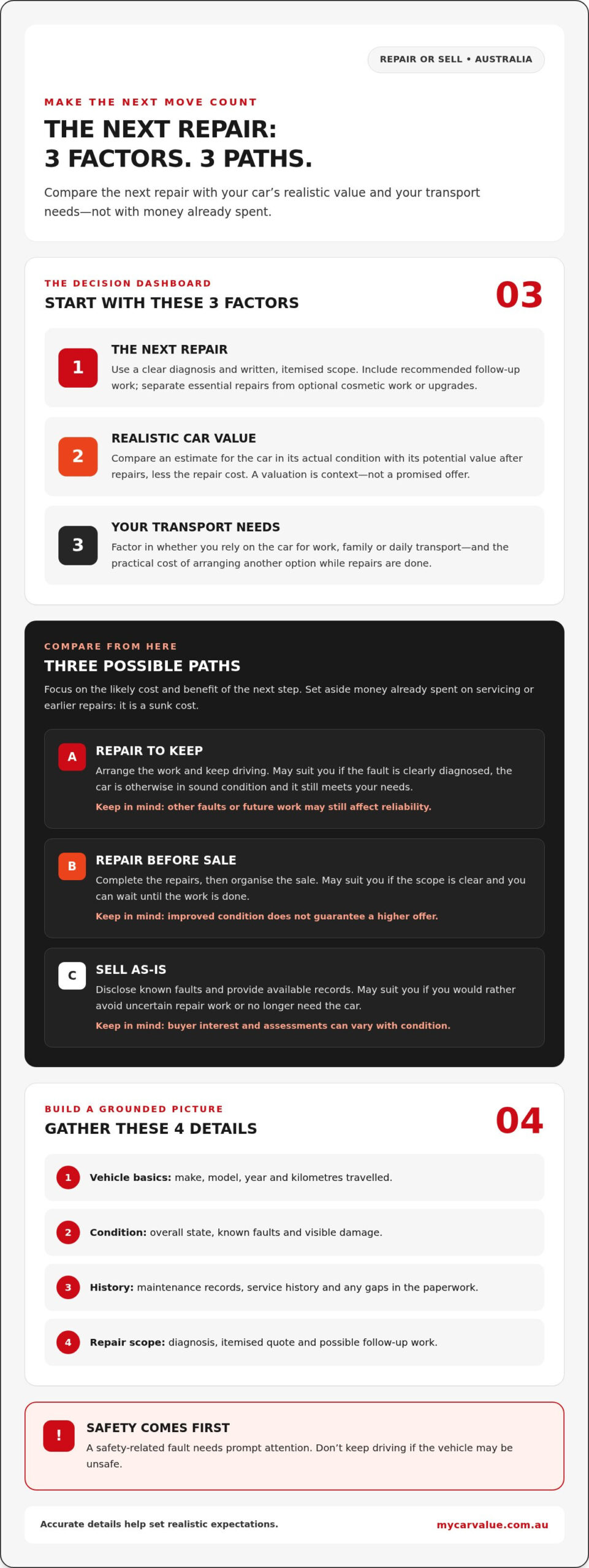
Start with the next repair, not the money you’ve already spent. Compare the written quote with your car’s current condition and realistic value, then factor in whether you rely on it for daily transport. You might repair it to keep driving, fix it before selling, or sell it in its current condition. Each option has different implications for your budget, time and transport arrangements.
Your decision should be guided by three things: the next repair, the car’s realistic value and your transport needs. There’s no single repair-cost threshold that works for every vehicle. A repair that makes sense for a dependable car you need every day may be harder to justify for a vehicle you can replace easily.
Look at the full ownership picture, not just the immediate quote. Depreciation, maintenance and repairs all contribute to car ownership costs. Ask whether the next repair helps you keep a vehicle that suits your needs, or simply delays a sale without resolving wider reliability concerns.
What does “repair or sell” mean for your situation?
Separate essential work from optional improvements. A safety-related fault needs prompt attention, and you shouldn’t keep driving if the vehicle may be unsafe. Cosmetic work or upgrades are different: weigh their likely benefit against your plans. If you rely on the car for work or family transport, include the practical cost of arranging another option while it’s being repaired.
You can consider selling a car with known faults. Describe its condition accurately and share relevant information with prospective buyers. You don’t have to assume every fault must be fixed before a sale, but be clear about what is and isn’t working.
Which details should you gather before deciding?
Gather the facts before comparing your options. Get a clear diagnosis and written repair scope, including any recommended follow-up work. Then record the vehicle details buyers and valuation tools use to assess its condition:
- Make, model, year and kilometres travelled.
- Overall condition, including known faults and visible damage.
- Maintenance history, service records and any gaps in the paperwork.
- The diagnosis, itemised repair quote and possible follow-up work.
Use these details to build a realistic picture rather than relying on a best-case estimate. A vehicle market value calculator can provide useful context for your car’s value. Treat the figure as one input, then consider how faults, service history and condition may affect buyer interest. With the quote and vehicle details in front of you, you’ll have a stronger basis for deciding whether to repair, sell as-is or explore a sale after repairs.
How repair costs, car value and reliability change the equation
Once you have a repair scope and a value estimate, compare what each option gives you from here. Don’t let past spending drive the decision. Money already paid for servicing or earlier repairs is a sunk cost. Focus instead on the cost and likely benefit of the next repair, plus the transport you’ll need afterwards.
Compare the written quote with a realistic estimate of the car’s current value in its actual condition. If you’re considering repairs before selling, think about the car’s potential value after the work, minus the repair cost. That figure isn’t a promised offer: buyers may assess the vehicle differently, especially if it has other faults or gaps in its history.
The same repair can be sensible for an owner who needs a reliable car, but impractical for someone ready to change vehicles. Use this comparison to clarify what matters most in your circumstances:
| Option | Effort | Uncertainty | May suit you if |
|---|---|---|---|
| Repair to keep | Arrange and manage the work, then continue using the car. | Other faults or future work may still affect reliability. | The fault is clearly diagnosed and the car otherwise meets your needs. |
| Repair before sale | Complete repairs, then organise the sale. | The work may improve condition, but won’t guarantee a higher offer. | The repair scope is clear and you can wait to sell until the work is done. |
| Sell as-is | Disclose known faults and provide available records. | Buyer interest and assessments may vary with the vehicle’s condition. | You’d rather avoid uncertain repair work or no longer need the car. |
When might repairing the car make more sense?
Repairing may be practical if the fault has a clear diagnosis, you plan to keep driving the car and its general condition is sound. Consider its maintenance record and any known upcoming work, not just the immediate quote. For example, one defined repair on a well-maintained vehicle presents a different decision from a repair followed by several unresolved issues. Neither outcome guarantees future reliability or resale value.
When could selling the car as it is be worth considering?
Selling as-is may be worth exploring if faults keep returning, the repair scope remains uncertain or your transport needs have changed. No single fault or vehicle age automatically means you should sell. Buyers can assess the car based on its disclosed condition and available records, so accurate information helps set realistic expectations. Be clear about known problems rather than presenting the car as fault-free.
For a repair or sell car australia decision, compare the likely cost and effort of each path with what you need next. If selling is on the table, a valuation can help you understand the car’s market context, and My Car Value can connect vehicle owners with professional used car buyers. My Car Value facilitates those connections rather than purchasing vehicles directly.
Compare repairing, selling as-is and selling after repairs
There are three practical paths: keep the car and repair it, complete repairs before selling, or sell it with its known faults. Compare each against your priorities. If you need transport every day, a repair may help you keep a familiar vehicle. If you’re ready to replace it, paying for work first could add time and cost without changing your decision.
For a repair or sell car australia decision, consider the effort involved, how clear the repair scope is, how easily you can describe the car’s condition and what transport you’ll need. A tidy presentation can help a car make a better first impression, but repairs don’t guarantee a higher offer. Buyers assess the whole vehicle, not just the work recently completed.
What are the trade-offs of repairing before selling?
A completed repair can make a vehicle easier to present, depending on the work and the car’s wider condition. But repairs can take time, reveal additional work or cost more than expected. Even if the fault is fixed, there’s no guarantee you’ll recover the outlay in the sale. Check current roadworthiness requirements with your state or territory transport authority, as rules can vary.
Before authorising work, consider whether you can manage repair delays and what happens if the diagnosis changes. For broader preparation steps, use this guide to selling your car in Australia.
What should you consider when selling a car with faults?
Selling as-is avoids spending time and money on repairs you may not need for your next step. Be direct about known issues and provide clear records of completed repairs. A buyer’s assessment and offer can reflect the car’s condition, the information available and any uncertainty about the work required. Accurate details help set realistic expectations without implying the car is fault-free.
Think about how you want to manage the sale. A private listing gives you control over the advertisement and conversations with potential buyers, but you’ll handle those steps yourself. Connecting with professional used car buyers offers a different route. My Car Value facilitates connections with buyers rather than purchasing cars directly. Learn more in this professional used car buyers guide.
Choose the path that fits your circumstances, not an assumed rule about a particular fault or age. If you’re leaning towards selling, My Car Value can help you understand your car’s market value and connect with professional used car buyers.
Use this step-by-step checklist to make your decision
Turn the decision into a short process. Gather reliable information first, then compare the options using the same vehicle details and repair scope. This keeps an online estimate or a single workshop quote from becoming the whole basis for your repair or sell car australia decision.
- Diagnose the fault. Get a clear explanation of what needs attention and whether the issue affects safe use. Separate the immediate repair from any recommended follow-up work.
- Document the scope. Keep the written quote and note what it covers, what it excludes and any uncertainty about further repairs. A quote for one fault may not account for other work the car needs.
- Estimate the car’s value. Use a current valuation as a starting point, then account for kilometres, service history, condition and known faults. Treat an online figure as context, not a guaranteed sale offer.
- Compare the choices. Weigh repair-to-keep, repair-before-sale and selling as-is. Include the value of continuing to use a car that suits your needs, as well as the cost, time and uncertainty of repairs.
- Choose a practical next step. Decide what you’ll do next, whether that’s clarifying the repair scope, arranging work or preparing to sell. If selling, organise the information a buyer needs to understand the vehicle’s condition.
Keep the comparison grounded in specifics. For example, if a quote covers one diagnosed fault but lists other work as possible, don’t treat the quoted repair as the full cost of future ownership. Compare what’s confirmed with what remains uncertain, then decide how much risk you’re comfortable carrying.
How do you compare the repair quote with the car’s value?
Start with an evidence-based estimate of the car’s current market value, then adjust your expectations for its actual condition and known faults. If you plan to keep it, consider the value of having transport that meets your needs, not only what you might receive in a sale. There’s no universal percentage or repair-cost cut-off that can make the decision for every owner.
What should you prepare before deciding to sell?
Gather available ownership and service documents, all keys, the odometer reading and a clear list of known issues. Record completed repairs and keep supporting paperwork. Be accurate about the vehicle’s condition, including faults that remain unresolved. If a PPSR or written-off vehicle check is relevant to your circumstances, use current official guidance to understand the process.
Registration, transfer and roadworthiness processes can differ between Australian states and territories. Before selling, check current requirements with the relevant state or territory transport authority. The right paperwork and a clear account of the car help you move forward with fewer unknowns.
Ready to sell? Understand your car’s value and connect with buyers
If you’ve decided to explore a sale, start with a realistic view of your car’s market value. It gives you useful context for deciding whether selling fits your plans and helps you approach the next step with clearer expectations. A valuation is a guide, not a guaranteed final offer from a buyer.
How can a valuation help you move forward?
Use the estimate alongside your repair quote and transport needs. It can help you consider whether selling now makes more sense for your circumstances than paying for further work or keeping the car. The estimate is more useful when it reflects the vehicle you actually have, so enter accurate details rather than relying on a best-case description.
Include the make, model, year and kilometres, and be realistic about the car’s condition. Note known faults and relevant service or repair history. Differences between the details provided and the vehicle’s actual condition can affect how buyers assess it. An indicative value helps you start the conversation, but it doesn’t promise a particular sale price or buyer response.
What happens when you explore a buyer connection?
My Car Value helps vehicle owners understand market value and facilitates connections with professional used car buyers. It connects you with buyers to explore a sale; it doesn’t directly purchase vehicles. Buyer interest and any offer depend on the individual car, including its condition and the information available about it.
Keep your expectations practical. A valuation can help you decide whether to investigate selling, while a buyer connection gives you a way to explore that option. Neither guarantees that a buyer will be interested or that a sale will proceed. If the vehicle has faults, describe them accurately so its condition is clear as you consider the next step.
You don’t need to resolve every uncertainty before exploring a sale. Start with accurate vehicle details, use the valuation as context and decide whether connecting with professional buyers suits your plans. This gives you a straightforward way to move from weighing repair or sale options to considering what comes next.
If you’re making a repair or sell car Australia decision and want to explore selling, start with your vehicle’s details.
Make your next move with confidence
A car decision doesn’t have to be perfect to be practical. Use the information you’ve gathered to choose the next step that best fits your budget, daily transport needs and plans. If you’re still weighing “repair or sell car australia”, compare the options without treating past spending as a reason to keep investing.
If selling is the direction you’re considering, a valuation can help you move from uncertainty to a clearer starting point. You can then decide whether to explore a buyer connection, prepare the car further or pause while you consider your options. Checking its value doesn’t commit you to a sale.
Take the next step at your own pace. A clear view of your options puts you in a stronger position to make a decision that works for you.
Frequently Asked Questions
Is it better to repair or sell an old car in Australia?
It depends on the car’s condition, the repair needed and how well it suits your transport needs. Age alone doesn’t settle the repair or sell car australia decision. For example, an older car with a clear fault and a strong maintenance record may still suit an owner who wants to keep driving it. Consider its overall reliability and likely future work before committing to another repair.
Can I sell my car in Australia if it needs repairs?
Yes, you can explore selling a car with faults. Be upfront about what you know, including symptoms that haven’t been diagnosed, and avoid describing the car as fault-free. Keep any inspection notes or repair quotes that help explain its condition. If the fault could affect whether the car can be driven safely, don’t drive it until you’ve addressed that risk. Buyer interest will depend on the vehicle.
How do I know if a car repair is worth the money?
Ask what the repair is expected to resolve, what it excludes and whether other work may follow. Then consider how long you plan to keep the car and whether it’s likely to meet your needs after the repair. For instance, a defined repair may be easier to assess than an intermittent problem without a confirmed cause. If the diagnosis or scope remains uncertain, get the details clarified before deciding.
Should I get a car valuation before deciding whether to repair it?
A valuation can help you understand the car’s market context before you commit to more work. Use accurate details, including the model variant, kilometres and known condition issues, so the estimate relates to your vehicle. Compare it with the repair decision and what keeping the car means for you. Treat the result as an indication, not a promise of what a particular buyer will offer.
Does repairing a car before selling it guarantee a better offer?
No. A repair may address a concern a buyer would otherwise consider, but it doesn’t guarantee a higher offer or that you’ll recover the money spent. A buyer may also take account of other faults, the car’s overall condition and available records. Before arranging work solely for a sale, weigh the confirmed repair cost against the likely benefit and consider whether selling with the fault disclosed is a more practical option.
What documents should I gather before selling a car with faults?
Gather documents that help establish the vehicle’s identity, ownership and history. Useful items may include registration details, service books, maintenance receipts, inspection reports and invoices for completed repairs. Keep a written note of unresolved faults and any diagnosis or quote you have. Collect the keys and owner’s manual if available. Clear records help you answer questions accurately and give prospective buyers a better picture of the car.
Can My Car Value repair my car or buy it directly?
No. My Car Value doesn’t provide mechanical repairs or directly purchase vehicles. It helps Australian vehicle owners understand market value and facilitates connections with professional used car buyers. If you’re considering a sale, start with a valuation and use it as context while exploring a buyer connection. Any buyer interest or offer depends on the individual vehicle and its condition.