

Professional Car Buyers in Australia: The 2026 Guide to a Stress-Free Sale
The traditional private sale is officially dead in 2026. Spending your weekends haggling with tyre kickers or dodging marketplace scams is no longer the price you have to pay for a fair deal. Finding reputable car buyers who understand the current Australian market shouldn’t feel like a second job. You want a transaction that respects your time and reflects the actual value of your vehicle based on real-time data, not a guess from years ago.
Selling a car often feels like a minefield of low-ball offers and endless paperwork. It’s frustrating when you aren’t sure if the price you’re quoted is actually fair in a market where new brands are shifting values overnight. This guide changes that. You’ll learn how to master the 2026 automotive market to secure a fast, secure sale with immediate payment. We’ll show you how to bypass the stress of private listings and use professional tools to ensure you get every cent your car is worth without the usual paperwork headaches.
Key Takeaways
- Identify why private marketplaces in 2026 are saturated with time-wasters and how to pivot to a more efficient selling strategy.
- Distinguish between traditional dealership trade-ins and professional car buyers who use real-time data to offer fair market prices.
- Calculate the true cost of selling privately by accounting for advertising fees, mechanical inspections, and the value of your own time.
- Prepare your vehicle effectively by organising service records and presentation to maximise your valuation outcome.
- Streamline the entire transaction using a digital facilitator that connects you with reputable buyers and handles the paperwork stress.
The Australian Car Selling Landscape in 2026
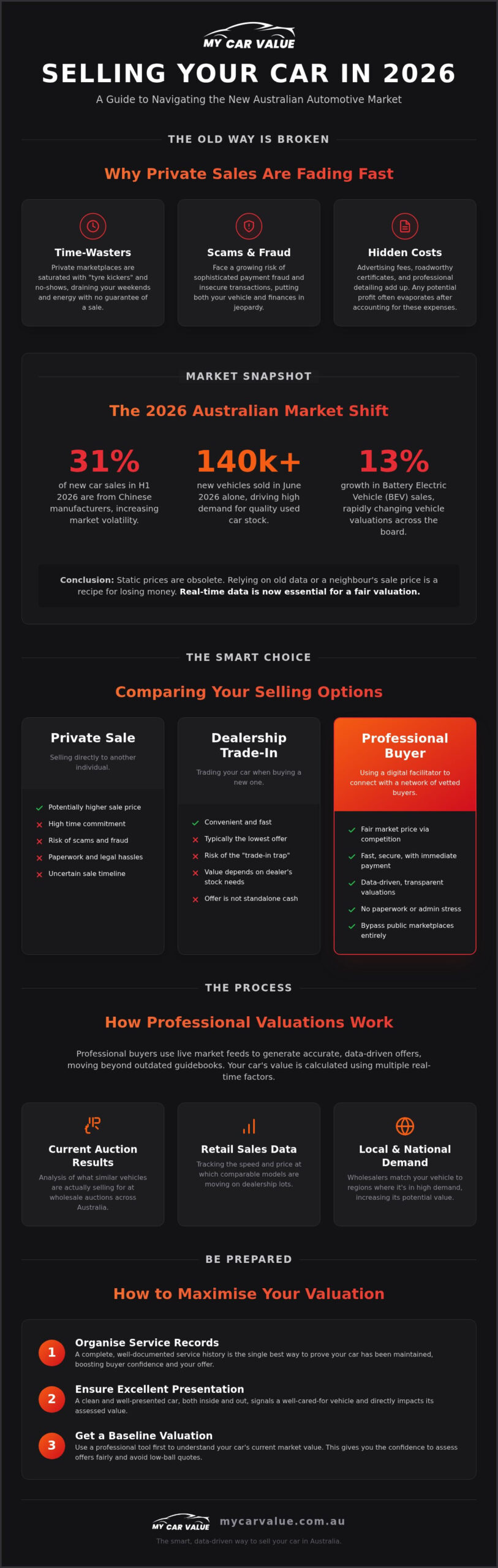
The Australian automotive sector is currently experiencing a significant transformation. With Chinese manufacturers now accounting for over 31% of new car sales in the first half of 2026, the secondary market is more volatile than ever. Traditional Japanese brands are seeing their dominance challenged. This creates a massive ripple effect throughout the used-car market. For sellers, this means static prices are a thing of the past. Relying on what a neighbour sold their car for six months ago is a recipe for losing money. You need real-time data to get it right. Professional car buyers are increasingly becoming the preferred choice for those who value speed and accuracy over the chaos of the open market.
Why Private Sales are Losing Their Appeal
Selling a car privately used to be the default choice for getting a better price. That’s no longer the case. The time cost involved in organising roadworthy certificates and managing inspections often outweighs any potential profit. Private marketplaces are increasingly saturated with “tyre kickers” who have no intention of buying. You’ll also face scammers using sophisticated payment fraud. Dealing with insecure payment methods or “no-show” buyers is a drain on your resources. The administrative burden of rego transfers and verifying a buyer’s identity adds another layer of unnecessary stress. It’s a legacy system that doesn’t work in a fast-paced market. Most sellers find that the “extra” money promised by a private sale evaporates once they account for advertising fees and lost weekends.
The Rise of Professional Buyer Networks
Modern technology has bridged the gap between private sellers and wholesalers. Professional car buyers now use real-time data to provide “sight-unseen” initial offers. These networks are looking for quality stock to meet the growing demand for reliable used vehicles. New vehicle sales reached over 140,000 units in June 2026 alone. This shift toward digital-first selling allows you to bypass the public marketplace entirely. You get a transparent, data-driven offer without leaving your driveway. It’s a faster, safer way to secure a sale. Wholesalers need your car to maintain their inventory levels. This demand works in your favour. It simplifies a process that used to take weeks into something that can be resolved in hours.
Before you engage with any potential buyer, you must have a clear understanding of your vehicle’s worth. Obtaining a professional valuation is the only way to ensure you aren’t being underquoted. It provides a baseline for negotiations. It gives you the confidence to walk away from low-ball offers. In a market where Battery Electric Vehicle (BEV) sales grew by 13% last year, values are shifting fast. Don’t guess. Use a professional tool to see exactly where your car sits in the current Australian market before you sign anything.
What are Professional Car Buyers?
Professional car buyers are specialised businesses that purchase vehicles directly from the public for inventory or wholesale purposes. Unlike a private individual looking for a single car, these buyers operate at scale. They prioritise a streamlined transaction over the emotional negotiation typical of the used car market. By removing the need for public listings and private viewings, they offer a direct path to a sale. Facilitators like My Car Value play a vital role here. They act as the link between your driveway and a national network of vetted professionals, ensuring you don’t have to hunt for the right buyer yourself.
Wholesalers vs. Retail Dealerships
It’s vital to understand who is actually bidding on your vehicle. Retail dealerships generally want cars they can clean and sell on their own lot within 30 days. If your car doesn’t fit their specific “brand” or current inventory needs, they’ll offer a low trade-in price. Wholesalers work differently. They move high volumes of stock across Australia to match specific regional demands. A car that’s unpopular in one state might be in high demand in another. This ability to shift volume means wholesalers can often provide more competitive offers than a local dealer. You should also watch out for the “trade-in trap.” This is where a dealer appears to give you a high price for your car but simply adds that cost back into the finance or purchase price of your next vehicle. Dedicated car buyers provide a transparent, standalone figure, keeping the two transactions separate and honest.
How Professional Valuations Work
In 2026, relying on static data or outdated guidebooks is a mistake. Professional car buyers use live market feeds to formulate their offers. They look at current auction results, retail sales data, and even the speed at which similar models are moving. While factors like mileage, condition, and service history remain critical, local demand now plays a much larger role in the final number. Market value is the price a professional buyer is willing to pay based on current auction and retail data. Understanding this helps you set realistic expectations. To ensure you meet all legal requirements during the handover, you should have your paperwork ready. If you want to see how your vehicle stacks up against current trends, you can get a professional valuation today.
Comparing Selling Methods: Private vs. Auction vs. Professional Buyers
Choosing the right way to sell your vehicle in Australia depends on your priorities. You have three main paths: private listings, public auctions, or professional car buyers. While a private sale might promise the highest “sticker price,” the actual profit often looks quite different after you subtract expenses. Auctions provide speed but lack price certainty. Professional networks offer a data-driven middle ground. When deciding how to move your vehicle, reviewing the official government guidelines for selling a vehicle helps clarify your legal obligations across these different channels.
The Hidden Costs of Private Listings
DIY selling is rarely free. Advertising fees on major Australian platforms can cost hundreds of dollars before you even receive your first enquiry. You also need to factor in the cost of a Roadworthy Certificate (RWC), which is mandatory in many states before a sale can be finalised. The true drain, however, is your time. Hosting test drives and answering late-night messages takes hours away from your week. Then there is the haggling. Most private buyers will try to knock thousands off your asking price, eroding the very profit margin you were trying to protect. By the time the car is sold, your effective hourly rate for the effort involved is often remarkably low.
Professional Buyers: The Efficiency Advantage
Professional car buyers eliminate the variables that make private sales and auctions risky. Public auctions are unpredictable. If the right bidders don’t show up on the day, your car might sell for far less than its market value; you’ll still owe the auction house a commission regardless. In contrast, a professional buyer provides a firm offer based on current market data. Many sellers find that Professional Used Car Buyers offer a superior alternative to traditional methods because the payment is guaranteed and secure.
The administrative relief is equally significant. These buyers handle all the legal paperwork and rego obligations on your behalf. You don’t have to wait for a cheque to clear or worry about fraudulent bank transfers. The funds are typically sent via secure digital platforms, ensuring you have the money in your account before the car leaves your driveway. It is a methodical, transparent process designed to value your time as much as your vehicle.
How to Organise Your Vehicle for a Professional Buyer
Preparation is the difference between a good offer and a great one. Professional car buyers aren’t just looking at the odometer; they’re looking for a low-risk asset. You need to present your vehicle as a well-maintained machine. This starts with your paperwork. A complete service history proves you haven’t skipped essential maintenance. In the 2026 market, where complex electronics and hybrid systems are standard, proof of professional servicing is non-negotiable. It provides the buyer with the confidence that the vehicle’s battery health and software updates are current. Evidence of regular oil changes and logbook stamps acts as a secondary currency during the valuation process.
The Value of a Clean History Report
Professional buyers always perform a PPSR check before making a final payment. They are looking for encumbrances, such as outstanding finance, or a history on the Written-off Vehicle Register (WOVR). A car with a “clear title” always commands a premium. If your vehicle has been previously repaired after an accident, disclose this early. Transparency builds trust. It ensures the initial valuation remains accurate through to the final handover. You can learn more about this in our Car Service History Check guide. Disclosing minor flaws upfront prevents a last-minute price drop during the physical inspection.
Physical Presentation and Minor Repairs
Does a professional detail pay for itself? Usually, yes. A clean car suggests a careful owner. It allows the buyer to inspect the paintwork and interior without distractions. Focus on minor cosmetic issues that are cheap to fix, like a blown light globe or a missing hubcap. However, don’t over-invest in major mechanical repairs. Professional car buyers often have their own repair networks and can handle mechanical faults more cost-effectively than you can. Ensure you have both sets of keys, the owner’s manual, and any accessories like floor mats or cargo nets ready for inspection. Missing keys are a common reason for price deductions, as modern smart keys are expensive to replace.
Before the buyer arrives, gather every piece of relevant documentation. You’ll need the original registration certificate to prove ownership and your current driver’s licence for identity verification. If there is still finance on the vehicle, obtain a current payout letter from your lender. Professional buyers can often settle this debt directly, paying the balance to you and the remainder to the bank. Having these items organised ensures the handover takes minutes rather than hours.
Streamlining Your Sale with My Car Value
My Car Value functions as a professional facilitator. We bridge the gap between your driveway and a national network of vetted car buyers. This digital-first approach eliminates the need to visit multiple dealerships or manage marketplace listings. You gain access to a competitive marketplace where wholesalers bid based on real-time demand. It is a modernised system designed to strip away the complexity of a legacy process. We do the heavy lifting, acting as a savvy intermediary that prioritises your time and security.
Step 1: Get an Accurate Valuation
Accuracy starts with data. Most generic online tools use outdated models that fail to track the rapid shifts in the 2026 market. With Chinese manufacturers now holding a significant share of Australian sales, static valuations are no longer reliable. Use our Vehicle Market Value Calculator to get an estimate that reflects current Australian conditions. To receive a firm quote, ensure you provide your VIN, accurate mileage, and honest condition details. This methodical approach ensures the figure you see online matches the reality of the market, preventing any surprises during the final transaction.
Step 2: Connecting with Vetted Buyers
We match your vehicle with car buyers who have a specific interest in your make and model. This targeted connection is what drives fair market value. Unlike a local dealer who might only want stock for their own lot, our network looks at national demand. Our Sell My Car process focuses on speed and security. Once a match is made, the final steps are straightforward. A professional buyer conducts a brief inspection to verify the car’s condition. Payment is then issued via secure bank transfer, ensuring the funds are in your account before the vehicle is collected.
Transparency is our priority. We manage the connection to ensure every buyer in our network is reputable. You don’t have to worry about unsafe payment methods or fraudulent marketplace enquiries. We handle the paperwork, including rego transfers and disposal requirements. This creates an atmosphere of relief and trust. You move from an initial valuation to a completed sale with minimal friction. The entire workflow is predictable, structured, and geared entirely toward your convenience.
Secure Your Best Sale in a Modern Market
The Australian car market is moving faster than ever; your selling strategy should too. Professional car buyers provide the most efficient path to a secure transaction by cutting out time-wasters and static price guides that no longer serve today’s sellers. By leveraging accurate 2026 market data and a national network of professionals, you ensure you don’t leave money on the table or waste weekends on failed inspections. This methodical approach strips away the complexity of a typically stressful process.
Preparation and transparency remain your best tools for a smooth handover. Stop guessing what your vehicle is worth in a shifting landscape and choose a method that prioritises speed and security. You can bypass the stress of private listings and move straight to a secure, data-driven outcome. It’s about working smarter to achieve a result that respects both your time and your vehicle’s true worth.
Frequently Asked Questions
How do professional car buyers determine the value of my car?
Professional buyers calculate your vehicle’s worth by analysing live market feeds and recent auction data across Australia. They move beyond static guidebooks to look at real-time demand for your specific make and model. Key variables include the odometer reading, service history, and overall physical condition. Using a data-driven platform ensures your valuation reflects current 2026 trends rather than an outdated estimate from a few months ago.
Is it safer to sell to a professional buyer than a private individual?
Selling to professional car buyers is significantly safer than navigating private marketplaces. You avoid the risks of fraudulent bank transfers, “no-show” inspectors, and aggressive haggling from strangers. These buyers are vetted businesses that prioritise secure digital payments and transparent paperwork. This professional approach eliminates the uncertainty of the private market, providing a clear audit trail and ensuring the funds arrive in your account before you hand over the keys.
What documents do I need to sell my car to a professional buyer in Australia?
You generally need three primary pieces of documentation for a successful handover. First, provide your current Australian driver’s licence to verify your identity. Second, present the original registration certificate to prove ownership. Finally, include your complete service logbook and any spare keys. If the vehicle has outstanding finance, you must also provide a current payout letter from your lender to facilitate a direct settlement during the final transaction.
Can I sell a car that still has finance owing to a professional buyer?
Yes, selling a financed vehicle is a standard procedure for professional buyers. They can coordinate directly with your finance provider to settle the outstanding debt. Once the payout is confirmed, the buyer pays the remaining balance of the agreed sale price to you. This process removes the administrative burden of closing the loan yourself and ensures the title is cleared legally and efficiently as part of the sale.
How long does the process take from valuation to getting paid?
The entire workflow is designed for speed and can often be completed within 24 to 48 hours. Once you receive your initial digital valuation, a final inspection is organised at your convenience. If the vehicle matches the description provided, the sale is finalised immediately. Most professional buyers use secure, instant bank transfers; meaning the funds are often available in your account on the same day the car is collected.
Will a professional buyer collect the car from my house?
Most reputable car buyers in our network offer a mobile service that includes a final inspection and collection from your home or workplace. This eliminates the need for you to drive to a dealership or wait around in a showroom. Once the physical condition is verified and the digital paperwork is signed, the buyer handles the transport. This door-to-door service is a key part of making the 2026 selling experience stress-free.
Do I need to organise a Roadworthy Certificate (RWC) before selling?
No, you typically don’t need to provide a Roadworthy Certificate when selling directly to a professional buyer or licensed motor dealer. These businesses are equipped to handle any necessary mechanical inspections and reconditioning themselves. This saves you the time and expense of visiting a mechanic and simplifies the legal requirements for the sale. It is one of the primary advantages of choosing a professional network over a private listing.
What is the difference between trade-in value and market value?
Trade-in value is often a lower figure offered by a dealership as part of a new car purchase, sometimes used to mask the true cost of the new vehicle. Market value represents the actual worth of your car as a standalone asset based on current auction and retail data. Professional buyers focus on market value, providing a transparent and competitive offer that isn’t tied to an expensive upsell or a complicated finance package.