

Online Car Valuation vs Dealer: Which Is More Accurate in 2026?
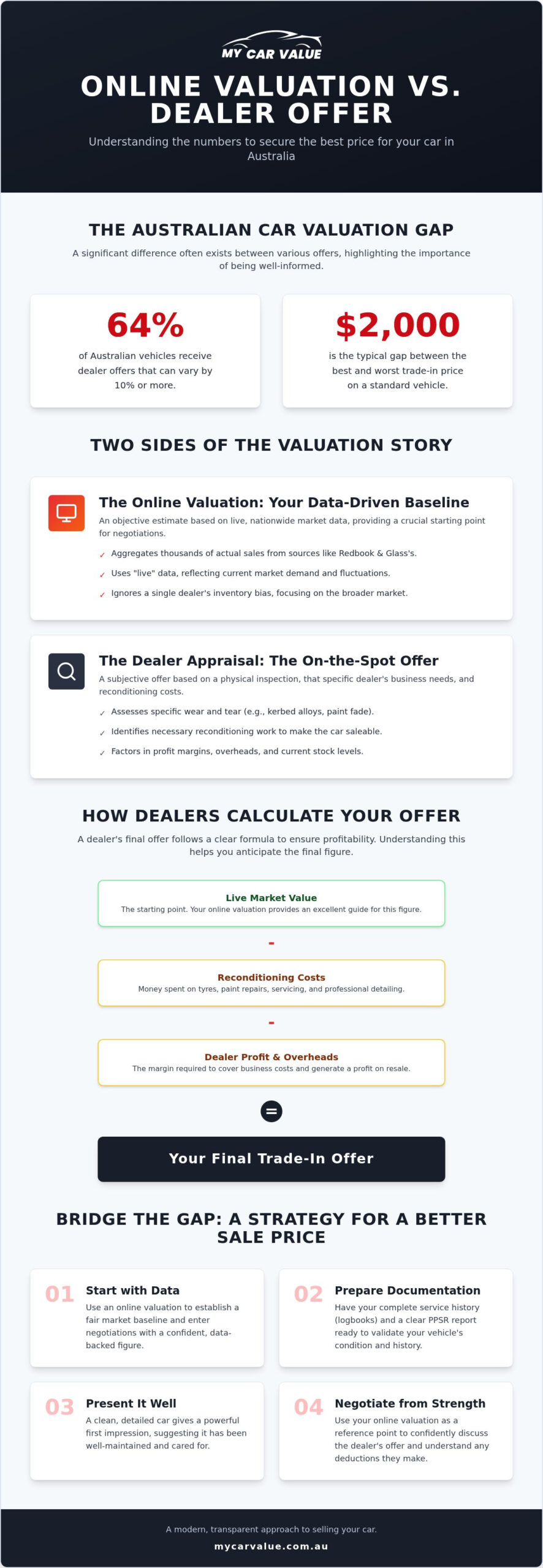
Did you know that 64% of Australian vehicles receive dealer offers that vary by 10% or more? On a standard trade-in, that often represents a $2,000 gap between the best and worst price. When comparing an online car valuation vs dealer offer, it’s easy to feel like the goalposts are constantly moving. You might get a high digital estimate only to face a much lower figure once you’re standing on the showroom floor. This discrepancy creates unnecessary stress and makes it hard to know which number to trust.
It’s frustrating to feel like you’re losing money before the negotiation even begins. We understand the pressure of trying to secure a fair price from experienced buyers who do this every day. This article will show you exactly how to interpret these figures so you can sell with total confidence. You’ll learn which valuations carry the most weight in 2026 and how to use market data to your advantage. We’ll break down the 13.1% median price spread and provide a clear strategy to ensure you don’t leave money on the table.
Key Takeaways
- Understand why modern car valuations rely on live market data rather than just a dealer’s visual inspection.
- Learn the specific formula dealers use to calculate offers by subtracting reconditioning costs and profit margins from the market price.
- Discover how to use an online car valuation vs dealer comparison to create a baseline for negotiations and avoid being low-balled.
- Prepare essential documentation like logbooks and PPSR reports to validate your vehicle’s history and maximise its sale value.
- Identify a streamlined path to selling by connecting directly with professional used car buyers who value transparency and speed.
The Evolution of Car Value in Australia: Digital vs Physical
The Australian used car market has moved away from the days of “gut feeling” appraisals. In the past, a dealer would walk around your vehicle, kick the tyres, and offer a figure based on their own stock levels and intuition. This subjective process often left sellers feeling disadvantaged and confused. By 2026, the industry has shifted toward a more transparent, data-centric model. Transparency is now the expected standard, not a premium feature.
Sellers now have access to the same professional-grade information that dealers use. Utilising a “Value My Car” service is the essential first step for any Australian seller. It strips away the mystery of the traditional trade-in process. When you weigh up an online car valuation vs dealer offer, you’re looking at a clash between objective market data and a specific business’s tactical bid. This evolution has empowered private sellers to enter negotiations with a clear “North Star” figure based on actual sales figures rather than dealer guesswork.
The Rise of Data-Driven Valuations
Modern valuation platforms aggregate thousands of real-time sales across the country to find a precise average. Unlike static quarterly guides that were once the industry standard, these tools use “live” data. This accounts for sudden shifts in buyer demand or fuel price fluctuations that occur week-to-week. It’s a fast-paced system that values accuracy and speed.
Using diverse car valuation methods ensures the estimate isn’t skewed by a single dealer’s bias. A local dealer might offer less because they already have too many similar models on their lot. An algorithmic valuation ignores these local stock issues. It focuses purely on what the broader Australian market is willing to pay, providing a fairer starting point for your sale.
Why Physical Inspections Still Matter
Digital tools provide the market average, but they can’t smell a “smoker car” or hear a ticking timing belt. Software has limitations when assessing specific wear and tear that falls outside the norm. This is why the physical inspection remains a critical part of the process. You can’t skip the human element if you want a final, binding offer.
Dealers use the “walk-around” to justify reconditioning costs. They look for kerbed alloys, fading paintwork, or missing service stamps. While the online car valuation vs dealer comparison might show a discrepancy, the physical appraisal identifies the unique state of your car. Speed comes from the digital estimate, but final accuracy is confirmed on the forecourt. Success in 2026 means using digital data to validate the dealer’s physical assessment.
How Online Car Valuations Work: Behind the Data
An online car valuation is a data-backed estimate of your vehicle’s worth based on historical and current Australian market trends. When comparing an online car valuation vs dealer offer, remember the digital number is built on core pillars: make, model, year, and the odometer reading. These variables form the foundation of any appraisal. Regional demand also plays a massive role in the final figure. A 4WD might fetch a premium in Western Australia or Queensland compared to a metropolitan centre in Melbourne. Algorithms track these geographic preferences to ensure the data reflects local reality.
Digital reports typically provide two distinct figures: “Private Sale Value” and “Trade-in Value”. Private sale figures are generally higher because they represent the price a buyer pays directly to an owner. Trade-in values are lower because they account for the dealer’s overheads and profit margin. Understanding this distinction is vital for determining your car’s worth accurately before you begin negotiations.
Data Sources: Redbook, Glass’s, and Live Listings
Platforms use industry standards like Redbook and Glass’s to establish baseline figures for every vehicle sold in Australia. Modern vehicle market value calculators go even further by using API feeds from active sales sites. This live data captures what buyers are actually paying right now. It includes recent auction results and wholesale data to provide a realistic snapshot. This ensures the online car valuation vs dealer comparison is based on current market pulse rather than outdated quarterly guides.
The “Adjusted” Value: Factoring in Options
Software weights specific features like sunroofs, leather trim, or tow bars to refine the estimate. In 2026, even the colour of your car impacts the digital result. Neutral tones like white, silver, or grey often hold value better because they appeal to a wider range of buyers. Accurate input is vital for a reliable output. If you forget to list a major factory option, the algorithm cannot value it. Small details like a full service history or recent tyre replacements can significantly shift the final number. You can quickly Value My Car to see where your vehicle sits in the current market before talking to a professional buyer.
Dealer Appraisals: Why the Forecourt Price Often Differs
A dealer offer is essentially a wholesale bid, not a retail valuation. While an online estimate tells you what the car is worth in the broader market, a dealer calculates what it is worth to their specific business. Their formula is simple: Market Value minus Margin, Reconditioning, and Risk. They must factor in the cost of holding the vehicle, paying staff, and eventually making a profit when they resell it. This explains why the gap in an online car valuation vs dealer offer can sometimes feel significant.
Local stock levels also dictate the price you are offered. If a dealer already has five white Corollas sitting on the lot, they simply won’t want yours. To manage their inventory risk, they will provide a lower “buy-in” price to discourage the sale or cover the cost of wholesaling it to another yard. Demand is regional and specific. A dealer’s need for your particular make and model on that specific day influences the figure far more than a national average does.
Watch out for the “trade-in trap” when buying a new car. Dealers often inflate the trade-in price of your old vehicle to make the deal look attractive, while simultaneously refusing to budge on the retail price of the new one. It’s a psychological shell game. Always negotiate the sale price of your current car and the purchase price of the new one as two completely separate transactions to ensure you’re getting a fair deal on both sides of the ledger.
The “Reconditioning” Deduction
Dealers look for reasons to chip away at the price during a physical inspection. Common deductions include worn tyres, paint chips, or missing spare keys. They also scrutinise your documentation. Detailed car service history checks are used to verify maintenance; any gaps in the logbook will be used to negotiate the price down. The dealer also factors in the cost of a Roadworthy Certificate (RWC) and any mechanical repairs needed to meet their “certified” used car standards. These costs are subtracted directly from your offer.
Online vs Dealer: The Direct Comparison
Choosing between an online car valuation vs dealer appraisal depends on your priorities. Use the table below to see how each method stacks up across key categories.
| Criteria | Online Valuation | Dealer Appraisal |
|---|---|---|
| Speed | High (Instant) | Moderate (Requires visit) |
| Price | High (Theoretical Market) | Lower (Wholesale Bid) |
| Effort | Low | Moderate |
| Certainty | Low (Estimate only) | High (On-the-spot offer) |
Bridging the Gap: How to Get the Best Price for Your Vehicle
Securing the best price requires a shift in perspective. You must view an online car valuation vs dealer offer as a data set rather than a final verdict. Start by obtaining a comprehensive online valuation to serve as your “North Star” baseline. This figure represents the objective market truth before individual business interests or local stock levels interfere. Once you have this number, don’t settle for the first offer you receive. Compare multiple professional bids to identify where the market is most active for your specific make and model.
Use your digital report as a defensive shield. If a dealer makes a verbal offer that feels suspiciously low, present your data. Ask them to explain why their figure differs so significantly from current market averages. Be prepared to walk away if the “Forecourt Gap” remains too wide. The power in any car sale lies with the person who is willing to leave the room. If a buyer isn’t respecting the data, there is always another one who will.
Documentation that Drives Value
Proof of pedigree is your strongest negotiation tool. A full service history does more than just show maintenance; it defends your online price against “risk” deductions. Ensure your logbooks are up to date and clearly stamped. Having a current PPSR report ready demonstrates that you are a transparent seller with nothing to hide. This builds immediate trust and removes a common hurdle for professional buyers.
Don’t underestimate the value of a professional detail before the appraisal. A clean car suggests a well-maintained engine. Small cosmetic fixes, like repairing a minor scratch or cleaning the upholstery, can return significantly more than their cost by preventing “reconditioning” price chips. Presentation often bridges the gap between a wholesale bid and a premium offer.
Negotiation Tactics for the Modern Seller
Modern negotiation is about data, not drama. When presented with a low offer, use a direct approach: “The market data suggests $22,000; why is your offer $18,500?” This forces the buyer to justify their deductions with specifics rather than vague generalisations. Be wary of the “Changeover Price” during a trade-in. Focus on the actual cash value of your car as a standalone figure to avoid hidden losses in the new car’s contract.
Specialised used car buyers often provide a better middle ground than traditional franchise dealers. They operate with lower overheads and a higher focus on volume, which often translates to a more competitive offer for the seller. By cutting out the showroom floor expenses, these professionals can align closer to your online valuation baseline while still offering the speed of an instant sale.
My Car Value: The Modern Way to Organise Your Sale
Choosing between an online car valuation vs dealer offer shouldn’t be a gamble. My Car Value provides the impartial middle ground you need to secure a fair price. We leverage live data to set a realistic baseline before connecting you with our national network of professional buyers. This competitive model forces transparency. It ensures that the final offer you receive reflects the true Australian market rather than a single dealer’s stock requirements. You get the benefit of a data-driven estimate combined with a concrete path to a sale.
Efficiency is at the core of our national network. We have built relationships with professional used car buyers in Sydney, Melbourne, and across every major Australian city. This reach means your car is visible to buyers who actually need your specific model. You aren’t limited by the stock levels of a single local yard. This broader access is often the key to closing the gap between a digital estimate and a physical offer. We eliminate the “tyre-kickers” and the stress of low-ball negotiations by dealing only with verified professionals.
The My Car Value Difference
We act as your advocate in the Australian market. By operating as an independent facilitator, we remove the inherent bias found in traditional trade-ins. We help you sell my car by stripping away the jargon and the pressure tactics. Our focus remains entirely on transparency. You get honest market data without hidden fees or strings attached. This empowers you to make a decision with total confidence. The online car valuation vs dealer conflict is resolved when you have a partner who understands the data as well as the buyers do.
Ready to Value Your Car?
Take the first step toward a better sale price today. Our digital platform is built for speed, providing an accurate estimate in seconds. You don’t need to book an appointment or drive across town just to get a starting figure. Get the data first, then decide how you want to proceed. Our algorithm handles the heavy lifting, providing a pragmatic solution for a task that used to take days of research. By starting with us, you avoid the common pitfalls of the traditional sales process and gain immediate clarity on your vehicle’s worth.
Take Control of Your Car Sale
Selling your vehicle in the current Australian market requires more than just a clean logbook. It demands a strategy built on data. You now understand that an online car valuation vs dealer appraisal represents two different perspectives: one is an objective market average and the other is a tactical business bid. By using digital data as your baseline, you remove the guesswork and enter the showroom with a position of strength. You don’t have to accept the first offer that comes your way.
Success comes from transparency and having the right partners. Our platform connects you with a national network of professional used car buyers who value speed and accuracy. This ensures you receive competitive bids backed by real-time market transparency. We’ve simplified the entire transition from initial research to final payment, stripping away the complexity of a traditionally stressful process. Our goal is to provide you with the tools to maximise your return without the usual hassle.
Sell your car with total confidence and ensure you get the price you deserve. We’re here to provide the data and the connections you need for a no-stress selling process.
Frequently Asked Questions
Is an online car valuation legally binding for a dealer?
No, an online car valuation is not a legally binding contract. It serves as a data-backed estimate based on broader market trends and historical sales figures. A dealer will only provide a binding offer after a physical inspection of the vehicle’s condition. While the online car valuation vs dealer figure provides a baseline for negotiation, the final price is always subject to the buyer’s assessment of mechanical health, cosmetic wear, and local stock requirements.
Why is my trade-in offer so much lower than the “Market Value”?
Trade-in offers are lower because they represent wholesale value, while “Market Value” often reflects retail prices. Dealers must subtract their profit margin, reconditioning costs, and the risk of the car sitting in stock. They buy at a price that allows for resale overheads and staff costs. Comparing an online car valuation vs dealer bid helps you identify if the deduction is fair or if the dealer is simply trying to increase their margin.
Does a car valuation include GST in Australia?
Most Australian car valuations for private individuals are inclusive of GST. If you are selling as a private seller to a dealer, the price quoted is usually the total amount you receive. However, if you are selling a vehicle owned by a GST-registered business, you may need to provide a tax invoice. Always clarify with the buyer whether the offer is “GST inclusive” to avoid surprises during the final settlement and ensure your tax obligations are met.
Can I get a valuation for a car with a blown engine or mechanical issues?
Yes, you can obtain a valuation for a damaged vehicle, but the figure will be significantly reduced to reflect salvage or scrap value. Most standard online tools assume the car is in “Good” or “Fair” running condition. If the engine is blown, professional buyers will estimate the cost of a full replacement or simply value the car for its parts. Be transparent about mechanical faults from the start to ensure the estimate remains realistic and accurate.
How often do car market values change in Australia?
Market values in Australia change weekly as algorithms process new sales data and auction results. The 2026 market is highly volatile due to fluctuating fuel prices and shifting demand for various vehicle types. A valuation you received a month ago is likely outdated. It is best to get a fresh estimate right before you begin the selling process to ensure you are using the most current market data available for your specific model.
What documents do I need to bring to a dealer for an appraisal?
Bring your current registration papers, a complete service logbook, and your driver’s licence for identification. If the car is under finance, you must provide a current payout letter from your lender. Having a PPSR certificate ready also speeds up the process and builds trust. These documents prove ownership and maintenance history, which helps the dealer verify the data and provides them with the confidence to make a firm, on-the-spot offer.
Will adding aftermarket accessories increase my online valuation?
Aftermarket accessories rarely increase a car’s valuation and can sometimes decrease it. While you might have spent thousands on custom wheels or a loud exhaust, these items often narrow the pool of potential buyers. Dealers prefer “factory standard” vehicles because they are easier to resell to the general public. Unless the accessory is a high-demand functional add-on like a quality tow bar or bull bar on a 4WD, don’t expect a significant price increase.
How does the odometer reading specifically impact the value calculation?
The odometer reading acts as a primary proxy for mechanical wear and the vehicle’s remaining lifespan. High kilometres significantly accelerate depreciation because they indicate a higher likelihood of upcoming major service costs, such as timing belt or suspension replacements. Conversely, a vehicle with exceptionally low kilometres for its age will command a premium. Algorithms use specific depreciation curves based on average Australian driving habits, which is roughly 12,000 to 15,000 kilometres per year.