
Online Car Valuation vs Dealer Appraisal: The 2026 Australian Guide
The local car dealer might seem like the most reliable source for a price, but their appraisal often reflects their current floor stock needs rather than your car’s true worth. Selling a vehicle in 2026 feels more complex than ever. You’ve likely encountered conflicting estimates across various websites and feel frustrated by the gap between a “book value” and the actual market reality. It’s exhausting to worry about being low-balled when you just want a fair, transparent deal.
This guide settles the online car valuation vs dealer appraisal debate by comparing accuracy, speed, and the final financial outcome for your vehicle. You’ll learn how to strip away the confusion and maximise your return without the typical stress. We’ll examine why digital tools provide a vital data-driven baseline while a professional buyer network can deliver the real-world premium that local dealers often miss. By the end, you’ll have the confidence to navigate your sale with total clarity. This roadmap is fast, methodical, and results-driven.
Key Takeaways
- Discover why the 2026 Australian market requires live data to distinguish between trade-in, market, and scrap values effectively.
- Evaluate the speed and impartiality of digital tools against the physical trade-in potential of an online car valuation vs dealer appraisal.
- Identify how the “Big Three” factors-age, kilometres, and condition-interact with your service logbook to dictate your final sale price.
- Learn how professional detailing and organised paperwork build immediate trust with buyers and maximise your vehicle’s worth.
- Understand how to bypass the stress of private classifieds by connecting directly with a national network of professional used car buyers.
The Fundamentals of Professional Vehicle Valuation in Australia
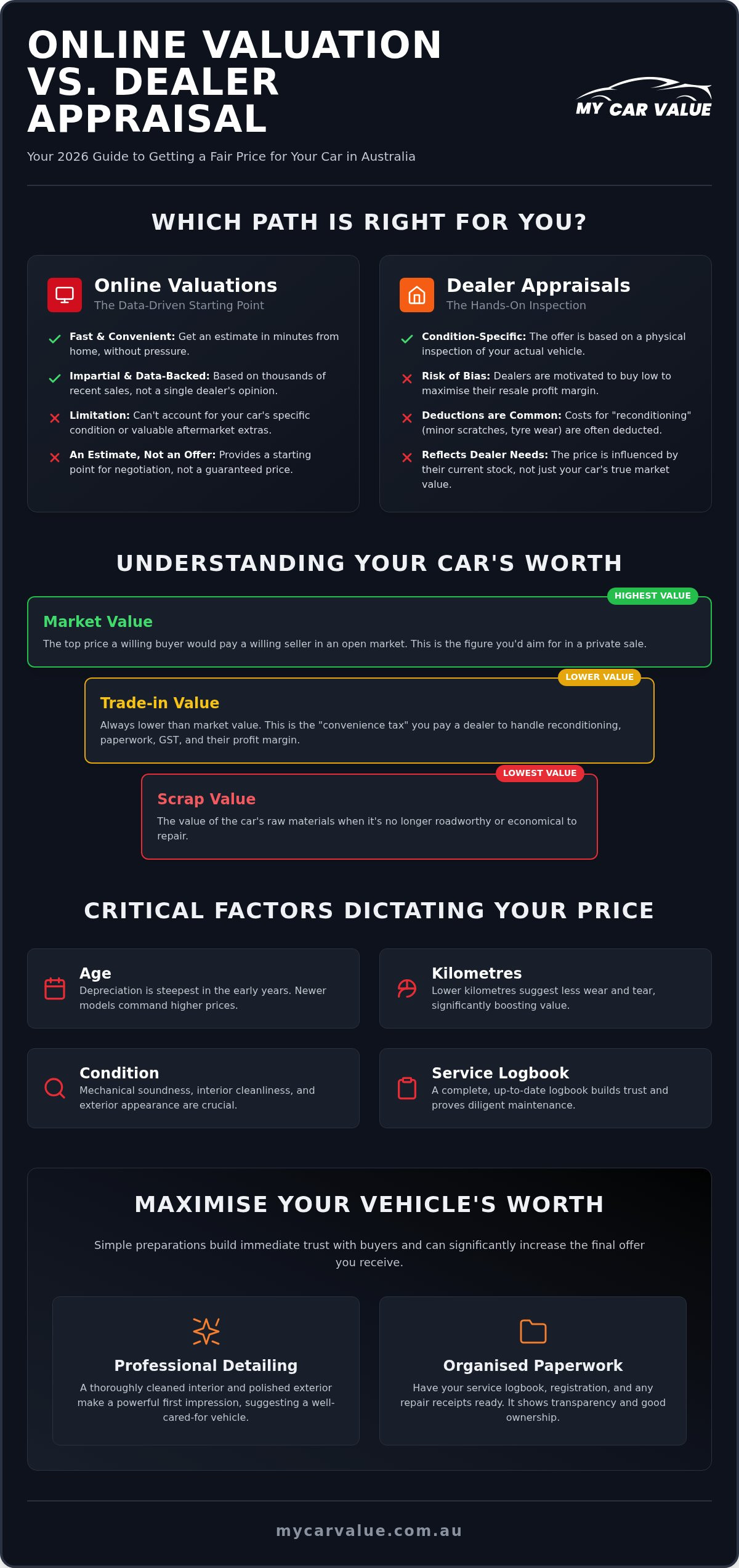
Understanding Car valuation is the first step toward a successful sale. In Australia, three main figures dictate your car’s worth: market value, trade-in value, and scrap value. Market value represents the top of the spectrum. Trade-in value sits lower to account for dealer overheads. Scrap value applies only when a vehicle is no longer roadworthy or repairable. When comparing an online car valuation vs dealer appraisal, you must understand how these figures are calculated to avoid disappointment.
The 2026 Australian market moves quickly. While SUV sales grew by 7.3% in July 2026, overall new vehicle sales saw a slight year-on-year decrease of 0.2% in the first seven months of the year. Relying on six-month-old data leads to missed opportunities or unrealistic expectations. Professional buyers prioritise live market demand over historical averages. They look at what buyers want right now, not just what they wanted last year. This real-time approach ensures offers remain competitive even as market conditions shift.
Market Value vs. Trade-In Value
Trade-in offers are almost always lower than private market valuations. This gap is often described as a “convenience tax.” You are essentially paying the dealer to handle the paperwork, cleaning, and eventual resale of the vehicle. Dealers must factor in reconditioning costs, GST obligations, and their own profit margins. Professional buyers use these figures to formulate offers that balance speed with financial fairness. It’s a trade-off between achieving the highest possible price and enjoying the easiest possible process.
The Role of Industry Data Standards
Services like Redbook and Glass’s Guide provide the essential data backbone for the Australian automotive sector. These platforms aggregate millions of data points to create a reliable baseline for every make and model. However, you should view online calculators as a starting point rather than a final quote. They provide a data-driven estimate but cannot account for your car’s specific condition or service history. Market value is the price a willing buyer pays a willing seller in an open market. Recognising this helps you manage expectations when navigating an online car valuation vs dealer appraisal.
Online Car Valuation vs Dealer Appraisal: Which is Right for You?
Choosing between an online car valuation vs dealer appraisal often feels like a choice between speed and accuracy. Digital estimates offer a fast, impartial baseline. They remove the emotional friction of face-to-face negotiations. Conversely, a dealer appraisal involves a hands-on inspection. This can lead to a more precise offer based on your car’s physical state, but it often carries a higher risk of bias. Dealers are motivated to buy low to maximise their resale profit.
The “valuation gap” occurs because an algorithm sees data, while a dealer sees a liability. A digital tool looks at thousands of sales across Australia. A dealer looks at how long your specific car might sit on their lot. You can bridge this gap by using a digital estimate as a negotiation floor. If you’ve already used a vehicle market value calculator, you have a data-backed figure to present if a dealer’s offer feels too low. This shifts the power balance back in your favour.
The Pros and Cons of Digital Estimates
Digital estimates excel at removing pressure. You can research at home without a salesperson looking over your shoulder. This transparency builds confidence and helps you set a realistic price. However, these tools have limits. They struggle to account for “mint” condition or expensive aftermarket extras like high-end sound systems or custom wheels. Consulting a reputable car price guide helps you understand how these extras influence the broader market. It’s about knowing the difference between what you’ve spent on the car and what the market actually values.
What Happens During a Dealer Appraisal?
A dealer appraisal is a methodical, physical process. The appraiser will check the engine, tyres, and interior for wear. They look for signs of previous accidents or poor maintenance. Most dealers then apply a “reconditioning” deduction. This covers the cost of preparing the car for their showroom. These deductions often feel aggressive to sellers. They might cite minor scratches or service gaps to justify a lower price. Professional buyer networks offer a middle ground. They combine digital efficiency with a national network of buyers who may value your specific car more than a local dealer. If you want to see how this works, you can Value My Car through our streamlined platform to secure a competitive offer without the showroom games.
Critical Factors Impacting Your Car’s Market Value in 2026
The “Big Three” remain the pillars of any vehicle assessment: age, odometer reading, and overall condition. When weighing an online car valuation vs dealer appraisal, these factors form the baseline of your estimate. A car with low kilometres and a pristine exterior naturally commands a higher price. However, even a late-model vehicle can lose thousands if the interior shows signs of neglect. Professional appraisers look past the shiny paint to check for seat tears, dashboard cracks, and lingering odours. This “kerb appeal” creates the first impression that often dictates the final offer.
Mechanical Health and Documentation
A complete service logbook is the most valuable document you own. It provides psychological security for professional buyers. It proves the vehicle has been maintained according to manufacturer standards. If you lack these records, expect significant deductions. Buyers assume the worst when documentation is missing. Use a car service history check to verify your records before seeking a quote. Any pending mechanical repairs, such as worn brake pads or a leaking head gasket, will be deducted directly from your final valuation. Most buyers prefer a car that needs zero immediate investment.
Market Demand and Desirability
Australian market trends shift rapidly. In July 2026, SUV sales increased by 7.3%, reflecting a sustained preference for larger family vehicles. Conversely, passenger car sales fell by 4.0% in the same period. If you are selling a sedan, your online car valuation vs dealer appraisal might reflect this cooling demand. Colour and transmission also play vital roles. White, silver, and grey remain the safest bets for resale. Manual transmissions are increasingly difficult to sell in the used market, except for specific enthusiast models. This is particularly true as electric vehicles (EVs) gained a 23.4% market share in June 2026, pushing the market toward simpler, automatic drivetrains.
New model releases also trigger immediate depreciation for older versions. When a manufacturer updates a popular SUV, the previous generation’s market value often drops overnight. Be cautious with aftermarket modifications. Bull bars, lift kits, or custom wheels rarely return their original cost. They often decrease the pool of potential buyers. Most professional buyers want a vehicle in its original factory specification. Stick to the basics to protect your car’s residual value.
How to Maximise Your Vehicle Worth Before an Appraisal
Preparing your car for sale is about more than just a quick wash. It is about presenting a vehicle that requires zero immediate work from the buyer. When you compare an online car valuation vs dealer appraisal, the physical presentation of your car is the biggest variable. A professional detail often pays for itself by removing years of grime and minor surface scratches that a standard DIY wash misses. It signals to an appraiser that the vehicle has been cherished, not just used. You are selling a lifestyle and a well-maintained asset, not just a machine.
Address minor cosmetic issues before the inspection. Fix small stone chips with a touch-up pen or restore foggy headlights. These low-cost improvements yield a high return on investment. They prevent an appraiser from using “general wear and tear” as a reason to slash your offer. You want to remove every possible excuse for a price deduction. A car that looks ready for the showroom floor is much harder to low-ball than one that looks neglected. Small investments in appearance often translate to hundreds of dollars in the final offer.
The Pre-Valuation Checklist
A structured approach ensures nothing is overlooked. Professional buyers look for completeness and attention to detail. Follow these steps to prepare:
- Gather all sets of keys, including spares and remotes.
- Locate the original owner manuals and warranty booklets.
- Perform a deep interior vacuum and remove all personal clutter from the glovebox and boot.
- Check that the spare tyre is inflated and the original jack and tool kit are present.
- Wipe down the engine bay to remove dust and oil residue, but avoid using high-pressure water near electronics.
Verification and Transparency
Data accuracy is critical for a smooth sale. Conduct a PPSR (Personal Property Securities Register) check to prove the vehicle has no outstanding finance or written-off status. This report acts as a certificate of health for your car’s legal title. Verify your VIN and chassis number against your registration papers to ensure accurate data matching during the online car valuation vs dealer appraisal process. Discrepancies here can stall a sale or cause a buyer to walk away entirely. Transparency regarding a vehicle’s history leads to faster, more secure transactions. Providing this information upfront builds immediate trust and often results in a firmer, more reliable offer. It positions you as a serious seller who values the buyer’s time and removes the “paperwork hurdle” that often scares off professional buyers.
From Valuation to Sold: The My Car Value Advantage
Researching the online car valuation vs dealer appraisal landscape is only half the battle. The real challenge lies in converting that data into a cleared bank transfer. Private classifieds are often a drain on your time and patience. You deal with tyre-kickers, low-ball offers, and people who never show up for inspections. My Car Value eliminates this friction by connecting you directly with a national network of professional buyers. This streamlined approach represents the future of the Australian automotive market. It moves you from research to revenue with minimal effort and maximum transparency.
Traditional selling methods often leave you feeling vulnerable to a single dealer’s inventory needs. If a local lot already has three white SUVs, they won’t offer you a premium for yours. Our model bypasses this local bias. By accessing a broader network, you find the buyer who actually needs your specific make and model. This competition drives better results for you. It replaces the stress of face-to-face haggling with a data-driven, methodical process designed for speed. You get the accuracy of a professional assessment without the typical showroom pressure.
The Facilitator Model Explained
We act as the essential bridge between your initial valuation and a professional purchaser. We don’t buy your car directly; we facilitate the connection to those who do. This distinction is vital. It means our interests align with yours. We want to provide the most accurate market baseline possible. The process is fast. You move from an online estimate to a firm offer in a fraction of the time it takes to manage a private listing. This efficiency is why more Australians are choosing to sell my car through a facilitator rather than a traditional trade-in. It is about reclaiming your time while securing a fair market price.
Your Next Steps
Taking action is simple and structured. Start by using our calculator to establish an immediate market baseline for your vehicle. This tool uses live 2026 data to ensure your expectations match current demand. Once you have your estimate, review it against the “Big Three” factors we discussed earlier: age, kilometres, and condition. Prepare your logbook and PPSR report to build immediate trust. Finally, connect with our network of used car buyers to see who is ready to make an offer. This logical sequence ensures you remain in control of the sale from start to finish. Stop guessing what your car is worth and start the process of actually selling it today.
Secure Your Best Price in 2026
Securing a fair price for your vehicle in the 2026 Australian market requires a balance of live data and careful preparation. You now understand that while digital tools offer an impartial baseline, physical inspections reveal the specific condition that adds real value to your asset. The choice between an online car valuation vs dealer appraisal doesn’t have to be a gamble. By using a facilitator model, you leverage accurate market-driven valuations and bypass the narrow stock needs of local dealers.
Focus on the critical factors of age, kilometres, and mechanical documentation to protect your car’s residual worth. This transparency, combined with professional presentation, ensures you enter negotiations from a position of strength. You can now skip the frustration of private classifieds and tyre-kickers. Connect directly with a national network of professional buyers who understand the true market demand for your specific make and model. This streamlined approach delivers the results you deserve without the typical showroom games.
Take the next step with total confidence. A stress-free Sell My Car process is ready to help you transition from research to revenue today.
Frequently Asked Questions
Is an online car valuation legally binding for a sale?
No, an online car valuation is not a legally binding contract. It serves as a data-driven estimate based on current market trends and historical sales data. A binding sale only occurs once a physical inspection is completed and both parties sign a contract of sale. When comparing an online car valuation vs dealer appraisal, remember that the digital figure is your negotiation baseline, while the appraisal leads to the final legal agreement.
How often should I check the valuation of my vehicle?
You should check your vehicle’s valuation every three to four months or immediately before any major service or registration renewal. Market conditions in Australia fluctuate based on fuel prices and new model releases. With SUV sales growing by 7.3% in July 2026, your car’s worth could shift significantly in a short period. Regular checks help you time your sale to maximise your return before the next depreciation cycle begins.
Does a high number of previous owners affect my car’s value?
Yes, a high number of previous owners typically decreases a car’s market value. Each additional owner adds a layer of uncertainty regarding how the vehicle was driven and maintained. Professional buyers prefer “one-owner” vehicles because they usually come with a more consistent service history. If your car has had four or more owners, expect a deduction during an online car valuation vs dealer appraisal to account for the perceived risk of inconsistent care.
Will a modified exhaust or suspension increase my valuation?
Modified exhausts or suspensions rarely increase a car’s valuation and often decrease it. Most professional used car buyers look for vehicles in original factory condition to appeal to the widest possible audience. Modifications can signal that the car was driven aggressively or may have insurance complications. Unless you find a specific enthusiast buyer, you will likely see a higher return by returning the vehicle to its stock specifications before seeking an appraisal.
What is the difference between a PPSR check and a valuation?
A PPSR check verifies the legal and financial status of the vehicle, while a valuation determines its monetary worth. The PPSR (Personal Property Securities Register) confirms if there is outstanding finance, if the car is stolen, or if it has been written off. A valuation uses market data, age, and kilometres to estimate a price. You need both to ensure a secure transaction, as a “clean” PPSR report builds essential buyer trust.
Can I get a valuation for a vehicle with a blown engine?
You can obtain a valuation for a vehicle with a blown engine, but the figure will reflect its status as a “non-runner.” The valuation will typically be based on the car’s scrap weight or the value of its salvageable parts. Professional buyers will deduct the total estimated cost of a full engine replacement from the healthy market value. Be transparent about mechanical failures early to ensure the offers you receive are realistic and final.
How much does mileage over 200,000km impact the final price?
Crossing the 200,000km threshold significantly impacts the final price because it represents a major psychological barrier for many buyers. At this mileage, the risk of expensive mechanical failures, such as transmission or timing chain issues, increases. Most dealers will offer a lower price to account for the difficulty of reselling a high-kilometre vehicle. While the car may still be reliable, the market value drops as the pool of interested buyers shrinks considerably.
Why do different websites give me different car values?
Different websites provide varying values because they use different data sources and algorithms. Some rely on historical sales figures from Redbook, while others track live auction results or private listing prices. The difference often comes down to how frequently they update their data. One site might prioritise national averages, while another looks at specific demand for SUVs or EVs. This variance is why using a facilitator model helps provide a more balanced, market-accurate baseline.