
How Timing Belt Maintenance Affects Your Car’s Resale Value in 2026
Spending A$1,500 on a timing belt service won’t actually increase your car’s market price. In the 2026 Australian used car market, this maintenance is viewed as a baseline requirement rather than an added feature. Understanding how timing belt affects car value is critical because while a fresh belt doesn’t add a premium, a neglected one can trigger a valuation drop of several thousand dollars. Professional buyers often view an overdue belt as a significant risk, leading to lower offers that reflect the potential for catastrophic engine failure.
You likely feel the tension between investing in a costly repair or selling the vehicle as-is. It is a common dilemma for owners of popular Australian models like the Toyota HiLux or Ford Ranger where service intervals are strictly monitored. This article clarifies how a timing belt’s condition swings your car’s valuation and teaches you the smartest way to handle maintenance before a sale. We will examine the exact impact on market value, help you decide whether to repair or discount, and show you how to get a fair valuation from professional buyers who value a transparent logbook history.
Key Takeaways
- Understand that a serviced timing belt is a market expectation. It protects your baseline price rather than acting as a premium upgrade.
- Discover how timing belt affects car value by creating a significant price gap between a well-maintained logbook and a vehicle at risk of engine failure.
- Learn why professional buyers are often a more reliable option than private buyers when selling a car with overdue maintenance.
- Master the “Sell vs. Repair” calculation by comparing a professional valuation against firm quotes for timing belt and water pump replacements.
- Use a data-driven valuation tool to determine the most cost-effective path forward before you list your vehicle for sale.
Understanding the Timing Belt’s Role in Vehicle Valuation
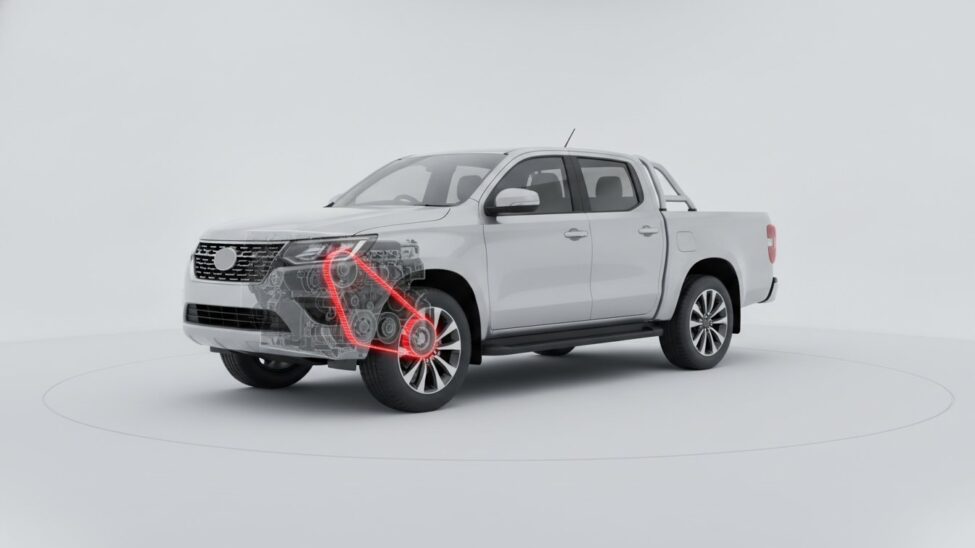
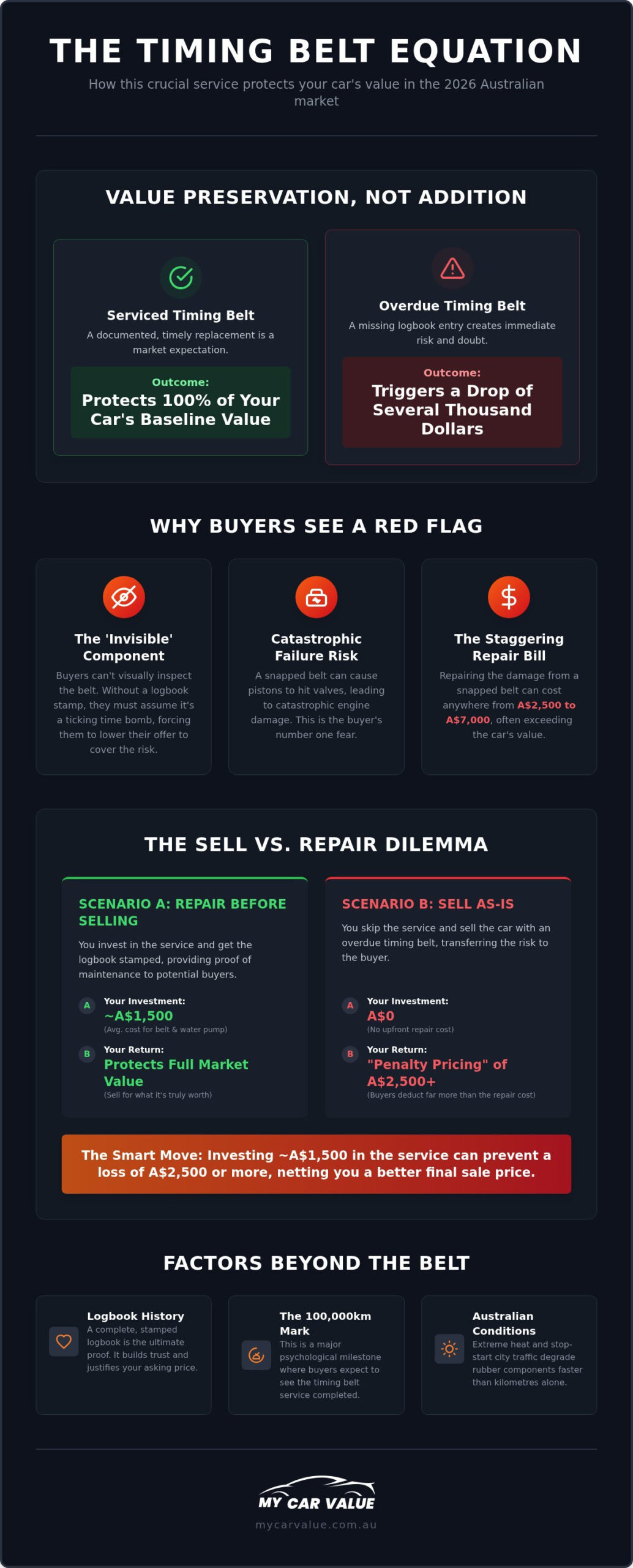
The timing belt acts as the heartbeat of your engine’s synchronisation. It is a reinforced rubber component that ensures the crankshaft and camshaft rotate in perfect harmony. This precision allows the engine’s valves open and close at the exact micro-second required for combustion. If this belt snaps, the synchronisation vanishes instantly. In most modern Australian vehicles with interference engines, the pistons will strike the open valves. This collision causes catastrophic damage, often resulting in bent valves, ruined cylinder heads, or a completely seized engine. Because the cost to rectify this failure can reach between A$2,500 and A$7,000, it is easy to see how timing belt affects car value before you even reach the negotiation table.
In the Australian used car market, the 100,000km mark represents a significant psychological milestone for buyers. Most owners of popular models like the Toyota HiLux or Ford Ranger know that this is when the major service usually falls due. Buyers look for proof of this maintenance immediately. If the logbook is blank, they see a looming liability rather than a reliable vehicle. This contrasts sharply with vehicles equipped with timing chains. Chains are made of metal and are generally designed to last the lifetime of the engine. While a chain-driven car offers more peace of mind regarding long-term maintenance, a belt-driven car requires proactive proof of care to maintain its market standing.
The “Invisible” Component: Why Buyers Worry
You cannot easily inspect a timing belt during a pre-purchase check. It is tucked away behind covers and engine components. Because the belt’s condition is invisible, buyers must rely entirely on trust and documentation. A missing service record for a belt change creates a “worst-case scenario” in a buyer’s mind. They don’t just see a maintenance item; they see a potential engine replacement. This mechanical risk directly dictates the final offer price. If you cannot prove the work was done, buyers will naturally subtract the cost of a full reconditioning from your asking price to hedge their bets.
Australian Conditions and Belt Longevity
Our local climate plays a massive role in how quickly these components degrade. Extreme heat in northern regions and the intense stop-start traffic found in Sydney or Melbourne put immense stress on rubber parts. Heat causes rubber to become brittle and crack over time. This is why “time” is just as critical as kilometres. Even if your car has only travelled 60,000km, a belt that is seven years old is likely reaching the end of its safe life. Professional buyers are trained to look for these climate-related signs. They understand that how timing belt affects car value is tied as much to the car’s age and location as it is to the odometer reading.
The Financial Impact: Does a New Timing Belt Increase Market Value?
A fresh timing belt does not actually increase your car’s price above the market average. It is a maintenance expectation, not a luxury upgrade. Buyers assume that a vehicle listed for sale is in good working order and that all scheduled services are complete. Market Value is the price for a vehicle in good mechanical condition. When you understand how timing belt affects car value, you realise it acts as a safeguard. It protects the baseline price. If the service is overdue, you don’t just lose the cost of the repair. You face “Penalty Pricing,” where buyers deduct a significant amount to cover the risk and the immediate hassle of booking a mechanic.
While basic replacements typically cost between $500 and $1,000, 2026 data suggests that standard Australian vehicles now range from A$500 to A$2,000 for this service. If you neglect this, a buyer might demand a discount of A$2,500 or more to account for the uncertainty. You aren’t just paying for a rubber belt; you’re paying to keep your car’s valuation from crashing. You can Value My Car to see where your vehicle stands in the current market before deciding on repairs.
Maintenance vs. Modification
It is vital to distinguish between “value-adding” features and “value-preserving” maintenance. A new set of alloys or a tray upgrade on a ute can command a premium because they are optional extras. A timing belt is different. It is an essential component required for the engine to function. You won’t find a buyer willing to pay extra because the engine “works as intended.” To understand your starting point, use a vehicle market value calculator to find your baseline. This gives you a clear figure of what the car is worth with a perfect service history.
The ROI of a Timing Belt Service
Calculating the return on investment (ROI) for a timing belt service requires looking at the “Discount at Sale.” Private buyers are often risk-averse. If they see an overdue belt, they don’t just calculate the A$1,200 repair cost. They factor in the A$2,500 to A$7,000 cost of a potential engine failure. This fear leads to aggressive low-ball offers. By completing the service, you remove this leverage. A fresh service also speeds up the sale process. A car that is “ready to drive” attracts more interest and sells faster than one with a looming mechanical debt. This reduces your holding costs, such as ongoing registration and insurance, while you wait for a buyer. Knowing how timing belt affects car value helps you decide if spending the money now will save you a much larger loss during negotiations.
Risk Assessment: How Professional Buyers View an Overdue Belt
Private buyers on Facebook Marketplace or Gumtree often react with anxiety when they discover a timing belt is overdue. They see a potential engine disaster and a massive upcoming bill. In contrast, used car buyers and dealerships operate with a pragmatic reconditioning mindset. They don’t fear the mechanical work; they simply view it as a standard line item in their valuation spreadsheet. This professional approach fundamentally changes how timing belt affects car value because it replaces emotional fear with clear, data-driven subtraction. It allows for a more rational negotiation based on actual workshop rates rather than a private buyer’s worst-case imagination.
Being transparent about your service history builds immediate trust with professional networks. If you admit the belt is due, a professional buyer knows exactly what they are dealing with. They appreciate the honesty because it reduces the risk of “hidden” mechanical surprises during their final inspection. This transparency often leads to a smoother transaction and a more predictable final offer. Professionals handle this risk differently because they have established workflows to manage repairs, whereas a private buyer sees the task as a personal burden they would rather avoid.
The Dealer Wholesale Calculation
Professional buyers estimate trade-in value by starting with the current market price and subtracting the cost of bringing the car up to “retail ready” standards. Because dealers have access to in-house mechanics and wholesale parts, their repair costs are significantly lower than what you would pay at a retail shop. Bundling the water pump with the belt replacement can save you around $400 in labor costs, and pros know this efficiency well. Consequently, they might offer you a higher price than a private buyer who is overestimating the repair bill based on a quote from a high-priced dealership. They focus on the margin, not the individual repair.
Logbooks and Service History Checks
Your logbook is the most influential document during a valuation. A stamped book proves you haven’t skipped critical intervals, which maintains the vehicle’s integrity. If your history is only “partial,” professional buyers will default to a conservative quote to protect their margins. They assume the worst if they can’t see the proof of a major service. Before you list your vehicle in cities like Perth or Adelaide, perform a car service history check to ensure you have all your receipts in order. This preparation ensures that how timing belt affects car value in your specific case is based on verifiable facts rather than a buyer’s guesswork.
The Sell vs. Repair Dilemma: Calculating Your Best Move
Deciding whether to book a mechanic or list your car immediately requires a logical framework. You need to strip away the emotion. Look at the numbers. Start by getting an accurate market valuation for your car in its current state. Next, obtain a firm quote for the timing belt and water pump service from a reputable local workshop. By comparing the “As-Is” sale price with the potential “Serviced” price, you can see exactly how timing belt affects car value in your specific situation. Finally, factor in the “Time to Sell”. A vehicle with a major service due often sits on the market for weeks longer as buyers hesitate. This delay costs you money in registration, insurance, and the ongoing depreciation of the vehicle.
When to Repair Before Selling
If your car is otherwise immaculate and has low kilometres, an overdue timing belt is a glaring red flag. In this scenario, completing the repair is often essential to secure a premium price. A fresh receipt for a timing belt service is a powerful closing tool. It removes the buyer’s last excuse to negotiate the price down. You are targeting the “Peace of Mind” buyer segment. These individuals are willing to pay a fair market price to avoid immediate mechanical risks. They value a car that is truly “turn-key” and ready for the road. Providing this certainty can be the difference between a quick sale and a stagnant listing.
When to Sell “As-Is”
There are times when the repair cost exceeds any potential value gain. This is common with high-kilometre older utes or budget hatchbacks nearing the end of their primary life cycle. If a repair quote is A$1,800 but the car’s total value is only A$7,000, you are unlikely to recoup that investment in the private market. In these cases, selling to professional buyers in centres like Brisbane is the smartest move. Professionals can handle the maintenance cheaper than you can because they have trade accounts and in-house labour. You can disclose the due service upfront without losing the sale. They will simply adjust their offer based on wholesale reconditioning rates rather than retail prices.
Maximising Your Return with My Car Value
My Car Value simplifies the entire selling process by providing a clear, transparent valuation from the start. You don’t have to guess how timing belt affects car value because our platform uses real-time market data to give you an accurate figure. This removes the stress of explaining service history gaps to skeptical private buyers. Instead of haggling over repair costs, you receive a valuation that reflects the true state of the Australian used car market. An accurate assessment is the vital first step in any sell my car journey. It gives you the confidence to negotiate with facts rather than assumptions.
Our network consists of professional buyers who understand that a car is more than just its odometer reading. They recognise the value of a well-maintained logbook and know how to price a vehicle that needs work. This professional insight ensures you aren’t penalised unfairly for a single maintenance item. By using a platform that values transparency, you avoid the emotional exhaustion of justifying your car’s worth to people who don’t understand mechanical maintenance. We do the heavy lifting by connecting you with a network that respects your car’s actual market standing.
Fast, Accurate Valuations
We use a data-driven approach to ensure your quote is precise. Our system analyses thousands of data points to reflect the real Australian market in 2026. You get a figure that considers your car’s specific make, model, and service history. This allows you to skip the “tyre-kickers” common in private sales. These individuals often use an overdue timing belt as a tool to drastically low-ball your price. Our valuations provide a firm foundation. You will know exactly where you stand before you speak to a buyer. It is the most efficient way to determine how timing belt affects car value for your specific vehicle.
Connecting with the Right Buyers
Our national network connects you with professional used car buyers across the country. Whether you are in Brisbane, Perth, or Adelaide, we help you find a buyer who values your time. A professional transaction is fast and secure. You don’t have to worry about strangers visiting your home or deals falling through at the last minute. We bridge the gap between your car’s current condition and a fair market price. Stop worrying about mechanical service gaps and start your selling process with clarity. Get your valuation today.
Securing Your Car’s Market Standing
Navigating the 2026 used car market requires a clear understanding of how timing belt affects car value. You now know that while a fresh belt won’t push your price above the average, a neglected one will certainly pull it down by thousands. Professional buyers offer a pragmatic path forward by calculating reconditioning costs fairly. This removes the emotional stress and aggressive haggling often found in private sales. It’s about protecting your baseline rather than chasing a premium that doesn’t exist for standard maintenance items.
Use a data-driven valuation to determine if the repair investment is worth your time or if selling “as-is” to a professional network protects your bottom line. This strategy ensures you don’t lose money on repairs that won’t be recouped at the point of sale. Australia’s most efficient buyer-matching network is ready to help you navigate these decisions with confidence and speed.
Our real-time market data ensures you get a fair price based on current conditions. Trusted by thousands of Aussie sellers, we make the process transparent and fast. You have the facts; now make the move that maximises your return with total peace of mind.
Frequently Asked Questions
Does a new timing belt increase my car’s trade-in value?
A new timing belt maintains your car’s market value rather than inflating it. Professional buyers expect all scheduled maintenance to be current before they offer a top-tier price. If the belt is fresh, you simply avoid a significant price deduction. It won’t command a premium over other similar models with up-to-date logbooks. It is a value-preservation step that ensures you receive the full market rate for a vehicle in good mechanical condition.
How much value does a car lose if the timing belt service is overdue?
An overdue timing belt can trigger a valuation drop of A$2,000 to A$5,000 depending on the engine type. This happens because buyers calculate the immediate repair cost and add a risk premium for potential engine damage. Understanding how timing belt affects car value is vital; a buyer sees an overdue belt as a looming mechanical debt. They will aggressively discount their offer to protect themselves against the high cost of a failure.
Should I replace the water pump at the same time as the timing belt?
Replacing the water pump alongside the timing belt is a standard and highly recommended practice in Australia. Since a mechanic already dismantles the engine to reach the belt, adding a water pump replacement only adds the part cost. This can save you around A$400 in future labour charges. Proving you replaced both components at once demonstrates high-quality maintenance to potential buyers, which builds trust and protects your final sale price during negotiations.
Can a buyer tell if the timing belt has been changed without a receipt?
It is nearly impossible for a buyer to accurately judge a timing belt’s age just by looking at it. Most belts are hidden behind plastic covers and require significant disassembly to inspect properly. Without a tax invoice or a stamped logbook, most professional buyers will assume the service hasn’t been performed. They rely on documentation rather than visual cues to verify mechanical integrity, so keeping your paperwork is essential for a successful sale.
Is it better to sell a car with a broken timing belt or fix it first?
Selling a car with a broken timing belt usually means selling it as salvage, which slashes the value by 50% or more. If the engine is an interference type, the damage could cost A$7,000 to fix. In these cases, it is often better to sell to professional used car buyers who manage repairs at wholesale rates. They offer a more realistic price than private buyers who are often scared of the mechanical complexity and high retail repair costs.
How do I prove to a buyer that the timing belt has been replaced?
The most effective way to prove a replacement is through a tax invoice from a registered Australian mechanic and a matching stamp in your logbook. Many workshops also place a timing belt replacement sticker in the engine bay, noting the date and kilometres. Having these documents ready for inspection is the best way to demonstrate how timing belt affects car value by removing any doubt from the buyer’s mind during the valuation process.
Does a timing chain affect car value differently than a timing belt?
A timing chain generally supports a higher resale value for older vehicles because it is designed to last the engine’s lifetime. Unlike belts, chains don’t require expensive scheduled replacements every 100,000km. This removes a major maintenance hurdle for buyers. While a belt-driven car needs proactive proof of service to maintain its price, a chain-driven car offers inherent peace of mind, often making it easier and faster to sell in the used market.
What is the average cost of a timing belt service in Australia in 2026?
In 2026, the average cost for a timing belt replacement in Australia ranges from A$500 to A$2,000 for standard vehicles. If you include the water pump, tensioners, and seals, the price typically sits between A$900 and A$1,800. These costs vary based on your car’s make and whether you choose an independent workshop or a dealership. Dealerships generally charge 20% to 40% more for the same service compared to local independent mechanics.