
Free Car Valuation Calculator: The 2026 Australian Guide to Vehicle Worth
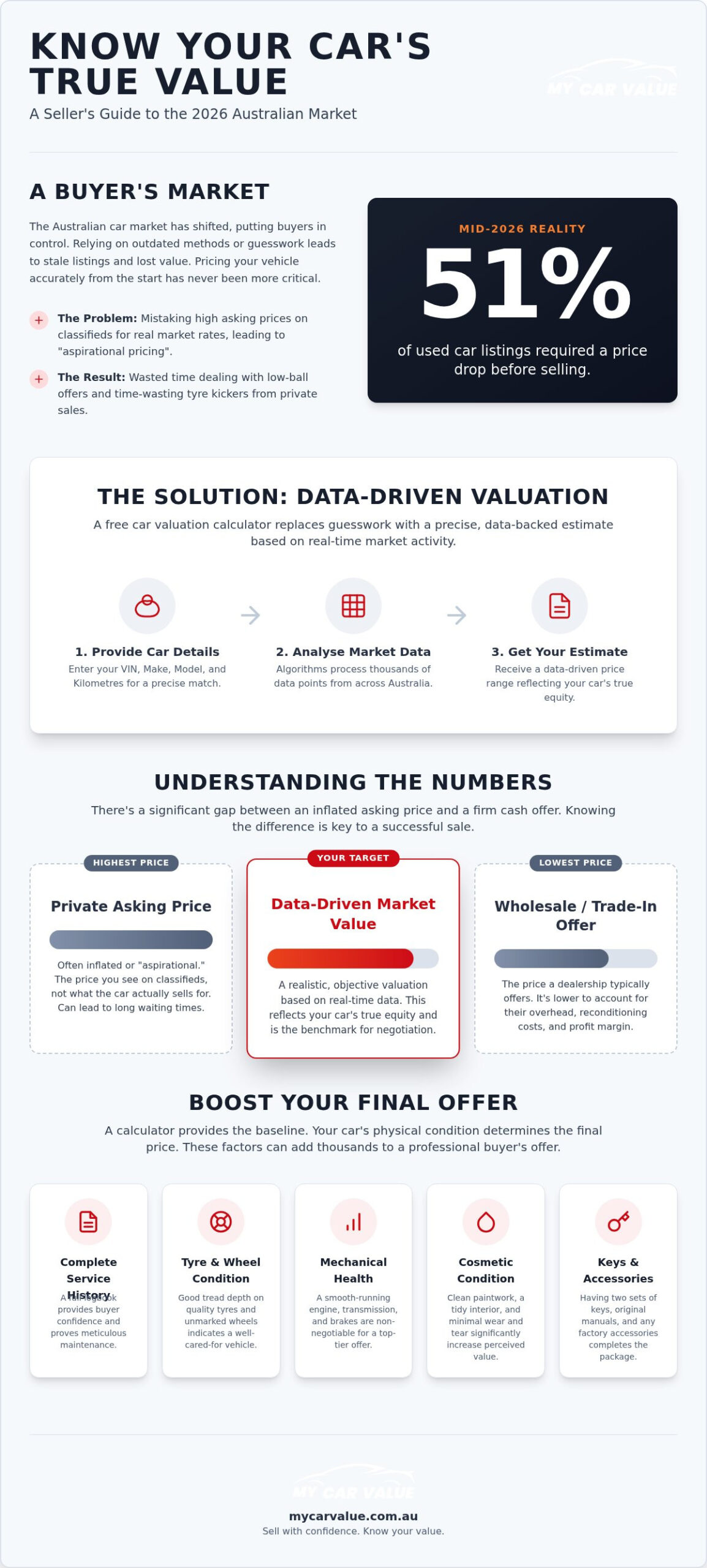
Did you know that in mid-2026, over 51% of used car listings required a price drop before finding a buyer? It’s a clear sign that the Australian market has shifted into a buyer’s territory, leaving many sellers confused about their vehicle’s actual equity. You likely feel the pressure of avoiding low-ball offers while wanting to sidestep the time-wasting tyre kickers found on private classifieds. This guide provides the clarity you need, starting with a free car valuation calculator that delivers a data-driven price range for your specific make and model.
We promise to show you how to secure a professional, firm offer without the typical stress of a private sale. We’ll also break down the critical 2026 market factors, including the latest Luxury Car Tax thresholds and the impact of the New Vehicle Efficiency Standard (NVES). By the end of this guide, you’ll have a streamlined path to a sale and the confidence to negotiate from a position of strength. We have done the heavy lifting so you can move forward with absolute certainty.
Key Takeaways
- Navigate the volatile 2026 automotive climate by understanding how recent market shifts impact your vehicle’s current equity.
- Access a reliable price range with a free car valuation calculator that uses your VIN to provide a precise, data-driven estimate.
- Identify the gap between private market value and wholesale trade-in prices to ensure you aren’t leaving money on the table.
- Learn how a complete service history and well-maintained tyres can add thousands to your final professional offer.
- Streamline your selling experience by moving from a digital estimate to a firm cash offer through a trusted network of professional buyers.
Why use a free car valuation calculator in the 2026 Australian market?
The 2026 Australian car market moves fast. Supply levels have stabilised, and buyer power has surged, making accurate pricing more difficult than ever. Relying on gut feeling or what your neighbour sold their car for three years ago will likely lead to a stale listing. A free car valuation calculator provides an objective, data-driven starting point. It strips away the emotion and provides a realistic figure based on current national trends rather than outdated historical averages. It’s the most efficient way to gauge where your vehicle sits in a crowded marketplace while maintaining total transparency. Using these tools provides immediate clarity, removing the stress of uncertainty from the very start.
The evolution of vehicle valuations
Industry standards have shifted significantly. We’ve moved away from static paper guides toward real-time algorithmic estimates that process thousands of data points instantly. In 2026, market data is more critical than ever due to evolving car valuation methods that now account for the New Vehicle Efficiency Standard (NVES) and updated Luxury Car Tax thresholds. These regulatory factors create a “two-speed” market. Fuel-efficient models and EVs often hold value differently than traditional petrol variants. Modern tools allow you to bypass the guesswork and access the same insights used by professional Used Car Buyers. This shift toward professional buyer matching ensures your valuation isn’t just a number; it’s a gateway to a firm offer.
Empowering the private seller
Entering a dealership without a benchmark is a tactical error. An instant valuation empowers you during trade-in discussions, providing a clear ceiling and floor for negotiations. Many sellers fall into the “aspirational pricing” trap seen on private listing sites. They see high asking prices on classifieds and assume that’s the current market rate. However, there’s a significant gap between an asking price and a final sale price. A free car valuation calculator helps you identify this discrepancy before you waste weeks on dead-end enquiries. Using a data-driven platform ensures national market accuracy. It stops you from being penalised by local demand fluctuations that might not reflect the true worth of your vehicle across Australia.
- Avoid the 51% price-drop trend by pricing correctly from day one.
- Counter low-ball dealer offers with documented market evidence.
- Understand how 2026 regulations impact your specific model’s resale value.
- Identify the real-world cash value versus inflated private asking prices.
By using these digital tools, you transition from a hopeful seller to a savvy market participant. You save time, reduce stress, and position yourself for a faster, more profitable exit. We do the heavy lifting so you can focus on your next purchase.
How car value estimators calculate your vehicle’s worth
A free car valuation calculator is a high-speed digital tool that aggregates vast amounts of market data to provide a reliable price estimate. It isn’t a guess. It’s a sophisticated analysis of real-time auction results, dealership transactions, and professional buyer demand. In 2026, these tools have become the industry standard for transparency. They allow owners to bypass the traditional “black box” of dealer pricing. By leveraging live data, you get a clear view of what your vehicle is worth right now, rather than what it was worth six months ago. This immediate clarity removes the friction from the selling process.
Data sources behind the screen
The accuracy of an estimator depends on the quality of its inputs. Most systems analyse thousands of similar national listings to find the mean price for your specific make and model. This includes comparing wholesale data with retail market trends to see where the actual “cash” value lies. Seasonal demand also shifts values across Australia. For example, SUVs currently hold a dominant 74.18% share of used vehicle transactions. Our algorithms account for these shifts, ensuring your valuation reflects the high demand for popular models like the Ford Ranger. These tools also help you factor in purchase costs and ongoing costs, which are vital for setting a competitive price that attracts serious buyers.
The role of the VIN and Chassis number
General details like “2022 Toyota HiLux” aren’t enough for a precise offer. There are dozens of trim levels and optional extras that significantly impact the final figure. This is why decoding vehicle identification number (VIN) data is the most reliable way to get an accurate result. The VIN acts as a digital fingerprint. It allows the system to verify the exact build date, factory-fitted options, and safety specifications. It eliminates human error and ensures that your depreciation schedule is based on the actual manufacture date. If you want to see how these factors impact your specific car, you can Value My Car today for an instant, data-backed result.
By integrating these complex data points, a modern calculator does the heavy lifting for you. It provides a logical, step-by-step path to understanding your vehicle’s equity. This ensures you enter any negotiation with a firm, evidence-based position. You aren’t just guessing; you’re using the same logic that professional Used Car Buyers use to value their own stock. It’s a smarter, faster way to prepare for your next move in the 2026 market.
Market value vs trade-in price: Understanding the discrepancy
The gap between what you see on a free car valuation calculator and the figure a dealer offers can be frustrating. To manage this, you must distinguish between “Private Treaty” market value and “Wholesale” trade-in prices. Private Treaty represents the price a private individual might pay you. Wholesale is the price a dealer or professional buyer pays to acquire stock. This difference isn’t arbitrary; it represents a “convenience tax” you pay for a fast, guaranteed sale. Selling privately often takes weeks of managing enquiries and tyre kickers. A professional offer provides immediate liquidity, but it must account for the buyer’s operational costs.
Dealers apply a “reconditioning margin” to every purchase. This covers the cost of mechanical checks, cosmetic repairs, statutory warranties, and GST. In 2026, these margins have tightened as the market shifts toward buyers. With 51.1% of 1-to-5-year-old vehicles requiring price reductions before selling in June 2026, dealers are more cautious. A professional buyer offer usually sits between a low-ball trade-in and a high private asking price. It offers a savvy middle ground for those who value their time.
Decoding the Redbook value
Many Australians use redbook car value as their primary baseline. It is a vital tool for insurers and finance companies to set asset values. However, real-world offers in 2026 often deviate from these estimates. Static guides can struggle to keep pace with rapid shifts, such as the 54.6% increase in used EV sales seen in early 2026. Use Redbook to understand your car’s historical depreciation curve, but rely on live market data for an actionable selling price. A digital calculator that processes current auction results will always be more accurate than a monthly printed guide.
Why trade-in offers feel low
Traditional trade-in offers often feel underwhelming because of dealer overheads. A physical showroom has rent, staff, and floorplan interest to cover. Professional Used Car Buyers operate differently. By focusing on volume and national demand, they can often provide better rates than a local dealer who is only looking at their specific lot capacity. They offer a “guaranteed” price, which removes the risk of a private buyer pulling out at the last minute. This certainty is a significant asset in a volatile 2026 market where selling times have increased for traditional petrol and diesel vehicles.
- Private Treaty: Higher price, high effort, long wait times.
- Wholesale Trade-in: Lower price, low effort, instant sale.
- Professional Buyer: Competitive price, zero effort, streamlined process.
Understanding these tiers allows you to choose the path that fits your priorities. If you need the highest possible dollar and have months to wait, go private. If you want a fair price and a 24-hour result, a professional buyer is the logical choice.
5 Critical factors that the calculator won’t tell you
While a free car valuation calculator provides a solid baseline, it cannot see the vehicle sitting in your driveway. Algorithms rely on statistical averages. They assume your car has standard wear and a typical maintenance record. However, several invisible factors can swing your final offer by thousands of dollars. Understanding these ensures you aren’t surprised when a professional buyer conducts a physical inspection. We provide the data, but these physical realities dictate the final figure.
The “Service History Premium” is the most significant variable. A car with a complete, stamped logbook from an authorised dealer or reputable specialist is worth significantly more than one with missing entries. Major upcoming maintenance, such as a 100,000km timing belt service or a fresh set of tyres, will be deducted from a firm offer. Buyers look for vehicles that don’t require immediate mechanical investment. If you haven’t serviced your car in 18 months, expect the valuation to drop regardless of the odometer reading.
The PPSR and history check
Every professional buyer runs a ppsr check immediately. This reveals the vehicle’s legal and financial soul. If your car has a “written-off” status on the WOVR, its value is permanently capped, regardless of how well it was repaired. Similarly, any “encumbrance” or outstanding finance must be settled before a sale can proceed. Transparency here is vital for a streamlined experience. It’s better to disclose these details early rather than having them discovered during the final paperwork. A clean PPSR report is the fastest way to build trust with a buyer.
Physical condition and “The Bonnet” factor
Physical condition extends beyond simple scratches. Interior wear, particularly in the harsh Australian climate, can be a deal-breaker for some buyers. Smoker vehicles or those used to transport pets often require deep cleaning that a calculator won’t account for. Interestingly, professional detailing often provides a 3x return on investment. A car that presents as “near new” allows a buyer to skip expensive reconditioning, putting more cash in your pocket. Small dents are expected, but structural issues or faded paint from sun damage will trigger a price adjustment.
Local demand also plays a role. While SUVs hold a dominant 74.18% share of the used market in 2026, specific colours like white, silver, or grey remain the safest bets for resale. A bright or unusual colour might look great to you, but it limits the buyer pool for a dealer, potentially lowering your offer. We do the heavy lifting by matching your specific car to buyers who actually want that configuration, ensuring you aren’t penalised for niche preferences.
Turning your valuation into a firm offer with professional buyers
Finding a price range through a free car valuation calculator is a vital first step, but it doesn’t put money in your bank account. The real challenge is bridging the gap between a digital estimate and a firm offer. In the 2026 market, many owners find themselves stranded with a number but no clear path to a sale. This is where the transition from value my car to our “Sell My Car” solution becomes essential. We connect you with a national network of experts who specialise in streamlined, professional acquisitions. It’s a no-nonsense approach designed to bypass the traditional hurdles of the automotive industry.
Private classifieds have become increasingly difficult to navigate. With used car sales volume declining by 6.6% in early 2026, the competition for genuine buyers is fierce. Listing your vehicle online often leads to a barrage of low-ball offers and time-wasting enquiries. Moving away from these legacy systems allows you to regain control of your time. Our process is methodical. You receive an initial estimate, undergo a brief inspection, and get a firm offer. It is fast, smart, and impartial.
The professional buyer advantage
Selling to a professional buyer eliminates the risks associated with private transactions. You avoid the tyre-kickers and late-night messages on social media platforms. Instead, you deal with businesses that use secure payment methods and handle immediate title transfers. While traditional trade-ins often offer lower rates due to high showroom overheads, professional Used Car Buyers focus on market transparency and volume. They often pay more because they have the infrastructure to move stock across Australia efficiently. This creates a logical, step-by-step path to a successful sale without the stress of haggling with strangers.
Next steps for Australian sellers
Ready to move forward? Start by gathering your essential paperwork. You will need your current registration documents, complete logbooks, and valid identification. Having these ready ensures the final inspection moves quickly. Next, organise your final valuation through the My Car Value platform to lock in your current market position. Once the inspection is complete and the offer is accepted, the sale is finalised. You get cash for your vehicle and a clear title transfer, often within 24 hours. It is the most efficient way to sell your car in 2026. We do the heavy lifting so you can focus on what comes next.
Secure Your Vehicle’s Real-World Value Today
You now have the insights required to navigate the 2026 Australian automotive market with total confidence. By starting with a free car valuation calculator, you have established a data-driven baseline that reflects current demand and regulatory shifts. You understand the critical difference between a high asking price on a private listing and a firm, actionable offer from a professional buyer. This knowledge protects you from low-ball negotiations and ensures you don’t waste time on unproductive enquiries.
Moving from an estimate to a finalised sale is now a logical, step-by-step process. Our platform provides the transparency needed to strip away the complexity of traditional selling methods. We handle the heavy lifting by connecting you with experts who value efficiency and fair market rates. This data-driven transparency ensures you stay ahead of changing 2026 market conditions.
Take the next step toward a stress-free transaction. With our national network of professional used car buyers, you can finalise your sale quickly and move on to your next vehicle with absolute peace of mind. It’s the smarter way to sell in 2026.
Frequently Asked Questions
Is a free car valuation calculator actually accurate in 2026?
Yes, provided it uses real-time data. Modern calculators aggregate thousands of live listings and auction results. In 2026, these tools are more precise because they factor in current market volatility and new regulations like the NVES. However, a digital estimate is a baseline. A physical inspection is always required to confirm the final offer based on specific vehicle condition. This ensures the price reflects the actual state of your car.
What is the difference between market value and trade-in value?
Market value is the price a private individual might pay, whereas trade-in value is the wholesale price offered by a dealer. Dealers must account for reconditioning, GST, and profit margins, which usually makes the trade-in offer lower. Professional buyer offers typically sit between these two figures. This provides a balance between getting a fair price and enjoying a fast, guaranteed transaction without the stress of private selling.
Do I need a PPSR check before using a car valuation tool?
You don’t need one to use a calculator, but a professional buyer will run one before making a firm offer. The PPSR check confirms if there is any finance owing, if the car is stolen, or if it has been written off. Knowing your car’s status beforehand helps you provide accurate details. This transparency ensures the initial valuation matches the final cash offer and prevents delays during the paperwork phase.
Does my car’s service history affect the online valuation?
A standard calculator assumes a typical service history, but a physical inspection will adjust the price based on your logbook. A complete, dealer-stamped service history can add thousands to your car’s worth. Conversely, missing services or upcoming major maintenance will lead to a lower offer. Keeping detailed records is the most effective way to protect your vehicle’s resale value. It proves the car has been maintained to a professional standard.
Can I get a valuation for a car with finance still owing?
Yes, you can still get a valuation. However, the outstanding finance must be settled as part of the sale process. Professional buyers often handle the payout directly with your finance provider, deducting that amount from the total purchase price. This simplifies the transition and ensures the title is cleared correctly for the new owner. Always have your current payout letter ready to expedite the finalisation and avoid unnecessary back-and-forth communication.
Why is my Redbook value different from my real-world offer?
Redbook provides a historical baseline often used for insurance, but it doesn’t always reflect live market demand. In 2026, used EV sales surged by 54.6%, a trend that static guides may not catch instantly. A free car valuation calculator uses real-time auction and listing data to provide a more current figure. Real-world offers respond to immediate supply and demand shifts that monthly guides cannot track, ensuring your price reflects today’s actual market.
How do optional extras like a sunroof or towbar impact my car’s worth?
Factory-fitted extras like sunroofs or premium sound systems generally improve resale value and make your car more attractive. Aftermarket additions like towbars or roof racks can also add value if they are high-quality and professionally installed. However, niche modifications may not appeal to every buyer. Using a VIN-based tool is the best way to ensure these specific inclusions are factored into your estimate. It provides a more accurate reflection of your car’s unique configuration.
What is the fastest way to turn a valuation into a firm cash offer?
Connecting with professional Used Car Buyers is the most efficient path. Once you have used a free car valuation calculator to establish a range, you can request a physical inspection. Professional buyers provide a firm offer immediately after viewing the vehicle. This removes the weeks of waiting associated with private classifieds. If you accept the offer, payment is usually processed via secure transfer within 24 hours, making it the fastest way to sell.