

PPSR Check Australia: 2026 Guide for Buyers & Sellers
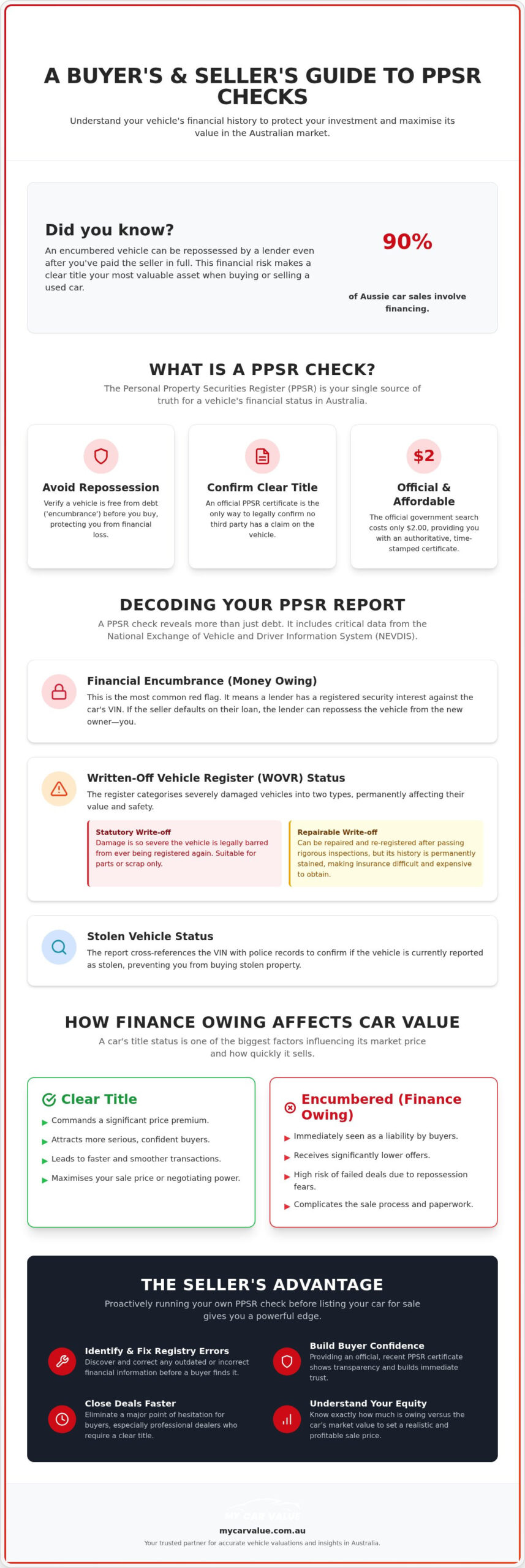
Did you know that roughly 90% of all car sales in Australia involve some form of financing? This statistic transforms every private transaction into a potential financial minefield. It is natural to feel anxious about hidden debt or confusing written-off codes that might ruin your investment. You must understand exactly how finance owing affects car value before you sign any paperwork or set a listing price. An encumbered vehicle can be repossessed by a lender even after you’ve paid the seller in full. This risk makes a clear title your most valuable asset in the 2026 market.
We agree that the process of verifying a vehicle should be simpler and less stressful. This guide empowers you to master the Personal Property Securities Register to protect your money and secure the best possible market value. You’ll gain the confidence to navigate vehicle histories with total transparency and speed. We will walk through the $2.00 official search process, explain what those status codes actually mean for your resale, and show you how to obtain a debt-free certificate that closes deals faster.
Key Takeaways
- Identify the national Personal Property Securities Register (PPSR) as your primary tool for avoiding vehicle repossession.
- Discover how finance owing affects car value and why a clear title commands a significant premium in the 2026 market.
- Decode report indicators for written-off status and theft to protect your investment from hidden mechanical and legal risks.
- Learn how sellers can proactively use PPSR data to fix registry errors and close deals faster with professional buyers.
What is a PPSR Check and Why is it Essential in 2026?
The Personal Property Securities Register (PPSR) is Australia’s national database for security interests in movable assets. Managed by the Australian Financial Security Authority (AFSA), it serves as the single point of truth for lenders and buyers alike. This system replaced the old state-based REVS checks, which were often inconsistent and difficult to navigate. Today, the PPSR provides a streamlined, digital way to verify if a vehicle has “encumbrance” or money owing.
In 2026, car buyers are more data-conscious than ever. They have instant access to valuation tools and history reports. Because of this digital transparency, sellers must understand exactly how finance owing affects car value. A vehicle with an active security interest is often seen as a liability. Buyers fear repossession, and this fear directly translates to lower offers or failed deals. Clear data is the new currency in the used car market.
The Difference Between PPSR and a Standard History Report
Many third-party websites offer vehicle history summaries. While these reports provide a broad overview, they lack the legal authority of an official PPSR certificate. A PPSR search is the only way to confirm a “clear title” in Australia. This means the government officially recognises that no third party has a legal claim to the vehicle.
You should always demand the official government search certificate. It provides a unique search number and a timestamp. This document is essential for your permanent records and provides a layer of protection that third-party summaries cannot match. It is the gold standard for transparency and is often required by professional buyers during a transaction.
What Personal Property Actually Means in the Automotive Context
The register covers “personal property,” which is a broad legal term. It includes almost all movable goods, such as cars, utes, motorcycles, and caravans. It specifically excludes land, buildings, and fixtures. For the automotive market, the focus is on serial-numbered goods that can be easily identified and moved.
The 17-character Vehicle Identification Number (VIN) is the critical identifier here. Unlike registration plates, which can be swapped or updated, the VIN is tied to the chassis. The PPSR uses this unique code to track financial interests accurately. Whether you are selling a family SUV or a work ute, the VIN is the key to unlocking its financial history and proving the car is debt-free.
Decoding Your PPSR Report: Debt, Write-offs, and Theft
An official PPSR report is a detailed document that requires a methodical approach to read. It integrates live data from the National Exchange of Vehicle and Driver Information System (NEVDIS) to highlight if a car is currently recorded as stolen or written off. When you conduct a PPSR check for the official $2.00 fee, you are issued a Search Certificate. Note that these government fees are not subject to GST. This document includes a unique Search Number and a Verification Number. Always verify these details on the official government website to ensure the report is authentic and has not been digitally altered. Authenticity is your primary defence against fraud in the used car market.
Understanding WOVR Codes: Statutory vs. Repairable Write-offs
The Written-Off Vehicle Register (WOVR) categorises damaged cars into two distinct types. A Statutory Write-off is a vehicle with structural damage so severe that it is legally barred from ever being registered again in Australia. These vehicles are relegated to the scrap heap or used for spare parts. In contrast, a Repairable Write-off can return to the road, but the process is arduous. In 2026, these vehicles must pass a rigorous Vehicle Identity Check and meet updated safety standards. Even with a certificate of roadworthiness, a write-off history permanently stains the vehicle’s record. This history makes comprehensive insurance significantly more expensive or, in many cases, entirely unavailable through mainstream providers.
Finance Interests and Encumbrance
Financial encumbrance is the most frequent red flag found on the register. Lenders register a security interest against the 17-character VIN to protect their financial stake in the asset. This reality is central to how finance owing affects car value. An encumbered car is worth less to a private buyer because it carries the immediate risk of repossession. If a seller defaults on their loan, the bank can seize the vehicle from the new owner without compensation.
Knowing how finance owing affects car value allows you to set a transparent price that accounts for the outstanding debt. To maintain your car’s marketability, you must clear the security interest before the final handshake. If you are preparing to sell, checking your status via Value My Car helps you understand how much equity you actually have. Professional buyers often facilitate the debt payout directly with your lender. This ensures the finance is cleared and the PPSR is updated as part of a seamless transaction. Clear debt leads to a clean sale.
How Finance Owing Affects Your Car’s Market Value
A vehicle’s financial history is not just a footnote; it is a primary driver of its market price. In the current 2026 market, a “clean title” acts as a premium badge. When you understand how finance owing affects car value, you realise that an active debt acts as a valuation ceiling. Buyers view encumbered vehicles as high-risk assets. They often expect a discount to compensate for the administrative hassle and the lingering fear of repossession. Transparency is the most effective tool to combat this downward pressure on your sale price.
Beyond finance, other PPSR markers significantly impact the bottom line. A repairable write-off history typically devalues a vehicle by 30% to 50% compared to an identical model with a clean record. Even if the repairs are perfect, the permanent record on the Written-Off Vehicle Register (WOVR) scares away most private buyers. Odometer discrepancies are equally damaging. If the digital history shows a higher mileage at a previous point in time, trust is broken instantly. Professional used car buyers always run a PPSR before making a firm offer to avoid these hidden liabilities.
Transparency as a Value Driver
Building trust starts before the first inspection. Providing a PPSR report upfront in your listing signals that you have nothing to hide. This proactive approach allows you to justify a higher Value My Car estimate. When buyers see a clear report, they don’t feel the need to submit low-ball offers. They recognise they’re paying for a secure investment rather than a potential legal headache. A documented history creates a competitive environment where the focus stays on the car’s condition rather than its risks.
The Risk of Dirty PPSR Results
A “dirty” PPSR result-one showing active finance, theft, or write-off history-is a deal-breaker for most private purchasers. Most professional buyers will flatly reject a car with active finance unless they have a system to pay out the lender directly. Selling a previously written-off vehicle privately in Australia is notoriously difficult due to strict registration and insurance hurdles. If your vehicle has a complex history, we help you navigate the process. My Car Value connects you with professional buyers who understand the data and can organise a fair price based on the actual condition, even with a non-standard PPSR status.
The Seller’s Advantage: Why You Should Run Your Own Check
Running your own PPSR check before listing your vehicle is a strategic move that separates serious sellers from the rest. Most people wait for a potential buyer to discover the car’s history, which puts you on the defensive. If a buyer finds an unexpected encumbrance, they’ll likely walk away or use the information to slash your price. By taking control early, you understand exactly how finance owing affects car value and can resolve any discrepancies before they scupper a deal. This proactive approach is essential for a smooth Sell My Car experience. It allows you to present a clean bill of health from day one.
Before you start, gather your registration papers and locate your 17-character VIN. You can usually find this stamped on a small metal plate on the driver’s side door pillar or visible through the bottom of the windscreen. For older vehicles, check the engine bay or the chassis rail near the front wheel. Having these details ready ensures your search is accurate and matches the physical asset exactly. This small step prevents administrative delays when you are ready to close the sale.
Step-by-Step: Conducting a Professional PPSR Search
Conducting a search is straightforward and cost-effective. Visit the official ppsr.gov.au portal and enter your VIN. The government fee is $2.00 for an online search. Avoid third-party sites that charge inflated prices for the same data. Once you receive your Search Certificate, download it as a PDF. Storing this document allows you to provide immediate proof of a clear title to any interested buyer or professional network. Professional buyers appreciate this level of transparency and speed during the appraisal process.
Troubleshooting Common PPSR Errors
Errors on the register are more common than you might think. A loan you paid off months ago may still show as an active security interest if the bank failed to update the AFSA. This error directly impacts how finance owing affects car value because the register still lists the vehicle as encumbered, even if you have a zero-balance letter. If you find an outdated entry, contact the financier immediately. They’re legally required to remove the interest once the debt is cleared. For other data entry errors, such as a mistyped VIN, you must contact the AFSA to correct the record. Fixing these issues early ensures your car’s marketability remains intact.
Maximising Your Sale Price with My Car Value
My Car Value streamlines the selling process by integrating PPSR transparency into every valuation. We know exactly how finance owing affects car value and adjust our models to reflect the reality of the 2026 market. This data-driven approach removes the ambiguity that often plagues private car sales. We act as your savvy intermediary, connecting you with professional buyers who value a documented history. By providing a clear starting point based on actual register data, we help you secure the best possible market price.
Professional buyers move fast because they rely on data rather than emotion. When you use our platform, you skip the stress of private listings and the frustration of tyre-kickers. Our network understands that a car with a history is still a valuable asset if the data is presented honestly. We handle the heavy lifting, allowing you to transition from an encumbered vehicle to a clear sale with minimal effort. Speed, accuracy, and reliability are the foundations of our service.
Professional Valuation vs. DIY Guesswork
Standard online calculators often provide a broad range that ignores the specifics of your vehicle’s title. If you have active finance, you need more than a guess. Our professional buyer network simplifies the entire verification process. These buyers understand the administrative steps required to clear a title and often coordinate directly with your bank to settle the debt. This speed advantage is critical when you want to settle your loan and move on to your next vehicle quickly.
Ready to Sell? Your Next Steps
The most efficient way to close a deal with finance owing is to work with experts who handle these transactions daily. Private buyers are often scared away by encumbrance, but professionals see it as a standard part of the automotive business. You can Get an Accurate Valuation in minutes and skip the hassle of managing a complex sale on your own. Follow this final checklist for a successful result:
- Run an official $2.00 PPSR search to confirm your current status.
- Request a formal payout letter from your lender if finance is active.
- Establish a realistic market price through My Car Value.
- Present your service history alongside your PPSR certificate to build trust.
- Finalise the sale with a professional who handles the registry updates for you.
Secure Your Financial Future with Clear Data
A clear title is your most powerful negotiation tool in the used car market. Performing an official search eliminates the risks of repossession and hidden write-off history. Proactive sellers who provide this transparency upfront always secure faster sales and better prices. You now understand exactly how finance owing affects car value and how to resolve registry errors before they impact your bottom line.
My Car Value is trusted by thousands of Aussie sellers to provide accurate, data-driven market valuations. We simplify the transition from an encumbered vehicle to a successful sale through our national network of professional buyers. These experts handle the technical details of debt payouts and registry updates so you don’t have to manage the stress alone. Our platform connects you with buyers who value transparency and speed. You’ve done the research and mastered the PPSR. It’s time to trade with total confidence and get the price your vehicle actually deserves.
Frequently Asked Questions
How much does a PPSR check cost in 2026?
An official online PPSR search costs $2.00 in 2026. This is the government-set fee and is not subject to GST. If you prefer to conduct the search via the national contact centre, the fee is $7.00. While third-party websites often offer bundled history reports for a higher price, the official $2.00 search is the only way to receive a government-backed Search Certificate. Always use the official portal to ensure your data is accurate and legally recognised.
Can I do a PPSR check with just a number plate?
No, you cannot conduct an official PPSR search using only a registration plate. For vehicles manufactured after 1989, you must provide the 17-character Vehicle Identification Number (VIN). The register tracks assets based on their unique chassis identifier rather than a plate that can be changed. Always verify the VIN physically on the vehicle’s door pillar before starting your search. This ensures the data matches the car and provides a valid result for your records.
What is the difference between a VIN and a Chassis number for a PPSR search?
A VIN is a 17-character code used for vehicles built after 1989, while a chassis number is typically found on older vehicles. Both serve as the primary identifier for the register. The PPSR uses these unique serial numbers to link financial interests to the physical asset. Ensure you enter the characters exactly as they appear on the vehicle chassis. Accuracy here is vital for maintaining the legal standing of your search and ensuring a clear title for the next owner.
Does a PPSR check show the previous owners of the car?
No, a PPSR report does not reveal the names or contact details of previous owners. Australian privacy laws prevent the disclosure of personal information on the public register. The report focuses exclusively on the vehicle’s legal status, including active finance, theft records, and written-off history. If you need to verify ownership history, you should check the vehicle’s service logbook or request a registration history from your state’s transport authority. The register is strictly for checking security interests.
How long is a PPSR certificate valid for when selling a car?
A PPSR certificate is a snapshot of the register at a specific point in time. While there is no legal expiry date, the information can change if a lender registers a new interest. The PPSR recommends conducting a search on the day of, or the day before, a transaction. Providing a same-day certificate to a buyer builds trust. It ensures the most accurate representation of the vehicle’s financial status and protects you from last-minute deal complications or skeptical buyers.
What should I do if my car shows finance owing but I have paid the loan?
You must contact the financier who registered the interest and request that they extinguish it. Lenders are legally required to remove their interest once the debt is settled. If the lender fails to update the register, you can lodge a formal dispute with the Australian Financial Security Authority (AFSA). This is critical because understanding how finance owing affects car value shows that an outdated record can unfairly lower your sale price and deter potential professional buyers.
Will a PPSR check show the service history of the vehicle?
No, a PPSR check does not provide information regarding mechanical repairs or routine servicing. It is strictly a financial and status register managed by the government. To verify maintenance, you should examine the physical service logbook or contact the servicing dealers. Combining a clear PPSR certificate with a complete service history is the most effective way to maximise your vehicle’s market value. This transparency gives professional buyers the confidence to make a fast, competitive offer.
Is a PPSR check the same as a REVS check?
Yes, the PPSR is the modern version of the old state-based REVS (Register of Encumbered Vehicles) system. In 2012, Australia transitioned to a single national register to simplify the process for buyers and sellers. While many people still use the term REVS check, an official PPSR search is now the only way to legally verify a clear title and identify financial encumbrances on a vehicle. It is a faster and more reliable national data system for the automotive market.