
Private Car Sale vs Dealer: Which is Best for Selling Your Vehicle in 2026?
Choosing the highest listing price on a classifieds site could actually be the most expensive mistake you make when selling your car. When you weigh up a private car sale vs dealer trade-in, most Australian sellers feel stuck between a rock and a hard place. You want the best price, but you don’t want the headache of weekend inspections or the constant fear of a dealer low-balling your offer. It’s difficult to feel certain about your car’s worth when the market feels so unpredictable.
This guide settles the debate for the 2026 market. You’ll discover the critical differences between these two paths and learn how to use a car value calculator to benchmark your vehicle. This ensures you aren’t leaving money on the table. We will break down the hidden costs of DIY listings, explain how new transparency regulations affect your trade-in, and show you how to secure a fast, fair sale with minimal administrative hassle. It’s time to strip away the complexity and get a result that values your time as much as your car.
Key Takeaways
- Compare the financial upside of a private car sale vs dealer trade-in against the significant time saved by choosing a professional buyer.
- Benchmark your expectations using a car value calculator to ensure you have an accurate, data-backed starting point for any negotiation.
- Streamline your exit by learning how professional buyers manage the paperwork and legal requirements for vehicles with remaining finance.
- Identify the hidden costs of private listings, from detailing and repairs to the time spent managing enquiries and weekend inspections.
- Leverage modern platforms to access a national network of professional buyers who offer a fast and secure alternative to traditional classifieds.
Understanding the Trade-off: Private Car Sale vs Dealer
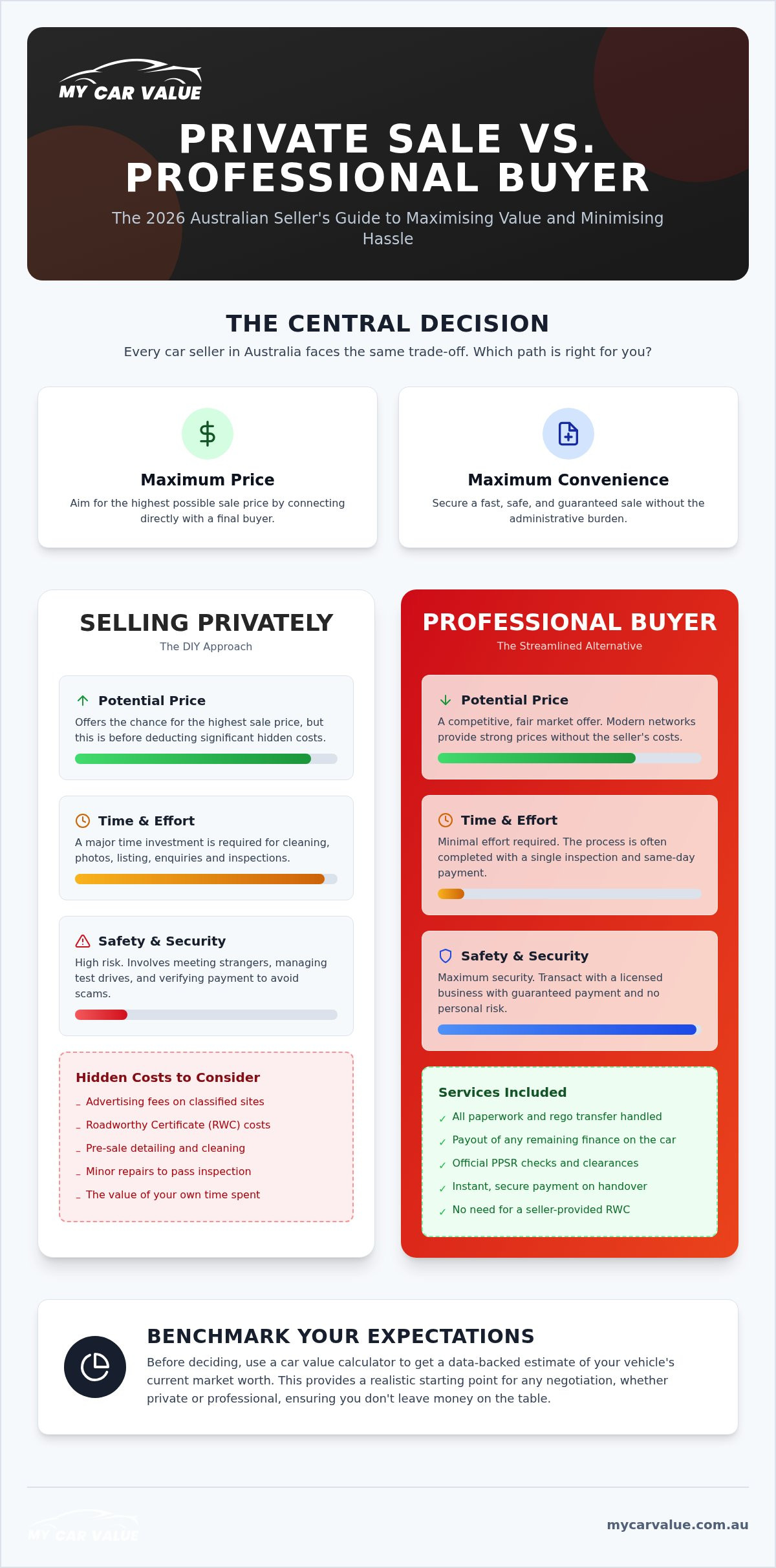
The decision of a private car sale vs dealer trade-in is the first hurdle every Australian seller faces. A private sale involves listing your vehicle on public classifieds, managing enquiries, and coordinating the legal transfer yourself. Conversely, a dealer sale involves trading your car in toward a new purchase or selling it directly to an automotive business. This choice dictates how much time you’ll spend on the process and how much money ends up in your bank account. To understand the broader context, an overview of the used car market shows that while private sales often promise a higher price, the logistical friction is significantly higher.
The primary tension lies between maximum profit and personal safety. In 2026, Australian regulations around PPSR (Personal Property Securities Register) checks and Roadworthy Certificates (RWC) add layers of complexity. Sellers must ensure their vehicle is legally cleared and safe for the road before a private handover can occur. This requires a level of transparency that many casual sellers find daunting. You aren’t just selling a car; you’re managing a small business transaction with significant legal obligations.
The Private Sale Landscape in 2026
Selling privately requires significant legwork. You must professionally clean the car, take high-quality photos, and write a compelling description. Once the ad is live, the real work begins. You’ll likely deal with “tyre-kickers” who ask endless questions without ever intending to buy. Managing these time-wasters is a major drain on your weekends. There’s also the administrative burden of transferring rego and ensuring all state-specific paperwork is lodged correctly with the relevant transport authority. If the car has mechanical issues, you’re responsible for disclosing them or fixing them to secure a sale.
The Dealer and Professional Buyer Alternative
Dealers and professional buyers offer a streamlined exit. The transaction is often immediate. You can frequently settle the deal and receive payment on the same day. They handle the “nitty-gritty” of the paperwork, including PPSR clearances and finance payouts if you still owe money on the vehicle. While traditional trade-ins are known for lower offers, modern professional buyer networks provide a middle ground. These networks offer competitive prices by connecting you with buyers who specifically want your make and model. It’s a faster, more secure way to move on to your next vehicle without the risks of meeting strangers at your home.
The Pros and Cons of Selling Your Car Privately
Selling your vehicle yourself often feels like the most profitable path. By skipping the middleman, you can aim for a higher retail price closer to what a yard might charge. You maintain total control over the negotiation and the final sale price. If you don’t like an offer, you simply walk away. However, the debate of a private car sale vs dealer isn’t just about the final number on the cheque. It’s about what you sacrifice to get there. You are essentially taking on the role of a car salesperson, which includes all the administrative and logistical burdens that come with the job.
Hidden Costs of the DIY Approach
Listing a car isn’t free. Major Australian classified sites often charge premium fees to ensure your ad stays visible among thousands of others. You must also factor in the cost of a Roadworthy Certificate (RWC) or a Blue Slip. These are mandatory for ownership transfers in many states. If your car needs minor repairs to pass an inspection, those costs come directly out of your pocket before you even find a buyer. Then there is the opportunity cost. If you spend ten hours cleaning, photographing, and showing the car, you have to ask what your time is actually worth. These expenses quickly eat into the profit margin you hoped to gain by avoiding a dealer.
Navigating the Risks of Private Transactions
Safety is a significant concern that many sellers underestimate. Meeting strangers at your home or a public car park carries inherent risks. You must verify that funds have cleared in your bank account before handing over the keys. A screenshot of a transfer is never enough proof of payment. Unlike a professional transaction, you have limited legal protection if a buyer claims a fault weeks later. To manage test drives safely, always check the buyer’s licence and never let them drive alone. The lack of a cooling off period in private sales can also lead to messy disputes. If these risks feel overwhelming, it might be time to Sell My Car through a professional network that handles the security for you.
The private car sale vs dealer decision ultimately comes down to your tolerance for risk and your available free time. While a private buyer might pay more, they also bring more uncertainty. Professional buyers eliminate the “tyre-kickers” and provide a secure, guaranteed payment method. This peace of mind is often worth more than the slight price premium of a private listing.
Why Professional Dealers and Buyers Win on Efficiency
Efficiency is the strongest argument for choosing a dealer or professional buyer. While private listings can linger for weeks, a professional transaction is often completed within hours. This is the “Same Day” advantage. You get paid and move on immediately. In the debate of a private car sale vs dealer, this speed is often the deciding factor for those with busy schedules or those who need funds for their next purchase.
Dealing with existing finance is another area where professionals excel. Many Australian vehicles are sold with an encumbrance. Managing this in a private transaction requires immense trust from the buyer and complex coordination with your lender. Professional buyers bypass this friction. They contact the finance company, settle the payout directly, and transfer the remaining equity to you. It’s a transparent process that removes the legal risk for all parties.
You also eliminate the “Roadworthy” headache. Most states require a valid certificate for private sales. This often leads to unexpected repair bills and multiple trips to the mechanic. Dealers and professional buyers take the vehicle in its current condition. They handle their own reconditioning and inspections, saving you both time and out-of-pocket expenses. This “as-is” approach is a major relief for sellers who don’t want to invest more money into a car they are about to leave behind.
The End-to-End Service Model
Professional buyers provide a comprehensive service that covers every logistical detail. They organise the vehicle pick-up and manage the transfer of registration paperwork. Unlike the “guesstimates” often found in private negotiations, professional valuations are based on real-time market data. To ensure you get the most accurate offer, providing a car service history check allows the buyer to see the maintenance record immediately. This transparency builds trust and often results in a faster, firmer offer.
Avoiding the “Trade-In Trap”
Many sellers fear the “trade-in trap” where a dealership offers a low-ball price because you are buying a new car from them. Modern professional used car buyers operate differently. They aren’t trying to sell you a replacement; they are solely focused on purchasing your current vehicle at a fair market rate. This creates a competitive environment where you aren’t limited to one yard’s opinion. You get a result that balances the higher price of a private sale with the unmatched speed of a dealer.
How to Use a Car Value Calculator to Decide Your Strategy
Before you commit to a sales path, you need an objective baseline. A car value calculator is the essential starting point for any vehicle transition. It removes the emotional bias that often clouds a seller’s judgement. You might value your car based on personal memories or recent maintenance, but the market operates on cold data. By using a calculator, you can settle the private car sale vs dealer debate with facts rather than feelings. This tool analyses age, kilometres, overall condition, and current market demand to provide a realistic figure.
Accuracy is paramount. Overpricing your car based on a “gut feeling” leads to stagnant listings and frustrated enquiries. Underpricing it means leaving thousands of dollars on the table. A data-driven valuation ensures you hit the “sweet spot” where the price is attractive to buyers but still fair to your bottom line. It provides the certainty you need to negotiate with confidence, whether you’re talking to a private individual or a professional buyer.
Step-by-Step: Getting an Accurate Valuation
Start by gathering your vehicle’s documentation. Enter your VIN or registration number into the tool to pull the exact make, model, and year. This ensures the data reflects your specific variant. Next, provide a brutally honest assessment of the car’s condition. Note any dents, interior wear, or tyre tread depth realistically. A quote is only as useful as the data you provide. Finally, compare the estimated private sale price against the professional purchase offer. This comparison allows you to see the actual “effort-to-profit” ratio before you spend a cent on advertising.
Interpreting the Results
The “spread” represents the difference between the wholesale price a business pays and the retail price a private buyer might offer. In the Australian market, this gap covers the dealer’s reconditioning costs, GST, and profit margin. Use the vehicle market value calculator to establish your “walk-away” price. This is the minimum amount you’ll accept before the convenience of a professional sale outweighs the potential private profit. If the difference is only a few hundred dollars, the time saved by avoiding a private car sale vs dealer negotiation is usually the smarter choice.
The My Car Value Advantage: A Modern Selling Alternative
My Car Value offers a modernised path that resolves the typical tension found in the private car sale vs dealer choice. We act as the savvy intermediary, doing the heavy lifting to ensure you aren’t guessing your car’s worth. Our platform provides a data-driven valuation first, then connects you with professional buyers to ensure you receive a competitive result. This transparency creates an atmosphere of relief and trust, allowing you to bypass the low-ball offers common in traditional trade-ins. It is a streamlined system built specifically for the 2026 market, stripping away the complexity of a typically stressful process.
Transparency is our core principle. We provide the data you need to make an informed decision before any commitment is made. By removing the complexity of the negotiation, we allow you to focus on your next move. Our process is fast, impartial, and designed to value your time as much as your vehicle. We have simplified a legacy system to put the power back in your hands, ensuring that the transition to your next car is as seamless as possible. You are no longer limited to the traditional binary choice of a slow private sale or an undervalued trade-in.
Why Our Network Beats the Traditional Trade-In
Traditional trade-ins often limit you to one dealer’s opinion, which is usually dictated by their specific inventory needs. If your car doesn’t fit their current stock requirements, they’ll offer a lower price to mitigate their risk. Our network changes this dynamic entirely. We connect you with multiple professional buyers across the country who compete for your vehicle. This competition drives a more realistic market price that reflects true demand. Our network maintains a strong presence in major metropolitan areas, key capital cities, and large regional hubs. This national reach means we find the right buyer for your specific make and model, providing a fair balance between private profit and dealer speed.
Ready to Move On? Your Next Steps
The decision ultimately rests on your priorities. If you have weeks of free time and a high tolerance for risk, a private listing might eventually yield a result. However, if you value certainty and efficiency, the professional route is superior. You can secure a fair price without the “tyre-kickers” or the administrative burden of a private car sale vs dealer transaction. Start by using our car value calculator to see where you stand. Once you have your figure, you can sell my car through a trusted system that prioritises your ease. Move forward with confidence. Get paid and move on to your next vehicle without the typical stress of a legacy sales process.
Secure Your Best Sale Result
Navigating the choice between a private car sale vs dealer trade-in requires a clear focus on your own priorities. You now understand that while private listings might promise a higher retail price, the hidden costs of advertising, tyre-kickers, and administrative paperwork often eat into that profit. Professional buyers offer a streamlined exit that handles the complexities of finance payouts and legal transfers on your behalf. It’s a faster, safer way to move into your next vehicle without the typical stress of managing a DIY transaction.
Focus on the data rather than your gut feeling. Use a car value calculator to set a firm benchmark and remove the emotion from your negotiation. This ensures you never leave money on the table while prioritising your own safety and weekend time. You can skip the endless inspections and move straight to a secure payment through a trusted network. This modern approach gives you the best of both worlds: a competitive price and unmatched efficiency.
Take the complexity out of your next vehicle transition. Access accurate Australian market valuations and connect with our network of professional used car buyers to finish your sale with total confidence. It’s time to sell your car the smart way and move on to your next adventure.
Frequently Asked Questions
Is it better to sell my car privately or to a dealer?
Selling privately is better if you have the time to manage listings and inspections to chase a higher price. Selling to a dealer or professional buyer is superior if you value speed and safety. The private car sale vs dealer choice really comes down to your personal “effort-to-profit” ratio. Most modern sellers prefer the professional route to avoid the administrative burden of state-specific transfers and the risks of meeting unknown buyers at home.
How much more do you get selling a car privately in Australia?
You might see a listing price roughly 10% higher than a wholesale offer. However, you must subtract advertising costs on major classified sites and the price of a mandatory Roadworthy Certificate. When you factor in the hours spent cleaning, photographing, and showing the car, the actual profit margin often shrinks significantly. Many Australian sellers find that the “extra” money doesn’t always justify the weeks of logistical friction and weekend interruptions.
How does a car value calculator help me choose a selling method?
A calculator provides an objective baseline by pulling real-time Australian market data. It shows you the realistic “spread” between what a private buyer might pay and what a professional will offer. This transparency helps you set a “walk-away” price. If the difference is minimal, you can confidently choose the faster professional method. It stops you from overpricing your vehicle based on sentimental value, which is the leading cause of stagnant listings.
What are the risks of selling a car privately?
Private sales carry significant security and financial risks. You have to manage test drives with strangers and verify that bank transfers have actually cleared before handing over the keys. There is also no legal “cooling-off” period, which can lead to messy disputes if the buyer discovers a mechanical fault later. Using a professional buyer eliminates these concerns by providing a secure, guaranteed payment and a transparent transaction that protects your privacy and your bank account.
Can I sell a car with finance still owing to a dealer?
Yes, selling a vehicle with an encumbrance is much easier through a professional. Dealers and professional buyers contact your finance provider directly to obtain a payout figure. They settle the debt and transfer any remaining equity to your bank account. This removes the massive trust barrier found in a private car sale vs dealer comparison, where private buyers are often hesitant to pay for a car that still has money owing to a bank.
Do dealers pay fair market value for used cars?
Professional buyers offer a competitive wholesale price based on current auction results and demand. While this is lower than a retail price, it is a “fair” reflection of the car’s value in its current condition without the need for you to perform repairs. They take on the risk of reconditioning, GST, and finding a new owner. This price provides you with an immediate exit and certain payment without any further investment.
What paperwork do I need for a private car sale in Australia?
Requirements vary by state, but you generally need a completed Transfer of Registration form and a current Roadworthy Certificate (RWC). You must also provide a receipt or “bill of sale” that includes the VIN, engine number, and sale price. Ensure you check the PPSR to show the car has no hidden history. Professional buyers handle all this paperwork for you, whereas a private sale leaves the entire administrative burden on your shoulders.
How long does it typically take to sell a car to a professional buyer?
The process is incredibly fast, often concluding within 24 hours. After you receive an initial valuation online, a physical inspection is organised at a time that suits you. Once the final price is agreed upon, the payment is usually processed via electronic funds transfer on the same day. This speed is the primary reason sellers choose professional networks over private listings, which can take several weeks or even months to find a serious buyer.