

Car Value Finder: How to Get an Accurate Valuation in Australia (2026)
An online car valuation is nothing more than a digital guess until a professional buyer puts money on the table. Most Australian drivers find that using a car value finder across different websites often produces wildly inconsistent results. It’s frustrating to see a high number on your screen only to face lowball offers or the endless hassle of managing private enquiries and weekend inspections. You want a fair price, but you also want to avoid the headache of organising a roadworthy certificate or dealing with the stress of rego transfers.
We understand that your time is valuable and transparency is non-negotiable. This article bridges the gap between a digital estimate and a real-world cash offer. You’ll learn how to determine your vehicle’s true worth in the current market and discover a streamlined path to a sale. We’ll show you how to bypass the complexity of private listings by connecting with professional used car buyers who value efficiency. This guide provides the steps to secure a reliable price range and convert it into a fast, transparent transaction without the usual mechanical hurdles.
Key Takeaways
- Learn why a digital estimate serves as a benchmark rather than a final offer. It helps you set realistic expectations before you speak with buyers.
- Discover how a comprehensive service history and low kilometres significantly increase professional buyer confidence. This helps you justify a higher valuation.
- Use a car value finder to aggregate real-time market data and establish a reliable price range for your specific vehicle.
- Follow a practical guide to preparing your logbooks and spare keys. Proper documentation ensures you don’t lose value at the final inspection.
- Understand the process of converting a digital estimate into a firm cash offer. This removes the stress of private enquiries and roadworthy certificates.
What is a Car Value Finder and Why Do You Need One?
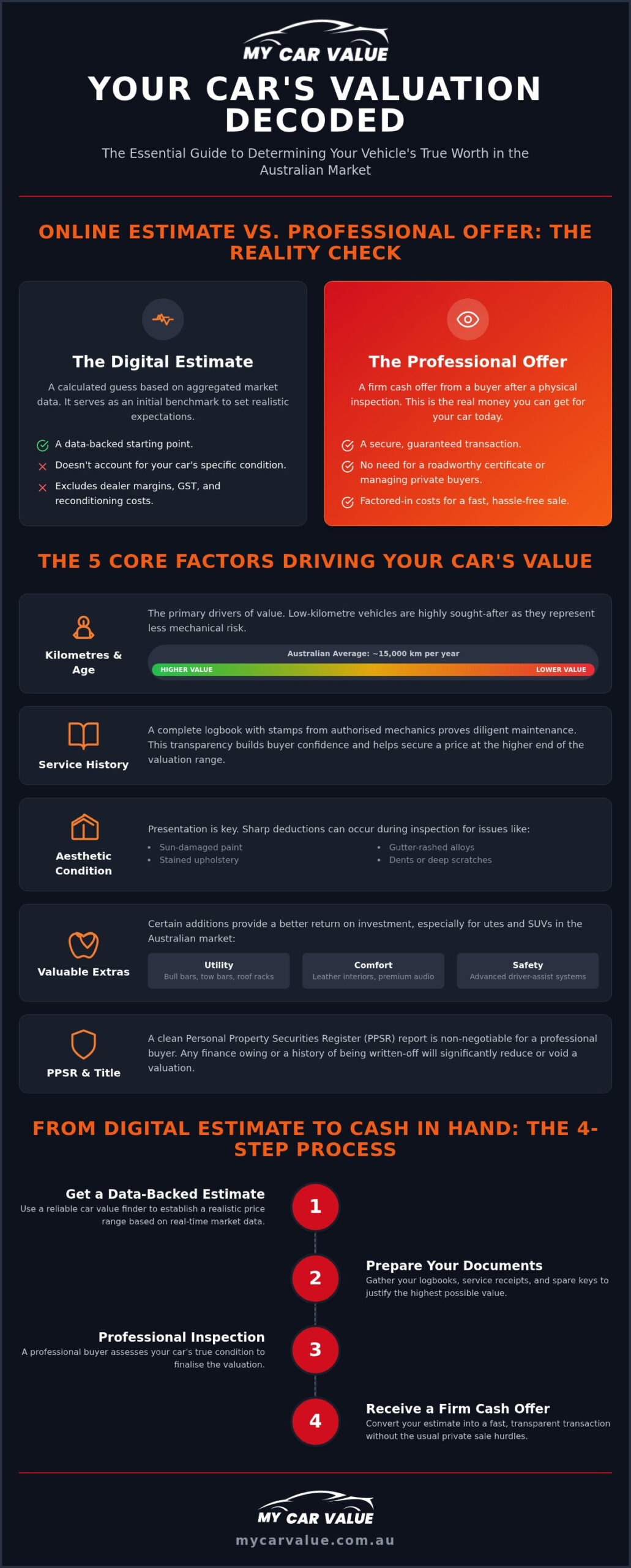
A car value finder is a sophisticated digital tool designed to strip away the guesswork from selling your vehicle. It aggregates vast amounts of market data to provide a calculated estimate of what your car is worth right now. This isn’t just a random number; it’s a benchmark based on recent auction results and actual dealer sales across the country. It serves as a critical starting point for both private sales and dealer trade-ins, ensuring you enter negotiations with a data-backed position.
Accuracy depends entirely on the quality of the data sources. Reliable tools look beyond simple year and model filters, instead analysing real-world transactions to see what buyers are actually paying. Without this data, you risk two common mistakes. You might overprice the car and watch the listing sit for weeks without a single enquiry. Alternatively, you might underprice it and leave thousands of dollars on the table. A reliable finder provides the clarity you need to make an informed decision about your asset.
The Difference Between Market Value and Trade-in Price
Understanding these two figures is essential to avoid sticker shock when you transition from a digital estimate to a real-world offer. Market value represents what a private buyer might pay in an ideal scenario. However, this figure doesn’t account for the time, risk, and marketing costs you’ll incur during a private sale. You also have to consider the stress of managing inspections and potential no-shows.
Trade-in prices are naturally lower because they include dealer margins, reconditioning costs, and GST obligations. While the number might look smaller on paper, it represents a faster, more secure transaction. Knowing both figures allows you to weigh the convenience of a professional buyer against the potential gains of a private listing. It empowers you to recognise a fair offer when you see one.
Why 2026 Market Data Matters More Than Ever
The Australian automotive landscape has shifted significantly. Standard depreciation curves that applied five years ago are now largely irrelevant for popular models like 4×4 utes and family SUVs. Vehicle supply chains and fuel prices continue to fluctuate, impacting resale value in ways that traditional logbooks can’t predict. Real-time data provides a more accurate reflection of buyer demand than static pricing guides that only update once a quarter. Using a modern car value finder ensures your expectations align with current market reality rather than outdated historical trends.
The Core Factors That Influence Your Australian Car Valuation
Kilometres and age are the primary drivers of any vehicle valuation. In the Australian market, a car that has travelled roughly 15,000 kilometres per year is considered average. If your odometer shows significantly higher figures, expect the valuation to reflect that extra wear. Conversely, low-kilometre vehicles are highly sought after by professional buyers because they represent less mechanical risk. A reliable car value finder accounts for these regional driving habits to provide a realistic figure for your specific model.
Service history is the next most influential factor for any professional assessment. A logbook filled with stamps from authorised mechanics proves the car has been maintained according to manufacturer standards. This transparency builds buyer confidence and helps you secure the higher end of a price range. To learn more about documenting your maintenance, read our guide on Car Service History Check: The Australian Guide to Maximising Value (2026).
Aesthetic condition and optional extras also play a decisive role. In Australia, certain additions provide a better return on investment than others. Consider these common value-adders:
- Utility: Bull bars, tow bars, and roof racks are high-value additions for utes and family SUVs.
- Comfort: Premium leather interiors and advanced safety tech appeal to a broader range of professional buyers.
- Presentation: Sun-damaged paint, gutter-rashed alloys, or stained upholstery can lead to sharp deductions during a physical inspection.
Before you commit to a sale, it’s wise to Value My Car using a tool that considers these local nuances. This preparation ensures your expectations align with current market demand.
PPSR Checks and Vehicle History
A clean Personal Property Securities Register (PPSR) report is essential for securing a top-tier valuation. Professional buyers always check if a vehicle has any finance owing or if it’s listed on the Written-Off Vehicle Register (WOVR). If a car is on the WOVR, its value can drop by up to 50 percent because many insurers refuse to cover these vehicles. Securing a clear report before you start the process ensures there are no surprises that could derail your sale.
The Impact of “Rego” and Roadworthy Status
Current registration adds immediate value and convenience for any purchaser. A buyer doesn’t want the hassle of visiting a state transport centre immediately after the exchange. Similarly, a valid Roadworthy Certificate (RWC) reduces the perceived risk. While private buyers often demand a RWC before handover, professional used car buyers are often equipped to handle “as-is” sales. They can manage the repairs and certifications themselves. This saves you the significant stress of managing mechanical inspections and costly repairs before you sell.
Online Estimators vs. Real-World Professional Offers
An online estimate is a useful starting point, but it isn’t a cheque in your hand. Most drivers use a car value finder to get a ballpark figure, yet they’re often surprised when the actual offers come in. This happens because most digital tools rely on static historical data from sources like Redbook or Glass’s Guide. While these are reputable, they don’t always reflect this week’s specific demand in the Australian market. A professional offer, by contrast, is a firm commitment to buy based on the current state of the industry.
Professional buyers assess your vehicle through detailed photos or an in-person inspection to provide a firm price. They look at the specifics that an algorithm simply can’t see, such as the exact condition of the tyres or the quality of the interior. While a private sale might promise a slight premium, the convenience of a professional transaction often carries more weight. You avoid the weeks of waiting and the constant back-and-forth with tyre-kickers who have no intention of buying.
Why Some Valuations Feel “Too Good to be True”
Algorithmic finders often assume your car is in “Excellent” condition by default. This creates a “sticker shock” effect when a real-world inspection identifies minor scratches or a missing service stamp. The highest online number is rarely the final sale price because it doesn’t account for the reconditioning costs a buyer must absorb. Remember that vehicle market value calculators should be used as a guide only. They provide the context, but the market provides the cash.
The Role of Professional Used Car Buyers
Professional buyers operate differently than private individuals. They look for specific stock to fill immediate gaps in their network. If you have a popular SUV or a late-model ute, they might be willing to move quickly to secure that inventory. This process is highly streamlined. You get immediate payment and someone else handles the mountains of paperwork and rego transfers. For a deeper look at this process, see our guide on Professional Used Car Buyers: The Efficient Way to Sell Your Vehicle in 2026. This approach values your time as much as your car.
How to Maximise Your Result Using a Car Value Finder
Maximising your valuation requires a methodical approach. You cannot expect an accurate number if the information you provide is vague or incomplete. A car value finder relies on specific inputs to filter through thousands of data points. By gathering your documentation and being precise with your details, you ensure the digital estimate aligns closely with the eventual cash offer. Accuracy at this stage prevents surprises later in the process.
Be honest about the vehicle’s condition from the start. If you skip over a dent or a cracked windscreen, the final offer will inevitably drop when the buyer sees the car. Transparency builds trust and ensures the transition from a digital estimate to a real-world sale is seamless. You want to provide a complete picture of the asset to get the most reliable result possible.
Step 1: Accurate Data Entry
Start with the technical details. Your Vehicle Identification Number (VIN) is the most reliable way to identify your car’s exact specifications. This ensures the tool accounts for specific trim levels and factory-fitted option packs that might otherwise be missed. Many Australian models have mid-year updates or special editions that significantly impact resale value. Using the VIN removes any ambiguity about which version you own.
Be exact with your odometer reading. Don’t round up to the nearest thousand, as every kilometre counts toward the final calculation. You should also highlight any recent major maintenance. If you’ve recently replaced the timing belt, fitted a new set of tyres, or installed a new battery, mention it. These are high-cost items that a professional buyer won’t have to spend money on, which justifies a stronger valuation for your vehicle.
Step 2: Presentation and Minor Repairs
First impressions matter even in a digital environment. If you are uploading photos for a professional assessment, ensure the car is clean. A professional detail often returns its cost many times over by making the vehicle look years younger. It’s much harder for a buyer to justify a low offer when the car looks pristine. Clean the engine bay, vacuum the carpets, and remove any personal clutter before taking photos.
Fix minor scuffs or paint chips before the final inspection. These small blemishes give buyers a reason to “chip away” at your price during negotiations. You should also gather all physical items associated with the car. This includes:
- Logbooks: Ensure all service stamps are up to date and present.
- Spare Keys: Modern keys are expensive to replace; having both adds immediate value.
- Owner’s Manuals: Having the original documentation proves the car has been well-kept.
Organise your service records chronologically. A tidy folder of receipts demonstrates a well-maintained vehicle and builds immediate confidence with used car buyers. This level of preparation shows you are a serious seller who has looked after their investment.
Why My Car Value is the Smartest Choice for Australian Sellers
My Car Value solves the primary frustration of the Australian automotive market: the disconnect between a digital estimate and real-world cash. While other platforms provide a static number and leave you to manage the fallout, we provide a functional solution. Our car value finder integrates real-time market insights with a direct connection to professional used car buyers. This ensures you aren’t just reading a report; you’re starting a genuine transaction. When you choose to Value My Car through our platform, you gain more than just a number.
We intentionally strip away the complexity of private listings. You shouldn’t have to deal with late-night enquiries from scammers or the frustration of no-shows on your day off. Our national network ensures your vehicle attracts competitive interest from verified industry professionals across the country. This platform prioritises speed and clarity, helping you transition from a valuation to a completed sale with minimal effort. We handle the heavy lifting so you don’t have to.
A Modern Approach to a Traditional Task
We act as a savvy intermediary in a crowded marketplace. Instead of you chasing buyers, we do the heavy lifting to find professionals who need your specific stock. The entire process is transparent and built on trust. We focus on pragmatic outcomes rather than optimistic guesses. We understand that your time is your most valuable asset. To understand the full scope of our service, read our Sell My Car: The Ultimate 2026 Guide. We’ve modernised a legacy system to ensure your selling experience is as fast as it is fair. Our goal is to provide a reliable path forward for every Australian driver.
Getting Started with Your Valuation
The first step is simple. Enter your vehicle details into our system to begin your journey. You’ll immediately feel the relief that comes with a streamlined, professional process. There’s no need to worry about the “rego” or roadworthy stress that typically plagues private sales. We handle the logistical hurdles so you can focus on the result. Our network of used car buyers is ready to provide a firm offer based on the data you provide. Choosing a professional network beats the “tyre-kicker” alternative and ensures you get the value you deserve without the headache.
Secure Your True Market Value Today
Determining the actual worth of your vehicle doesn’t have to be a source of uncertainty. By using a reliable car value finder and providing precise data, you establish a firm foundation for a successful sale. You’ve learned that a professional offer provides the speed and transparency that private listings simply can’t match. This approach removes the burden of managing weekend inspections and roadworthy certificates yourself.
Leverage our trusted national network of professional buyers to move from a digital estimate to a firm cash offer. The process is designed to be fast, impartial, and entirely transparent. You can avoid the frustration of private classifieds and the risk of dealing with unverified enquiries. We do the heavy lifting to ensure your selling experience is as efficient as possible.
Take the next step with confidence and clarity. Experience the relief of a streamlined selling process that values your time as much as your vehicle.
Frequently Asked Questions
How accurate is a car value finder compared to a dealer offer?
A digital valuation provides a data-driven benchmark based on national sales, while a dealer offer is a specific business decision. The estimate gives you the market range, but the dealer’s price includes their overheads and profit margin. Digital tools are excellent for setting expectations. However, a physical inspection by a professional buyer is the only way to secure a firm, binding commitment to purchase your vehicle.
Do I need to pay for a car valuation report in Australia?
You don’t need to pay for a basic valuation report in Australia. Many platforms offer free estimates to help you understand your vehicle’s worth. While some premium services sell detailed historical data, most sellers find that a free car value finder provides sufficient clarity. Avoid paying for reports that don’t offer a direct path to a sale, as these often provide the same data available elsewhere for free.
What is the best way to find my car’s value if it has high kilometres?
Be precise with your odometer reading when using a car value finder. High kilometres increase the mechanical risk for buyers, which naturally lowers the valuation. The best way to maintain value in this scenario is to provide a complete service history. This proves the vehicle has been maintained despite the heavy use. Professional buyers often look for well-serviced, high-km vehicles to fill specific market gaps.
How does a PPSR check affect my car’s value?
A PPSR check confirms if a car has financial encumbrances or is listed on the Written-Off Vehicle Register. If a vehicle has a recorded status on the WOVR, its value can drop by up to 50 percent. Buyers view these cars as higher risk because they are harder to insure and finance. A clear report is essential for achieving a top-tier valuation and ensuring a smooth transfer of ownership.
Can I get a valuation for a car with a blown engine or mechanical issues?
Yes, you can get a valuation for a car with mechanical issues, but it will be significantly lower than a running model. Professional used car buyers often purchase as-is vehicles to refurbish or use for parts. You should be completely transparent about the engine’s condition during the enquiry. This allows the buyer to calculate repair costs and provide a realistic offer that reflects the car’s current state.
Why is my car’s resale value lower than the same model online?
Online listings represent asking prices, not actual sale prices. Many private sellers overprice their vehicles and wait weeks for a buyer who never arrives. Additionally, your car might have different trim levels, higher kilometres, or less registration than the one you’ve seen. Professional buyers base their offers on actual transaction data rather than the optimistic figures found on public classified websites. This reflects real-world demand.
What documents do I need to provide for an accurate car valuation?
You need your registration papers, a full service logbook, and your photo identification. Providing the Vehicle Identification Number (VIN) is also critical for identifying the exact model and factory options. If you have receipts for recent major repairs or new tyres, include these as well. Having all your paperwork organised chronologically demonstrates that the vehicle has been well-maintained and helps justify a higher final valuation for your car.
How long does a car valuation estimate remain valid?
Most car valuation estimates remain valid for seven to fourteen days. The Australian used car market is dynamic, with prices shifting based on supply, demand, and seasonal trends. If you wait too long after receiving an estimate, the data may become outdated. It’s best to move from the initial valuation to a professional inspection quickly to lock in the price and avoid any unexpected market fluctuations.