
Car Market Value Calculator: The 2026 Australian Guide to Pricing Your Vehicle
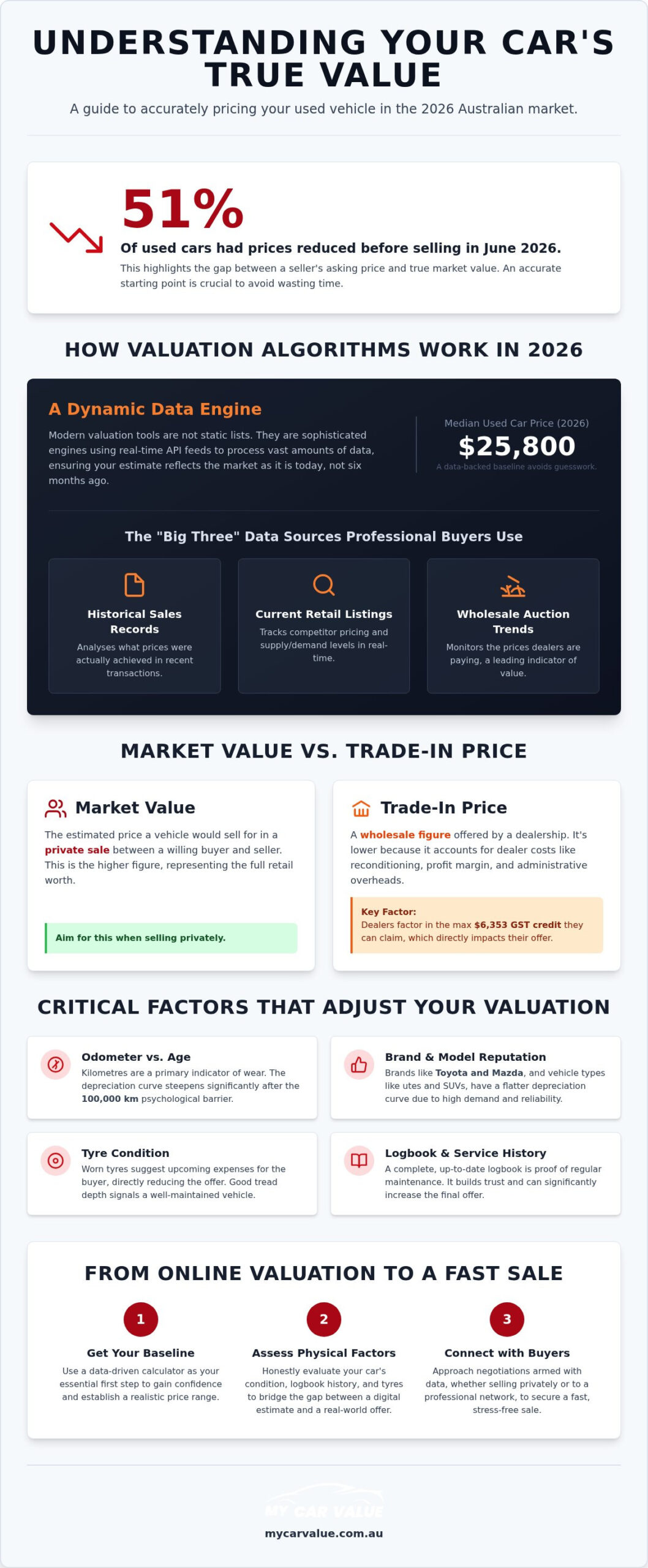
In June 2026, over 51% of used vehicles across Australia had their prices reduced before they finally sold. This highlights a common frustration for sellers. It’s the gap between expectation and reality. It’s exhausting to use a car market value calculator only to find that real-world buyers aren’t matching that digital number. You deserve a price that reflects the current market. You don’t need a generic estimate that ignores local demand or your car’s specific history.
We understand you want a fast, transparent path to a sale. You need to avoid the pressure of low-ball offers. This guide shows you how to accurately determine your car’s worth and move from an online estimate to a completed transaction. You’ll learn how to interpret live market data and understand the difference between trade-in and private values. We’ll simplify the process. This ensures you secure a realistic price range and enjoy a stress-free transition to your next vehicle.
Key Takeaways
- Understand how 2026 valuation technology uses real-time API feeds and live market data to provide a precise baseline for your vehicle’s worth.
- Learn why a car market value calculator is the essential first step to gaining confidence and avoiding low-ball offers during negotiations.
- Identify the critical physical factors, such as tyre condition and logbook history, that bridge the gap between a digital estimate and a real-world cash offer.
- Discover the “Big Three” data sources that professional buyers use to adjust pricing based on current supply chain shifts and wholesale trends.
- Master the process of converting an online valuation into a fast, stress-free sale by connecting with a national network of professional used car buyers.
What is a Car Market Value Calculator and Why Do You Need One?
A car market value calculator is a sophisticated data engine. It processes thousands of historical sales records and live market listings to generate a price estimate. Understanding what car valuation is requires looking past emotional attachment to see your vehicle as a data point. In 2026, the median used car price in Australia sits at $25,800. Without a data-backed baseline, you’re guessing.
Sellers often confuse the ‘asking price’ with ‘market value’. The asking price is what you see on classifieds. It’s a wish list. Market value is what buyers actually pay. With over 51% of used cars seeing price reductions before selling in mid-2026, relying on asking prices leads to wasted weeks. A calculator grounds your expectations in reality.
Market volatility is the new normal. Supply chain shifts and changing buyer preferences mean your car’s worth can change in weeks. Using a car market value calculator ensures your information is current. It reflects today’s demand for fuel efficiency and specific brands like Toyota, Mazda, or Hyundai.
The Difference Between Market Value and Trade-In Price
Market value represents the fair price for your car in a private or retail environment. It assumes a buyer is paying for the vehicle’s full utility. Trade-in price is a wholesale figure. Dealers offer this lower amount because they must account for reconditioning costs, GST credits, and their own profit margin. For the 2026-27 financial year, the maximum GST credit a business can claim on a vehicle is $6,353. This directly impacts what a dealer can offer you. Most calculators provide a range rather than a single figure. This range accounts for variables like local demand and specific vehicle condition.
Why ‘Free’ Tools Are Essential for Australian Sellers
Using these tools removes the stress of the ‘guessing game’. It provides a neutral third-party figure you can use to justify your price to potential buyers or professional purchasers. You save time by filtering out unrealistic expectations early in the process. This prevents your car from sitting on the market for months while its value depreciates.
- Stop the Sit: Cars priced accurately from day one sell faster.
- Filter Buyers: Quickly identify low-ball offers that fall far below the data-driven range.
- Market Agility: Fuel prices in 2026 have shifted demand toward smaller SUVs and EVs. Digital tools update faster than traditional books to reflect these trends.
How Valuation Algorithms Determine Your Car’s Worth in 2026
Modern car market value calculators are no longer static spreadsheets. They are dynamic engines that process vast amounts of data via real-time API feeds. These algorithms track the “Big Three” sources: historical sales records, current retail listings, and wholesale auction trends. By 2026, technology has advanced to adjust for supply chain shifts within hours. If a manufacturer increases new car production, the value of used equivalents drops almost instantly. This ensures your estimate reflects the actual state of the market today.
The “odometer vs age” ratio remains a primary driver in these calculations. Algorithms weigh kilometres heavily because they indicate wear on major components. In the Australian market, 100,000 km is a significant psychological barrier. Once a vehicle crosses this threshold, the depreciation curve steepens. Conversely, low-kilometre utes and SUVs retain a higher percentage of their original value. These Australian favourites follow a much flatter depreciation curve than standard sedans or luxury hatchbacks. Brands with strong reputations, such as Toyota and Mazda, benefit from algorithms that recognise their long-term value retention.
The Role of Live Listings and Supply Demand
Supply and demand dynamics shift rapidly. A sudden influx of a specific model can drop your calculator result overnight. If a major rental fleet offloads hundreds of compact SUVs, the market becomes saturated. Algorithms detect this surplus and adjust valuations downward. Seasonal trends also play a major role. Demand for 4WDs and large family vehicles typically spikes before school holidays. This increased appetite allows for stronger pricing. Regional supply levels are analysed at a national level. This ensures your valuation reflects broader market trends rather than a single local dealership’s overstock.
Historical Sales Data vs Real-World Offers
Looking at what sold six months ago is dangerous in a volatile market. Historical data often lags behind current buyer sentiment. Professional buyers focus on “buy-prices” rather than the optimistic “list-prices” seen on classified sites. List prices often include a buffer for negotiation and don’t represent the final transaction. This is why using a vehicle market value calculator that reflects current buyer appetite is so critical. It provides a realistic expectation based on what professionals are actually paying today. If you want a clear picture of your car’s current worth, get a market-accurate valuation to start your selling journey.
Calculator Results vs Actual Offers: Bridging the Gap
Many sellers experience a moment of shock when they transition from a screen to a showroom. You might see a figure on a car market value calculator and assume it’s a guaranteed price. However, a digital tool cannot see the specific condition of your tyres or the scuffs on your leather interior. It provides a statistical range based on broad data. The gap between that number and a real-world offer is often where the most confusion happens. A professional buyer evaluates your car in person to narrow that range into a firm figure.
A professional buyer acts as the bridge between theory and cash. They evaluate the “Cheque-in-Hand” factor. This is the tangible value of an immediate, guaranteed sale without the risk of a private buyer backing out at the last minute. While a calculator gives you the “what,” a professional offer gives you the “when” and “how.” Understanding this distinction helps you enter negotiations with realistic expectations and a clear strategy.
Why Your Car Might Be Worth More (or Less) Than the Screen Says
Your vehicle might possess “Unicorn” qualities that an algorithm misses. Exceptional service history, rare factory colours, or high-demand optional extras can push your value to the top of the suggested range. Conversely, “Maintenance Debt” can pull it down. If your car is due for a major service or the rego is about to expire, a buyer will deduct those anticipated costs from their offer. Performing a car service history check can validate a higher-than-average valuation by proving the vehicle has been meticulously maintained. Physical wear and tear, such as faded paint or interior stains, will also lead to adjustments that a digital tool simply cannot predict.
Professional Buyers vs Private Sale Stress
Private selling is often a full-time job. You must manage listings, filter out “tyre-kickers,” and organise inspections around your busy schedule. The time-cost of this process is significant and often overlooked. Professional buyers in the My Car Value network provide a more efficient alternative. They offer firm prices based on live market data and the physical condition of your vehicle. Dealing with licensed professionals offers a level of security you won’t find with anonymous internet buyers. It replaces the stress of negotiation with a clear, methodical path to a sale. This ensures you aren’t just looking at a car market value calculator result but actually moving toward a successful transaction with total confidence.
Factors That Can Make or Break Your Online Valuation
A car market value calculator is only as accurate as the data you input. If you provide vague details, you will receive a vague result. Kilometres remain the most significant variable. In 2026, the 15,000km per year benchmark still dictates the standard depreciation rate. If your vehicle has travelled significantly more, the algorithm will penalise the value. Conversely, low-kilometre cars command a premium because they suggest less wear on the drivetrain and suspension.
Service history is your strongest evidence of value. A missing logbook can decrease an offer by thousands of dollars. Professional buyers view a complete service history as a guarantee of mechanical health. You must also categorise your car’s condition realistically. Most sellers claim “Excellent” condition, but true “Excellent” means the car is showroom-ready with no stone chips or interior wear. If there are minor scratches or worn tyres, “Good” or “Fair” is a more honest starting point for your estimate.
Aftermarket modifications often complicate valuations. While that expensive bull bar or custom suspension felt like a great investment, it rarely adds dollar-for-dollar value. Professional buyers often prefer stock vehicles because they appeal to a broader audience. Modifications can sometimes even limit your pool of potential buyers.
The PPSR and WOVR Impact
In 2026, 13.4% of used cars checked in Australia had a history of being written off. If a vehicle has a “Repairable Write-Off” status on the Written-Off Vehicle Register (WOVR), its market value can be slashed by 30% to 50%. A car market value calculator might not always pick this up immediately, but a professional buyer will. They instantly verify PPSR (Personal Property Securities Register) data to ensure there is no finance owing and the title is clear. Having a clear title is non-negotiable for a smooth, professional sale.
Presentation and Mechanical Health
First impressions carry financial weight. A $200 professional detail can often add $1,000 to the perceived value during a physical inspection. It signals to the buyer that the car has been meticulously maintained. Mechanical health is equally critical. Issues like low tyre tread depth or squeaky brakes are immediate red flags. In a professional sale, the buyer often handles the Roadworthy Certificate (RWC) process, but they will deduct the cost of any required repairs from their final offer. Addressing these hidden issues early ensures your digital valuation matches your real-world sale price.
Value my car with market-accurate data
Turning Your Valuation into a Sale with My Car Value
Most online tools leave you with a number and no clear path forward. My Car Value changes this by acting as an efficient facilitator between you and the market. Once you use our car market value calculator, you aren’t just left with a digital estimate. We bridge the gap by connecting you with a national network of professional used car buyers. This ensures the theoretical value you see on your screen translates into a real-world cash offer. You avoid the “take it or leave it” pressure common with single-dealer platforms.
Our platform prioritises transparency. We recognise that there is a median gap of 13.1% between the highest and lowest dealer offers for the same vehicle in 2026. By leveraging a broad network, we help you find the most competitive price without the need for manual haggling. The entire process is no-obligation. You receive your valuation and decide if you want to proceed. This puts the control back in your hands, allowing you to make informed decisions with minimal effort.
How the Connection Process Works
We have streamlined the transition from data to dollars into three logical steps. This methodical approach ensures speed and accuracy.
- Step 1: Enter your vehicle details into our car market value calculator. Provide accurate information regarding kilometres, condition, and service history to ensure the best result.
- Step 2: Receive your data-driven valuation range instantly. This range reflects live market appetite and current supply levels across Australia.
- Step 3: Get matched with professional buyers who are ready to act. These are licensed experts looking for stock like yours, removing the need for private classifieds.
Why 2026 Sellers Prefer the My Car Value Method
Speed is a critical factor in a volatile market. Sellers in 2026 prefer moving from “thinking about selling” to “sold” in days rather than weeks. Private sales often drag on for a month or more, especially when 51% of vehicles require price reductions to attract interest. Our method bypasses this delay. You also gain significant security. You avoid the risks associated with private test drives, anonymous internet buyers, and potential payment scams. Dealing with a professional network provides a level of safety that classified sites simply cannot match.
For a deeper look at the final steps of the transaction, read our Sell My Car guide. It provides a comprehensive breakdown of the closing process, ensuring you are prepared for a seamless handover.
Take Control of Your Car’s Resale Journey
Determining your vehicle’s worth in a shifting market doesn’t have to be a guessing game. You’ve seen how modern algorithms use live data to provide a precise baseline. By understanding the factors that influence your price, from service history to PPSR status, you can negotiate with absolute confidence. A car market value calculator is your most powerful tool for setting realistic expectations and avoiding the frustration of wasted time.
Moving from a digital estimate to a real-world sale is the final step. Our streamlined 2026 digital valuation process connects you directly with a national network of industry experts. This eliminates the stress of private classifieds and the uncertainty of anonymous buyers. You get a firm path forward with professional Australian buyers ready to act on your data-driven valuation.
Take the first step toward a fast and secure transaction. You’re now equipped to turn your car’s value into a successful sale and move on to your next vehicle with ease.
Frequently Asked Questions
Is the car market value calculator really free?
Yes, using our car market value calculator is completely free and carries no obligation. We provide this tool to ensure transparency for Australian sellers. You get a data-driven estimate without any upfront costs or hidden fees. This allows you to understand your vehicle’s worth before making any commitments. Once you have your range, you can choose to connect with our network of professional buyers or simply use the information for your own research.
How accurate are online car valuations in 2026?
Accuracy depends on the quality of the data feeds used by the algorithm. In 2026, our systems use real-time API feeds to track live listings and wholesale trends across the country. While a digital tool provides a highly reliable baseline, it cannot account for specific interior wear or mechanical nuances. The calculator provides a realistic range that helps you navigate market variations and enter negotiations with a clear, data-backed expectation.
Does the calculator take my car’s specific condition into account?
The calculator relies on the condition inputs you provide to weight the valuation. Algorithms apply different depreciation curves based on whether a car is showroom-ready or has visible wear. While the digital tool estimates value based on your description, a professional buyer will perform a physical inspection to confirm these details. This ensures the final cash offer aligns with the true state of your vehicle’s tyres, paintwork, and mechanical health.
What is the difference between Redbook value and market value?
Redbook provides a statistical average based on historical data, whereas market value reflects live demand. A Redbook Valuation Report costs $33 plus GST and is primarily used for insurance or finance purposes. However, it often lags behind rapid market shifts. A car market value calculator that uses live market data is more effective for sellers. It captures current buyer appetite for specific models, including the recent shift toward fuel-efficient SUVs and electric vehicles.
Can I sell my car immediately after using the calculator?
Yes, the calculator is designed to be the first step in a fast sales pipeline. Our platform connects you with professional buyers who are ready to act immediately. This is much more efficient than private sales, which often require multiple inspections and weeks of waiting. After receiving your estimate, you can choose to be matched with our national network. This streamlines the process and secures a firm offer without the typical delays of the private market.
Will a professional buyer pay the full market value shown?
Professional buyers offer a competitive wholesale price that accounts for reconditioning, risk, and business margins. While this offer might be lower than a theoretical private retail price, it provides the benefit of an immediate, guaranteed transaction. You avoid the stress of “tyre-kickers” and the risk of payment scams. You trade a small percentage of the retail value for speed, security, and a professional handover process that values your time.
Do I need my VIN number to use the calculator?
You don’t need a VIN for a basic estimate, but providing it significantly increases the accuracy of your valuation. A VIN allows the system to verify the exact build date, engine specifications, and factory features of your vehicle. It also enables professional buyers to perform necessary title checks more quickly. Having this data ready builds trust with buyers and ensures your valuation is based on your car’s verified identity rather than a generic model description.
What happens if my car has finance owing on it?
Selling a car with finance owing is a standard process when dealing with professional buyers. They will coordinate with your lender to get an accurate payout figure. If the offer for your car is higher than the payout, the buyer pays the balance directly to you. If it’s lower, you pay the difference to clear the title. This professional coordination ensures the debt is settled correctly and the title is legally transferred to the new owner.