
How Much Is My Car Worth? The 2026 Australian Valuation Guide
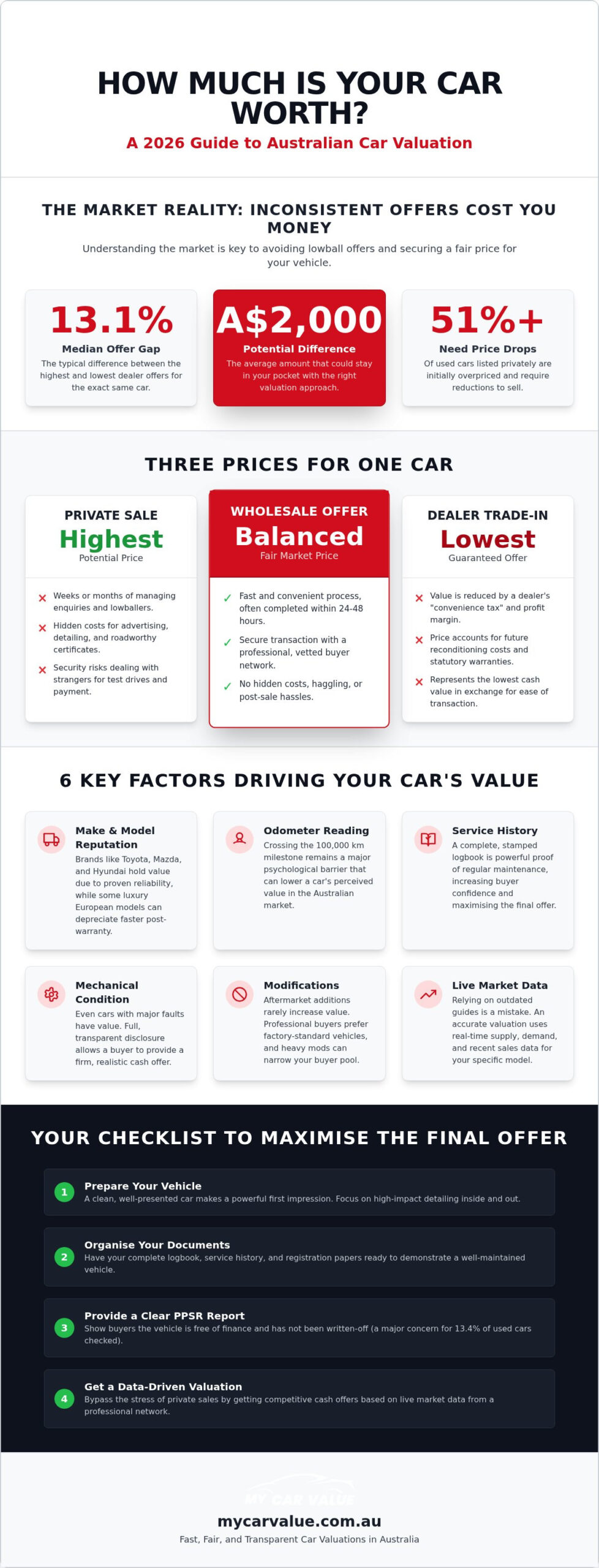
Did you know there’s a median gap of 13.1% between the highest and lowest dealer offers for the exact same vehicle in Australia? This translates to a A$2,000 difference that could stay in your pocket or disappear depending on where you look. When you start asking how much is my car worth, you often face inconsistent valuations and the stress of potential lowball offers. Finding a straight answer is difficult in a market where over 51% of used vehicles recently required price reductions before selling.
We believe the valuation process should be transparent and efficient. This 2026 guide eliminates the guesswork. Discover the exact factors that determine your vehicle’s market value and learn how to secure the best possible cash offer in the current Australian climate. We’ll preview the shift toward live market data and explain how to bypass the typical hurdles of private selling. Follow this logical roadmap to establish a realistic price expectation and achieve a fast, no-fuss sale for your car, regardless of its specific condition.
Key Takeaways
- Distinguish between trade-in, private sale, and wholesale offers to establish a realistic baseline for your vehicle’s value.
- Learn how to accurately answer “how much is my car worth” by prioritising live market data over static statistical averages.
- Identify why high-demand makes and specific odometer thresholds significantly impact resale prices in the 2026 Australian market.
- Maximise your final offer by preparing a clear PPSR report and focusing on high-impact detailing before presenting to buyers.
- Streamline the selling process by connecting with a professional buyer network to secure competitive cash offers without the stress of private classifieds.
Understanding Car Valuation in Australia: More Than Just a Number
In the current Australian climate, car market value is the exact price a willing buyer pays for a vehicle at a specific moment. It isn’t a static figure pulled from a dusty ledger. It’s a fluid number shaped by state-based regulations, local demand, and economic shifts. As of August 2026, the median used car price in Australia is A$25,800. This reflects a market that has finally stabilised after the inflated post-COVID era. Understanding car valuation requires looking past historical data and focusing on real-time demand.
To accurately answer how much is my car worth, you must distinguish between different price points. A trade-in value is typically the lowest, while a private sale price represents the theoretical ceiling. Wholesale cash offers sit in the middle, providing a balance of speed and fair market returns. In 2026, supply chain shifts have made certain models more valuable than others, meaning a car’s worth can change significantly in just a few months. Relying on data from last year will likely lead to an unrealistic expectation.
The Difference Between Trade-In and Private Sale Price
A dealer trade-in offer includes what many call a “convenience tax.” You accept a lower price because the dealer handles the paperwork, reconditioning, and statutory warranties. Chasing a higher private sale price often involves hidden costs. You’ll spend weeks managing enquiries, hosting inspections, and risking security issues with strangers. Wholesale value acts as the baseline for professional buyers, representing the raw market price before retail markups are added.
Why Online Estimates Vary Between Platforms
Different platforms use different algorithms to generate estimates. Some prioritise “asking prices” from classified listings, which are often inflated and optimistic. Data from June 2026 shows that over 51% of used vehicles had their prices reduced before a sale was finalised. This proves that listing prices don’t always reflect reality. Other tools focus on auction results or historical trends that may lag behind today’s market needs. For a more grounded perspective, use a vehicle market value calculator to see how current demand impacts your specific make and model. This ensures you start your selling journey with a figure based on actual market movement rather than statistical guesswork.
Key Factors Influencing Your Car’s Resale Value in 2026
Determining how much is my car worth involves looking beyond the basic year and model. In the Australian market, brand reputation dictates a significant portion of resale value. Brands like Toyota, Mazda, and Hyundai often retain higher value due to their perceived reliability and the ready availability of spare parts. Conversely, luxury European models may depreciate faster as they exit their warranty periods because maintenance costs typically escalate. A stamped logbook service history remains your most powerful tool for maintaining value. It proves the vehicle has been cared for according to manufacturer standards, which directly impacts buyer confidence.
Optional extras and aftermarket modifications often have a counterintuitive effect on your final offer. While a high-end sound system or custom wheels cost thousands to install, they rarely return that investment. In many cases, heavy modifications can narrow your buyer pool. Most professional buyers prefer a “clean” vehicle that meets factory specifications. If your car has specific faults or unique modifications, getting an expert valuation for your vehicle ensures you receive a figure based on its actual configuration rather than a generic estimate.
Mechanical Condition and the “Blown Engine” Factor
Many owners assume a car with a blown engine or a failed transmission is worth nothing more than scrap. This is a common misconception. Professional buyers often value these vehicles based on their salvageable parts or their potential for refurbishment. With 13.4% of used cars checked in 2026 having a history of being written off, transparency is essential. Disclosing mechanical faults early allows a buyer to provide a firm, realistic cash offer. It removes the risk of price haggling during the physical inspection and ensures a smoother transaction for both parties.
The Impact of Odometer Readings and Vehicle Age
The 100,000km milestone remains a major psychological barrier in the Australian used car market. Once a vehicle crosses this threshold, its perceived value often drops, even if it is in excellent mechanical health. This is partly due to buyer psychology and partly due to finance restrictions. Many lenders tighten their criteria for vehicles over ten years old or those with high kilometres, which limits the number of private buyers who can afford your car. However, a well-maintained car with 120,000km and a perfect service record will often attract a better offer than a neglected vehicle with only 80,000km. Condition and history frequently trump the numbers on the dashboard.
Redbook vs Market Value: Decoding the Price Gap
Redbook is the industry standard for insurance and finance sectors, but it isn’t a guaranteed purchase price. When you ask how much is my car worth, Redbook provides a statistical average based on historical trends. A Redbook Valuation Report costs A$33 plus GST, offering a solid baseline for theoretical value. However, these figures often lag behind immediate market shifts. Dealers and professional buyers prioritise live bidding data over static “book” values. They need to move stock quickly in a fluctuating economy, and historical data doesn’t always reflect the urgency of current demand.
There is a median gap of 13.1% between the highest and lowest dealer offers for the same vehicle in Australia. This discrepancy proves that theoretical guides are only a starting point. While Redbook uses a massive database of past sales, it cannot account for the specific buyer who needs your exact car today. Relying solely on a book value can lead to disappointment if you expect that figure to be a firm cash offer. Use these guides as a ballpark, but look to live competition for the final result.
Why Real-World Cash Offers Often Differ
Professional buyers operate on thin margins and must account for reconditioning, statutory warranties, and GST. For the 2026-27 financial year, the maximum GST credit a business can claim on a vehicle is A$6,353. These tax obligations influence the final offer you receive. If a dealership already has high “floor stock” of your specific model, their offer will naturally decrease to avoid oversupply. Connecting with professional used car buyers allows you to bypass the limitations of dealing with a single dealership. This network approach ensures your car is seen by buyers who actually have space on their lots.
Market Volatility and National Demand
Demand varies wildly across Australia. A rugged 4WD might command a premium in areas with challenging terrain or remote operations, while a fuel-efficient hybrid fetches a higher price in densely populated urban centres. Fuel prices in 2026 have shifted buyer preferences toward smaller SUVs and electric vehicles. My Car Value aggregates this national demand to find the best price, ensuring you aren’t penalised by limited individual buyer interest. By looking at national trends rather than just a restricted market, you gain a clearer picture of how much is my car worth right now. This approach bridges the gap between historical data and the reality of a competitive marketplace.
How to Maximise Your Car’s Worth Before Selling
Preparation bridges the gap between a generic estimate and a premium cash offer. When you ask how much is my car worth, you’re usually looking at a valuation range. To hit the top end of that range, you must address the vehicle’s presentation and administrative readiness. A buyer’s first impression is formed within seconds of seeing the car. If the exterior looks neglected, professional buyers will often assume the mechanical maintenance has been equally poor. Investing a small amount of time in preparation can prevent significant deductions during the final inspection.
Cosmetic Presentation and Minor Repairs
Curb appeal is vital. Apply tyre shine and ensure the interior is thoroughly deodorised to remove any lingering smells. For vehicles valued over A$20,000, a professional detail is a smart investment. It often returns double its cost in the final offer by making the car look “showroom ready.” Focus on minor, high-impact fixes. A cracked taillight or a missing hubcap should be replaced immediately. However, leave major bodywork or deep scratches to the buyer. Professional buyers can often repair these at a wholesale cost, and you rarely recoup the full retail price of major panel work.
Documentation and PPSR Transparency
Administrative transparency is just as important as physical condition. Ensure you have two keys available. Modern transponder keys are expensive to replace; missing a spare will lead to an immediate deduction from your offer. Organise your service logbook and any recent repair receipts into a single folder. This level of organisation signals a responsible owner and justifies a higher price point. It proves the vehicle has been maintained according to manufacturer standards.
A clear PPSR car check is essential for buyer confidence. It proves the vehicle has no outstanding finance and hasn’t been recorded on the Written-Off Vehicle Register. If your car does have a history on the register, disclose it immediately. Being upfront prevents price re-negotiations later in the process and builds the trust necessary to close a deal quickly. When you accurately account for these details, the question of how much is my car worth becomes much easier to answer with a firm, high-value figure.
Fast-Track Your Sale with My Car Value
My Car Value provides a direct answer to the question of how much is my car worth by replacing theoretical estimates with real-world competition. Traditional methods often leave sellers at the mercy of a single dealership’s local stock levels or the whims of private buyers. We’ve modernized this legacy system. Our platform acts as a smart intermediary, doing the heavy lifting by presenting your vehicle to a broad network of professional buyers. This approach ensures your car is valued by someone who specifically needs your make and model in their inventory.
Our coverage extends across the entire country. Whether you’re selling in major metropolitan hubs or regional centres, the process remains consistent. We facilitate connections that prioritize speed and transparency, stripping away the complexity of traditional car selling. You receive a realistic price expectation based on current demand, not just a historical average. This data-driven method removes the emotional stress of haggling and provides immediate clarity on your vehicle’s true market standing.
The My Car Value Professional Buyer Network
The strength of our platform lies in our connection to a professional network of used car buyers. We serve sellers in Melbourne, Brisbane, and every other Australian state. Instead of visiting multiple yards to haggle, you access a pool of professionals through a single point of contact. This competitive environment naturally drives better outcomes. We find the buyer who values your vehicle’s specific condition, even if it has mechanical faults or high kilometres. Our buyers are vetted professionals who understand the nuances of the Australian market, ensuring you aren’t penalised by local lack of interest.
Moving from Valuation to Cash in Hand
The transition from an online valuation to a finalised sale is designed to be seamless. Once you accept an initial estimate, a final inspection confirms the vehicle’s condition. This is a straightforward verification step, not a lengthy negotiation. We believe in transparency, so there are no hidden fees or last-minute surprises. Payment is processed quickly, often putting cash in your bank account much faster than a private sale would allow. You avoid the waiting periods typical of traditional finance settlements.
Private selling involves endless messages, failed appointments, and the risk of being ripped off. We eliminate these pain points. You can sell my car with total confidence, knowing the process is backed by professional standards. Move from inquiry to settlement in a fraction of the time it takes to manage classified listings. Start the process today and experience a smarter, faster way to trade your vehicle. We handle the hard work so you can focus on your next move.
Secure Your Best Market Offer Today
Determining how much is my car worth doesn’t have to be a guessing game. You’ve seen how real-time market demand and proper preparation outweigh theoretical book values. By focusing on transparency and professional presentation, you position your vehicle for the highest possible return. The Australian market in 2026 rewards sellers who move quickly and use data-driven platforms to bypass the stress of private classifieds. It’s about finding the specific buyer who values your car’s unique history and condition.
We provide national coverage and fast payment to ensure your transition to a new vehicle is seamless. Our platform connects you to a network of 1,000+ professional buyers ready to compete for your car. These no-obligation valuations provide the immediate clarity you need to make an informed decision. You avoid the pressure of traditional dealership tactics and the uncertainty of waiting for a private enquiry that may never come.
Take control of your sale and secure a fair price with minimal effort. We’re here to simplify the process and help you move forward with confidence.
Frequently Asked Questions
How is my car’s value calculated online?
Online valuations use algorithms to analyse your car’s make, model, year, and kilometres against current market data. These tools look at recent sales and current listings across Australia to estimate a price range. For a more accurate figure, you should provide specific details about the vehicle’s condition and service history. This ensures the calculation reflects real-time demand rather than just a generic statistical average.
Is Redbook value the same as the price I will get from a buyer?
No, Redbook provides a statistical average used primarily for insurance and finance purposes. It often lags behind immediate market changes and doesn’t account for the specific stock needs of a professional buyer. While it’s a helpful guide, a real-world offer depends on live competition and the current demand for your specific model. Use Redbook for a ballpark figure, but expect cash offers to fluctuate based on market volatility.
Can I sell my car if it has a blown engine or mechanical faults?
Yes, you can sell a car with major mechanical issues like a blown engine. Professional buyers often value these vehicles for their salvageable parts or refurbishment potential. Disclosing these faults upfront ensures you receive a firm, transparent offer without last-minute price drops. This is a much faster alternative to private selling, where most buyers seek roadworthy vehicles and avoid cars requiring significant repairs.
Does a full service history really increase my car’s worth?
A stamped logbook service history significantly increases your car’s resale value by proving consistent maintenance. It builds buyer confidence and justifies a higher price point compared to vehicles with missing records. When you ask how much is my car worth, remember that a clear history can prevent thousands in deductions. It demonstrates that you’ve followed manufacturer standards, which reduces the perceived risk for the next owner.
How much does a high odometer reading affect my car’s value?
High kilometres typically decrease a car’s value because they signal increased wear and upcoming maintenance costs. Crossing the 100,000km milestone often acts as a psychological barrier for many Australian buyers. However, a well-maintained car with high kilometres and a perfect service record can still secure a competitive offer. The impact depends on how the vehicle compares to the average distance travelled for its specific age and model type.
What is a PPSR check and do I need one to sell my car?
A PPSR check is an official search of the Personal Property Securities Register to confirm a vehicle has no outstanding finance or written-off history. While you don’t strictly need one to list a car, professional buyers will always conduct this check before finalising a sale. Providing a clear report upfront builds trust and speeds up the transaction. It ensures the buyer that you have the legal right to sell the vehicle.
Why is my trade-in offer lower than the prices I see on carsales?
Trade-in offers are lower because dealers must account for reconditioning costs, statutory warranties, and their own profit margins. The prices you see on classified sites are “asking prices,” which are often inflated and subject to negotiation. Data shows over 51% of used vehicles recently required price reductions before selling. Trade-ins offer immediate convenience and tax benefits, which compensates for the lower raw figure compared to a theoretical private sale.
How long does it take to get a cash offer through My Car Value?
You can receive an initial valuation online in minutes. After providing your vehicle details, we connect you with our network of professional buyers to secure a competitive offer. The entire process, from the first enquiry to the final inspection and payment, is designed for speed. Most sellers find this method much faster than private listings, often completing the transaction and receiving funds in their bank account within a few business days.