

Roadworthy Certificate (RWC) Australia: The 2026 Seller’s Guide
What if the biggest hurdle to selling your car isn’t finding a buyer, but passing an inspection you don’t actually need? For many Australian sellers, the Roadworthy Certificate (RWC) feels like a high-stakes gamble. You worry about failing the inspection. You fear the mounting repair costs that follow. It’s a common frustration, especially when you want to sell car without rwc delays or expensive mechanical bills. We recognise that state-specific rules often create more confusion than clarity.
This guide simplifies the entire process for 2026. You’ll learn exactly what an inspection covers, how much it costs in your state, and how long your certificate remains valid. More importantly, we’ll show you how to handle the selling process without the traditional repair hassle. We start with a clear breakdown of state regulations and conclude with a streamlined strategy to move your vehicle quickly. Get ready to take control of your sale with confidence and speed.
Key Takeaways
- Identify the specific safety requirements for your state to avoid confusion between an RWC, Safety Certificate, or Pink Slip.
- Master the inspection checklist for components like tyres and brakes to prevent unexpected failure results and high repair costs.
- Learn how to legally sell car without rwc delays by connecting with professional buyers who purchase vehicles in as-is condition.
- Navigate the 2026 validity periods and inspection fees to ensure your paperwork remains current throughout the selling process.
- Use a data-driven valuation to decide if pre-sale repairs offer a genuine return on investment for your specific vehicle.
What is an RWC? Understanding Roadworthy Certificates in Australia
A Roadworthy Certificate (RWC) is a formal document verifying that a vehicle meets the minimum safety requirements to be driven on public roads. It’s a point-in-time assessment. This means it confirms the car is safe on the day of the test; it doesn’t predict the future. The certificate serves as a baseline for road safety, ensuring that vehicles on Australian roads don’t pose a danger to the driver or other road users.
Most sellers encounter this requirement when they decide to list a vehicle privately. However, if you want to sell car without rwc complications, you’ll need to understand the legal triggers. These certificates are typically mandatory for:
- Transferring ownership to a private buyer.
- Re-registering a vehicle that has been unregistered for a period.
- Clearing a police-issued defect notice or “yellow sticker”.
RWC vs. Mechanical Inspection: Know the Difference
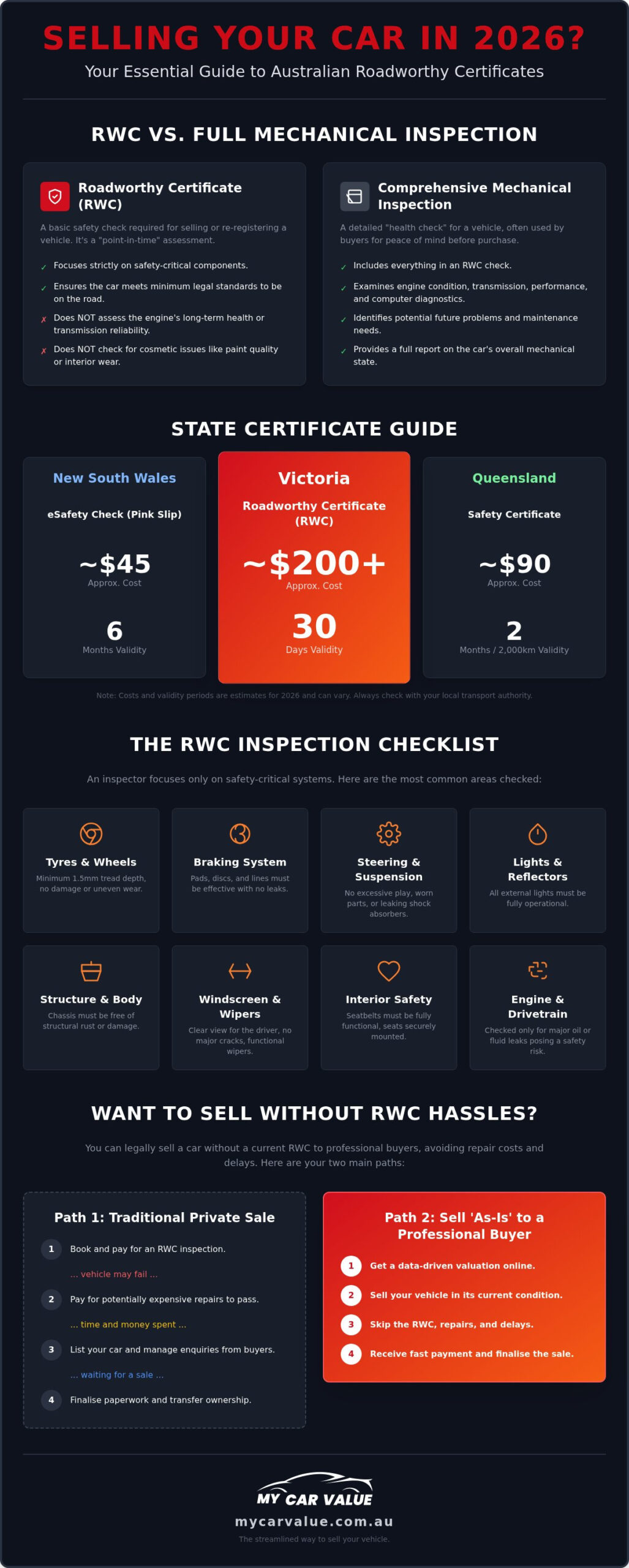
Don’t confuse a roadworthy check with a comprehensive mechanical inspection. RWCs are narrow. They focus strictly on safety-critical components. The examiner checks tyres, brakes, steering, and lights. They ensure the structure is sound and the windscreen is clear. They won’t check if your engine is burning oil or if the transmission shifts smoothly. A car can be legally roadworthy while being mechanically unreliable. This distinction is vital for sellers who fear a “fail” result based on engine noises that don’t actually impact the safety certificate.
State-by-State Terminology Across Australia
The terminology varies depending on your location. In Victoria and Queensland, you’ll hear the term RWC or Safety Certificate. In New South Wales, it’s widely known as a Pink Slip or an eSafety check. For a broader look at how these systems differ, you can review the history of Vehicle inspection in Australia.
In 2026, most states have digitised these records. When an authorised inspection station completes the check, the result is uploaded directly to the transport authority’s database. This makes it easier to sell car without rwc paperwork physically in hand, as the digital record links to your registration. Always verify the latest requirements with your state’s transport department. While the systems are modernised, the core requirement for a safety baseline remains the same across all jurisdictions.
What Does an RWC Inspection Cover? The Safety Checklist
An RWC inspection is a technical audit of your vehicle’s safety-critical systems. It doesn’t assess the car’s cosmetic appearance or general engine health. Instead, it focuses on components that could cause an accident or injury if they fail. Understanding this checklist is the first step if you want to sell car without rwc surprises. Knowing these requirements helps you decide if it is better to fix the car or sell car without rwc hassles through a professional buyer.
- Tyres and wheels: Inspectors check for a minimum tread depth of 1.5mm. They also look for uneven wear, bulges, or structural damage to the rims.
- Braking system: This includes a physical test of the pads, discs, and drums. Any leaks in the hydraulic lines or a faulty handbrake will result in a failure.
- Steering and suspension: The car must handle predictably. Worn bushes, leaking shock absorbers, or excessive play in the steering wheel are common failure points.
- Lights and reflectors: Every external light must work. This includes high beams, indicators, and the tiny light above your rear number plate.
Visibility and Structural Integrity
Your windscreen must provide a clear view of the road. Chips or cracks in the driver’s line of sight are strictly regulated. If a crack is too large or interferes with the wipers, you won’t receive your Certificate of Roadworthiness. Inspectors also check the chassis for structural rust. While surface rust is often acceptable, any corrosion that compromises the vehicle’s strength is a major defect. Wipers and washers must also be fully functional to ensure you can clear the screen in poor weather.
Interior Safety and Engine Basics
The interior check focuses on occupant protection. All seats must be secure. Every seatbelt must click firmly into place and retract without hesitation. Frayed or cut belt webbing is an automatic fail. Under the bonnet, the engine check is limited but vital. Mechanics look for significant oil leaks that could drip onto hot components or the road surface. If your car has these issues, it might be more cost-effective to value your car as-is rather than paying for expensive repairs. 2026 Australian safety standards ensure every registered vehicle maintains a baseline of mechanical integrity and occupant safety.
RWC Costs and Validity: Planning Your Sale
Navigating the financial side of a roadworthy inspection requires a clear understanding of what you are paying for. In most states, the inspection fee is not a fixed government charge. Instead, it is a service fee set by the individual authorised provider. Costs fluctuate based on the workshop’s location and the type of vehicle you own. For example, a standard passenger car in Victoria typically costs between A$150 and A$250; SUVs or 4WDs may attract higher fees in the A$180 to A$280 range. In New South Wales, the government regulates the fee; a pink slip for a light vehicle in 2026 costs approximately A$51 to A$52. Remember that this fee only covers the inspection itself. Any repairs needed to meet the Certificate of Roadworthiness requirements will be an additional expense. If these costs are prohibitive, you may prefer to sell car without rwc by dealing with a licensed motor dealer.
Validity periods are another critical factor in your sales timeline. In Victoria, a certificate is only valid for 30 days from the date of issue. Queensland offers a window of two months or 2,000 kilometres for private sellers. If your vehicle fails the initial check, workshops usually provide a re-inspection window. This period is often seven to fourteen days. During this time, you must rectify the listed defects. Returning within this window usually results in a reduced re-inspection fee or even a free follow-up, depending on the provider’s policy. This structured approach helps ensure vehicles remain safe without forcing sellers into an endless cycle of inspections.
Managing Potential Repair Costs
The total cost of a roadworthy can escalate quickly if your car requires safety-critical repairs. You must distinguish between essential safety items, such as worn brake pads, and optional cosmetic maintenance like minor paint scratches. A roadworthy failure can be a shock for private sellers who haven’t budgeted for mechanical work. To avoid this, ask for a pre-inspection report or a repair quote before committing to the formal RWC process. If the repair bill exceeds your budget, you might choose to sell car without rwc delays by opting for a professional buyer who handles the repairs themselves after the purchase is complete.
Timing Your Certificate for a Smooth Transfer
Timing is everything when selling a vehicle privately. Obtaining your RWC too early is a common mistake. If the car doesn’t sell within the 30-day or 60-day validity period, the certificate expires. You will then have to pay for a completely new inspection. This risk is particularly high when waiting for the right private buyer to appear. For a more detailed look at coordinating your sale, consult our Sell My Car guide. Aligning your inspection with a serious offer ensures you don’t waste money on a document that becomes useless before the registration is transferred.
Selling a Car Without an RWC: Is It Possible?
The short answer is yes. While state laws in Victoria and Queensland generally require a certificate for private sales, there are clear legal pathways to sell car without rwc delays. The most efficient route is selling to a professional buyer or a Licensed Motor Car Trader (LMCT). These entities are legally authorised to purchase vehicles as-is. They take on the responsibility for the safety inspections and necessary repairs after the transaction is complete, shifting the compliance burden entirely away from you.
Other exemptions exist but are more situational. For instance, transferring registration to a spouse or de facto partner often doesn’t require a certificate in several Australian states. You can also choose to cancel the registration and sell the vehicle as an unregistered asset. This is a common tactic for cars that need significant mechanical attention. However, keep in mind that an unregistered car cannot be legally driven on the road. This limitation often deters private buyers and can significantly lower your final sale price.
The Benefits of Selling to Professional Used Car Buyers
Choosing to sell car without rwc through a professional channel saves you more than just the inspection fee. You skip the weeks of waiting for a mechanic’s appointment and the subsequent repair queue. Private buyers often view a car without an RWC with suspicion, but professional Used Car Buyers understand the mechanical risks. They value the vehicle based on its potential, allowing you to walk away with a fair price instead of a repair bill. This removes the “failed RWC” stigma that can kill a private listing instantly.
Impact on Your Car’s Market Value
Does a current RWC actually increase your car’s value? In a private market, it is often seen as a prerequisite rather than a value-add. Most private buyers won’t even look at a listing without one. You must calculate if the repair costs will be offset by the higher private sale price. If your car needs A$2,000 in safety work to pass, but the market value only increases by A$1,000 with a certificate, you are losing money. Use a Vehicle Market Value Calculator to establish your baseline worth. This data helps you decide if the “as-is” price from a professional is more lucrative than the net profit of a private sale.
Maximising Your Sale Price with My Car Value
Maximising your sale price starts with a clear understanding of the current market. Don’t guess your car’s worth based on outdated listings or emotional attachment. A precise, data-driven valuation gives you the leverage needed to negotiate with confidence. You must weigh the high-effort path of a private sale against the speed and reliability of a professional connection. While a private buyer might theoretically offer a higher headline figure, the hidden costs of an RWC, advertising, and mechanical repairs often significantly reduce your actual profit.
My Car Value bridges this gap by removing the traditional friction of the used car market. We connect you with professional buyers who simplify the entire process. These experts handle the compliance paperwork on your behalf, providing the most reliable way to sell car without rwc stress. You receive a firm offer based on real-time data, and the buyer takes full responsibility for the safety checks and any necessary repairs after the transaction is finalised. This ensures you get paid quickly without the risk of a failed inspection stalling your progress.
Streamlining the Selling Experience
Access our Value My Car service to establish a realistic market figure in minutes. This tool uses live Australian data to reflect the most current 2026 pricing trends. Once you have your valuation, you can choose to skip the mechanic’s repair queue entirely. Buyers in our network are equipped to handle the RWC process and can even organise vehicle transport directly from your driveway. Transparency remains a vital part of this process. Providing a Car Service History Check builds immediate trust with professional buyers. It proves you have maintained the vehicle’s core systems, even if you haven’t yet obtained a formal safety certificate.
Your Next Steps to a Successful Sale
Gather your vehicle’s VIN and your most recent service records to begin. These documents allow our platform to provide a highly accurate 2026 quote tailored to your vehicle’s specific condition. Next, decide on your preferred selling route. You can choose to invest time and money into fixing the car for a private sale, or you can sell car without rwc delays by opting for a professional buyer. For many Australians, the professional route is the smarter financial move, especially for older vehicles or those requiring safety-critical work like new tyres or brake rotors.
Take the first step toward a seamless sale today. Use our Value My Car tool to see what your vehicle is worth in its current condition and discover a faster way to sell.
Take Control of Your Car Sale
Understanding the RWC process doesn’t have to be overwhelming. You now know that while an inspection covers safety basics like tyres and brakes, it isn’t a total mechanical guarantee. You also understand how state-specific costs and 30-day validity periods impact your selling timeline. If the repair bill for a private sale looks too high, you have a legal pathway to sell car without rwc stress by choosing a professional buyer. This route protects your profit and saves you from the uncertainty of a failed inspection.
Our platform provides the essential tools you need for a fast result. We use accurate 2026 market data to deliver a realistic figure for your vehicle based on its current condition. Our national network of professional buyers specialises in as-is purchases, removing the need for you to visit a mechanic or manage complex compliance paperwork. This streamlined digital process ensures you get a fair price with minimal effort and total transparency.
Frequently Asked Questions
How much does an RWC cost in Australia in 2026?
Costs vary by state and vehicle type. In Victoria, prices are unregulated and typically range from A$150 to A$250 for standard cars. Queensland sets a regulated fee of A$102.70 for vehicles up to 4.5t GVM as of July 2026. New South Wales pink slips are approximately A$51 to A$52. These fees cover the inspection only; any required safety repairs to meet roadworthy standards will incur additional costs from your mechanic.
Do I need an RWC if I am selling my car to a dealer?
No, you don’t need an RWC when selling to a licensed motor dealer. Dealers and professional used car buyers are exempt from this requirement in all Australian states. They take on the legal responsibility of ensuring the vehicle is roadworthy after the purchase. This is a common strategy for owners who want to avoid the time and expense of fixing safety defects before finalising their car sale.
How long is a Roadworthy Certificate valid for when selling?
Validity periods depend on your specific state transport authority. In Victoria, a Roadworthy Certificate is valid for 30 days from the date of issue. Queensland safety certificates last for two months or 2,000 kilometres for private sellers. In New South Wales, a pink slip remains valid for six months. Ensure you time your inspection correctly to avoid the certificate expiring before you find a buyer and complete the registration transfer.
What happens if my car fails the RWC inspection?
If your vehicle fails, the inspector will provide a list of items that require rectification. You generally have a re-inspection window of seven to fourteen days to fix these defects and return to the same station. If you miss this window, you may be charged for a full new inspection. If the repair costs are too high, you might choose to bypass the repairs and connect with professional buyers through our platform.
Can I sell a car without an RWC in Australia?
Yes, you can legally sell car without rwc documentation by choosing specific sales channels. Selling to a licensed motor dealer or a professional buyer removes the need for a certificate entirely. Alternatively, you can cancel the registration and sell the vehicle as an unregistered asset. While this avoids the RWC requirement, it often results in a lower sale price because the buyer cannot drive the car away immediately.
Is an RWC the same as a car service?
No, an RWC and a car service are entirely different procedures. A roadworthy check is a mandatory safety inspection focusing on critical components like tyres, brakes, and lights to ensure the car is safe for the road. A car service is proactive maintenance designed to prolong the life of your engine and gearbox through oil changes and filter replacements. A well-serviced car is more likely to pass a roadworthy test easily.
Does an RWC check the engine and gearbox?
An RWC doesn’t provide a comprehensive check of the engine or gearbox performance. The inspector only examines these components for safety risks, such as significant oil leaks that could cause a fire or drop onto the road surface. They also check that engine mounts are secure. They won’t assess internal wear, compression, or transmission smoothness. For a full mechanical report, you would need a separate pre-purchase inspection from a specialised mechanic.
Who is responsible for getting the RWC, the buyer or the seller?
In Victoria and Queensland, the legal responsibility to provide a valid safety certificate rests with the seller when disposing of a registered vehicle. Failure to provide one in Queensland can lead to a fine exceeding A$700. In New South Wales, while not strictly required for the sale, a pink slip is necessary for the buyer to transfer the registration if the car is older than five years. Always check your state’s current 2026 regulations.