

Second Hand Car Values Online: The 2026 Australian Seller’s Guide
Did you know that in June 2026, over 51% of used vehicles in Australia had their prices reduced before they finally sold? Finding accurate second hand car values online has become a moving target in a market where stock levels are high and buyers hold the upper hand. It’s frustrating to see one figure on a screen only to be met with a low-ball offer when you’re ready to sign.
We understand the uncertainty that comes with conflicting data and the fear of being undervalued. This guide will show you how to accurately determine your vehicle’s worth using modern digital tools. You’ll learn how to bridge the gap between a digital estimate and a real-world bank transfer without the stress of private classifieds.
We’ll explain the crucial difference between market value and trade-in price while showing you how to verify your car’s worth reliably. Follow this logical path to sell your car quickly for a price that reflects its true condition and service history.
Key Takeaways
- Understand the difference between retail, trade-in, and wholesale prices to set realistic expectations for your vehicle’s worth.
- Use your Vehicle Identification Number (VIN) to pull precise build data and ensure your quote reflects your car’s exact specifications.
- Learn why live market data provides more accurate second hand car values online than traditional book values that often lag by several months.
- Discover how simple steps like organising a full service history and professional detailing can significantly increase the final offer you receive.
- Master the transition from a digital estimate to a firm offer by connecting directly with a network of professional used car buyers.
Understanding Second Hand Car Values Online in Australia
In the 2026 Australian market, an online valuation is more than just a guess. It is a data-driven benchmark that reflects live market conditions. Finding accurate second hand car values online requires looking past the surface numbers and understanding the data behind them. Using digital tools allows you to gather essential research before you ever speak to a buyer. These platforms aggregate thousands of data points to give you a starting point for your sale. Understanding the Car valuation process is the first step to ensuring you don’t leave money on the table.
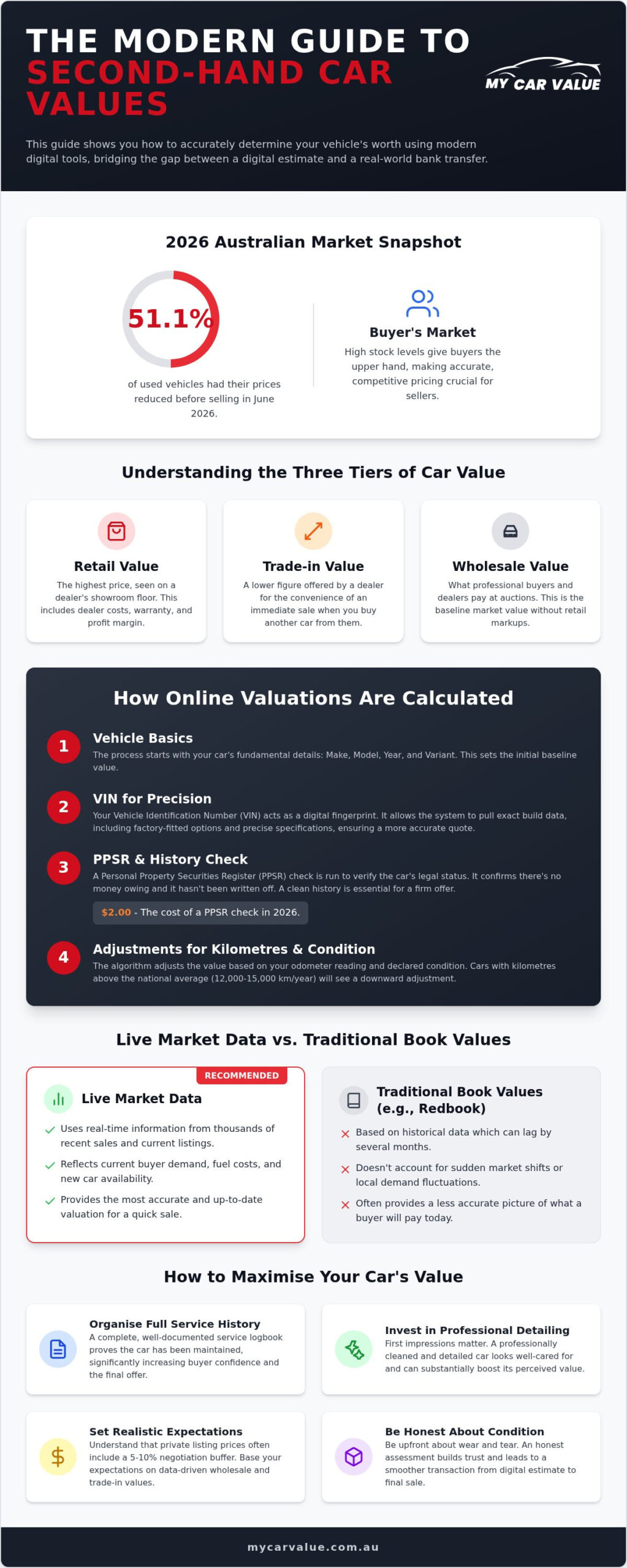
You need to recognise three distinct value tiers. Retail value is the price a dealer asks on the showroom floor. Trade-in value is a lower figure offered for the convenience of a quick swap. Wholesale market value represents what professional buyers pay at auction. Prices in Australia currently fluctuate based on interest rates and fuel costs. When petrol prices spike, smaller cars often see a surge in demand. External factors like the 0.6% growth in new car sales during the first half of 2026 also impact used prices. When new cars are readily available, used car values tend to soften as buyers opt for the latest models.
The Difference Between Asking Price and Realised Value
Many sellers make the mistake of browsing classified sites to determine second hand car values online. These listings show the asking price, which is essentially what a seller hopes to receive. Most private listings include a negotiation buffer of 5% to 10%. Professional buyers don’t look at these hopeful numbers. They use realised data, which is the actual price paid once the paperwork is signed. Professional buyers focus on the speed of sale and the cost of reconditioning. They calculate value based on what the car will actually fetch at a dealer-only auction, not the inflated prices seen on social media marketplaces. This distinction is vital for setting a realistic budget for your next vehicle.
Why 2026 Market Trends Matter for Your Estimate
The 2026 market is unique. Used electric vehicle (EV) sales rose by 54.6% in the first half of the year. This surge is putting pressure on traditional internal combustion engine (ICE) residuals. If you are selling a petrol SUV or a diesel ute in cities like Sydney or Melbourne, your car still holds strong appeal due to local lifestyle preferences. Market Value is the intersection of historical data and current buyer demand. It changes weekly based on supply chain health and new car availability. In June 2026, 51.1% of used vehicles had their prices reduced before being sold. This trend highlights why a static estimate from three months ago is likely no longer accurate.
How Online Estimators Calculate Your Vehicle’s Worth
Online estimators don’t pull numbers out of thin air. They use complex algorithms to determine second hand car values online based on real-time data. These systems start with the basics: make, model, year, and variant. The algorithm then cross-references these details with thousands of recent sales and current listings. Your odometer reading is the most significant variable in this calculation. High kilometres suggest more mechanical wear, which automatically triggers a downward adjustment in the digital quote.
The Role of the VIN and PPSR Check
The Vehicle Identification Number (VIN) acts as your car’s digital fingerprint. When you enter it into a valuation tool, the system pulls your car’s exact build data from national databases. This ensures the estimator accounts for specific factory features rather than just a base model. A PPSR check is another critical step in the calculation. This search verifies if the car has any money owing or if it has been recorded as a write-off. In 2026, a PPSR check costs just $2.00. Professional buyers will not touch a vehicle with encumbrance, so a “clean” history is essential for a firm offer. This transparency protects both parties and ensures the valuation is grounded in legal reality.
Adjusting for Kilometres and Condition
The average Australian vehicle travels between 12,000 and 15,000 kilometres per year. If your car sits significantly above this range, expect the algorithm to reduce the estimate. Digital tools typically categorise condition into tiers like Fair, Good, Excellent, or Showroom. Be realistic here. The harsh Australian climate often causes “wear and tear” that sellers overlook, such as sun-faded paint or cracked leather. This is why two different websites might provide slightly different second hand car values online for the same vehicle. One might be more aggressive with its condition penalties than another.
Accessories also play a major role in the Australian market. Features like bull bars, snorkels, or tow kits add value to utes and SUVs in regions like Brisbane or Perth. Sunroofs and premium leather interiors are also tracked. The Federal Chamber of Automotive Industries monitors these trends, noting how specific options influence resale demand. To see how these factors impact your specific vehicle, you can value my car using our streamlined digital tool to get an instant benchmark.
Redbook vs. Market Value: Which Number Should You Trust?
Most Australian sellers start their journey with Redbook or Glass’s. These are the industry standards for insurance providers and finance companies. However, there is often a significant disconnect between these “book” figures and what a professional buyer will actually pay. Insurance companies value predictability; they use historical data to set “agreed values” and premiums. Dealers and professional buyers ignore these guides when the market is moving fast. Research indicates that Redbook values can lag the live market by 3 to 6 months. This delay creates a frustrating gap between your expectations and real-world offers when you check second hand car values online.
When Book Value Falls Short
Standard guides rely on mathematical depreciation curves. They can’t account for “cult” status or sudden shifts in consumer preference. For example, if a manufacturer announces they are moving to a purely electric line-up, the value of their final diesel models often defies the “book” and climbs. Rare colour combinations or specific factory options also create outliers that standard data simply misses. If your car has a unique specification, the book value will likely underquote you. Conversely, if a model develops a known mechanical reputation, the book might remain high while the actual market value plummets. Using a vehicle market value calculator helps bridge this gap by looking at current demand levels rather than just historical averages.
The Importance of Live Market Data
Professional buyers live in the “now”. They track wholesale clearances and auction results across the country every day. In cities like Adelaide or Perth, local stock levels can influence prices more than a national average. Live data reflects the immediate impact of economic changes, such as the 16.2% drop in used car sales recorded in June 2026. Buyers use this information to adjust their offers instantly to stay competitive. Relying on real-time platforms ensures your second hand car values online are accurate for the exact week you intend to sell. This methodical approach prevents the frustration of chasing a price that no longer exists in the current buyer’s market. It moves you closer to a concrete sale rather than a theoretical estimate.
Maximising Your Car’s Value Before Seeking Quotes
Algorithms provide a baseline for second hand car values online, but your preparation determines the final cheque. A professional buyer will look past the digital estimate to see how well the car has actually been treated. Addressing minor issues before an inspection prevents a buyer from “chipping away” at your price. Replace blown light bulbs, fix cracked wiper blades, and ensure all tyres meet legal tread requirements. Organise your registration papers, spare keys, and all service receipts into a single folder to project a sense of transparency and care. This methodical approach signals that the vehicle is a low-risk purchase.
The Logbook Premium
A car service history check is the single most important tool for justifying a higher price. Buyers in Sydney and Melbourne often look for “Dealer Serviced” stamps, which can command a premium over independent workshop entries. However, any consistent history is better than none. Presenting a chronological record of maintenance proves you haven’t skipped essential oil changes or timing belt replacements. This documentation reduces the risk for the buyer, allowing them to offer a figure at the top of the market range. If you have misplaced your logbook, contact your regular mechanic to print a summary of your service history.
Presentation and First Impressions
Curb appeal isn’t just for real estate. A professional detail can add hundreds to an offer by making the car “showroom ready” for an inspection. Focus on high-traffic areas like the steering wheel, driver’s seat, and centre console. Neutralising odours from pets or smoke is vital for professional buyers who need to turn the stock quickly. Simple wins like replacing faded number plates or worn floor mats can drastically improve the first impression. Clean headlights also suggest a car that has been garaged rather than left in the harsh Australian sun. These small investments protect the second hand car values online that you’ve worked hard to research.
From Screen to Sale: Connecting with Professional Buyers
A digital quote is only the first step in the journey. To finalise your sale, you must transition from viewing second hand car values online to receiving a firm, physical offer. This involves a brief inspection to confirm the vehicle’s condition and service history. Professional buyers are currently seeking quality stock across major metropolitan centres, including Sydney, Melbourne, and Brisbane. By connecting with these experts, you bypass the uncertainty of the open market and secure a guaranteed result.
Selling to a professional offers immediate advantages. You avoid the risk of uninsured test drives and the frustration of “tyre kickers” who have no intention of buying. Payment is secure and usually processed on the same day. This efficiency is vital in a market where used car sales volumes decreased by 16.2% in June 2026. Taking a professional offer ensures you aren’t left holding a depreciating asset while waiting for a private buyer who may never materialise.
Avoiding the Private Sale Headache
The traditional sell my car experience through private classifieds is often a source of significant stress. Scammers and time-wasters frequent these platforms, looking for easy targets. A professional network provides a layer of protection that private listings cannot match. In the current volatile economy, the speed of a professional transaction often outweighs the marginal price increase you might get from a private sale. Don’t let your vehicle sit on the driveway for weeks. Choose a path that prioritises your time and security.
How the My Car Value Process Works
We have streamlined the path from research to bank transfer. Follow these three logical steps to exit your vehicle with confidence:
- Step 1: Enter your vehicle details and VIN into our platform for an accurate, market-based valuation. This provides your baseline for second hand car values online.
- Step 2: Get connected with our network of used car buyers who are actively looking for your specific make and model.
- Step 3: Arrange a physical inspection at a time that suits you. Finalise the sale with professional transparency and a secure funds transfer directly into your account.
This methodical workflow removes the friction from the selling process. It empowers you to make an informed decision without the pressure of a traditional dealership environment. Start your journey today and see how simple a professional car sale can be.
Secure Your Vehicle’s True Market Value
Navigating the Australian used car market in 2026 requires more than a quick glance at a screen. You now understand that second hand car values online are benchmarks that require validation through live market data. By prioritising your service logbook and presentation, you’ve taken the necessary steps to justify a premium offer. You are no longer guessing what your vehicle is worth; you are using data to drive the conversation.
Connecting with a professional network removes the friction of private classifieds and tyre kickers. This path allows you to move from a digital estimate to a secure bank transfer with total confidence. Our Australia-wide network provides transparent, data-driven valuations and a streamlined path to a sale. It’s the most efficient way to handle your vehicle’s disposal in a volatile market while ensuring you receive a fair price.
Turn your research into a real-world result. Experience a faster, safer, and more reliable way to sell your car today.
Frequently Asked Questions
How accurate are second hand car values online in Australia?
Digital estimates are highly accurate as a market benchmark because they aggregate real-time data from auction results and current listings. They provide a reliable starting point for your research. However, these tools cannot see your vehicle’s specific condition. A physical inspection is always the final step to turn a digital estimate into a firm financial offer.
Do online car valuations include the cost of a Roadworthy Certificate (RWC)?
Most online estimates do not factor in the cost of an RWC. Private sale price guides usually assume the seller will provide a certificate as part of the deal. If you sell to a professional buyer, they often purchase the vehicle “as-is.” This removes the need for you to spend money on repairs just to pass a roadworthy test before the sale.
Why is my online car valuation lower than what I see on classified sites?
Classified sites display asking prices, which almost always include a negotiation buffer and dealer margins. Online valuations focus on the realised value, which is the actual amount paid once the deal is done. This reflects current market appetite rather than the hopeful figures seen in private advertisements that may take weeks to sell.
Does a high odometer reading automatically ruin my car’s value?
It doesn’t ruin the value, but it does trigger a standard reduction in the quote. High kilometres indicate more mechanical wear and suggest that major service intervals are approaching. You can often offset some of this reduction by providing a complete service history. This proves that the vehicle has been maintained correctly regardless of the distance travelled.
Can I get a valuation for a car with a blown engine or mechanical issues?
You can, but the valuation will be significantly lower than a car in running order. Most standard tools assume a vehicle is in “Good” or “Fair” condition. If your car has major mechanical failures, you should speak directly to a professional buyer. They can provide a tailored quote based on the car’s salvage or repair value.
Is Redbook the only source for car valuations in Australia?
Redbook is a well-known historical data provider, but it isn’t the only source. Many modern platforms now use live market data from wholesale auctions and dealer networks to determine second hand car values online. These live sources often reflect sudden shifts in buyer demand more accurately than traditional book values that rely on historical averages.
How often do online car values change?
Market values can shift weekly based on stock levels and economic conditions. Factors like changing fuel prices or new model releases immediately impact the secondary market. Because the Australian market is currently volatile, a valuation from even a month ago may no longer be accurate. Always get a fresh quote when you are ready to sell.
Will adding aftermarket accessories increase my online valuation?
Standard algorithms often miss accessories, but they add significant value during a professional review. Features like bull bars, snorkels, and tow kits are highly prized in the Australian market, especially for utes and SUVs. Mention these additions when seeking second hand car values online to ensure your final offer reflects the true worth of your vehicle’s upgrades.