

Car Value Finder: The 2026 Guide to Accurate Australian Valuations
Why settle for a “guesstimate” when the Australian used car market shifted by 6.6% in the first half of 2026? Most owners rely on outdated data, only to face the frustration of tyre-kickers and low-ball dealership offers. You want a car value finder that provides more than just a random number; you need a tool that reflects real-world demand and current economic shifts.
We know the goal is to secure a fair price without the stress of private listings or endless negotiations. It’s about finding that balance between speed and profit while ensuring you don’t leave money on the table. This guide bridges the gap between a digital estimate and a professional sale.
You will learn how to pinpoint your vehicle’s true worth in a market where hybrid values are holding at 93.4% and new competitors are changing the game. We’ll show you how to connect with professional buyers to streamline your experience and get a competitive result fast.
Key Takeaways
- Navigate 2026 market volatility by using real-time data instead of relying on outdated price guides.
- Discover how a car value finder uses actual Australian auction and dealer data to pinpoint your vehicle’s current market position.
- Identify the specific factors, such as regional demand and reconditioning costs, that bridge the gap between digital estimates and final offers.
- Prepare the correct documentation and clear your PPSR history to ensure you don’t face unnecessary deductions during the inspection.
- Skip the stress of private sales by connecting directly with professional used car buyers for a fast, transparent transaction.
Using a Car Value Finder in the 2026 Australian Market
A car value finder is a sophisticated digital tool that aggregates thousands of recent transaction points across the country. It doesn’t just guess; it pulls from auction results, dealer wholesale figures, and reported private sales to create a realistic market snapshot. Understanding the car valuation process is the first step in avoiding the common trap of overestimating your vehicle’s worth based on emotional attachment. It provides an objective baseline that strips away the guesswork.
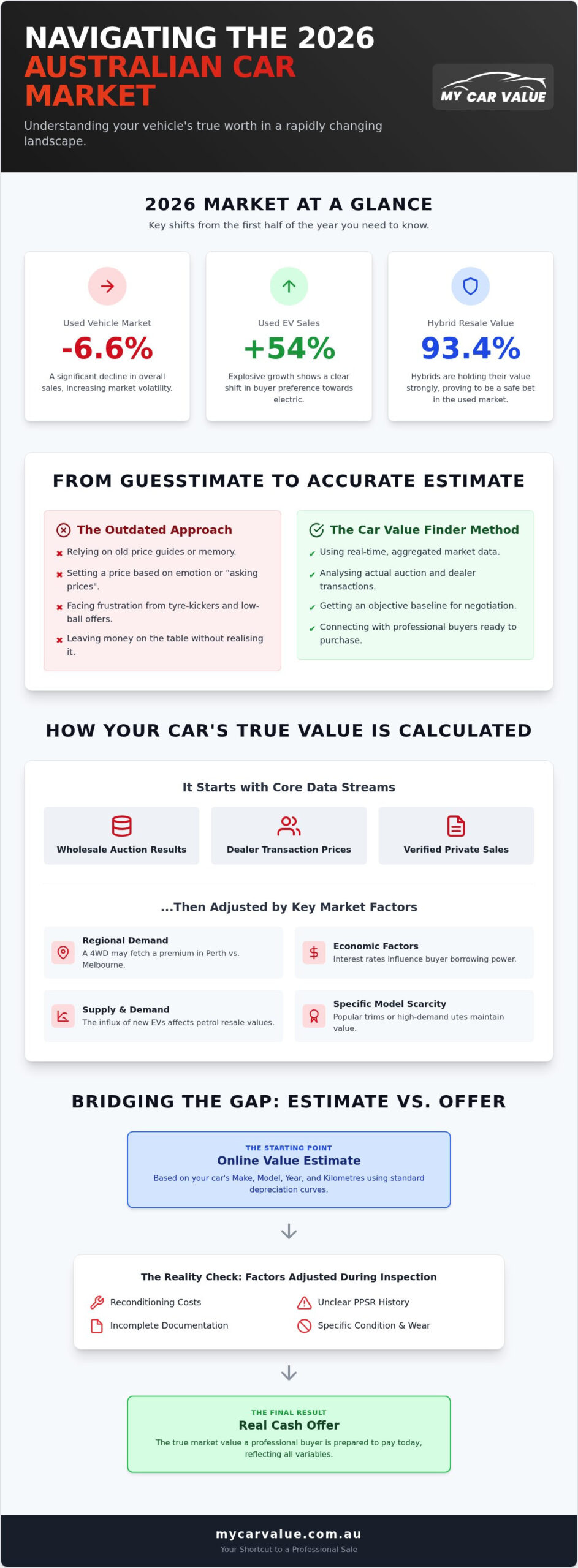
In 2026, the Australian market is particularly volatile. Used vehicle sales saw a 6.6% decline in the first half of the year, while used EV sales surged by over 54%. If you’re using data from six months ago, you’re already behind. Real-time data is essential because it accounts for these rapid shifts in buyer preference and the increasing pressure from affordable new entrants in the SUV and electric segments. A car value finder helps you stay ahead of these trends.
There is a significant difference between “asking prices” on private marketplaces and “actual sale prices”. Many sellers list high to leave room for negotiation, but these figures don’t represent what money is actually changing hands. A professional valuation tool focuses on the latter. This grounded figure empowers your negotiation position. Instead of a “pie in the sky” number that leads to weeks of silence on classified sites, you get a figure that professional buyers recognise.
Why Digital Estimators Are the Starting Point
Digital tools provide a critical baseline by analysing your car’s make, model, year, and odometer reading. They apply standard Australian depreciation curves to your specific variant. For the 2026-27 financial year, the maximum value for calculating depreciation on business vehicles is A$69,883. This limit directly influences how professional buyers value late-model stock. Remember that an online estimate is a guide price. It sets the stage for a physical inspection where specific condition and service history come into play.
The Shift Toward Professional Buyer Networks
The traditional “wait and see” approach of private sales is losing ground to professional buyer networks. Private listings often result in weeks of dealing with tyre-kickers and low-ball offers from people who aren’t serious. Platforms like My Car Value simplify this by connecting you with reputable purchasers through their Value My Car service. Professional buyers often have specific inventory gaps to fill. If your car matches their current needs, you might secure a more competitive offer than the general market average, all while bypassing the stress of a private sale.
How Australian Car Market Value is Calculated
Calculating a car’s worth isn’t about looking at one high-priced ad on a classifieds site. It requires a cross-section of data from across the Australian automotive industry. Accurate valuations pull from three primary streams: wholesale auction results, actual dealer transaction prices, and verified private sales. These data points provide a realistic view of what buyers are actually paying, rather than what sellers are hoping for. Understanding how vehicle valuation works helps you see why a professional approach beats a simple guess.
Regional demand plays a massive role. A 4WD might fetch a premium in Brisbane or Perth compared to an inner-city suburb in Melbourne. Broader economic factors like interest rates also dictate market movement. Higher rates often push buyers toward the used market; however, they also limit how much they can borrow. Using a vehicle market value calculator allows you to input these variables to get a tailored result that reflects your specific location.
The Role of Redbook and Glass’s Guide
Industry giants like Redbook and Glass’s Guide provide the benchmarks that insurers and dealers live by. These guides are useful for setting a baseline, but they can feel disconnected from the “cash in hand” reality of a quick sale. A car value finder often provides more agility by capturing weekly market shifts. It’s also vital to distinguish between “wholesale value” and “retail price”. Wholesale is what a buyer pays you. Retail is what they sell it for after adding their margin and reconditioning costs.
Supply and Demand Dynamics in 2026
The 2026 market is defined by the massive influx of new EV and hybrid models. With BEV market share hitting 23.4% in June 2026, traditional petrol and diesel resale values are facing new pressures. However, high-demand 4WDs and utes still maintain a “scarcity factor” in Australia. Specific trim levels or popular colours like graphite or pearl white often command premiums in the second-hand market. If you want to see how these trends affect your specific model, you can check your car’s current worth in just a few clicks.
Chinese brands like BYD and MG are also reshaping expectations. Their competitive pricing for new cars is forcing used car sellers to be more realistic with their figures. A modern car value finder incorporates this competitive pressure to ensure your valuation isn’t stuck in the past. This data-driven approach ensures you enter negotiations with confidence and clarity.
The Gap Between Online Estimates and Real Cash Offers
It’s a common scenario. You run your details through a car value finder, see a figure of A$30,000, and feel ready to sell. Then, a professional buyer offers you A$26,000. This A$4,000 gap isn’t necessarily a low-ball tactic. It represents the practical reality of the secondary market. Digital tools provide a “clean” market value based on statistical averages. Real cash offers account for the specific reconditioning costs required to get your vehicle ready for a showroom floor. You aren’t just selling a car; you’re selling a product that another business must warrant and resell.
When you receive a car valuation Australia report, it’s vital to interpret it as a market range. A professional buyer must factor in GST, holding costs, and a small profit margin. They also look at the “instant” nature of the transaction. You’re trading a portion of the retail price for the certainty of a bank transfer today rather than a potential sale in six weeks. It’s about liquidity and risk management.
Why Condition is Subjective
In the eyes of an owner, a car is often in “Excellent” condition. To a professional, “Excellent” means the vehicle is indistinguishable from new. Most cars on Australian roads fall into the “Good” or “Fair” categories. Minor cosmetic issues like scuffed alloy wheels or small door dings from a shopping centre car park are line items that reduce the final offer. This is why a comprehensive car service history check is non-negotiable. A stamped logbook proves you’ve maintained the mechanical integrity, which can bridge the price gap and secure a top-tier offer.
The Convenience Premium
Selling to used car buyers involves a trade-off between the absolute maximum price and total convenience. Consider the “hidden costs” of a private sale. Professional detailing costs between A$300 and A$600. Premium advertising listings on major marketplaces can cost over A$100. Then there’s the cost of your time. If you spend three weekends meeting strangers who don’t show up, the A$4,000 gap starts to look like a bargain. A fair professional offer often nets you more “real” profit when you subtract the expenses and stress of the private marketplace. It’s a faster, cleaner path to your next vehicle.
While a car value finder provides the statistical baseline, your preparation determines where you land in that range. Professional buyers value transparency over a “quick polish” designed to hide flaws. If you can provide a clear paper trail, you reduce the buyer’s risk. Lower risk always translates to a higher cash offer.
The Power of a Clean PPSR Report
The Personal Property Securities Register (PPSR) is the single most important document in an Australian vehicle sale. It confirms if a car has finance encumbrance or if it’s recorded on the Written-off Vehicle Register (WOVR). In 2026, buyers are more cautious than ever. If your car has an uncleared interest, the sale will halt immediately. Run your own check first to resolve any historical “surprises” before you seek a quote. This proactive step prevents the “valuation hits” that occur when a buyer discovers a murky history during the final inspection.
Presentation and Mechanical Integrity
Don’t confuse “detailing for photos” with “preparing for a professional inspection”. A professional buyer looks past the tyre shine. They check for mechanical integrity. Fixing a minor oil leak or replacing worn brake pads often yields a 2x return on the repair cost. This is because it removes the buyer’s “uncertainty discount”. Ensure you have both sets of keys and the original logbook ready. Missing keys for modern vehicles can cost between A$400 and A$800 to replace. This cost is naturally deducted from your offer.
Remaining registration (rego) adds tangible value. With annual registration costs in Australia now ranging from A$700 to over A$1,500 depending on your state, a car with ten months of rego is significantly more attractive. Similarly, with the ACCC increasing its focus on consumer guarantees in 2026, having a transferable manufacturer warranty provides peace of mind. A car value finder might not account for these extras, but a professional buyer certainly will.
Connect with professional buyers in Sydney today
My Car Value: Your Shortcut to a Professional Sale
Most digital tools stop at the estimate. They provide a number and leave you to manage the chaos of the private market alone. My Car Value operates differently. We act as the essential bridge between a data-driven car value finder result and a secure bank transfer. Our platform is built specifically for Australian owners who prioritise their time and financial security over the uncertainty of traditional classified listings. We’ve simplified a legacy system to ensure you don’t leave money on the table or waste hours on dead-end inquiries.
Our buyer network has a massive national reach. Whether you are selling a rugged 4WD in Perth or a fuel-efficient hybrid in Brisbane, we connect you with professionals who understand your local market. This isn’t a “one size fits all” approach. It’s a targeted system that matches your specific vehicle with the buyers who need that exact inventory. It’s fast, impartial, and designed to strip away the complexity of a typically stressful process.
How the Connection Process Works
We’ve refined the journey into three logical steps to maximise efficiency. First, enter your vehicle details into our streamlined interface. We only ask for the critical data points required to establish a precise market position. Second, receive a transparent valuation. This figure isn’t pulled from an outdated spreadsheet; it’s based on real-time 2026 Australian market data, reflecting the current 6.6% shift in used vehicle sales volumes. Finally, get matched with professional buyers. You’ll receive offers from verified experts who are ready to complete the transaction without the usual back-and-forth.
Why Choose My Car Value Over Private Classifieds?
Private marketplaces are often a race to the bottom. You spend A$300 on detailing and A$100 on premium ads, only to be met with tyre-kickers and “low-ball” SMS offers at midnight. There’s also the inherent security risk of inviting strangers to your home for test drives. My Car Value eliminates these friction points entirely. You gain immediate access to a vetted network of industry professionals who value transparency. No tyre-kickers. No stress. Just a professional result.
We focus on speed and certainty. Our partners understand 2026 market dynamics, including the impact of the A$91,661 Luxury Car Tax threshold on resale values. They aren’t looking to haggle over minor details; they’re looking for quality cars to fill their lots. By using our car value finder as your starting point, you move from an initial inquiry to a completed sale with minimal effort. It’s a modern, data-driven solution for the savvy Australian seller.
Secure Your Best Market Offer Today
Succeeding in the 2026 Australian automotive market requires more than just a rough estimate. With used car sales volumes shifting and new competitors changing the landscape, using a data-driven car value finder is the only way to ensure your expectations match reality. You’ve seen how documentation, a clear PPSR report, and mechanical transparency protect your vehicle’s worth from unnecessary price hits.
By moving away from the stress of private marketplaces, you gain access to a streamlined process that values your time and security. Our network of professional buyers is ready to offer a competitive price based on accurate, real-time market data. You don’t have to deal with tyre-kickers or low-ball offers from strangers. This modern approach strips away the complexity of a legacy system, giving you a clear path to a bank transfer.
Take the guesswork out of your next sale and move forward with clarity. Connect with vetted professional buyers nationwide and secure a competitive price with total confidence.
Frequently Asked Questions
How accurate are free online car value finders in Australia?
A free car value finder is highly accurate for establishing a market baseline, provided the tool uses real-time transaction data rather than static annual guides. In the volatile 2026 market, where used vehicle sales have fluctuated by 6.6%, these tools provide a “guide price” based on recent auction and dealer results. It gives you a realistic starting point for negotiations.
Does a high odometer reading always mean a low valuation?
Not necessarily, as value is always relative to the average kilometres for that specific model and year. A well-maintained vehicle with 150,000km and a complete service history can often secure a better offer than a low-kilometre car with missing logbook entries. Professional buyers prioritise mechanical reliability and evidence of consistent upkeep over the odometer reading alone.
Will a professional buyer pay more than a dealership trade-in?
Professional buyers often provide more competitive offers because they aren’t trying to “bundle” the price into the purchase of a new vehicle. Dealership trade-ins can sometimes obscure the true value of your car within a complex finance contract. A professional buyer offers a transparent, standalone cash figure based on current demand within their specific inventory network.
What documents do I need to have ready when using a car value finder?
You should have your current registration papers, a stamped service logbook, and any receipts for recent major repairs ready. These documents prove ownership and maintenance standards, which are vital for moving from a digital estimate to a firm offer. Having both sets of keys and a clear PPSR report also helps you stay at the higher end of the valuation range.
Can I still get a valuation if my car has remaining finance?
Yes, you can certainly get a valuation, but the finance must be settled as part of the sale process. Most professional buyers are equipped to handle this by contacting your financier for a payout figure. They pay the lender directly and transfer any remaining equity to your bank account, making the transition seamless and legally compliant.
How does the current 2026 economic climate affect my car’s worth?
Interest rates and the rapid growth of the electric vehicle sector are the primary drivers of 2026 valuations. With battery-electric vehicles reaching a 23.4% market share in June 2026, some traditional petrol models are experiencing faster depreciation. A modern car value finder incorporates these specific shifts to ensure your valuation reflects today’s buyer preferences and economic constraints.
What is the difference between market value and agreed value?
Market value is the estimated amount a buyer would pay for your car in its current condition today. Agreed value is a fixed sum determined by you and your insurer when you take out a policy. While an insurer might set an agreed value at A$35,000, the actual market value dictated by supply and demand could be higher or lower at the time of sale.
Is it worth getting a professional detail before a valuation?
A basic professional clean is usually worth the investment, but an expensive “show-room” detail rarely provides a full return on cost. Focus on removing personal items and ensuring the interior is tidy. Professional buyers are trained to look past surface shine to evaluate mechanical integrity and structural condition, so a clean car simply signals that the vehicle has been respected.