
Second Hand Car Values Online: The 2026 Australian Reference Guide
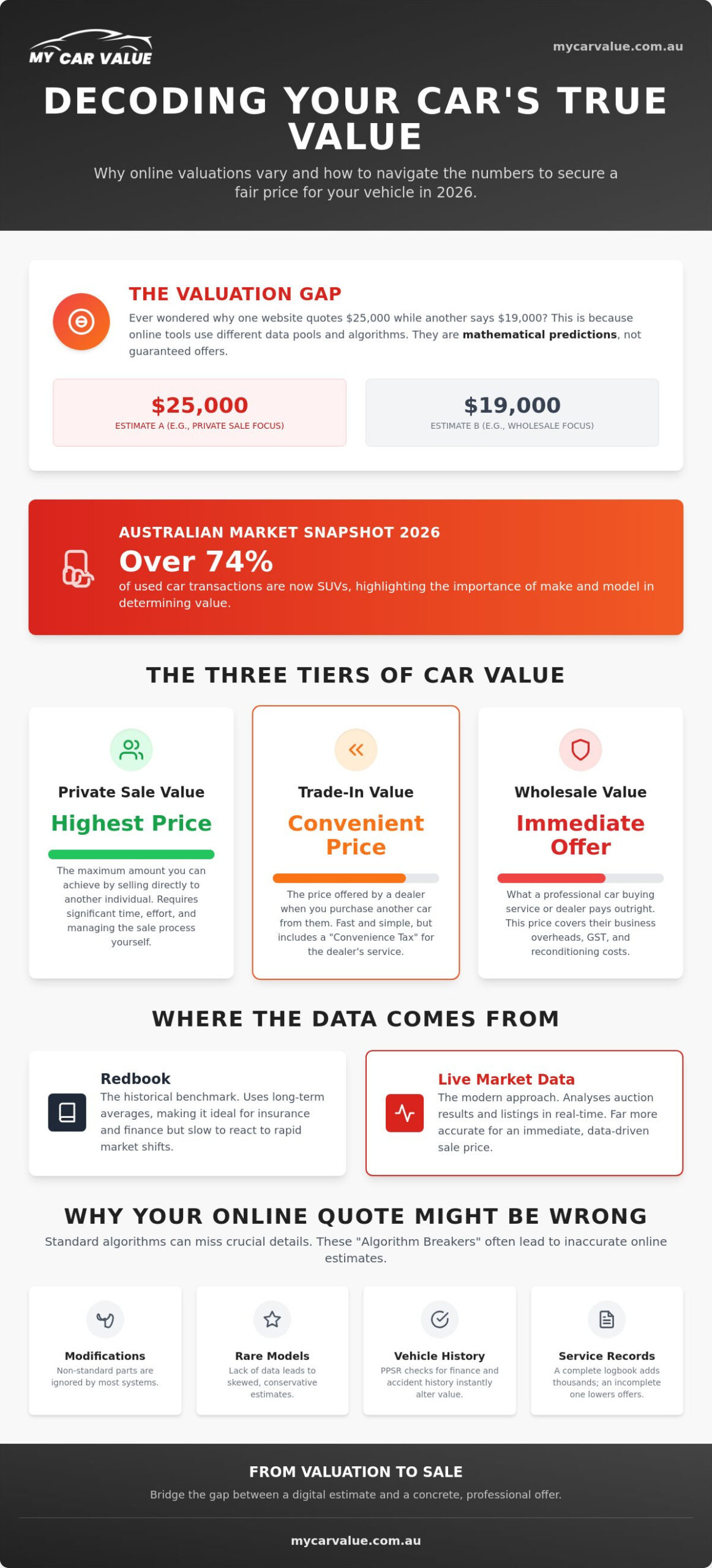
Why does one website value your car at $25,000 while another suggests it’s only worth $19,000? This massive discrepancy is a common frustration for anyone researching second hand car values online in 2026. You deserve clarity, not a collection of conflicting estimates that make you second-guess your car’s worth. It’s exhausting to navigate low-ball offers from dealers and vague market definitions when you just want a fair price for your vehicle.
We agree that the “market value” of your vehicle often feels like a moving target. This guide will change that. You’ll master the logic behind vehicle valuations and discover how to interpret online data to secure the best possible price. With SUVs now making up over 74% of used car transactions in Australia, knowing how to position your specific make and model is more important than ever. We strip away the complexity to provide a pragmatic path forward.
Follow our breakdown of the different valuation types to identify which one applies to your specific situation. We provide a clear, step-by-step framework that builds your confidence for negotiations. This guide ensures you move from uncertainty to a position of strength, allowing you to finalise your sale with total peace of mind.
Key Takeaways
- Learn why valuation figures vary across platforms and how to pinpoint the most reliable data for your car’s specific make and model.
- Understand the “Convenience Tax” and how it creates the price gap between private sales and professional trade-in offers.
- Discover how to interpret second hand car values online to account for non-standard modifications that standard algorithms often ignore.
- Master the transition from a digital estimate to a concrete sale by leveraging professional tools designed to bridge the gap between data and a final offer.
Decoding Second Hand Car Values Online: Why the Numbers Vary
Online valuations are digital estimates. They use aggregated historical data and live market feeds to predict a vehicle’s worth. When you research second hand car values online, you aren’t viewing a guaranteed offer. You’re seeing a mathematical prediction. This reality explains the ‘Valuation Gap’. If three websites provide three different figures, it’s because their data pools vary. One might prioritise private sales, while another focuses on dealer stock. In the 2026 Australian market, these numbers are incredibly fluid. With SUVs making up over 74% of used car transactions and personal loan rates averaging 9.06% p.a., buyer demand shifts quickly. Treat these figures as a strategic benchmark rather than a fixed contract.
The Role of Algorithms in Vehicle Pricing
Algorithms serve as the engine for modern vehicle pricing. These ‘black box’ models scan thousands of live listings to find a statistical median. There’s a major difference between an ‘asking price’ on a public classified site and the ‘actual sale price’ recorded in industry-only databases. Sellers frequently inflate their asking price to allow for negotiation room. Algorithms attempt to filter this noise, but they aren’t always successful. High-volume models like the Toyota HiLux or Ford Ranger provide the most reliable data because the sample size is massive. Niche vehicles or luxury cars with rare options often result in skewed estimates. Understanding the factors affecting used car prices is vital when you suspect an online tool is underestimating your car’s specific configuration.
Wholesale vs. Retail: The Hidden Margin
You’ll usually see two distinct figures: wholesale and retail. Wholesale value represents what a professional buyer pays. This figure must cover their business overheads, GST obligations, and the risk of the vehicle sitting in stock. Retail value is the higher ‘sticker price’ you see on a dealership forecourt. Most online valuation tools default to a conservative wholesale estimate. This helps manage your expectations and provides a realistic starting point for a professional buy-out. If you want the retail price, you must be prepared to manage the private sale yourself. This involves listing the car, handling enquiries, and managing the transfer of ownership, which takes considerably more time and effort.
Where the Numbers Come From: Understanding Australian Valuation Data
Reliable data is the foundation of any accurate car appraisal. In Australia, professional systems rely on three primary sources: Redbook, Glass’s Guide, and live auction feeds. These providers aggregate millions of data points to determine factors that influence car value, such as historical sales and current availability. However, the industry is moving away from static monthly guides. Modern platforms now use AI to track price changes in real-time. This shift ensures that second hand car values online reflect what is happening on the road today, not what happened six months ago.
Redbook vs. Live Market Pricing
Redbook has long served as the historical benchmark for the Australian automotive industry. Insurers and financiers use it to set premiums and loan limits based on long-term averages. It’s excellent for historical context, but it can be slow to react to sudden market shifts. In contrast, ‘Live Market’ tools analyse what cars actually sold for yesterday. They monitor auction floors and private listings to capture immediate demand. Use Redbook for insurance purposes, but rely on live market data when you want an immediate sale. This real-time approach is more accurate for high-demand vehicles where prices fluctuate weekly.
The Impact of the PPSR and History Reports
Your Vehicle Identification Number (VIN) is the key to a precise quote. It allows algorithms to identify your exact trim level, engine variant, and factory-fitted option packs. Without a VIN, an online tool might mistake your premium model for a base variant, costing you thousands. Professional models also integrate Personal Property Securities Register (PPSR) checks and history reports. If a vehicle has recorded accidents or outstanding finance, the system will instantly slash the estimate. Transparency is your best tool for a robust quote. You can learn more about maximising value through service history to ensure you get the best return. Providing a clean history up front leads to an unshakeable offer. To see how these data points affect your specific vehicle, you can get a valuation from a specialist who understands the current Australian landscape.
The Three Values: Private, Trade-In, and Wholesale
Vehicle value is not a static figure. It is a spectrum. When you research second hand car values online, the number you see depends entirely on your chosen exit strategy. This price difference is often called the ‘Convenience Tax’. It represents the financial gap between doing the hard work yourself and paying a professional to handle the logistics. Many sellers struggle with this concept because they overvalue their car’s emotional worth. You might remember the reliable road trips, but an algorithm only sees the odometer and the service history. To find your realistic floor price, use a Vehicle Market Value Calculator. This tool provides a data-driven baseline that removes sentiment from the equation and gives you a clear starting point for negotiations.
Private Sale Value: The High-Effort Ceiling
The private sale value is your high-effort ceiling. It offers the highest potential return because you are performing the role of a dealership. You are responsible for every step of the process. This includes professional detailing, organising roadworthy certificates, and managing the advertising. However, this route carries significant hidden costs. You must factor in the time spent responding to enquiries and waiting for ‘tyre kickers’ who may never follow through with a purchase. To set a competitive private price, look at similar listings in your area. Price your vehicle slightly below the dealer retail average. This strategy attracts genuine buyers quickly without scaring them off with an unrealistic ’emotional’ price tag.
Trade-In and Professional Buyer Value: The Efficiency Floor
Trade-in prices often feel low because they represent the efficiency floor. A dealer must account for reconditioning, GST, and their own profit margin before they can resell the vehicle. Professional used car buyers offer a strategic middle ground. They provide a more competitive rate than a standard dealership trade-in while maintaining a ‘no-fuss’ experience. These professional networks organise the entire logistics process, including the paperwork and vehicle collection. While the final figure might be lower than a private sale, the value in time saved and risk mitigated is often much higher. You avoid the stress of strangers visiting your home and the uncertainty of a sale falling through at the last minute. This speed and security are what define the true value of a professional buy-out.
Why Your Online Quote Might Be Wrong: The “Algorithm Breakers”
Algorithms are data-driven, but they lack eyes. When you research second hand car values online, the software assumes your vehicle is in average factory condition. If you have spent thousands on a bull bar, a winch, or heavy-duty lift kits for your 4WD, the algorithm often ignores these additions. It treats your modified touring rig like a standard city commuter. This is a primary reason why online quotes can feel disappointingly low. These automated systems prioritse volume and standardisation, meaning unique features are frequently undervalued.
The ‘Odometer Threshold’ is another logic gap that confuses digital tools. In the Australian market, 100,000 kilometres is a massive psychological barrier. A car with 99,000km often attracts a significantly higher price than one with 101,000km. The algorithm follows this human bias. It treats that 2,000km difference as a major milestone, even if the mechanical condition is identical. This quirk can lead to a sudden and sharp drop in your online valuation the moment you cross that six-figure mark.
Colour and interior trim also dictate value in our harsh climate. White and silver cars are easier to sell in Queensland or Western Australia because they reflect heat and stay cooler. A dark leather interior without seat cooling can be a hard sell in the height of summer. Algorithms struggle to factor in these regional preferences, which can swing a car’s value by thousands of dollars. Local demand for specific colours is a human factor that software often misses.
The Service History Premium
A full logbook is your strongest leverage for an offline price bump. It proves the vehicle has been maintained to manufacturer standards and suggests long-term reliability. A missing service history can reduce a second-hand car’s value by up to 20% in 2026. If your car has a perfect record, use it to override a generic estimate. Presenting a digital or physical service logbook to a professional buyer turns an average car into a premium one. It provides the buyer with the confidence they need to offer a higher price. Before your next inspection, review the ultimate 2026 Australian seller’s checklist to value your vehicle and ensure every document and detail is in order to maximise your return.
The 2026 EV and Hybrid Factor
Battery health reports are now the new odometer for second-hand values. For electric vehicles and hybrids, the total range capacity is more important than the kilometres driven. EV depreciation remains volatile as new models enter the market with better technology and longer ranges. Online tools often struggle to keep up with these rapid shifts in battery tech. A professional human appraisal is still vital for high-tech vehicles to ensure the battery health is accurately priced. This ensures you aren’t penalised for high mileage if the battery itself is in peak condition.
If your car doesn’t fit the standard mould, you need a valuation that accounts for its unique features. You can Value My Car today to get a quote that reflects its true worth.
From Valuation to Sale: The My Car Value Advantage
Knowing the theory behind second hand car values online is only useful if you can act on it. Most valuation sites provide a number and then leave you to manage the difficult part of the sale yourself. This often results in a pile of paperwork and a series of frustrating weekend viewings. My Car Value provides a different path. We act as the essential bridge between knowing your car’s worth and actually receiving the funds. Our process starts with a precision valuation and ends with a direct connection to a network of professional buyers. It is a modern, data-driven solution that prioritises your time and provides immediate results.
Traditional car auctions are often unpredictable. They involve high entry fees and no guarantee of a sale. We offer a “no-fuss” alternative that delivers certainty. For a complete breakdown of the selling process, consult Sell My Car: The Ultimate 2026 Guide. It is our comprehensive pillar resource for Australian sellers who want to maximise their return with minimal effort.
Why a Professional Network Beats a Private Listing
Security is the primary concern for many private sellers. You shouldn’t have to share your home address with strangers from the internet. Our verified network of industry professionals provides a secure environment for your transaction. We do the heavy lifting of matching your car with the right buyer. If you have a specific SUV or a fuel-efficient hybrid, we find the professionals who specialise in those segments. This ensures your second hand car values online are backed by real-world demand. The speed of our network is unmatched. You can often move from an initial online estimate to a finalised sale in just a few days. You avoid the weeks of waiting that define the private market.
Take the Next Step with Confidence
The Australian used car market is moving fast in 2026. Buyers are looking for quality stock, and savvy sellers are the ones who get the best results. You now understand how algorithms work and why certain factors like service history can override a generic quote. Use this knowledge to your advantage. A transparent, data-backed approach always leads to a better outcome. Don’t let uncertainty stop you from moving on to your next vehicle. The market is active, and the demand for well-maintained cars remains high.
Get started now. Value My Car today and connect with our national buyer network to experience a faster, simpler way to sell. Take control of your sale and move forward with the confidence of a market expert.
Secure Your Best Price in a Data-Driven Market
Navigating the Australian automotive landscape requires a pragmatic approach to data. You now understand that second hand car values online are benchmarks, not fixed offers. Success depends on identifying the right transaction type and accounting for unique factors like battery health or logbook history. By stripping away emotional sentiment and focusing on live market evidence, you position yourself as a savvy seller in a competitive environment.
We provide the tools to turn this knowledge into a finalised sale. Our expert Australian market analysis removes the guesswork; our direct connection to professional buyers eliminates the stress of private listings. Experience a no-fuss, streamlined selling process that respects your time and delivers immediate clarity. Move forward with the confidence that you are getting a fair, transparent price for your vehicle.
Get an accurate valuation and sell your car today. Take the lead in your next transaction and finalise your sale with total peace of mind.
Frequently Asked Questions
Is an online car valuation legally binding for a sale?
No, an online car valuation is not a legally binding contract. It serves as a data-driven estimate based on current market trends and historical sales. A binding agreement only occurs after a physical inspection is completed and both parties sign a formal contract of sale. Use these digital figures as a benchmark for your expectations rather than a guaranteed final payout.
Why is my car’s Redbook value different from the price I see on car classifieds?
Redbook values represent a statistical average used primarily by insurers and financiers, whereas classified prices are retail asking prices. Sellers often inflate their asking prices on public sites to allow for negotiation room. This creates a gap between the “book value” and the “market price” you see online. Always distinguish between a wholesale benchmark and a retail sticker price when researching.
Can I get an accurate second hand car value without providing my VIN?
You can obtain a general estimate without a VIN, but it will lack precision. A VIN allows the system to identify factory-fitted options and specific trim levels that can add thousands to a vehicle’s worth. Without this data, the tool defaults to a base model configuration. Providing your VIN ensures the second hand car values online you receive are tailored to your exact vehicle specifications.
How often do second hand car values change in the Australian market?
Market values shift frequently, often on a weekly basis in response to live auction results. In 2026, the Australian market is particularly volatile due to shifting fuel costs and the arrival of new vehicle brands. While traditional guides update monthly, modern live market tools track daily fluctuations. It is practical to refresh your valuation every fortnight if you are actively planning to sell your car.
Does a car’s colour actually affect its online valuation?
Yes, colour significantly impacts resale value and demand in the Australian climate. White and silver vehicles are generally more desirable because they reflect heat and are easier to maintain in sun-drenched states. While some algorithms treat colour as a minor detail, professional buyers know that neutral tones often lead to a faster sale. A polarising colour may result in a lower offer due to reduced buyer demand.
What happens to my car’s value if it has a blown engine or mechanical issues?
Mechanical issues cause a sharp decline in value because most online tools assume the vehicle is in a “good” running condition. A blown engine often reduces the car’s worth to its salvage or scrap value. If your vehicle has major faults, you must be transparent with the buyer. This ensures you receive an honest assessment based on the car’s remaining parts or repair potential.
Is it better to use a free car valuation tool or pay for a professional report?
Free tools are excellent for quick market benchmarks, while paid reports are typically used for legal or insurance purposes. Most sellers find that free, live-market calculators provide more relevant data for an immediate sale. These tools use real-time sales figures rather than historical averages. This makes them more practical for navigating 2026 market conditions and securing a competitive price.
How do I know if an online car buyer is reputable?
Reputable buyers maintain a transparent process and possess verified Australian business credentials. Look for companies that provide clear contact details and have a consistent track record of professional dealings. Avoid any service that offers an unrealistically high price online only to slash it significantly during an inspection without a valid mechanical reason. Trustworthy operators prioritise clarity and ease throughout the transaction.