

How Much Is My Car Worth? The 2026 Guide to Australian Car Valuations
Why does every online valuation tool give you a different price for the exact same vehicle? It’s a common frustration for Aussie drivers asking, “how much is my car worth” only to find a massive gap between a trade-in offer and a private sale estimate. You deserve a figure that reflects the actual market, not just a generic computer algorithm that ignores your car’s unique condition.
We know the anxiety of feeling like you’re being ripped off or stuck in a loop of confusing industry jargon. This 2026 guide strips away that complexity. We promise to show you the exact factors that determine your vehicle’s market value in the current Australian climate. You will learn how to secure the best possible price and avoid the common pitfalls of low-ball offers.
We’ll break down the impact of the 2026-2027 Luxury Car Tax thresholds and explain why a documented service history is your biggest asset. You’ll get a clear strategy to compare Redbook figures against real-world market demand. This guide provides the data you need to walk into any negotiation with complete confidence.
Key Takeaways
- Understand the critical differences between trade-in, retail, and market value to set a realistic price for the current Australian market.
- Discover why the 100,000km milestone significantly affects how much is my car worth and how a complete logbook protects your vehicle’s resale value.
- Learn why industry tools like Redbook are only a starting point and how to use real-world data to verify your car’s true worth.
- Identify simple ways to maximise your return, including how professional detailing and organising your service history can add thousands to the final price.
- Find out how to bypass the frustration of private sales by connecting directly with professional buyers through a modern, streamlined process.
What Does “Market Value” Actually Mean in Australia?
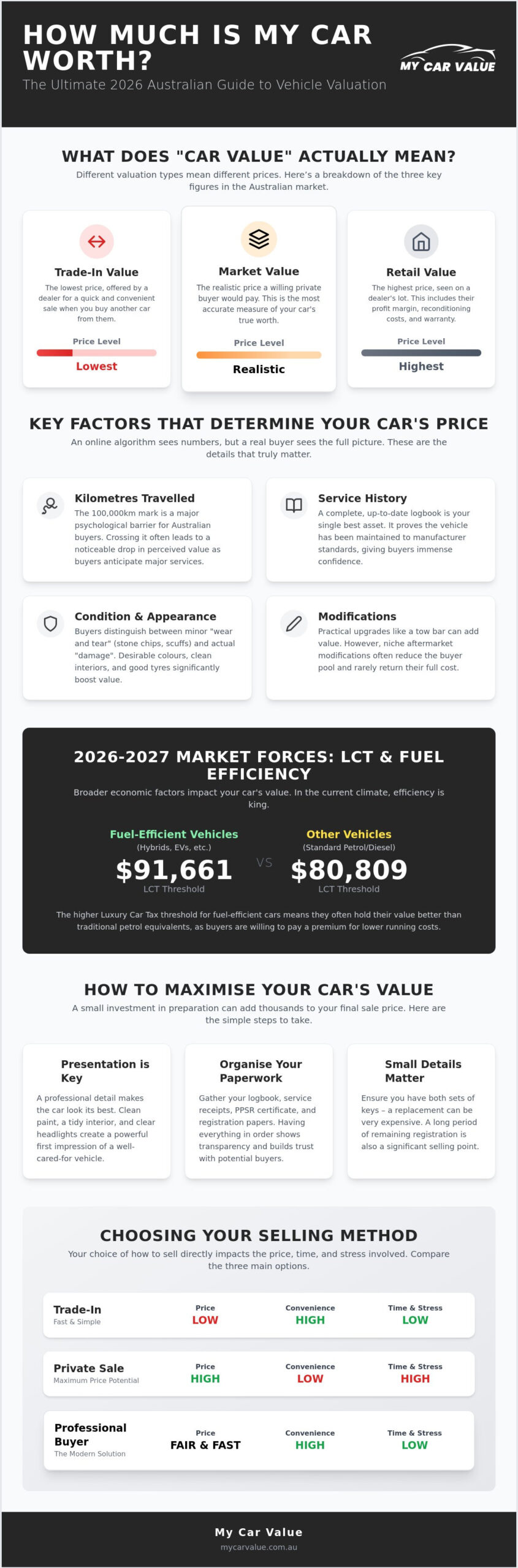
Understanding the true value of your vehicle requires more than a quick glance at a classifieds site. The process of Car valuation is often clouded by three distinct figures: retail, trade-in, and market value. Retail is the price a dealer charges on the lot. Trade-in is the lower amount they offer you to take the car off your hands quickly. Market value is the realistic middle ground. It’s the price a willing buyer pays a willing seller in an open market. This figure is the most accurate answer to the question, “how much is my car worth” because it reflects actual cash transactions rather than optimistic asking prices.
Many drivers assume their insurance policy’s “insured value” is a guaranteed sale price. It isn’t. Insurance figures are often based on broad depreciation curves that don’t account for the specific 2026 market. Today, Australian buyers prioritise fuel efficiency and integrated tech. With the Luxury Car Tax threshold sitting at $91,661 for fuel-efficient vehicles compared to $80,809 for others, a hybrid model might hold its value much better than a standard petrol equivalent. If your car lacks modern safety features or smartphone integration, its market value will likely sit below the broad online averages.
The Gap Between Online Estimates and Reality
Free online tools are a helpful starting point, but they have limits. Algorithms are excellent at processing kilometres and year models, but they can’t judge the “curb appeal” of your car. For instance, a specific colour might be highly desirable in Brisbane but harder to shift in Perth. Similarly, aftermarket modifications like roof racks or upgraded alloys rarely return their full cost. In some cases, niche mods can actually decrease your buyer pool and lower the overall price. Computers see data; professional buyers see the car’s actual desirability.
Trade-in vs. Private Sale vs. Professional Buyers
Choosing how to sell defines your final return. A trade-in offers maximum convenience, but you will almost always receive the lowest price. Dealers factor in their own profit margins and reconditioning costs. Private sales theoretically offer the highest price, but they come with significant stress. You’ll spend weeks managing enquiries and hosting test drives for “tyre kickers” who never show up. Professional buyers represent a modern middle ground. They provide a transparent, data-driven price that reflects the current market without the administrative headache of a private listing. Determining how much is my car worth through a professional buyer ensures you get a fair return without wasting your weekends.
Key Factors That Influence How Much Your Car Is Worth
Aussie buyers are notoriously picky about mileage. While the average age of a vehicle in Australia is over 10 years, the 100,000km mark remains a massive psychological barrier for many buyers. Crossing this threshold often triggers a drop in value as people anticipate major mechanical services like timing belts or suspension overhauls. Determining how much is my car worth requires looking at these local triggers. Financial experts at Canstar suggest that depreciation is the largest cost of car ownership, and high kilometres accelerate this process significantly.
Beyond the odometer, your service history is your strongest negotiating tool. A completed logbook proves the car has been maintained to manufacturer standards, which is vital for resale. Buyers distinguish between “wear and tear”—like tiny stone chips or minor upholstery scuffs—and “damage” that requires structural repair. In 2026, the demand for hybrids and EVs has surged, often leaving traditional petrol-only SUVs with steeper depreciation rates as fuel prices fluctuate. Buyers want efficiency, and they are willing to pay a premium for it.
The Critical Role of Documentation
Paperwork provides peace of mind and justifies a higher price. Ensuring you have a clean PPSR check is the first step in proving your vehicle’s history to a buyer. It confirms there is no finance owing and the car hasn’t been written off. Small details also carry significant weight. For example, having two sets of keys can add hundreds of dollars to an offer; modern fobs are notoriously expensive to replace. Recent maintenance, like new tyres or six months of remaining registration, also makes your car more attractive in a crowded market.
External Market Forces in 2026
Broader economic factors play a huge role in your final sale price. New car delivery times continue to fluctuate, which keeps the used car market buoyant. When people can’t get a new vehicle immediately, they pay more for high-quality used ones. Fuel prices also dictate whether a small car or a large SUV is the “flavour of the month” for commuters. Seasonal shifts like the End of Financial Year (EOFY) see a surge in buyers looking for tax-deductible assets, often driving up demand for late-model commercial vehicles. If you want to see how these factors affect your bottom line, it’s easy to get an accurate valuation before you list.
Valuation Tools: Redbook vs. Real-World Offers
Redbook and Glass’s Guide are the traditional pillars of the Australian automotive industry. Dealers and insurers rely on these data sets to establish baseline figures. However, these tools primarily track “wholesale” data, which represents the historical prices paid at auctions. This information is often weeks or months behind the “live market” data that reflects what buyers are paying today. When you ask, “how much is my car worth” you need a figure that accounts for today’s supply levels, not last quarter’s averages.
Securing a firm answer to how much is my car worth requires a platform that values speed and accuracy. While a vehicle market value calculator provides a fast and reliable starting point, it is a guide rather than a final guarantee. Professional buyers look beyond these calculators. They use internal networks to identify specific demand for your make and model. If a buyer in Melbourne or Sydney has a waiting list for your specific SUV, they will offer more than a generic book value suggests.
Why One Tool Isn’t Enough
Relying on a single source is a mistake. To find a realistic price range, you must compare multiple data points. It is also vital to remove emotional attachment from the equation. Your car is an asset, and the market doesn’t care about the memories attached to it. Look at “Sold” listings on marketplaces rather than current “Asking” prices. Asking prices represent a seller’s dream; sold prices represent the market’s reality. Comparing these figures helps you spot where a book value might be underestimating your car’s actual desirability.
The Shift to Data-Driven Professional Bidding
The traditional way of selling is being replaced by streamlined, data-driven platforms. These systems connect your vehicle details to multiple professional buyers simultaneously. This creates a competitive environment that works in your favour. Instead of receiving a vague “estimate” that might change upon inspection, you can secure a firm offer based on accurate descriptions. This transparency allows professional purchasers to bid with more confidence. It eliminates the guesswork and ensures you aren’t left wondering if you could have secured a better deal elsewhere. By using a modern approach, you bypass the typical “low-ball” tactics often found on public classifieds.
How to Maximise Your Car’s Value Before Selling
Maximising your return requires more than just listing the car and waiting for a phone call. While you already know how much is my car worth in a general sense, the final figure depends on preparation. Start by gathering every scrap of documentation you have. A complete logbook is essential, but receipts for new tyres, battery replacements, or recent brake work prove you haven’t neglected the vehicle. Performing a car service history check helps you identify any gaps in your records before a buyer points them out.
First impressions dictate the negotiation. A professional detail usually costs around $200, but it can easily add $1,000 to the perceived value of the car. Buyers associate a spotless interior and a high-gloss finish with a well-maintained engine. If the car looks neglected, they will assume the mechanicals are too. Fix the small things that create “mental friction” for buyers. Replace blown light bulbs, fit new wiper blades, and buy a fresh set of floor mats. These inexpensive fixes signal that the car is ready for the road without immediate spending.
Mechanical Transparency
Deciding whether to obtain a Roadworthy Certificate (RWC) depends on your selling strategy. In states like Victoria or Queensland, an RWC is mandatory for private sales. Professional buyers often handle this process themselves, but having one ready can still speed up the transaction. Focus on identifying “deal-breaker” repairs. A cracked windscreen or a leaking radiator will stall a sale, whereas a minor cosmetic scratch is often overlooked. Providing a comprehensive vehicle history report provides a transparent audit trail that instantly increases buyer confidence and justifies a premium price.
The Final Presentation
Clear the clutter before anyone sees the vehicle. Remove child seats, gym bags, and personal rubbish. Eliminating odours is equally important; a “clean car” smell is far more appealing than heavy air fresheners. Even if you are selling to a professional buyer, take high-quality photos in soft, natural light. Show the dashboard with the engine running to prove there are no warning lights. Ensure the VIN and engine numbers are clean and easily accessible. This level of transparency prevents haggling and shows you are a serious seller. Ready to see the result of your hard work? Get your final valuation here to see how much is my car worth today.
The Smart Way to Sell: Connecting with Professional Buyers
The traditional Australian ‘Sell My Car’ process is undergoing a significant shift. For decades, drivers were stuck between two extremes: accepting a low-ball trade-in offer or braving the stress of private marketplaces. Today, professional networks have filled this gap by offering a streamlined middle ground. By connecting with a network of professional used car buyers, you access a competitive market that operates on real-time data. This modern approach ensures you aren’t just getting a vague estimate; you’re getting a realistic price based on current demand across the country. It is an efficient way to find out exactly how much is my car worth without the typical retail markup or dealer fees.
Eliminating the Private Sale Headache
Private listings are notorious for attracting “tyre kickers” and “no-shows” who waste your time and compromise your safety. Dealing with strangers at your home or meeting in car parks is a risk many Aussie sellers are no longer willing to take. When you choose to sell my car through a professional network, you bypass these frustrations entirely. There are no expensive advertising costs or weekend-long waits for buyers who never arrive. You deal only with verified professional purchasers who are ready to transact. This level of safety and reliability is a major reason why the industry is moving away from legacy classifieds.
Getting Your Valuation Today
The journey to finding out how much is my car worth is now faster than ever. The My Car Value process starts with a simple digital submission of your vehicle details. Once your data is entered, your car is matched with professional buyers who specialise in your specific make and model. This matching phase is critical; it ensures that the people bidding on your car actually want it for their specific inventory. Whether you are in Adelaide or Perth, the network finds the best fit for your vehicle. After you accept a firm offer, the finalisation is quick. Inspections are straightforward, and secure payment is organised in record time, often within 24 to 48 hours of your initial enquiry.
Take Control of Your Car Sale
You now have the tools to move beyond generic estimates and understand the real-world factors driving vehicle prices in 2026. Market value isn’t a fixed number; it’s a reflection of current buyer demand, your vehicle’s condition, and the quality of your documentation. By organising your service history and opting for professional detailing, you’ve already done the heavy lifting to maximise your return.
Finding out exactly how much is my car worth shouldn’t be a source of anxiety or confusion. Instead of dealing with the stress of private listings or settling for a low trade-in, use a modern, data-driven approach. Get an accurate valuation and connect with buyers at My Car Value today. Our national network of professional buyers ensures you receive a transparent, competitive offer in record time. This stress-free alternative puts you in the driver’s seat of the entire transaction.
You’re ready to sell with confidence and secure the price you deserve.
Frequently Asked Questions
Is Redbook value the same as market value?
No, Redbook value is a historical benchmark used by the industry, while market value is the price a buyer pays today. Redbook data relies on past auction results and depreciation curves. It often lags behind sudden shifts in Australian demand or supply. Professional buyers use real-time bidding to determine how much is my car worth in the current week, ensuring the offer reflects today’s reality.
How much does a high odometer reading affect my car’s worth?
High kilometres significantly reduce a car’s value by increasing the perceived risk of mechanical wear. In Australia, the 100,000km mark is a major psychological hurdle. Once a vehicle passes this point, its value typically drops faster as buyers anticipate expensive timing belt or suspension replacements. Low-mileage cars always command a premium because they suggest less engine stress and a longer remaining lifespan.
Can I sell my car if it still has finance owing?
Yes, you can sell a vehicle with encumbrance. Professional buyers handle this by requesting an official payout letter from your financier. They pay the lender directly to clear the title and then transfer the remaining balance to your bank account. This process ensures the PPSR is updated correctly, which is a legal requirement for a clean transfer of ownership in every Australian state.
Does a full service history really increase the price?
A complete logbook significantly boosts your car’s resale price. It serves as documented proof that you have followed manufacturer maintenance schedules, which reduces buyer anxiety regarding hidden issues. Without a service history, buyers often negotiate much harder to cover the risk of potential neglect. A well-maintained car with a stamped logbook can often fetch thousands more than an identical model with missing records.
How do I find my car’s VIN and why is it important for valuation?
You can find your 17-digit VIN on the driver’s side door pillar, the base of the windscreen, or your registration papers. It is vital because it identifies the exact build date, engine type, and factory options. This specificity allows for an accurate valuation by ensuring the buyer knows exactly which trim level and safety features they are pricing, eliminating any guesswork during the offer phase.
What is the best way to get an accurate car valuation in Australia?
The most accurate way to determine how much is my car worth is to use a professional buyer network. Unlike generic online calculators, these platforms provide firm offers based on real-time demand from multiple purchasers. This bypasses the guesswork of book values and the high-stress environment of private listings. It delivers a realistic figure you can actually bank rather than just an estimate.
Will aftermarket modifications like a bull bar or roof racks add value?
Aftermarket modifications rarely add significant value to a standard passenger car and can sometimes decrease it. While they are expensive to install, they often narrow your pool of potential buyers. Some professional purchasers may value the car lower if the mods are non-standard or poorly fitted. Unless you are selling a dedicated off-road vehicle, an original factory condition usually has the broadest market appeal.
How long is a car valuation quote usually valid for?
Most car valuation quotes are valid for three to seven days. The used car market moves quickly, with prices fluctuating based on national auction results and new car supply levels. If you wait longer than a week, the buyer may need to re-evaluate the offer to reflect current market conditions. It is best to act quickly once you receive a price that meets your expectations to avoid market shifts.