
Valuation of Vehicles: The Definitive 2026 Australian Guide
The post-COVID era of inflated used car prices is officially over. With the Australian used car market reaching a $49.86 billion valuation in 2026, the valuation of vehicles has become a fast-moving target. It’s frustrating to face conflicting values from different websites while worrying that a dealer might rip you off. You need to know exactly how the surge in Chinese brands or the latest EV trends impact your car’s worth before you sign any papers.
We understand that the current market feels unpredictable and complex. This guide simplifies the process by stripping away the guesswork. You’ll learn how to interpret real-time data and account for specific factors like modifications or the 2026-27 tax thresholds. We promise to give you a realistic expectation of your car’s value so you never leave money on the table. We’ll cover everything from the 74% SUV market dominance to state-specific stamp duty, providing a clear, stress-free path to a fair sale.
Key Takeaways
- Learn why the 2026 Australian market requires a data-driven approach to account for shifting fuel preferences and new brand entries.
- Understand the valuation of vehicles through the lens of big data to see how depreciation curves vary significantly between different makes and models.
- Discover how provenance and PPSR checks influence your final offer, ensuring you don’t lose value due to overlooked history.
- Distinguish between Redbook values and real-world street prices to set a realistic expectation for your sale.
- Master the steps to prepare your car for inspection and use market data to confidently justify your asking price.
Understanding the Valuation of Vehicles in the Australian Market
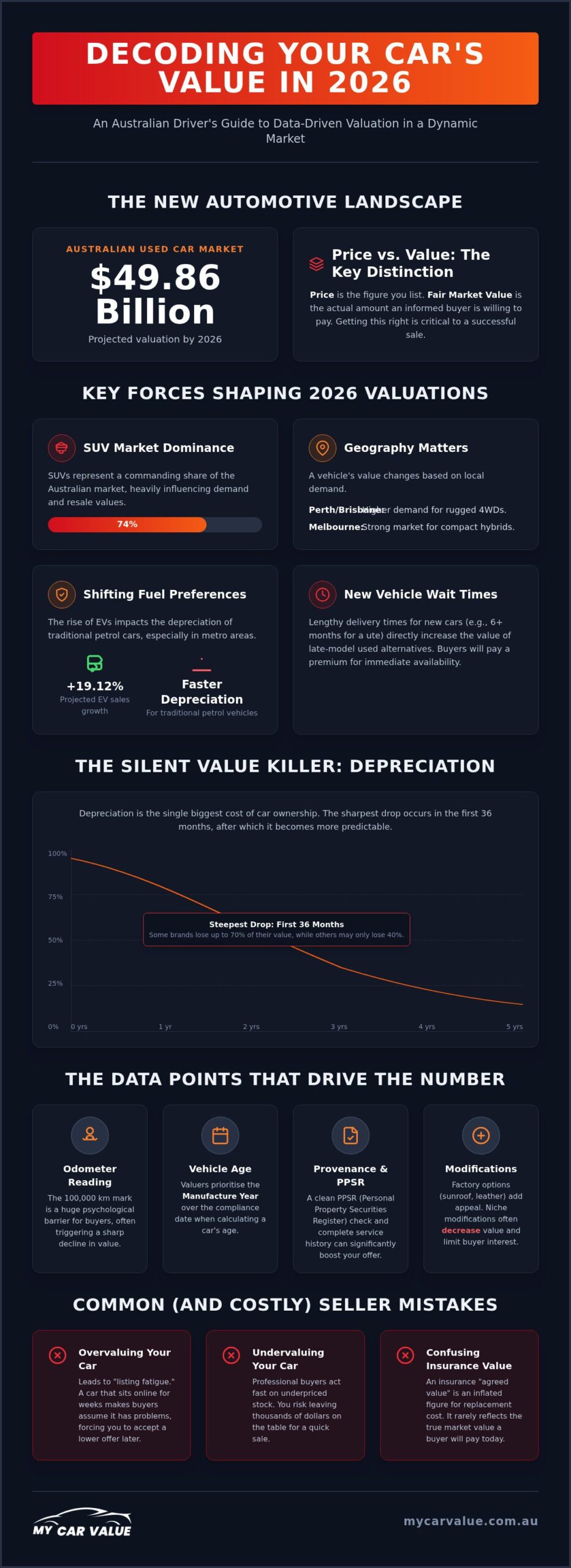
The valuation of vehicles in Australia is no longer a static number found in a dusty guidebook. It’s a dynamic calculation where historical sales data meets real-time market demand. While Car valuation traditionally relied on simple annual depreciation, the 2026 market is influenced by rapid technological shifts and supply chain fluctuations. You must distinguish between “Price” and “Value” immediately. Price is the figure you list on a classified site; value is the actual amount a buyer is willing to pay. In the Australian trade, we call this Fair Market Value. It’s the gold standard for transactions, representing a price agreed upon by a willing seller and an informed buyer without any external pressure.
Why Accuracy Matters for Sellers
Getting the number right from day one is critical. If you overvalue your car, you’ll likely suffer from “listing fatigue.” This happens when an ad sits online for weeks, leading buyers to assume there’s a mechanical fault. Eventually, you’re forced to accept an offer much lower than the original market value just to move the asset. Conversely, undervaluing your vehicle creates a different financial risk. Professional buyers move quickly on underpriced stock, meaning you could leave thousands of dollars on the table. Don’t confuse your insurance “agreed value” with a market valuation either. An agreed value is a fixed insurance payout, often inflated to cover replacement costs, and rarely reflects what a private buyer or dealer will pay you today.
The 2026 Australian Automotive Landscape
The current market is shaped by unique pressures. New vehicle delivery wait times continue to prop up second-hand values for specific models. If a buyer can’t wait six months for a new ute, they’ll pay a premium for a late-model used one. Geography also plays a massive role. A rugged 4WD will often fetch a higher price through Perth or Brisbane outlets compared to an inner-city Sydney dealership. Meanwhile, compact hybrids are in high demand in Melbourne. Shifting fuel preferences are also splitting the market. As used EV sales grow by a projected 19.12%, traditional petrol vehicles are seeing faster depreciation in metropolitan hubs. Accurate valuation of vehicles must account for these regional and technological divides. Market value is a direct reflection of current supply-demand parity.
The Core Mechanics: How Professional Valuers Determine Worth
Modern valuation of vehicles relies on algorithmic precision rather than gut feeling. Professional valuers now harness “Big Data” to compare thousands of similar transactions in seconds. Tools like a vehicle market value calculator aggregate these data points to provide a real-time snapshot of the market. Beyond digital tools, valuers look at historical auction data to establish a “floor” price. This represents the absolute minimum a vehicle is worth in a wholesale environment. Before a professional buyer makes an offer, they also calculate reconditioning costs. They inspect tyres, brakes, and paintwork to determine how much investment is required to make the car “lot-ready.” These hidden costs are why a trade-in offer often sits below the private sale price.
The Data Points That Drive the Number
Odometer readings remain the most significant variable in Australia. The 100,000km mark is a massive psychological barrier for many buyers. Crossing this threshold often triggers a sharper decline in value as major service intervals approach. You should also distinguish between the year of manufacture and the compliance date. The manufacture date is when the car was built; the compliance date is when it was approved for Australian roads. Valuers prioritise the manufacture year when calculating age. When considering extras, remember that not all options add value. A sunroof or leather trim might increase appeal, but niche modifications often do the opposite. Stick to factory-standard features for the most predictable return.
Depreciation: The Silent Value Killer
Depreciation is the most significant cost of car ownership. While some reliable brands might hold 60% of their value after three years, others can plummet to 30%. This is often due to brand perception or high maintenance costs. Most cars follow an accelerated depreciation curve. The steepest drop occurs in the first 36 months of a vehicle’s life. After this period, the decline usually becomes more linear and predictable. You can track this decline using an estimate car worth tool to find the optimal time to sell before the next major drop. If you’re ready to see how these factors impact your specific car, you can Value My Car online to get an instant result.
Understanding the valuation of vehicles requires looking past the shiny exterior. Professional buyers don’t just see a car; they see a mathematical equation. By stripping away the emotion and focusing on the data, you can position your car to attract the best possible offer without the stress of unrealistic expectations.
Key Factors That Shift Your Vehicle’s Market Value
The story behind a car is often as significant as the metal itself. Professional buyers refer to this as “provenance.” A vehicle with a single owner, complete service history, and no accident records will always command a premium. In the Australian market, a fully stamped logbook can be worth thousands of dollars. It proves the owner hasn’t cut corners on essential maintenance. If you’ve lost your original records, you should perform a car service history check to reconstruct the timeline and protect your return.
Colour choice also plays a pragmatic role in local resale. While “boring” white might seem uninspired, it remains the most popular choice in Australia for two reasons: heat reflection and ease of repair. Bright or niche colours might look great in a showroom, but they often limit your buyer pool. This lack of broad appeal can lead to a lower valuation of vehicles when it’s time to sell. Stick to neutral tones if you want to ensure the fastest possible sale at the highest price.
Mechanical vs. Aesthetic Condition
Don’t be fooled by a polished exterior. A professional buyer prioritises a healthy engine over a shiny bonnet every time. A leaking head gasket or a slipping transmission will slash your value far more than a few minor stone chips. Buyers also check for “hidden” wear like tyre tread depth and brake life. If your tyres are near the legal limit, expect the buyer to subtract the cost of a new set from their final offer. Interior condition is equally vital. A “smoker’s car” carries a heavy penalty. Lingering odours are notoriously difficult to remove, often requiring professional steam cleaning or component replacement, which directly impacts the valuation of vehicles.
The PPSR and WOVR Check
Transparency is the foundation of a fair trade. In Australia, the Personal Property Securities Register (PPSR) is the ultimate truth-teller. It reveals if a car has money owing on it, known as encumbrance, or if it’s been reported stolen. Even more critical is the Written-Off Vehicle Register (WOVR). If a car is listed as a “Repairable Write-off,” its market value can drop significantly. These vehicles are harder to finance and more expensive to insure. Buyers are naturally wary of structural repairs that might not be visible to the naked eye. Always check your car’s status on these registers before listing it to avoid awkward surprises during the final inspection.
Valuation Methods: Redbook, Glass’s Guide, and Real-World Offers
The valuation of vehicles often begins with a “book value,” but this figure rarely represents the final transaction price. In Australia, Redbook and Glass’s Guide provide a historical baseline based on past sales. However, the “street value” is what actually dictates your return. This live market price fluctuates daily based on local supply and demand. You must also understand the gap between wholesale and retail prices. Retail is the price a dealer lists a car for after adding their margin for warranties, detailing, and profit. Wholesale is what they pay you. Digital platforms now offer a more accurate, “live” look at the market because they aggregate real-time data, whereas printed guides can suffer from a lag in updates during rapid market shifts.
Redbook vs. Market Reality
Dealers use Redbook as a starting point, not a final answer. When you look at a report, you’ll see categories for “Good,” “Fair,” and “Poor” condition. Be honest about your car’s state; a “Good” rating requires a near-perfect service history and no cosmetic flaws. If the market shifts suddenly, like the recent influx of competitive Chinese brands in 2026, book values can take months to catch up. This delay often creates a disconnect between what the book says and what a buyer will actually offer you on the day.
Trade-in vs. Private Sale vs. Professional Buyers
Each selling method offers a different balance of profit and effort. A trade-in is the most convenient option, but it usually results in the lowest price because the dealer must factor in their own resale margin. Private sales can net you more cash, but they come with hidden costs. You’ll spend money on professional detailing and advertising, and significant time dealing with “tyre-kickers” and no-shows. Professional buyers act as a middle ground. They provide the speed of a trade-in with a price that more closely reflects the current valuation of vehicles in the live market.
Choosing the right method depends on your priorities. If you value your time as much as your car’s equity, a data-driven professional offer often proves to be the most efficient path. It removes the stress of negotiation while ensuring you don’t settle for an outdated wholesale figure.
Navigating the Sale: From Valuation to Final Handover
Once you’ve established a realistic valuation of vehicles using real-time data, you must execute the sale. This phase is about proof and presentation. You aren’t just selling a car; you’re selling the confidence that your vehicle is worth the asking price. Professional buyers look for reasons to chip away at your figure. Your job is to remove those obstacles before the inspection begins. A smooth handover requires a blend of physical preparation and administrative readiness to ensure the money ends up in your account without delay.
Preparing Your Vehicle for Maximum Return
Professional buyers follow the “First Impression” rule. A car that looks neglected often leads to lower offers because the buyer assumes the mechanical maintenance was also ignored. Spending $200 on a professional detail can frequently add $1,000 to the final offer. It’s one of the highest-return investments you can make. Clean the engine bay, vacuum the footwells, and ensure the boot is empty of personal clutter.
Fix the “small stuff” before the buyer arrives. Replace blown globes, fit new wiper blades, and address minor “shopping trolley” dents if they’re affordable to pull. These are low-cost repairs that remove easy negotiation points. Organise your service history in a clear, chronological folder. A stack of receipts alongside a stamped logbook proves the valuation of vehicles is justified and shows you’ve been a responsible owner.
Ensure you have a “Clean Title” ready for the transfer. If you have finance on the car, obtain a current payout letter from your lender. Have your registration papers and all sets of keys ready. A missing spare key is a common trap; it can lead to a $300 to $500 deduction during the final inspection because the buyer will have to source and programme a replacement themselves.
The My Car Value Advantage
We bridge the gap between a vague guess and a concrete offer. Instead of wondering what a dealer might say, we connect you with a network of professional Used Car Buyers across Australia. This system ensures you get a competitive price based on real-time market demand in your specific region. We take the heavy lifting out of the process, moving you from a digital valuation to a secure sale in record time.
Closing the deal should be the easiest part of the journey. Ensure the payment is secure, usually via Osko or a bank cheque, before you hand over the keys. Complete the notice of disposal online immediately to transfer legal ownership. This protects you from any future toll or fine liabilities incurred by the new owner.
Take control of your car’s equity and move forward with a clear path to a successful sale. You’re now ready to close the deal with speed and certainty.
Frequently Asked Questions
Is an online valuation of vehicles 100% accurate?
An online valuation of vehicles is a data-driven estimate rather than a final guarantee. It uses recent sales and market trends to provide a realistic price range. A final figure always requires a physical inspection to account for specific wear, tyre condition, and mechanical health. Treat online results as a powerful starting point for your negotiations.
Does a high odometer reading always mean a low car value?
High mileage typically reduces value, but it isn’t the only factor in the calculation. A well-maintained vehicle with 150,000km and a full logbook often holds more value than a 100,000km car with no service history. Certain 4WDs and diesel workhorses are also less sensitive to high odometer readings compared to luxury European sedans.
How does a PPSR check affect my car’s valuation?
A PPSR check provides transparency regarding financial encumbrance or accident history. If your car has money owing or is listed on the Written-Off Vehicle Register, its value will drop significantly. Most professional buyers won’t touch a vehicle with an uncleared “Repairable Write-off” status. Clear all debts before seeking a final valuation to ensure a smooth sale.
Why is my trade-in offer lower than the Redbook value?
Trade-in offers are wholesale figures that account for the dealer’s business costs. Dealers must factor in reconditioning, detailing, and a profit margin for resale. Redbook values often represent a broader market average that doesn’t always reflect the immediate cash-flow requirements or the current stock levels of a specific dealership on that day.
Can I increase my car’s value before selling?
You can certainly boost your return with targeted effort. A professional detail and fixing small issues like blown globes or worn wipers can add hundreds to an offer. Presenting a complete, chronological service history folder is the most effective way to prove your car’s worth and justify a higher price during the final inspection.
What is the difference between market value and agreed value?
Market value is the price a buyer will pay in the current economic climate. Agreed value is a fixed sum determined by your insurer for a total loss payout. Agreed values are often higher than market values to cover replacement costs, so don’t use your insurance policy as a guide for your actual selling price.
Do modifications like bull bars or roof racks add to the valuation?
Modifications rarely add significant dollar value and can sometimes decrease it. While an expensive bull bar might appeal to a specific 4WD buyer, it limits your overall market reach. Most professional valuers prefer factory-standard vehicles because they’re easier to sell to a wider audience without needing to find a niche buyer.
How long is a vehicle valuation quote valid for?
Most professional valuation quotes are valid for seven days. The Australian used car market is highly volatile, with prices shifting based on new car supply and economic changes. If you wait longer than a week, you’ll likely need a refreshed valuation of vehicles to reflect the most current data and demand levels.