
Trade-in Value vs Private Sale Value: The 2026 Australian Market Guide
Selling your car privately in 2026 is no longer the guaranteed financial win it once was. Most Australian drivers expect a massive payday by listing online, only to find themselves stuck between low dealership offers and the growing complexity of the trade in value vs private sale value australia landscape. It’s frustrating to see a “market price” on Redbook that doesn’t match the actual cash offers landing in your inbox. You want the highest return, but you are likely tired of the “tyre kickers,” the scam risks, and the endless weekend inspections that lead nowhere.
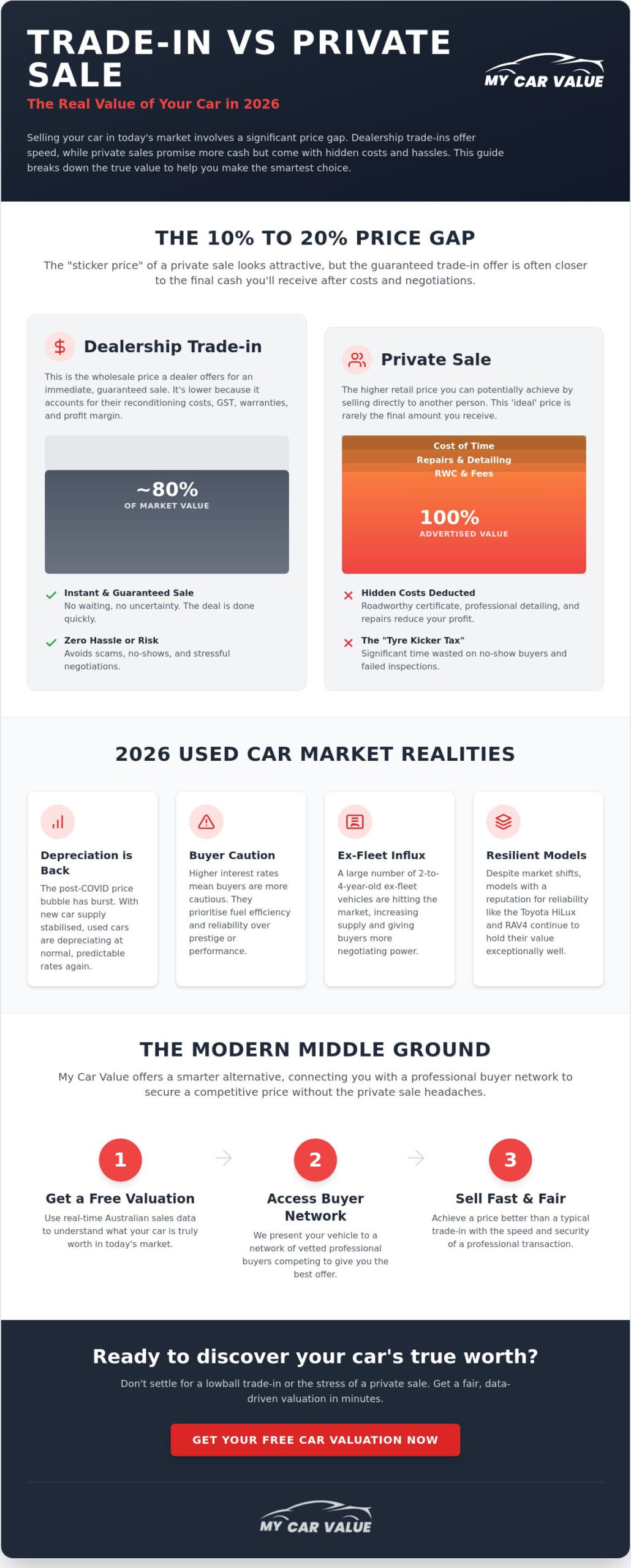
We’ve designed this guide to help you understand the real-world price gap, which typically sits between 10% and 20% in the current market. We will strip away the confusion by calculating the hidden costs of private sales, from Roadworthy Certificates to professional detailing. You will learn a clear strategy to maximise your return and discover a faster way to sell without losing thousands in the process. We have mapped out the 2026 state-based fees and market trends to give you total clarity before you sign any papers.
Key Takeaways
- Identify the 10% to 20% price gap between wholesale trade-in offers and the higher retail prices found in private listings.
- Calculate the true trade in value vs private sale value australia by factoring in hidden costs like Roadworthy Certificates and professional detailing.
- Evaluate the “Tyre Kicker Tax” to determine if the potential extra cash justifies the time spent on failed inspections and no-show buyers.
- Understand how the 2026 stabilisation of new car supply has impacted used car depreciation and shifted buyer demand toward reliable models.
- Leverage professional buyer networks to secure a competitive price and immediate liquidity without the stress of a private sale.
Trade-in Value vs Private Sale: Defining the Price Gap in 2026
Understanding the fundamental difference between these two figures is the first step toward a successful sale. Trade-in value is essentially the wholesale price a dealer pays to take the vehicle off your hands immediately. In contrast, private sale value represents the retail price a secondary user pays. This is typically the highest possible “sticker price” you will see in the market. While the private price looks higher, it comes with a level of effort and risk that the trade-in path avoids.
The “Dealer Margin” is the primary reason for this price gap. When a dealership buys your car, they aren’t just looking for a quick profit. They must cover reconditioning costs, a 10% GST component, and mandatory statutory warranties. In the 2026 Australian market, holding costs and floorplan interest rates have increased, making these margins tighter for businesses. Different car valuation methods help define an objective benchmark based on actual Australian sales data rather than just hopeful listing prices. This objective market value is the middle ground that professional buyers use to provide a fair offer.
Why Private Sale Prices Look Better on Paper
Private sale prices often look superior because they represent an ideal scenario. However, the “asking price” you see on listing sites is almost never the final “settlement price.” Private buyers expect significant negotiation room and will often haggle aggressively. Many sellers also suffer from emotional attachment, which inflates their expectations. You might list your car for $25,000 based on what you see online, but after weeks of messages, you could find the actual cash offers are much closer to the trade in value vs private sale value australia benchmarks you initially dismissed.
The Wholesale Foundation of Trade-in Offers
Wholesale value is the specific price dealers pay to ensure a profitable and safe turnaround of a vehicle. Dealers rely heavily on real-time auction data to hedge their risks against sudden market shifts. It’s a data-driven calculation designed for speed and reliability. While a unique paint colour or niche aftermarket features might increase appeal to a specific private buyer, they often lower wholesale interest. Dealers prefer “safe” stock that appeals to the widest possible audience to ensure the car doesn’t sit on the lot for months.
Australian Car Market Trends: What Is My Car Worth in 2026?
The “Post-COVID Bubble” has officially burst. By mid-2026, global supply chains have fully recovered, meaning new cars are readily available on dealership floors across the country. This shift has ended the era of used cars selling for near-new prices. Depreciation has stabilised, returning to a more traditional curve where a vehicle loses a predictable percentage of its value annually. This change directly impacts the trade in value vs private sale value australia dynamic, as buyers now have more options and less urgency to overpay for a second-hand vehicle.
Tighter financing and higher interest rates have also reshaped buyer appetites. Most Australian shoppers are prioritising fuel efficiency and reliability over prestige. The rapid adoption of low-emission vehicles is beginning to squeeze the resale prices of traditional petrol-only SUVs. While a large petrol wagon might have been a top seller five years ago, 2026 buyers are looking toward hybrids to offset rising running costs. You’ll find that the depreciation curve for traditional utes remains flatter than for passenger sedans, but even these “bulletproof” assets are no longer immune to market corrections.
Supply and Demand Shifts in the Local Market
A significant influx of ex-fleet vehicles has saturated the 2-to-4-year-old car segment. As corporations “de-fleet” their older stock, the market has become crowded, giving buyers more leverage to negotiate. Despite this, some models remain remarkably resilient. The Toyota HiLux and RAV4 continue to hold “sticky” value due to their reputation for longevity. If you own one of these high-demand models, you should estimate car worth using current data to ensure you don’t undersell. Understanding these micro-trends helps you set a realistic baseline before deciding how to sell.
The Regional Variance in Australian Valuations
Geography plays a massive role in what your car is worth. In metropolitan centres like Sydney or Melbourne, electric vehicles and compact hybrids command a premium due to better charging infrastructure. Conversely, regional hubs still show a strong preference for 4WDs and utes. Logistics and transport costs can also create price discrepancies; a car in Perth might fetch a different price than the same model in Brisbane. It is vital to get a valuation that reflects your specific capital city market rather than a national average. If you are looking for a straightforward way to Sell My Car, local demand will always be your strongest negotiating tool.
The Hidden Costs of Selling a Car Privately in Australia
The gap between a listing price and the final cash in your bank is often filled with unexpected expenses. While the trade in value vs private sale value australia comparison usually favours the private route on paper, this ignores the “leakage” that occurs during the process. You must account for the immediate financial outlays and the significant risk of repair costs required to make a vehicle legally transferable. Most sellers focus on the top-line figure without subtracting the friction costs required to reach it.
In Victoria, a Roadworthy Certificate (RWC) typically costs between $150 and $250 for the inspection alone. In Queensland, the fee is approximately $99.35 for a standard car. These fees are not government-capped, and the real danger lies in mandatory repairs. If an inspection reveals worn bushes or a cracked windscreen, you are legally obligated to fix them to complete a private sale. These surprise costs can easily strip $1,000 or more from your expected return before you even find a buyer.
Beyond mechanical costs, you face rising advertising fees. Premium listings on major Australian marketplaces have increased in price, making it expensive to keep your car at the top of search results. You also pay a “tyre kicker tax” in the form of your own time. Valuing your weekends is essential. If you spend ten hours cleaning, photographing, and showing the car to “no-show” buyers, you have effectively lowered your net profit. Security is another growing concern in 2026. Sophisticated digital payment scams and fraud in the private sector require constant vigilance, adding a layer of risk that many find overwhelming.
Regulatory Hurdles and Transfer Requirements
Preparing a car for sale involves more than just a quick wash. A professional detail typically costs around $200 and is essential to attract serious buyers in a saturated market. You must also manage PPSR reports to prove a clear title and handle the administrative burden of organising a transfer of registration. Each state has its own requirements, such as the $33.65 transfer fee in Queensland or the $46.20 fee in Victoria. These administrative tasks and small fees quickly accumulate, eating into your perceived private sale advantage. One critical step many sellers overlook is lodging a notice of disposal immediately after the sale to protect yourself from fines and legal liability once the buyer drives away.
The Mental Load of Private Negotiations
Managing aggressive negotiators and “low-ball” offers is mentally draining. You must also consider the safety implications of inviting strangers to your home for test drives. This lack of privacy and security is a major deterrent for modern sellers. Consequently, more Australians are opting for car auction alternatives to avoid this friction. These services provide a secure, professional environment that maintains your privacy while still delivering a competitive price, effectively bridging the gap between convenience and profit.
Trade-in Realities: When Convenience Outweighs the Cash Gap
While the numbers on paper often favour a private listing, the practical reality of a trade-in offers a level of efficiency that cash alone cannot buy. For many Australian drivers, the trade in value vs private sale value australia debate is settled by the need for instant liquidity. You can drive into a dealership or meet a professional buyer and settle the sale in a single afternoon. This speed is vital for those who cannot afford to have capital tied up in a depreciating asset while they hunt for their next vehicle.
Finance payouts are another major factor. Selling a car with an encumbrance to a private buyer is a logistical nightmare. Most private purchasers are wary of vehicles with existing loans, requiring complex three-way bank transfers that often fall through. Dealers and professional buyers simplify this by paying out the loan directly and giving you the balance. You walk away with a clear title and no debt, avoiding the administrative headache that often stalls private transactions.
The “changeover” mentality is a more strategic way to view the transaction. Instead of obsessing over the highest possible sale price, savvy sellers focus on the net cost to upgrade. If a dealer offers a lower trade-in price but provides a significant discount on the new car, the net result is often better than selling privately and buying at full retail. This holistic view accounts for your time, the lack of pre-sale repair costs, and the immediate transition into your new vehicle.
The Financial Benefits of a Seamless Transition
Trading in eliminates the “two-car” period that plagues private sellers. When you sell privately, you often end up owning two vehicles simultaneously, paying double for insurance and registration. In New South Wales, the annual registration fee is $84 as of July 2026, and these costs add up quickly alongside daily insurance premiums. Professional used car buyers offer a similar level of speed to traditional dealers but often provide more competitive pricing by operating through leaner digital networks. This allows for immediate settlement without the low-ball offers common in crowded showrooms.
Risk Mitigation for the Seller
Liability is a hidden risk in the private market. Once a dealer or professional buyer takes the keys, the mechanical risk is entirely theirs. Professional purchasers provide a “clean break” sale that protects the seller from post-sale disputes or claims of undisclosed faults. You don’t have to worry about a phone call two weeks later regarding a gearbox issue or an oil leak. This peace of mind is a significant component of the trade in value vs private sale value australia equation. If you want a fast, secure outcome, you can Value My Car today to see how a professional offer compares to the stress of the open market.
The Modern Middle Ground: My Car Value and Professional Buyers
Traditional selling options often feel like a choice between two extremes. You either accept a low wholesale figure at a dealership or endure the high-friction environment of the private market. In 2026, professional buyer networks have emerged as the dominant alternative. These networks bridge the trade in value vs private sale value australia gap by operating with significantly lower overheads than traditional showrooms. They provide a competitive offer that sits comfortably above typical trade-in prices while maintaining the speed and security of a professional transaction. This model focuses on immediate liquidity without the “tyre kicker” tax.
Transparency is the foundation of this modern approach. By using a vehicle market value calculator, you establish a data-driven baseline before you even speak to a buyer. This eliminates the guesswork that often leads to frustration during negotiations. The My Car Value process simplifies the sale by connecting you with a vetted network of industry professionals across Australia. Instead of you chasing buyers, these professionals compete for your vehicle. This competitive environment drives the price up, ensuring you receive a fair market return without the stress of managing multiple private inquiries or weekend inspections.
Australian car owners are increasingly preferring this model because it values their time. The 2026 market moves fast. Waiting weeks for a private buyer to secure finance is no longer viable for most. A professional buyer network provides a certain outcome, usually within 24 to 48 hours. You get a “clean break” sale, immediate payment, and a professional handling of all transfer paperwork. It is the most efficient way to navigate the current automotive landscape while protecting your financial interests.
How to Maximise Your Valuation Today
Securing the highest possible offer requires a small amount of preparation. A complete and stamped service history is your most valuable asset; industry data suggests cars with full records can sell up to 30% faster. You should also ensure you have a clean PPSR check ready to present to demonstrate clear title. Before your inspection, it is also worth understanding how to read your VIN digits to verify your vehicle’s exact build date, factory origin, and legal status, which gives professional buyers added confidence in your listing. If you are selling in major hubs like Sydney, Melbourne, or Brisbane, local demand for specific SUVs or utes can further boost your final figure. Present the car in its best light with a fresh wash and ensure all spare keys and manuals are easily accessible for the inspector.
Your Next Steps to a Stress-Free Sale
Transitioning from a valuation to a completed sale is a methodical process. Start by organising your essential documents. You will need your VIN, service logs, and current registration papers. Once your paperwork is ready, get an instant valuation to benchmark your expectations against the current trade in value vs private sale value australia trends. This puts you in a position of strength during the final inspection. Ready to skip the private sale circus and secure a professional price? Value My Car with My Car Value today and see how simple selling your car can be.
Secure Your Best Sale Outcome in 2026
You now have a clear roadmap for the current automotive market. The real gap in trade in value vs private sale value australia is no longer just about the final number on a contract. It’s about the total cost of your time, the risk of surprise mechanical repairs, and the need for immediate liquidity. While a private listing might show a higher sticker price, the hidden fees and negotiation stress often erode that perceived advantage. Professional buyer networks have simplified this process by offering a secure path that balances speed with a competitive return.
You don’t have to choose between a low-ball dealership offer and the chaos of private inspections. By leveraging real-time data and a professional network, you can secure a result that reflects your car’s true worth. Get an accurate valuation and connect with professional buyers today. Our trusted Australian network uses accurate 2026 market data to ensure you don’t leave money on the table. Eliminate the stress of private classifieds and move on to your next vehicle with total confidence. Take the first step toward a smarter, faster sale right now.
Frequently Asked Questions
Is it always better to sell a car privately in Australia?
No, selling privately is not always the best choice for Australian drivers. While you might see a higher listing price, you must subtract the cost of a Roadworthy Certificate, professional detailing, and advertising fees. Factor in the value of your time spent managing enquiries and inspections. For many, the immediate settlement and zero repair risk of a professional buyer provide a better net outcome than the friction of the private market.
How much less is a trade-in value compared to market value?
Expect a trade-in value to be 10% to 20% lower than a private sale price. For instance, a car worth $25,000 in a private advertisement might only fetch $20,000 to $22,500 as a trade-in. This gap allows the dealer to cover GST, statutory warranties, and reconditioning costs. Understanding this trade in value vs private sale value australia difference helps you set realistic expectations for your next vehicle upgrade.
Does a full service history actually increase my trade-in offer?
Yes, a full service history is a powerful tool for increasing your car’s value. Vehicles with a complete and stamped logbook can sell up to 30% faster than those without. It provides the buyer with mechanical peace of mind and proves the car has been maintained to manufacturer standards. This reduced risk allows professional buyers and dealers to offer a more competitive price compared to neglected vehicles.
Can I trade in a car that still has finance on it?
Yes, you can trade in a vehicle that has an active finance contract. The dealer or professional buyer will contact your financier to obtain a payout figure. They then settle the debt directly and pay you the remaining equity. This process removes the stress of managing a complex three-way transfer with a private buyer, which is a common reason private sales fall through in the 2026 market.
What is the fastest way to sell a car for a fair price in 2026?
Connecting with a professional buyer network is the most efficient method to secure a fair return. These services use real-time 2026 market data to provide an offer that reflects the current trade in value vs private sale value australia landscape. You can typically complete the entire transaction within 24 to 48 hours, receiving immediate payment without the need for an RWC or the hassle of managing online classifieds.
Why do dealers offer so much less than the Redbook value?
Dealers offer wholesale prices to account for the risk and costs of reselling the vehicle. Unlike Redbook, which often lists retail “asking prices,” a dealer must factor in GST, reconditioning, and floorplan interest rates. Current market conditions have made these margins tighter. Dealers need to buy at a price that ensures they can still offer a statutory warranty while remaining profitable after their overheads.
Do I need a Roadworthy Certificate if I sell to a professional buyer?
No, you do not need a Roadworthy Certificate (RWC) when selling to a professional buyer or dealer. They purchase vehicles “as is,” which saves you the upfront inspection fees and the cost of mandatory repairs. This is a significant advantage over private sales, where an RWC is a legal requirement in most states. Avoiding these repairs can save you thousands of dollars and several days of mechanical work.
How does the 2026 economy affect used car prices in Australia?
The 2026 economy has stabilised the used car market after years of volatility. Increased new car supply has ended the “scarcity premium,” meaning used cars are depreciating at traditional rates again. Higher interest rates have also shifted demand toward fuel-efficient hybrids and reliable compact models. Sellers must now rely on accurate, current data rather than outdated bubble prices to achieve a successful sale in the current Australian market.