
Car Price Trade Guide: How to Secure a Fair Deal in Australia (2026)
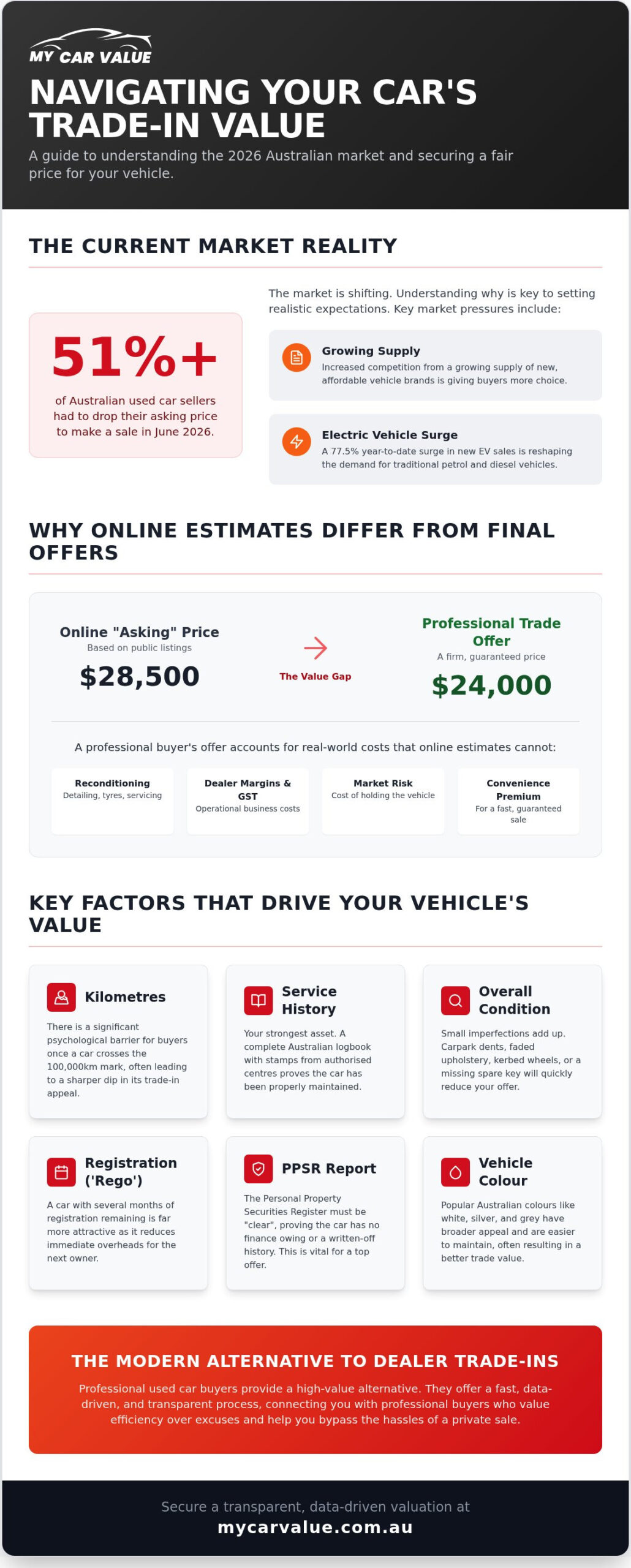
Did you know that over 51% of used car sellers in Australia had to drop their asking prices in June 2026 just to secure a sale? It’s a clear sign that the market is shifting, making it harder than ever to gauge a fair car price trade offer. You’ve probably felt that familiar knot of anxiety when thinking about trading in your vehicle. Nobody wants to lose thousands of dollars on a lowball offer, yet the thought of organising a private sale and dealing with “tyre-kickers” is often too time-consuming to consider.
You deserve a process that values your time as much as your car. This guide shows you how to navigate the car price trade landscape to ensure you get a competitive market offer without the typical stress. We’ll strip away the complexity of valuations and show you how to bypass operators with “dodgy” reputations. You’ll learn how to get a transparent price and connect with professional buyers who offer efficiency instead of excuses. We’ll outline a clear path to a fast, data-driven sale that puts you back in control of your car’s true worth.
Key Takeaways
- Understand how current market dynamics impact your car price trade and why professional valuations provide a more accurate baseline than dealer quotes.
- Identify the specific interior, exterior, and mechanical factors that cause the gap between online estimates and actual market offers.
- Explore how professional used car buyers serve as a modern, high-value alternative to traditional dealership trade-ins.
- Master a 5-step preparation checklist to ensure your vehicle makes a premium first impression during the inspection process.
- Learn how to use expert facilitation to secure a transparent valuation and a fast sale without the hassle of private “tyre-kickers”.
Understanding the Car Price Trade Landscape in Australia
A car price trade represents the value a professional purchaser assigns to your vehicle, either as a credit against a new purchase or as a direct cash payment. It’s a transaction defined by speed and certainty. In the current 2026 Australian market, these valuations are shifting quickly. While used vehicle sales rose by 11.8% in July 2026, sellers are facing increased competition from a growing supply of affordable Chinese brands and a 77.5% year-to-date surge in new electric vehicle sales. These factors mean that buyers are more selective than in previous years. Consequently, a trade-in price is the net value offered by a professional buyer after accounting for reconditioning and operational margins.
Professional purchasers rely on wholesale data rather than the inflated prices seen on public classifieds. Understanding this distinction helps you set realistic expectations before you begin the selling process.
Why Trade-In Values Differ from Private List Prices
Private sellers often look at online listings and assume their car is worth the same amount. This ignores the reality of dealer margins and GST obligations in Australia. When a professional buyer evaluates your car, they factor in reconditioning costs like new tyres, professional detailing, and mechanical servicing to meet roadworthy standards. These businesses also take on the risk of the vehicle’s future resale. You aren’t just paying for the sale; you’re paying for a convenience premium. You trade a portion of the potential retail price for an immediate, guaranteed result that avoids the hassle of private listings and “tyre-kickers”.
Common Terminology You Need to Know
To secure a fair car price trade, you must speak the language of the industry. Having a clear grasp of these terms ensures you aren’t caught off guard during negotiations.
- Retail vs Wholesale: Retail is what a buyer pays at a dealership. Wholesale is the baseline car valuation used by professionals to make offers.
- PPSR: The Personal Property Securities Register confirms your car has no encumbrance (finance) or written-off history. A “clear” PPSR is vital for a top offer.
- Estimate vs Firm Offer: Don’t confuse an online estimate with a final price. An estimate is a data-driven starting point, while a firm offer is a binding commitment made after the vehicle’s condition is verified.
- Market Value: This is a fluctuating figure based on supply and demand. In 2026, this value is heavily influenced by the rapid adoption of EVs and the influx of new manufacturers.
Market Value vs Trade-In Price: Decoding the Difference
Many sellers experience a form of “sticker shock” when they receive their first professional offer. You might see your car listed for a high price on classified sites, but your actual car price trade offer is lower. This gap exists because online estimates often reflect “asking prices” rather than “selling prices”. Tools like Redbook provide a helpful baseline, but they cannot account for the immediate local demand or the specific condition of your vehicle. A professional buyer must factor in the cost of bringing the car to a saleable standard while maintaining a viable business margin.
Vehicle condition is the most significant variable in this equation. Small imperfections like carpark dents, faded upholstery, or a missing spare key can quickly chip away at your offer. Mechanical health is equally vital. A car with a current roadworthy certificate and several months of “rego” remaining is far more attractive to buyers. Long registration periods reduce the immediate overhead for the next owner, which often translates into a more competitive offer. Consult the Victorian government guide to selling your car for a checklist of legal obligations that can affect your sale.
Factors That Drive Your Vehicle’s Market Value
Kilometres travelled play a massive role in the Australian market. There is a significant psychological barrier at the 100,000km mark; cars that have crossed this threshold often see a sharper dip in trade-in appeal. Beyond the odometer, your service history is your strongest asset. A complete Australian logbook with regular stamps from authorised centres proves the car has been maintained properly. Even the colour of your car matters. In our climate, popular Australian colours like white and silver trade better because they are easier to maintain and have broader appeal. To get a realistic start, you can value your car online to see how these factors influence your specific model.
The Dealer’s Perspective: How They Calculate an Offer
Professional buyers look at stock turnover rates above all else. If you are trading a high-demand model like a popular SUV or a dual-cab ute, the buyer knows they can resell it quickly. This lower risk allows them to offer a better car price trade. They rely on real-time market sales data and auction results rather than static price guides. Older vehicles or those with exceptionally high kilometres represent a higher “risk factor”. These cars often require more extensive reconditioning or may be sent straight to wholesale auctions, which naturally lowers the initial offer you receive.
Professional Used Car Buyers: The Modern Alternative to Dealer Trade-Ins
Traditional selling methods often leave Australians feeling short-changed. You are either forced to accept a low trade-in offer at a dealership or spend weeks managing a private listing on classified sites. Professional buyer networks offer a modern middle ground. These platforms facilitate a competitive car price trade by connecting you with a network of verified purchasers simultaneously. Instead of one dealer setting the price based on their own stock levels, multiple buyers compete for your vehicle. This tension drives the offer closer to a true market figure.
Digital-first platforms like My Car Value have streamlined this entire experience. You provide your vehicle details once and receive a valuation based on real-time demand. This efficiency removes the guesswork and the need to drive from showroom to showroom. By using Professional Used Car Buyers, you access a transparent system designed for speed and accuracy. It is the most direct path to a firm offer without the emotional drain of traditional negotiations.
Why Professional Networks Beat Traditional Trade-Ins
Traditional dealerships often calculate your trade-in value based on their current floor space. If they already have three similar SUVs on the lot, their offer will naturally be low. Professional networks bypass this limitation by accessing specialist buyers who specifically value your car type, whether it is a rugged 4×4 or a late-model EV. This system also eliminates “new car” negotiation bias. In a standard dealership setting, staff often manipulate the trade-in price to make the new car discount look more attractive. A professional buyer network provides a standalone offer based on live Australian market data. This ensures you see the real value of your asset, independent of any other transaction.
Avoiding the Pitfalls of Private Selling
Selling privately is often a secondary job that many Australians simply don’t have time for. You have to manage “tyre-kickers” who never show up and lowballers who waste your weekends. There is also the significant cost and time required to obtain a Roadworthy Certificate (RWC), which is a mandatory requirement for private sales in most Australian states. Professional buyers handle these complexities for you. They offer secure payment methods and manage the immediate transfer of ownership. You get a firm car price trade and a fast exit without the safety risks of inviting strangers to your home or the stress of managing classified ads.
How to Prepare Your Vehicle for a Competitive Trade Offer
First impressions are critical when negotiating a car price trade. A professional buyer sees dozens of vehicles weekly; yours needs to stand out immediately to signal that it has been well-maintained. While a quick home wash removes surface dust, it rarely addresses the deep-seated grime that professional inspectors look for. A professional detail is often a smart investment. It targets the engine bay, wheel arches, and door jambs, which are areas that suggest a vehicle has been cared for beyond just the surface level. If a buyer doesn’t have to factor in an immediate professional clean, they are more likely to offer a premium price.
Follow this 5-step checklist to prime your vehicle for inspection:
- Declutter the cabin: Remove all personal items, including dash cams, phone mounts, and rubbish.
- Check basic functions: Ensure all exterior lights, wipers, and interior electronics like the air conditioning are working.
- Verify the spare: Make sure the spare tyre is inflated and the jack and tool kit are present.
- Fluid top-ups: Ensure oil, coolant, and washer reservoirs are at the correct levels.
- Address the scent: Use a neutralising spray to remove any lingering food or pet odours that can deter buyers.
A clear PPSR report is the most vital document for a professional buyer.
The Documentation Checklist
Your paperwork acts as the vehicle’s resume. A missing service stamp can signal mechanical neglect, which often leads to a lower offer as the buyer prepares for “worst-case” maintenance scenarios. Ensure your logbook is up to date and physically present in the glovebox. You should also verify that your current rego papers match your driver’s licence details to avoid ownership transfer delays. Check our Car Service History Check guide to see how to recover lost records if you’ve missed a few stamps. Don’t forget the small essentials; gathering all sets of keys and the original owner’s manual is vital for securing a top-tier offer.
Physical Presentation and Minor Repairs
You don’t need to rebuild the engine to get a fair car price trade, but “curb appeal” matters. Small paintless dent removal (PDR) repairs for carpark dings are often worth the cost as they significantly improve the car’s silhouette. However, avoid spending thousands on major mechanical issues; professional buyers can usually fix these at wholesale rates more cheaply than you can. Remove non-standard modifications or stickers that might narrow the car’s appeal to a general audience. A clean, neutral vehicle suggests a low-risk purchase, which helps the buyer justify a more competitive offer.
Get a professional valuation for your vehicle today
Streamlining Your Sale with My Car Value
My Car Value acts as the modern bridge between your driveway and a fair sale. We don’t just provide a number; we facilitate a transparent transaction that removes the friction of traditional methods. By acting as a savvy intermediary, we do the heavy lifting for you. This expert facilitation ensures your car price trade is based on live data and genuine buyer intent rather than a dealer’s whim. We focus on providing immediate clarity so you can move forward with confidence and certainty.
Our process is built for speed and accuracy. We understand that your time is valuable. Instead of spending weeks managing classified ads, you can access a streamlined digital-first experience that delivers results in days. We have replaced the legacy system of “haggling” with a logical, data-driven workflow that prioritises fairness for the seller.
The My Car Value Difference
Our platform relies on a methodical approach to reflect the actual state of the Australian market. We track real-time trends, including the rapid growth of the EV sector and the shifting demand for traditional utes and SUVs. This ensures your valuation is accurate and competitive. We maintain a curated network of reputable used car buyers across the country. Every buyer in our system is vetted for reliability and professionalism. This process is designed to strip away administrative “red tape,” allowing you to bypass the paperwork hurdles that often stall private sales.
Ready to Get Started?
The journey to a successful sale is fast-paced and simple. Start by using our online tool to generate an initial market estimate. You provide the basic details of your vehicle, and our system delivers a baseline valuation in seconds. Once you have this estimate, the transition to receiving firm offers is seamless. We connect you with professional buyers who are actively looking for stock like yours. Our network operates across all major Australian hubs, including Sydney, Melbourne, and Brisbane.
You don’t have to manage multiple listings or negotiate with unverified buyers. We provide a clear path forward in a crowded marketplace. Take the first step toward a transparent car price trade by entering your vehicle details today. Our system will guide you through the sequence of events, from valuation to a secure payment, with minimal effort on your part. It’s the smartest way to ensure you receive a competitive market price without the typical stress of selling a car in Australia.
Secure Your Market Value with Confidence
Securing a fair car price trade in 2026 requires a shift from traditional dealership habits to a data-driven approach. You now understand that a transparent valuation is based on live market trends rather than a single dealer’s floor space. By prioritising complete Australian service records and professional presentation, you position your vehicle as a low-risk asset for professional purchasers. This preparation ensures you don’t leave money on the table when it’s time to sell.
My Car Value provides the expert facilitation needed to bridge the gap between a low trade-in and a stressful private sale. We use accurate market data to ensure you receive a competitive offer from our curated network of reputable used car buyers. Thousands of Australian sellers have already simplified their exit process through our streamlined digital platform. You can now bypass the administrative red tape and secure a fast payment with no-obligation professional buyer connections.
Take control of your car’s value and move forward with the confidence of a professional seller. It’s the smartest way to ensure you get a competitive deal in today’s shifting market. Start your valuation now and experience a faster, more transparent way to sell.
Frequently Asked Questions
Is a trade-in price always lower than a private sale price?
Generally, yes. Private sales target the retail market, while a trade-in reflects wholesale value. However, the gap is often offset by the convenience and speed of the transaction. You avoid advertising costs and the time-intensive process of meeting strangers. Professional buyers offer a firm price that accounts for the “convenience premium,” providing immediate liquidity without the typical delays of the private market.
How do I know if a car price trade offer is fair?
Compare the offer against real-time Australian market data rather than just static price guides. A fair offer considers your vehicle’s specific condition, service history, and current demand. Use expert facilitation platforms to receive multiple quotes. If the offer aligns with wholesale averages and accounts for the reconditioning costs discussed earlier, it’s likely competitive. Transparency is key; a fair buyer will explain how they reached their valuation.
Can I trade in a car that still has finance owing on it?
Yes, you can trade in a vehicle with an active loan. The buyer will require a “payout letter” from your financier to confirm the exact amount remaining. If the trade-in value is higher than the debt, the buyer pays off the loan and gives you the balance. If you have “negative equity” where the debt exceeds the car’s value, you must pay the difference to clear the title.
What documents do I need to trade in my car in Australia?
You need several key documents to finalise the sale. Ensure you have your current registration papers, a valid driver’s licence for identification, and the complete service logbook. If the car is under finance, provide the official payout figure. You should also present a clear PPSR report to prove the vehicle has no hidden history. Having all sets of keys and the original owner’s manual will further support a better car price trade.
Do I need a Roadworthy Certificate (RWC) for a trade-in?
No, professional buyers typically do not require you to provide an RWC. This is a major advantage over private sales, where a certificate is mandatory in most Australian states. The buyer assumes the responsibility for mechanical inspections and reconditioning. This saves you the cost of repairs and the time spent at a workshop. It’s a streamlined way to sell “as-is” while still receiving a competitive market offer.
How long is a trade-in valuation offer usually valid for?
Most professional offers are valid for seven days or a specific kilometre limit, such as 500km. The used car market moves quickly; factors like auction data and new car supply change weekly. If you wait too long, the buyer may need to refresh the valuation to reflect the latest market shifts. Always confirm the expiry date on your written offer to ensure you don’t miss out on a competitive price.
What happens to my insurance and rego when I trade in my car?
You remain responsible for the vehicle until the ownership transfer is complete. Once the sale is finalised, notify your insurance provider to cancel or transfer the policy. Regarding registration, the buyer typically manages the transfer paperwork with the state transport authority. In some states, you may be eligible for a pro-rata refund on the remaining registration period if the car is being de-registered or sold to a dealer.
Can I trade in a car that is not currently running?
Yes, but the offer will reflect its non-running status and the cost of towing. Professional buyers often purchase “project” cars or vehicles with mechanical failures for parts or restoration. However, the car price trade value will be significantly lower than a roadworthy equivalent. Be transparent about the specific mechanical issues during the valuation process to ensure the final offer is accurate and avoids surprises during the physical inspection.